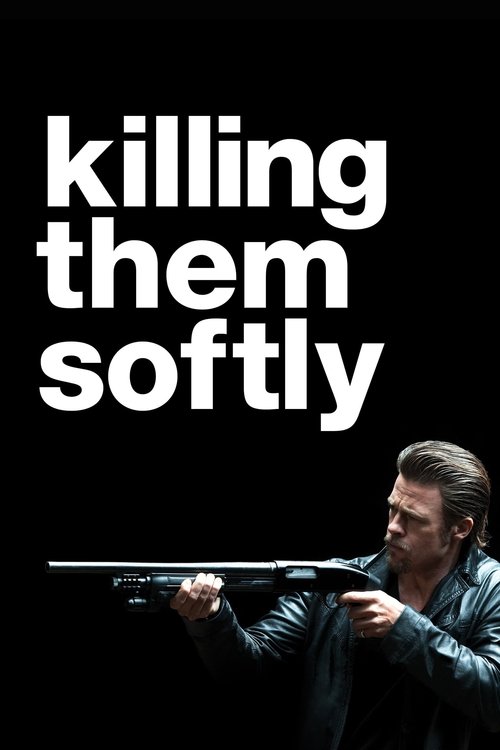
Killing Them Softly
2012 · Andrew Dominik
For when you want your crime movie mean and smart, not fun — a film to argue about afterward. Reach for it in a cynical mood; skip it when you need comfort.
What it's about
Three small-time crooks knock over a Mob-protected card game, and the local criminal economy seizes up — nobody trusts anybody, nobody's getting paid. Enter Jackie Cogan, a coolly professional enforcer hired to figure out who did it and restore confidence, one negotiation and one hit at a time. It all unfolds in a rotting American nowhere in the fall of 2008, with the financial crisis droning from every car radio and bar TV.
The experience
Cold, talky, and bitterly funny — long two-man conversations broken by sudden, stylized bursts of violence. It's less a thrill ride than a slow-drip of cynicism; you come out grinning at the last line and feeling a little poisoned.
Performances
Brad Pitt is at his flintiest as Cogan, a man whose professionalism is a philosophy, and James Gandolfini is quietly heartbreaking as a hitman gone to seed — a great actor turning a couple of hotel-room scenes into a whole ruined life.
The craft
Andrew Dominik adapts a 1974 crime novel and transplants it into the 2008 crash, flooding the margins with real news audio so the underworld plot becomes a running commentary on American business. The dialogue is the engine — profane, circular, novelistic — while the violence is staged with an eerie, slowed-down beauty that makes it land harder.
Why it matters
Divisive on release and defended ever since, it's become a touchstone for crime films that use the genre as open political allegory, and one of the most quotable closing scenes of its decade.
Snapshot
Killing Them Softly is Andrew Dominik's third feature, a lean, acrid crime picture adapted from George V. Higgins's 1974 novel Cogan's Trade and recast as an allegory of the 2008 American financial collapse. Brad Pitt plays Jackie Cogan, a contract enforcer brought in to settle accounts after two small-time idiots knock over a Mob-protected card game, freezing the local criminal economy in a paralysis of distrust. Dominik's central intervention is temporal and political: he transplants Higgins's recession-era Boston of the early 1970s into the autumn of 2008, then floods the film's margins with the actual broadcast voices of George W. Bush, Henry Paulson, John McCain, and Barack Obama emanating from car radios, barroom televisions, and gas-station forecourts. The genre furniture — the heist, the reprisal, the negotiation over price — becomes a parable about credit, confidence, and bailout. It is a film of long, circling conversations punctuated by sudden, stylized violence, and it ends on one of the most quoted lines of its decade: a flat declaration that America is not a community but a business. Premiered in competition at Cannes, it divided critics and was openly rejected by mainstream audiences, yet it has aged into one of the sharper crime films of the post-crash years.
Industry & production
The film originated as a long-gestating Dominik project to adapt Higgins, a writer whose dialogue-driven crime fiction had already produced one canonical screen translation in The Friends of Eddie Coyle (1973). Dominik wrote the adaptation himself and reunited with producer-star Brad Pitt, with whom he had made the commercially disappointing but critically admired The Assassination of Jesse James by the Coward Robert Ford (2007); Pitt's Plan B Entertainment was among the producing entities, alongside companies associated with Dede Gardner and Anthony Katagas, and the picture was distributed by The Weinstein Company. The budget was modest by star-vehicle standards — reported figures cluster in the mid-teens of millions, and I'd treat any precise number as approximate rather than documented here.
Production relocated Higgins's Boston to a deliberately unglamorous, largely unnamed American city, shooting in and around New Orleans and using the post-Katrina landscape of vacant lots, water-stained underpasses, and shuttered storefronts as a ready-made image of national decay. The film carried the working title Cogan's Trade before release. It premiered in competition at the 2012 Cannes Film Festival, where its craft drew respect even as its didacticism drew complaint, and opened in the United States that autumn. Commercially it is remembered as a notable disappointment: it underperformed relative to its star's drawing power and, famously, received an "F" CinemaScore from opening-night audiences — a grade reserved for films that actively antagonize the people who bought tickets, and a telling index of the gap between Dominik's austere intentions and the propulsive gangster picture the marketing implied.
Technology
Killing Them Softly sits at the hinge of the industry's transition to digital capture, and its most discussed sequences are essentially technological set-pieces. Cinematographer Greig Fraser combined conventional coverage with specialized high-frame-rate and effects photography to render two altered states of consciousness. A drug-haze sequence — Ben Mendelsohn's heroin-addled Russell — is shot to simulate the smeared, time-dilated subjectivity of the high, with focus, frame rate, and sound deliberately decoupled from naturalism. The film's signature killing, the murder of Ray Liotta's Markie Trattman, is staged as an extreme slow-motion ballet of shattering safety glass, raindrops, and shell casings, each fragment rendered with a clarity that turns brutality into something almost forensic and decorative at once. These passages depend on high-speed camera systems and meticulous post-production compositing, and they mark the kind of controlled, expensive image-making that a small crime film of an earlier decade could not have attempted. I won't claim a specific camera package or capture format with confidence, as I can't verify those technical credits here.
Technique
Cinematography
Fraser's photography is the film's most accomplished element and would help launch him toward Rogue One, Dune, and The Batman. The palette is desaturated and bilious — wet asphalt, sodium light, the institutional greens and browns of bars and back rooms. Compositions favor cramped two-shots that trap men across tables, emphasizing talk as the real transactional medium of this world. Against that grimy baseline, Fraser deploys bursts of formal extravagance: the rain-soaked slow-motion hit, the hallucinatory drug imagery, a foot-chase and a freeway shooting that are choreographed with cold precision. The contrast is the point — the texture of everyday criminal labor is drab and verbal, while the moments of violence are aestheticized to the edge of obscenity, forcing the viewer to register the seduction of the very thing the film is critiquing.
Editing
Cut by Brian A. Kates and John Paul Horstmann, the film is structured around long dialogue scenes that the editing lets breathe, resisting the impulse to accelerate. Tension is built through duration and the dread of anticipated violence rather than through rapid cutting. When violence arrives, the rhythm fractures — the Trattman murder is extended past comfort, every impact dilated — so that the editing itself enacts the film's split between tedious process and explosive consequence. The recurring device of letting political broadcasts run underneath and across scene transitions is an editorial strategy as much as a sound one, stitching the criminal narrative to the macroeconomic one.
Mise-en-scène / staging
Production designer Patricia Norris, who had worked with Dominik on Jesse James, builds a world of exhausted Americana: dim taverns, a derelict card room, anonymous sedans, rain-slick lots strewn with debris. Campaign posters and bailout-era signage haunt the backgrounds. The staging is theatrical in the best sense — much of the film is two men talking in a parked car or across a booth — and Dominik trusts the actors and the Higgins-derived dialogue to carry scenes that other crime films would cut away from. Decay is the controlling motif of the décor; even before a word of allegory is spoken, the environment reads as a system that has stopped working.
Sound
Sound design is arguably the film's primary editorial argument. The constant bleed of recorded political speech — Bush reassuring the nation, Paulson and Obama invoking confidence and collective responsibility — is mixed into nearly every public space, so that the ambient soundscape of 2008 becomes inescapable. The film largely forgoes a conventional orchestral score in favor of pointed source cues: the Trattman killing unfolds to Ketty Lester's "Love Letters," and the soundtrack reaches elsewhere for ironic pop and standards rather than underscoring. The effect is to keep emotion at an analytic distance; music comments rather than swells.
Performance
Pitt plays Cogan with watchful, deglamorized economy — a professional who prefers, as the title explains, to kill "softly, from a distance," avoiding the emotional mess of intimacy. Around him is a gallery of vivid character work: James Gandolfini as Mickey, a washed-up, alcoholic hit man dissolving into self-pity and grievance, in a performance that doubles as a melancholy commentary on the gangster persona Gandolfini had made iconic; Richard Jenkins as the bloodless corporate "Driver" who haggles over fees like a middle manager; Scoot McNairy and Ben Mendelsohn as the doomed, twitchy thieves; Ray Liotta as the unlucky Trattman; and Vincent Curatola as the scheming Johnny Amato. The acting register is naturalistic, profane, and patient, built for Higgins's overlapping, digressive talk.
Narrative & dramatic mode
The dramatic mode is anti-suspense and procedural-ironic. Rather than a tightly sprung thriller, Dominik offers a chain of negotiations: the planning of the robbery, the robbery itself, and then the long aftermath in which Cogan diagnoses what went wrong and methodically decides who must die to restore "confidence" in the market. The structure mirrors an economic logic — a panic, a freeze, an intervention, a settling of accounts — and the violence is presented as discipline applied to reassure a system, not as personal vendetta. Dialogue dominates; action is sparse and punctuating. The film withholds catharsis, closing not on a shootout but on a bar-room argument about money and the meaning of America, which redirects the entire genre exercise into political statement.
Genre & cycle
This is a crime film and neo-noir that works largely by negation. It belongs to the lineage of talky, deromanticized American crime cinema descended from The Friends of Eddie Coyle, and to a broader cycle of post-2008 films preoccupied with finance, fraud, and collapse. Where the classical gangster film mythologizes ascent and the heist film celebrates competence, Killing Them Softly foregrounds incompetence, drudgery, and the indignity of being underpaid for dangerous work. It is a recession picture wearing the clothes of a mob picture — closer in spirit to the era's economic exposés than to its action thrillers — and its refusal of genre pleasure is precisely what alienated audiences expecting a conventional Brad Pitt crime vehicle.
Authorship & method
Andrew Dominik — born in New Zealand, raised in Australia, and launched by the abrasive true-crime debut Chopper (2000) — is a deliberate, sparse director whose features arrive years apart and favor revisionist takes on masculine American myth. Killing Them Softly extends the project of The Assassination of Jesse James: a genre subject treated with art-cinema patience, formal control, and skepticism toward heroism. His method here is adaptation as overlay — preserving Higgins's dialogue and plot architecture while imposing a contemporary political frame the source novel never carried. His key collaborators reinforce that sensibility: cinematographer Greig Fraser, whose textured naturalism and bursts of stylized violence define the look; production designer Patricia Norris, returning from Jesse James to build a landscape of decay; editors Brian A. Kates and John Paul Horstmann, who sustain the film's unhurried, talk-driven rhythm. Notably, Dominik builds the film's emotional and ideological scoring out of curated source music and recorded political speech rather than a traditional composer's score — a structural authorial choice as much as a stylistic one.
Movement / national cinema
The film is an American production made by an Australasian sensibility, part of a generation of Australian and New Zealand filmmakers — Dominik among them — who entered Hollywood and brought an outsider's coolness to its native genres. It does not belong to a formal movement, but it can be read within an international art-cinema tradition of using genre as a Trojan horse for social critique, and within the specifically American post-crash cycle of films interrogating capitalism. Its Cannes-competition premiere situates it as a crossover object: a star-driven American crime film pitched, in form and ambition, at the festival circuit.
Era / period
Killing Them Softly is doubly period. Diegetically it is pinned with unusual precision to a few weeks in late 2008 — the height of the financial meltdown and the Bush-to-Obama transition — and it uses that moment not as backdrop but as text. Industrially it belongs to the early-2010s moment of digital-era prestige crime cinema and to a wave of movies reckoning with the recession's human and ideological fallout. Its sensibility is unmistakably of its years: disillusioned, suspicious of political rhetoric, and convinced that the language of hope masks an unsentimental machinery of debt and payment.
Themes
The governing theme is the identity of crime and capitalism: the underworld is run exactly like a market, dependent on confidence, vulnerable to panic, and restored only by enforced discipline. From this flow the film's preoccupations — labor and payment (everyone, including the killers, complains about being underpaid and squeezed by intermediaries); the hollowness of communal rhetoric set against the brutality of individual self-interest; the deglamorization of violence as mere business cost; and disillusionment with the American promise. The closing speech, in which Cogan rejects the Jeffersonian-Obaman idea of America as a community of equals and insists that it is a business in which one is simply owed, crystallizes the whole. The title's "softly" extends the theme to method: even murder is professionalized, distanced, kept emotionally clean.
Reception, canon & influence
Critical reception was broadly favorable but pointedly divided. Reviewers praised Fraser's cinematography, the performances — Gandolfini's mournful hit man especially — and the bracing intelligence of the Higgins-derived dialogue, while a significant faction found the political allegory heavy-handed, the radio-and-television device too literal, and the message underlined where it might have been implied. Audiences were far harsher: the film's "F" CinemaScore and weak box-office performance made it a byword for the gap between an auteur's intentions and a mass audience's expectations of a Brad Pitt crime movie.
The influences on the film run backward to George V. Higgins's novel Cogan's Trade and, through it, to the wider tradition of dialogue-saturated American crime fiction and its definitive screen ancestor, Peter Yates's The Friends of Eddie Coyle — the model for treating gangsters as tired tradesmen rather than romantic outlaws. Dominik's own Jesse James supplies the method of patient, painterly genre revisionism. Looking forward, the film's most durable legacy is twofold. It cemented Greig Fraser's reputation and helped propel one of the most significant cinematography careers of the following decade. And it stands as a defining entry in the post-2008 crime-as-capitalism cycle, its final line circulating widely as shorthand for recession-era American disillusionment. Among Dominik admirers it has undergone a quiet critical rehabilitation, increasingly cited as a rigorous, prescient film whose initial rejection said as much about its audience's appetite for myth as about the picture itself. The fuller scholarly assessment of its place in the crime canon is still being written, and on that longer-term standing the record remains genuinely open.
A Deleuzian reading
The windshield comes apart slowly, in the rain, while Ketty Lester sings "Love Letters." Ray Liotta's Markie Trattman is being shot to death, and the film holds on it — each shard of safety glass, each raindrop, each shell casing — with a clarity that turns a murder into jewelry.
The full Deleuzian reading of Killing Them Softly →
Reception
Audiences infamously hated it on release — it's one of the very few films ever slapped with an F CinemaScore — despite premiering in competition at Cannes. A decade on, it's been widely reappraised as a prescient, bitterly funny crime film about American capitalism.
How Killing Them Softly was received, from release to now →
Influences: the films it descends from and the films it influenced
- The Friends of Eddie Coyle (1973) — The foundational Higgins adaptation whose location-shot Boston naturalism and treatment of gangsters as weary, double-crossing tradesmen — not romantic outlaws — is the exact register Dominik reuses for Cogan's milieu.
- The Assassination of Jesse James by the Coward Robert Ford (2007) — Dominik's own prior film supplies the method carried forward: patient art-cinema pacing imposed on a genre subject, Patricia Norris's decay-laden production design, and a structural anti-suspense that drains the climactic killing of conventional thrill.
- Chopper (2000) — Dominik's debut establishes his deglamorized, abrasive staging of true-crime violence and his refusal to let a charismatic performance soften the brutality — the template for Pitt's flatly transactional hit man.
- The Wild Bunch (1969) — The slow-motion, multi-camera squib ballet cross-cut into rhythmic montage is the direct grammar behind the high-frame-rate Markie Trattman beating and the car-window assassination of Cogan's target.
- Bonnie and Clyde (1967) — Penn's balletic, ramped death-by-squib aestheticizes violence into a lyrical set piece — the formal precedent for Dominik shooting a killing as an operatic slow-motion shower of glass and blood.
- Point Blank (1967) — Boorman's fractured, abstracted neo-noir reduces the contract killing to cold geometry and ambient menace, modeling the de-romanticized, procedural view of the hit that Cogan voices.
- The Long Goodbye (1973) — Altman's revisionist deglamorizing of noir and his use of a single recurring source song in lieu of a composed score prefigures Dominik's score-less, curated-source-music construction.
- Medium Cool (1969) — Wexler weaves real diegetic political and news broadcasts into the fiction's soundscape so the historical moment frames the drama — the precise device of Dominik's omnipresent Obama/Bush crisis radio and TV.
- Mean Streets (1973) — Scorsese's use of curated pop records as the emotional scoring for small-time hoods is the source-music authorship Dominik adopts in place of a traditional composer.
- Jackie Brown (1997) — Tarantino's Elmore Leonard adaptation honors the same dialogue-saturated crime tradition as Higgins, sustaining long two-shot conversations where talk, not plot mechanics, carries the scene.
- Sicario (2015) — Fraser extends his Killing Them Softly signature — muted naturalistic surfaces punctured by sudden, clinically staged bursts of violence — into a fuller crime-procedural register.
- The Batman (2022) — The mature flowering of Fraser's desaturated neo-noir palette and tactile darkness, the visual idiom whose career trajectory Killing Them Softly is credited with propelling.
- Hell or High Water (2016) — A central entry in the post-2008 crime-as-capitalism cycle Killing Them Softly defined, foregrounding foreclosure-economics and recession debt as the literal engine and justification of the crime.
- Blonde (2022) — Dominik pushes the same authorial toolkit further — formal control, collaged source media as scoring, and a skeptical demythologizing of American iconography — extending the method first systematized here.
- Zero Dark Thirty (2012) — Released the same year, it showcases Greig Fraser's textured low-key naturalism that Killing Them Softly helped launch, establishing the desaturated, available-light look that defined his subsequent decade.
- The Drop (2014) — A Dennis Lehane adaptation that, like Cogan's Trade, prizes source-faithful crime dialogue and deglamorized small-timers — and carries the same meta-charge as James Gandolfini's final completed leading role.
- Nightcrawler (2014) — A neo-noir that reframes predatory crime as pure free-market enterprise, its protagonist mouthing entrepreneurial capitalism — the same crime-as-capitalism thesis Cogan delivers in the closing line.
- Foxcatcher (2014) — Shares the deglamorized-star strategy and slow, dread-laden anti-suspense staging, treating American decline through desaturated decay and withheld catharsis rather than genre payoff.
- No Country for Old Men (2007) — Dominik deploys NCFOM's scoreless diegetic-sound-design approach in a crime film where Brad Pitt's Cogan operates with Chigurh-adjacent professional remove—violence either withheld or staged as deflation rather than spectacle, catharsis structurally refused in favor of systemic bleakness.
- In Bruges (2008) — Post-Tarantino hitman film extending In Bruges's formal strategy: extended philosophical hitman dialogue in lieu of action sequences, diegetic sound prominent over musical scoring across long ambient-only passages, and a desaturated digital-intermediate color grade that deliberately drains the American crime landscape of generic glamour.
- Sexy Beast (2001) — Dominik deploys licensed music — including Ray Charles and Johnny Cash — as ironic tonal counterpoint rather than underscore, and structures his crime film around the postponement and deferral of expected violence, building dread through negative space and extended silence in formal parallel with Glazer's refusal of genre kinetics.
- Drive (2011) — Slow-cutting rhythms, silence-before-violence punctuation, and a laconic protagonist defined by professional code rather than personal history apply Drive's neo-noir temporal logic to American crime; Greig Fraser's neon-and-darkness palette and the film's digressive ambient passages treat genre convention as a surface to be stylized through art-cinema duration.
- The Funeral (1996) — Strips the gangster film of romance into a bleak, dialogue-driven moral and economic critique — the anti-gangster posture that treats crime as a metaphysical/ethical indictment, not glamour.
- Glengarry Glen Ross (1992) — Extends the predatory-capitalism-as-American-tragedy strain through long, profane, dialogue-driven two-handers in cars and bars, treating crime and commerce as one continuous con.
- A Most Violent Year (2014) — An inverted-gangster picture that reads organized crime as recession-era capitalism, deflating genre violence into procedural transaction — the same anti-payoff, money-as-subject crime drama.
Similar films
- The Assassination of Jesse James by the Coward Robert Ford (2007) — influence & lineage
- The Batman (2022) — influence & lineage
- Margin Call (2011) — same viewing thread
- Fight Club (1999) — same viewing thread
- American Psycho (2000) — same viewing thread
- Road to Perdition (2002) — often watched together
- The American (2010) — shared sensibility
- Ripley's Game (2002) — shared sensibility
All the films related to Killing Them Softly →
Watch it with: curated runs of related films
- The American Male Comes Apart — A run of self-made men — brokers, founders, dealers, drifters — hollowed out by the very thing they chase, each film pressing the same nerve where ambition curdles into alienation and violence.