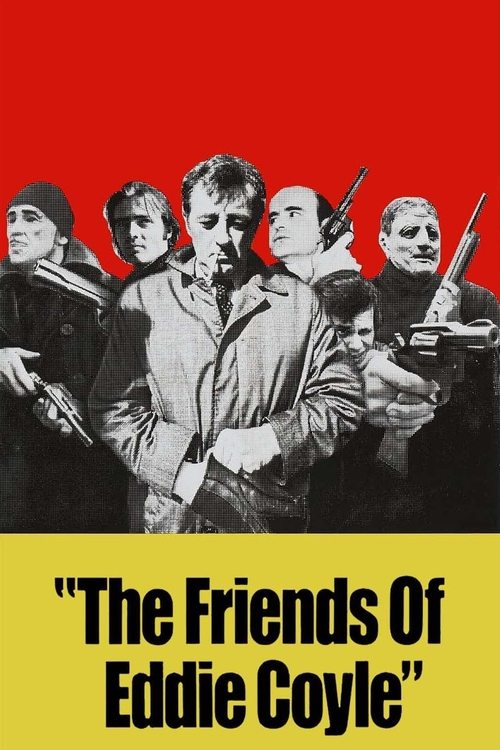
The Friends of Eddie Coyle
1973 · Peter Yates
For when you want crime with zero glamour — no kingpins, no heists-gone-cool, just tired men doing arithmetic with their lives. A downbeat slow burn for a patient, cynical evening.
What it's about
An aging, small-time Boston gun supplier is looking at a prison stretch he can't afford to serve, so he starts quietly feeding information to a federal agent — while still selling guns to the bank robbers he calls his friends. Everyone in his world is making the same calculation: who to sell out to stay on the street.
The experience
Cold, unhurried, and fatalistic — the tension lives in parking-lot meetings and diner conversations where every friendly word has a price. It doesn't excite you so much as slowly close a hand around you.
Performances
Robert Mitchum, late in his career, gives one of his greatest performances as Eddie — weathered, unheroic, and quietly heartbreaking, a man who knows exactly how little he's worth to everyone around him.
The craft
Adapted from George V. Higgins's talk-driven novel, the film trusts dialogue the way other crime movies trust gunfire — the deals, betrayals, and threats all happen in conversation. Peter Yates shoots drab, overcast Boston with documentary plainness that makes the menace feel real.
Why it matters
Barely noticed in 1973, it has grown into a touchstone of American crime realism and a founding text of the Boston crime picture.
Snapshot
The Friends of Eddie Coyle is a small, cold, exact film about the economics of betrayal at the bottom of the criminal food chain. Robert Mitchum plays Eddie "Fingers" Coyle, a middle-aged Boston gun supplier facing a prison stretch in New Hampshire for a hijacking conviction, who tries to trade information to a federal agent in hopes of a lighter sentence — even as he keeps doing business with the bank robbers and gunrunners who are, nominally, his friends. Adapted from George V. Higgins's 1970 debut novel and directed by the British-born Peter Yates, the picture rejects almost every convention of the gangster film: there are no kingpins, no glamour, no rise-and-fall arc, only a closed loop of small operators informing on one another to stay one step ahead of a sentence. Its reputation has grown steadily from a modest 1973 release into a touchstone of 1970s American crime realism, prized for Higgins's vernacular dialogue, Yates's unshowy location craft, and one of the great late performances of Mitchum's career.
Industry & production
The film was produced and released by Paramount Pictures in 1973, with Paul Monash serving as both screenwriter and producer. Monash, a veteran of television and a producer on Butch Cassidy and the Sundance Kid (1969), had optioned Higgins's novel, which had been a critical sensation on publication — Higgins, a former Assistant United States Attorney in Boston, wrote it almost entirely in the overheard cadences of criminals and cops, and reviewers immediately recognized something new in its ear for talk.
Peter Yates was an unusual choice and an apt one. He had made his American reputation with Bullitt (1968), whose San Francisco car chase had become a benchmark, and Paramount's faith in him rested partly on his demonstrated facility with location-based American genre material. Yet Eddie Coyle is the near-opposite of Bullitt's kinetic glamour — a deliberate de-escalation toward the procedural and the mundane.
The casting of Robert Mitchum was the production's defining decision. By 1973 Mitchum was in his mid-fifties, his star persona weathered into something heavy and valedictory, and Eddie Coyle uses that gravity precisely: the actor's slowness and watchfulness read as the fatigue of a man who has run out of moves. Around him the production assembled a deep ensemble of character actors — Peter Boyle as the bartender Dillon, Richard Jordan as the Treasury agent Dave Foley, Steven Keats as the young gun dealer Jackie Brown, and Alex Rocco as the bank-robbery crew's leader. The film was shot on location in and around Boston, a choice central to its texture and to its modest budget; the city's parking lots, bars, suburban tract houses, and bowling alleys are not backdrops but the substance of the film. Precise budget and box-office figures for the film are not something I can state reliably here; its commercial performance on release was unremarkable, and its standing rests on critical re-evaluation rather than initial returns.
Technology
Eddie Coyle is a film made with conventional early-1970s 35mm equipment, but its technological signature is its embrace of available and naturalistic light and real interiors rather than studio reconstruction. This belongs to the broader New Hollywood shift, enabled by faster film stocks and more portable lighting and camera packages, toward shooting in actual locations with a documentary palette. The film does not announce technical novelty; if anything it suppresses it, using the tools of the period to erase the seams between fiction and the lived surfaces of Boston. The bank-robbery sequences depend on practical staging in real streets and buildings rather than effects work.
Technique
Cinematography
The photography is by Victor J. Kemper, a key cinematographer of the period who would shortly shoot Dog Day Afternoon (1975). Kemper's work here is muted and wintry: a palette of browns, grays, and the flat cold light of New England in the off-season. Compositions favor functional framing over expressive flourish, often shooting characters in cars, across diner tables, or in the dead middle distance of parking lots. The camera tends to observe rather than editorialize, holding on faces during long exchanges and letting the environment — chain-link, bare trees, fluorescent bar light — supply the mood. The visual restraint is itself the statement: this is a world without grandeur, photographed without flattery.
Editing
The cutting is patient and weighted toward dialogue and procedure rather than acceleration. The film's most celebrated set pieces — the bank robberies, executed by a crew who take a bank manager's family hostage to compel cooperation — are built through methodical, almost clinical cross-cutting that generates suspense from process and timing rather than spectacle. The editing credit is to Patricia Lewis Jaffe; the rhythm she and Yates arrive at is one of accumulation and dread, with the violence arriving abruptly and then being absorbed back into routine. The contrast between the talky, becalmed dialogue scenes and the taut robbery sequences is the film's central structural rhythm.
Mise-en-scène / staging
Yates stages the film as a series of transactions. Again and again, two men meet in a neutral, semi-public place — a car, a bar, a shopping-center lot — to exchange goods, money, or information, and the staging emphasizes the wariness of the encounter: who arrives first, who sits where, who can leave. The gun deals are shot with the dry attentiveness of a how-to, foregrounding the physical objects (the weapons, the cash, the trunk of a car) as the literal currency of the relationships. The decor is resolutely lower-middle-class and un-stylized — kitchens, taverns, a Boston Bruins game — situating crime not in a shadow world but in the same drab civic spaces everyone else inhabits.
Sound
The sound design favors the flat acoustics of real rooms and the overlap of unglamorous speech. Dialogue is the film's true subject, and the staging and recording give it room to breathe — pauses, hedges, repetitions, the circling indirection of men who never quite say what they mean. The film resists musical underscoring in its tensest passages, letting silence and ambient noise carry the dread.
Performance
Performance is where the film's reputation chiefly lives. Mitchum gives Eddie a stooped, watchful weariness; the famous Mitchum heavy-liddedness here reads not as cool but as exhaustion and fear, a man calculating odds he already suspects are against him. It is widely regarded as among his finest performances precisely because it withholds charisma. Peter Boyle, as the bartender and informer Dillon, is quietly chilling — affable, reasonable, and finally lethal. Richard Jordan plays the federal agent Foley as a smooth, faintly contemptuous functionary who treats his informants as renewable resources, and Steven Keats brings a jittery, cocksure menace to the young gunrunner Jackie Brown. The ensemble's collective achievement is to make criminality feel like labor.
Narrative & dramatic mode
The narrative mode is anti-dramatic by design. There is no protagonist's triumph and no clean arc; instead the film interlocks several ongoing transactions — Eddie's gun sales to the bank crew, his informing to Foley, Jackie Brown's dealing in heavier weapons, Dillon's own hidden role as an informer — into a network in which everyone is selling everyone else. The dramatic engine is dramatic irony of the bleakest kind: Eddie is ultimately marked for death as a "rat," and is killed by Dillon on contract, when in fact the information that doomed the crew came from elsewhere. His one act of self-preservation buys him nothing; the system disposes of him on a mistaken premise, and indifferently. The mode is observational, elliptical, and structured around talk — the film trusts the audience to assemble motive and consequence from fragments, much as Higgins's prose does.
Genre & cycle
The film sits at the hard, naturalistic edge of the 1970s American crime cycle, alongside works that stripped the gangster picture of its operatic inheritance. Where The Godfather (1972) elevated the criminal to tragic dynasty, Eddie Coyle burrows downward to the interchangeable foot soldiers — the suppliers, fences, and informers who never see the top. It belongs to a lineage of crime realism that prizes procedure, vernacular, and moral exhaustion over heroics, and it is a foundational text for what would later be recognized as the Boston crime film. Its refusal of redemption and its bureaucratic conception of both law enforcement and crime align it with the disillusioned, post-Watergate temper of New Hollywood.
Authorship & method
The film is best understood as a collaboration between Yates's craft and Higgins's voice, mediated by Paul Monash's screenplay. Higgins's novel was famous for being almost all dialogue, and the film's fidelity to that method — long, circling conversations in which information is the only commodity — is its authorial signature. Monash's adaptation largely trusts the source, preserving its ear for the way criminals and cops actually speak, full of evasion and shop talk. Yates's contribution is one of discipline and restraint: having proven he could deliver spectacle, he subordinates his own flourishes to the material's grim naturalism, directing the actors toward understatement and the city toward documentary truth. Victor Kemper's cold cinematography and Patricia Lewis Jaffe's patient cutting realize that vision visually. The score is by Dave Grusin, a jazz pianist and composer whose music here is used sparingly and unsentimentally, avoiding the suspense-film cliché and reinforcing the film's deglamorized tone. The authorship is thus genuinely distributed — but Higgins's language is the gravitational center, and Yates's signal achievement was knowing to get out of its way.
Movement / national cinema
The film is a product of New Hollywood, the late-1960s-through-1970s American renaissance in which director-driven, realist, morally ambiguous filmmaking flourished within (and against) the studio system. Its location shooting, downbeat ending, ensemble texture, and rejection of genre uplift are hallmarks of that movement. It is notable that an English director — Yates, trained in British theater and film — produced one of the most regionally specific American films of the decade; the outsider's eye arguably sharpened the observational, almost ethnographic attention to working-class Boston. Within American national cinema, the film is also a cornerstone of a distinctly regional tradition: the Boston-set crime narrative grounded in class, ethnicity, and neighborhood loyalty.
Era / period
Released in 1973, the film is steeped in the malaise of its moment — a period of institutional distrust, economic anxiety, and the collapse of heroic narratives in American film. Its vision of law enforcement as a transactional, faintly cynical bureaucracy, and of criminals as petty wage-earners trapped in obligation, speaks directly to the post-1960s deflation of idealism. Period specifics — the wide lapels and vinyl interiors, the Bruins game, the pre-gentrification Boston of bars and parking lots — are rendered without nostalgia, as simply the texture of a present the film inhabits.
Themes
The film's central theme is the commodification of loyalty: in this world, friendship is a euphemism, and every relationship is finally a transaction priced in years of avoided prison. Its title is bitterly ironic — Eddie's "friends" are the people most positioned to sell him. Closely related is the theme of betrayal as systemic rather than personal: no one is especially villainous, yet everyone informs, because the architecture of plea bargaining and surveillance makes betrayal the rational move. Aging and obsolescence run through Mitchum's Eddie, a man whose usefulness has expired and who knows it. And over the whole film hangs a vision of futility — the recognition that individual cunning means little against an indifferent machinery of crime and law. A line from the film distilling this hard pragmatism — to the effect that life is hard, and harder still if you're stupid — has become its most-quoted sentiment, though it offers cold comfort to a man whose intelligence saves him from nothing.
Reception, canon & influence
On release the film earned strong critical notices, particularly for Mitchum's performance and Higgins's dialogue, even as it found only a modest commercial audience. Its critical standing has risen markedly over the decades; its 2009 release in the Criterion Collection helped consolidate its reputation as a neglected classic of 1970s American cinema, and it is now routinely cited among the finest crime films of its era and a career highlight for both Mitchum and Yates.
Looking backward, the film's influences lie less in earlier cinema than in its literary source: Higgins drew on his experience as a federal prosecutor and on a hard-boiled American crime tradition, and the film's documentary realism extends the location-driven naturalism that Bullitt and other New Hollywood crime pictures had been developing. Looking forward, its legacy is substantial. Higgins's dialogue method — criminals rendered through their evasive, profane, hyper-specific talk — became deeply influential on later crime writing and film, with Elmore Leonard and David Mamet among the authors who admired and absorbed his approach. Quentin Tarantino has cited the film's importance to him, and his 1997 Jackie Brown shares its name with the young gunrunner in Higgins's story, a nod to that lineage of dialogue-driven, transaction-based crime narrative. Most directly, Eddie Coyle is a foundational text for the modern Boston crime film, anticipating the milieu and moral world of later works such as Mystic River, The Departed, Gone Baby Gone, and The Town — films that share its sense of neighborhood loyalty, informing, and class-bound fate. Its deeper influence is tonal: it helped license a crime cinema in which there are no kingpins worth toppling and no honor to betray, only people doing business until the business is done with them.
A Deleuzian reading
A man sits in a parked car in a shopping-center lot and watches to see who arrives first.
The full Deleuzian reading of The Friends of Eddie Coyle →
Reception
A modest performer in 1973 that critics respected but audiences skipped, it spent decades as a hard-to-see cult item before the 2009 Criterion release sealed its reappraisal as maybe the best American crime film of its era.
How The Friends of Eddie Coyle was received, from release to now →
Influences: the films it descends from and the films it influenced
- Out of the Past (1947) — Establishes Mitchum's hooded, minimalist underplaying — the weary, already-defeated fatalist who speaks softly and expects the worst — the exact persona Yates exploits in Coyle's resignation.
- The Naked City (1948) — Pioneers the semi-documentary crime procedural shot on real city streets, the location-driven naturalism Eddie Coyle extends to working-class Boston.
- The Killing (1956) — Builds its heist from small-time specialists negotiating their cuts and roles, modeling crime as a fragile transactional arrangement rather than a glamorous caper.
- Bullitt (1968) — Yates's own template of available-light location shooting and deglamorized police procedure, whose documentary texture he strips of spectacle and reapplies here.
- The French Connection (1971) — Handheld, available-light location realism that renders cops and informants in cold, unromantic city light — the New Hollywood crime grammar Coyle inherits.
- Le Doulos (1962) — Carries forward the informer-as-tragic-figure at the center of a milieu defined by who is wearing a wire, treating the snitch's doomed calculus with the same deglamorized fatalism.
- The Breaking Point (1950) — The purest later statement of the form: gun-running staged as wage labor in flat New England daylight, with the score withheld almost entirely and the criminal transactions filmed in parking lots and bar booths as workplace procedure, so the crime reads as an entry in a household budget.
- Straight Time (1978) — Extends the ex-con procedural into documentary-real parole-and-job-and-score detail, treating criminality as a grinding occupation with no honor or escape.
- Thief (1981) — Recasts the professional thief as a skilled tradesman whose work is rendered in procedural, transactional detail and available-light naturalism.
- Reservoir Dogs (1992) — Builds tension almost entirely from criminals' circling, profane, digressive talk — the Higgins method of evasive shop-talk-as-information that Tarantino openly absorbed.
- Heat (1995) — Depicts crews as disciplined professionals doing a job, deglamorized into a work ethic, extending Coyle's vision of crime as commerce among interchangeable men.
- Jackie Brown (1997) — Names its gunrunner directly after Higgins's character and structures the film around dialogue-driven, transaction-based crime — an explicit homage to Coyle's lineage.
- Out of Sight (1998) — Carries forward the Elmore Leonard dialogue tradition Higgins helped seed — criminals defined by laconic, specific, deal-making talk rather than action.
- The Departed (2006) — Inherits Coyle's foundational Boston-crime moral world of informing, neighborhood loyalty, and class-bound fate among cops and criminals who all talk the same.
- The Town (2010) — Extends the modern Boston crime film Coyle founded — working-class neighborhood codes, location-shot realism, and fate determined by who you grew up with.
- Killing Them Softly (2012) — Adapts Higgins's own novel Cogan's Trade with fidelity to his talk-heavy method, criminals rendered through long, profane, transactional conversations.
- The Mastermind (2025) — The template for deglamorized, procedurally observed New Hollywood crime: low-energy small-timers, ambient working-class location texture, and a flat anti-heroic register that refuses the score's adrenaline — the exact tonal grammar Reichardt borrows for her heist.
- Gone Baby Gone (2007) — Yates and cinematographer Victor Kemper established the foundational visual grammar of Boston working-class crime cinema through actual-location shooting with photochemical grain that refuses atmospheric enhancement, giving Affleck the direct precedent for Dorchester as unembellished documentary space.
- Donnie Brasco (1997) — Establishes the demythologized low-level mob soldier as tragic protagonist: unglamorous practical location photography, Mitchum's behavioral naturalism as the 'never-gonna-make-it' archetype, and betrayal-to-death complicity without genre resolution — the direct template for Lefty Ruggiero.
- Mean Streets (1973) — Renders petty criminals almost entirely through their overlapping, profane, hyper-specific shop talk on real neighborhood locations — the same dialogue-as-action method.
- The Long Goodbye (1973) — Deglamorizes noir into mumbled, naturalistic, anti-dramatic talk and muted location color, dismantling genre suspense conventions in parallel with Coyle.
- Charley Varrick (1973) — Frames the small-time crook trapped between the law and the syndicate as a doomed independent contractor, sharing Coyle's 'business until the business is done with you' fatalism.
- The Outfit (1973) — Treats professional crime as flat, transactional labor among aging operators, with the same understated, anti-heroic deglamorization of the criminal milieu.
- Le Cercle Rouge (1970) — Yates applies the same procedural-fatalist grammar as Melville — professional criminal depicted with ethnographic patience, doom accumulating through information asymmetry revealed to audience before character, the betrayal structure operating as genre inevitability — while working entirely within an American realist register.
- The Killing of a Chinese Bookie (1976) — Reworks the crime film as a deglamorized character study of a doomed low-level operator, deliberately flattening suspense in favor of weary procedural realism.
- The Killers (1964) — Extends the talky, methodical, unglamorous professional-criminal milieu in naturalistic daylight, descending from the genre's modernization Siegel helped pivot.
- Mikey and Nicky (1976) — Ancestor in de-glamorized low-rent criminal milieu shot in transient shabby locations, and in the doomed-informer arc where an aging small-timer is quietly sold out by his own circle.
Similar films
- The Long Goodbye (1973) — influence & lineage
- Out of the Past (1947) — influence & lineage
- Mean Streets (1973) — influence & lineage
- Killing Them Softly (2012) — influence & lineage
- The Town (2010) — influence & lineage
- The French Connection (1971) — influence & lineage
- Thief (1981) — influence & lineage
- The Departed (2006) — influence & lineage
All the films related to The Friends of Eddie Coyle →