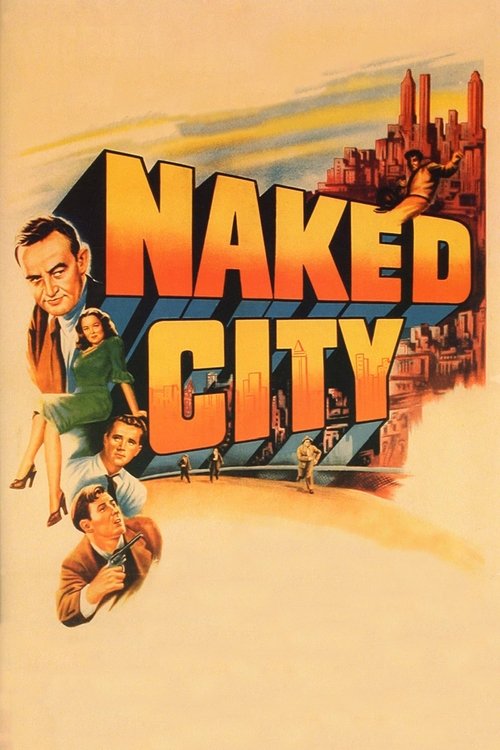
The Naked City
1948 · Jules Dassin
For when you want a smart, unpretentious old-movie evening — a crime story with atmosphere to spare that asks nothing of you but attention and rewards it with a vanished New York.
What it's about
A young model is found drowned in her bathtub in a Manhattan apartment, and a wry veteran homicide lieutenant and his eager junior detective work the case the unglamorous way: interviews, legwork, dead ends, shoe leather. Shot on the real streets of 1948 New York, it treats the murder as one story among the city's eight million.
The experience
Brisk, wry, and endlessly watchable — less about whodunit suspense than the pleasure of watching methodical work unfold against a living city, building to a genuinely gripping chase. It plays like a time capsule you can walk around inside.
Performances
Barry Fitzgerald is a delight as Lieutenant Muldoon, playing the veteran cop with twinkling patience instead of hard-boiled clichés — he carries the film's humane, unhurried tone.
The craft
Jules Dassin shot it largely on location in actual New York streets, subways, and tenements — radical for a studio picture — with hidden cameras catching real crowds, and a narrator framing the case as city portraiture. The finale on the Williamsburg Bridge is a stunning piece of location filmmaking that rewards a big screen.
Why it matters
Its closing line — eight million stories in the naked city — became one of the most quoted tags in American film, and its street-shot, procedure-first method fed decades of police procedurals on film and television, including the TV series it directly inspired.
Snapshot
The Naked City is a semi-documentary police procedural that turns the investigation of a murdered model into a portrait of New York itself. A young woman, Jean Dexter, is chloroformed and drowned in her bathtub; veteran homicide Lieutenant Dan Muldoon (Barry Fitzgerald) and his eager junior detective Jimmy Halloran (Don Taylor) work the case through interrogation, legwork, and accumulated procedure until it resolves in a foot chase across the Williamsburg Bridge. What lifts the film above its modest plot is its method: shot largely on the actual streets of New York, narrated by its own producer, and framed as one story drawn from a teeming metropolis. The closing voice-over — "There are eight million stories in the naked city. This has been one of them" — became one of the most quoted tags in American cinema, and the film stands as a foundational text of the postwar location-shot crime cycle. It won Academy Awards for Cinematography (William H. Daniels) and Film Editing (Paul Weatherwax), and its title, borrowed from the tabloid photographer Weegee, signaled an aesthetic of unsentimental urban observation.
Industry & production
The Naked City was the final production of Mark Hellinger, the Broadway columnist turned Hollywood producer who had previously shepherded The Killers (1946) and Brute Force (1947), both crime pictures with a hard documentary edge. Hellinger died of a heart attack in December 1947, shortly before the film's release in March 1948, and the picture is freighted with the poignancy of being his valediction — he himself supplies the omniscient narration, so the producer's voice quite literally presides over the movie. It was released through Universal-International.
The production's defining decision was to shoot on location in New York City rather than on Hollywood soundstages. The film is widely reported to have used over a hundred actual New York locations — tenements, the Lower East Side, police headquarters, the Williamsburg Bridge — with interiors and exteriors captured in the real fabric of the city. This required logistical innovation: cameras concealed in vans and behind one-way mirrors or hidden vantage points to catch crowds and traffic without staging them. The approach made the city a co-protagonist and gave the film a texture of authenticity that studio reconstruction could not match.
The project carried political shadows that would soon darken. The screenplay was credited to Albert Maltz and Malvin Wald, working from Wald's original story. Maltz was one of the Hollywood Ten, blacklisted for refusing to cooperate with the House Un-American Activities Committee; director Jules Dassin would himself be named and blacklisted within a couple of years, driving him to exile in Europe. These pressures hung over the production and its immediate aftermath, even if they do not surface on screen.
Technology
The film's technology is, in effect, its subject. The crucial enabling factors were postwar advances in portable equipment, faster film stocks, and lighting that made extensive location shooting practical in a way it had not been in the 1930s. War-era newsreel and combat-photography techniques — lightweight handling, available-light shooting, concealed cameras — fed directly into the semi-documentary crime film, and The Naked City exploited them aggressively. Hidden cameras allowed the production to record genuine street life; the result is a documentary substrate beneath a fictional drama. The film was shot and released in standard black-and-white Academy ratio, well before widescreen or color became commercial norms for this kind of picture, and its monochrome is integral to its grit. Beyond location capture, the film does not foreground special-effects or optical novelty; its innovation is one of working method rather than apparatus.
Technique
Cinematography
William H. Daniels, long associated with the glamour of MGM and Greta Garbo, won the Academy Award for Black-and-White Cinematography for The Naked City — a notable pivot from studio polish to street realism. The photography balances two registers: the candid, near-newsreel documentation of New York crowds and thoroughfares, and the more composed noir lighting of interiors and night sequences. Daniels and his team had to solve the problem of exposing real exteriors under uncontrolled conditions while preserving dramatic legibility. The film's most celebrated images come in the climactic pursuit, where the geometry of the Williamsburg Bridge — its girders, catwalks, and vertiginous spans — is used for genuinely vertiginous suspense. Throughout, the camera tends toward an observational eye, often placing the drama within deep, populated frames rather than isolating actors in stylized close-up.
Editing
Paul Weatherwax won the Academy Award for Film Editing, and the recognition is apt: the film's structure depends on cutting to bind disparate location footage, candid street material, and staged scenes into a coherent procedural rhythm. The editing advances the investigation through accumulation — a montage logic of clues, interviews, and legwork that conveys the grinding patience of police work and the simultaneity of a city's many lives. The climactic chase is the editorial set-piece, intercutting the fugitive Garzah's flight with converging police to build accelerating tension. The film's montages of the waking and working city, keyed to Hellinger's narration, are equally a product of the cutting room, stitching observed fragments into a civic portrait.
Mise-en-scène / staging
The film's staging is governed by its commitment to real space. Rather than building the city, Dassin stages action within it, so that the mise-en-scène is partly found rather than designed — the clutter of tenement apartments, the bustle of headquarters, the press of sidewalks. This lends scenes an unforced density of background detail. Where studio convention would isolate a dramatic exchange, The Naked City frequently embeds it in a continuing flow of incidental life. The effect is to subordinate individual figures to the larger organism of the city, reinforcing the film's thesis that any single crime is one thread in an immense social fabric.
Sound
The most distinctive sonic element is the narration, delivered by Hellinger in a wry, paternal, knowing register that addresses the audience directly, comments on characters, and frames the whole as a tale plucked from millions. This voice-of-the-city device — at once intimate and god-like — is the film's signature and was much imitated. The score is credited to Miklós Rózsa and Frank Skinner; Rózsa was by this point a leading composer of noir and psychological dramas, and the music supports the film's shifts between civic panorama and criminal tension. Location shooting also brings ambient urban sound into play, though dialogue recorded on real streets posed technical challenges that the production had to manage in post.
Performance
Barry Fitzgerald, the Irish character actor best known for sentimental roles (and an Oscar winner for Going My Way), plays Lieutenant Muldoon against type as a shrewd, twinkling, methodical detective whose folksy manner masks relentless competence — he anchors the film's procedural authority. Don Taylor's Halloran is the younger surrogate, an ordinary married cop whose domestic life grounds the investigation in everyday stakes. Howard Duff is memorable as the slippery liar Frank Niles, and Ted de Corsia makes the cornered killer Garzah a figure of animal desperation in the finale. The performances are pitched toward naturalism consistent with the documentary frame, avoiding the heightened theatricality of much studio melodrama, though Fitzgerald's charm supplies the film's warmth.
Narrative & dramatic mode
The film's dramatic mode is the procedural: a structure organized not around a single protagonist's psychology but around the methodical, collective process of solving a crime. There is no whodunit puzzle offered to the viewer in the classical sense so much as a demonstration of how police work actually proceeds — canvassing, cross-checking alibis, tracing objects, eliminating suspects. The narration reframes this procedural spine as something larger: a meditation on the anonymity and multiplicity of urban life, in which the murder is explicitly presented as merely "one of them," one story among eight million. This double movement — granular police realism nested inside a humanist civic essay — is the film's structural signature. Dramatically, it favors breadth over depth, surveying a wide cast of witnesses and bystanders rather than excavating a few interior lives.
Genre & cycle
The Naked City belongs to the postwar semi-documentary crime cycle, a strain of film noir that married location shooting and procedural plotting to a quasi-journalistic voice. Its immediate kin include The House on 92nd Street (1945), Boomerang! (1947), T-Men (1947), Call Northside 777 (1948), and He Walked by Night (1948) — films that emphasized authenticity, institutional process, and real-world settings over the expressionist studio shadows of earlier noir. Within that cycle, The Naked City is among the most influential because it foregrounded the city itself as both setting and theme. It is also a foundational police procedural, a form that would migrate powerfully to television. While it shares noir's nocturnal menace and fatalism in patches, its overall sensibility is closer to civic realism than to the doom-laden romanticism of canonical noir.
Authorship & method
The film is a product of collaboration more than singular auteurism, though each contributor's signature is legible. Jules Dassin, the director, brought a developing interest in social texture and location realism that would flower in his subsequent work; within a few years he would be blacklisted and forced to Europe, where he made Night and the City (1950) and the heist masterpiece Rififi (1955). Dassin reportedly chafed at aspects of the production and the imposed narration, and the degree to which the finished film reflects his intentions versus Hellinger's has been a subject of commentary — a useful caution against reading it as pure Dassin. Mark Hellinger, producer and narrator, was arguably the film's primary author of vision, importing the tabloid, street-level sensibility of his journalism. The screenplay by Albert Maltz and Malvin Wald (from Wald's Oscar-nominated story) supplied the procedural research and structure; Wald is said to have studied police operations to ground the film. William H. Daniels (cinematography) and Paul Weatherwax (editing) won Oscars for translating the location method into coherent images and rhythm. Miklós Rózsa and Frank Skinner scored it. The title and aesthetic owe an explicit debt to the photographer Weegee (Arthur Fellig), whose 1945 book Naked City gave the film its name and its ethos of raw, flash-lit urban witness; Weegee is commonly cited as a consultant and inspiration, though the precise extent of his on-set involvement is not richly documented.
Movement / national cinema
The film is an American work, but it is legible within the transnational currents of postwar realism. Italian neorealism — Rome, Open City (1945), Bicycle Thieves (1948) — had made location shooting, nonprofessional textures, and the lives of ordinary people into an internationally recognized aesthetic and moral program. The Naked City converges with that movement in its street-level method and its democratic attention to the anonymous urban multitude, even as it remains tethered to Hollywood genre machinery and a studio release. It is best understood as the American semi-documentary's answer to neorealism: realist in technique and civic in feeling, but commercial in form. Domestically, it is a New York film above all, part of a lineage that treats the city not as backdrop but as the central character of its drama.
Era / period
Released in 1948, the film sits squarely in the immediate postwar moment, when documentary techniques honed during the war were being absorbed into fiction filmmaking, and when a public appetite for authenticity and institutional reassurance shaped popular crime narratives. Its faith in the patient competence of municipal police reflects a postwar civic optimism, even as the noir cycle around it registered darker anxieties. The film also belongs to the threshold of the blacklist era: HUAC's Hollywood hearings of 1947 had just occurred, and the careers of both Maltz and Dassin would shortly be wrecked by it, making The Naked City a marker of the brief window before the industry's political purge fully closed.
Themes
The film's governing theme is the relationship between the individual and the mass — the idea that a single human story, including a violent death, is at once unique and utterly typical within the vast indifference of the metropolis. Hellinger's refrain insists on this scale: eight million stories, of which the murder is merely one. Against that anonymity, the film sets the consoling theme of process and accountability — the notion that institutions, through diligence, can extract justice from chaos and restore a name and a meaning to one of the city's countless dead. There are quieter currents too: the contrast between the dead woman's tawdry, aspirational world and the modest domesticity of Halloran's household sketches a class-inflected portrait of urban striving and its hazards. Throughout, the city is figured as a living organism whose daily rhythms — waking, working, sleeping — frame and dwarf the human drama.
Reception, canon & influence
The Naked City was well received and is generally remembered as a critical and popular success, validated by its Academy Awards for Cinematography and Editing and by Wald's nomination for the original story; precise contemporary box-office and review figures are beyond what can be reliably cited here without risk of invention. Its lasting reputation rests less on its plot, often judged routine, than on its method and its influence.
Looking backward, the film draws on Weegee's tabloid photography for its visual ethos, on wartime documentary and newsreel practice for its technique, on Italian neorealism for its location realism and humanist scale, and on the earlier semi-documentary noirs (notably the Louis de Rochemont–produced The House on 92nd Street) for its procedural template. Hellinger's own crime productions and his journalistic sensibility supplied the connective tissue.
Looking forward, its legacy is substantial. It helped establish the police procedural as a durable form and demonstrated the dramatic power of authentic location shooting, encouraging a generation of filmmakers to take cameras into real streets. Its most direct progeny was the television series Naked City (1958–1963), which borrowed the title, the New York setting, and the famous "eight million stories" framing to become a landmark of location-shot television drama. More broadly, the film's civic-portrait approach echoes through subsequent New York crime cinema and through the entire tradition of the realist procedural on screens large and small. Its closing line endures as one of American cinema's most recognizable signatures — a compact statement of the film's enduring idea that every crime is a window onto a whole metropolis of lives.
A Deleuzian reading
The film opens before the crime.
The full Deleuzian reading of The Naked City →
Reception
A hit in 1948 — it won Oscars for its cinematography and editing — but its reputation shifted from 'gimmicky docu-thriller' to foundational text: it's now credited with inventing the on-location police procedural, and was added to the National Film Registry in 2007.
How The Naked City was received, from release to now →
Influences: the films it descends from and the films it influenced
- The House on 92nd Street (1945) — Established the de Rochemont semi-documentary procedural template — authoritative voice-over narration, real locations, and a 'based on the files' framing — that The Naked City directly adopts for its police-investigation structure.
- Rome, Open City (1945) — Italian neorealism's practice of shooting in actual war-scarred streets with available light and a humanist attention to ordinary city dwellers gave Dassin his model for location realism and civic scale.
- Boomerang! (1947) — Kazan's de Rochemont-produced docu-noir embedded a real legal procedural in actual New England locations with newsreel-style narration, prototyping the authentic-location crime investigation a year before Naked City.
- Berlin: Symphony of a Great City (1927) — The city-symphony montage that builds a metropolis from rhythmic fragments of anonymous daily life supplies Naked City's framing conceit of the city itself as protagonist and its dawn-to-dusk structural arc.
- The Killers (1946) — Mark Hellinger's own production, scored by Miklós Rózsa, supplied the producer's tabloid crime sensibility and the Rózsa noir idiom that carry directly into Naked City.
- M (1931) — Lang's intercutting of a city-wide manhunt across police and underworld networks — the whole metropolis mobilized to catch one killer — is the procedural-dragnet montage Naked City restages on real New York streets.
- Weegee's New York (photographs) (1945) — Weegee's flash-lit tabloid photography of crime scenes and crowds — and the very title from his book Naked City — gave the film its raw, on-the-spot witness aesthetic and consultant input.
- Brute Force (1947) — Dassin and Hellinger's immediate follow-up extends the same tough, journalistic, semi-documentary crime aesthetic — shooting the institution/city as a verifiable physical fact rather than a studio abstraction.
- Night and the City (1950) — Dassin extends his own location method into the actual streets and nightspots of London, carrying the deep-populated urban frame and chase-through-the-city momentum into a doomed-protagonist noir.
- Panic in the Streets (1950) — Kazan pushes Naked City's location procedural into the docks and tenements of real New Orleans, sustaining the manhunt-across-an-authentic-city structure with non-professional faces in deep-focus crowds.
- The Naked City (TV series) (1958) — The most direct progeny borrows the title, the New York setting, and the 'eight million stories' framing to make location-shot television drama out of the film's civic-portrait procedural.
- Dragnet (1954) — Webb systematizes the semi-documentary police procedural — flat factual narration, researched real-case structure, deadpan investigative detail — that Naked City popularized for the cop genre.
- The French Connection (1971) — Friedkin's hidden-camera, run-and-gun shooting in real New York streets and its grimy procedural surveillance descend directly from Naked City's location method and montage-of-clues tailing.
- Rififi (1955) — Dassin transplants the same patient, process-obsessed observation of criminal method — here the wordless heist — onto real Paris locations, the procedural rigor of Naked City turned to the other side of the law.
- Naked City: Smashing the Crime Syndicate / civic crime cinema (1973) — Lumet's location-saturated New York police films inherit Naked City's ethic of the city as a deep-populated documentary frame in which institutional procedure and street texture are inseparable.
- Killer of Sheep (1978) — Burnett's neorealist, on-location portrait of a working community extends the found-mise-en-scène and humanist 'individual and the mass' impulse beneath Naked City's procedural surface.
- Le Samouraï (1967) — Dassin's location-documentary method — using New York's real transit infrastructure (subway corridors, platform edges, stairwells) as the machinery of pursuit rather than studio sets — is the technical ancestor of Melville and Decaë's Paris Métro sequences, where tile geometry and platform choreography replace action choreography as the suspense apparatus.
- High and Low (1963) — Dassin established the procedural grammar of patient, accumulative documentation of institutional police labor as serious cinematic subject — location shooting as authenticity guarantee, ensemble as social cross-section — which Kurosawa imports wholesale for the investigative second half.
- The Asphalt Jungle (1950) — Huston absorbed Dassin's semi-documentary location shooting and police procedural rhythm—the insistence that the city itself is a forensic fact—and translated it to the criminal's side of the same streets, grounding the heist milieu in the same unglamourised urban texture.
- Sweet Smell of Success (1957) — On-location night shooting of real Manhattan streets, the documentary-realist urban template Sweet Smell pushes toward neon stylization.
- The Set-Up (1949) — A contemporaneous noir built on real-time unfolding and deep-focus urban crowds, sharing Naked City's documentary attention to the textures of city nightlife and anonymous bystanders.
- Call Northside 777 (1948) — Released the same year, it pursues the same de Rochemont semi-documentary investigation on authentic Chicago locations with reporter-procedural narration tracing a case through real institutions.
- Bullitt (1968) — Pioneered the location-shot, semi-documentary police procedural — real streets and ambient grit standing in for studio sets, the realist grammar Bullitt strips down and modernizes.
- The Wrong Man (1956) — Supplies the template of New York itself as documentary subject — subway, precinct, and tenement shot on location with quasi-journalistic narration — the civic-texture realism Burks reproduces for Manny's city.
- H-8... (1958) — Threads multiple anonymous lives with an authoritative omniscient narrator over documentary-real locations, the 'many stories, one frame' voiceover grammar H-8... adopts.
Similar films
- Night and the City (1950) — influence & lineage
- The French Connection (1971) — influence & lineage
- Rififi (1955) — influence & lineage
- Chinatown (1974) — shared sensibility
- Double Indemnity (1944) — shared sensibility
- Where the Sidewalk Ends (1950) — shared sensibility
- L.A. Confidential (1997) — shared sensibility
- Laura (1944) — shared sensibility
All the films related to The Naked City →