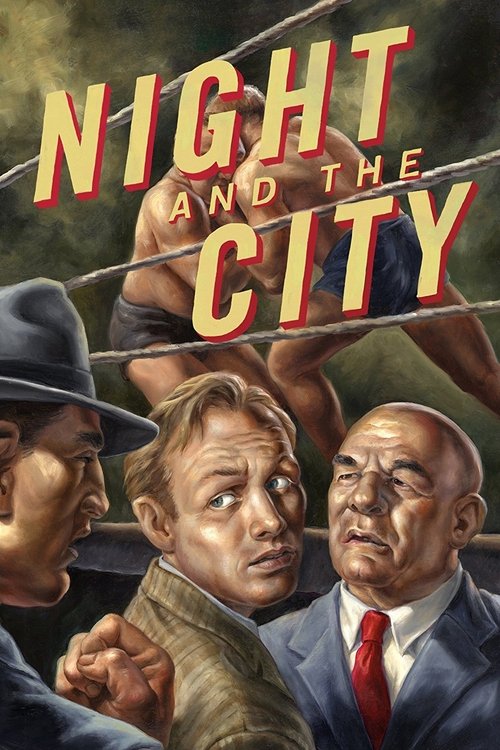
Night and the City
1950 · Jules Dassin
For when you want your crime films pitch-black and fatalistic — a shadowy, rain-slicked downer to sink into late at night, not a comfort watch. Reach for it when a doomed hustler sounds more appealing than a happy ending.
What it's about
Harry Fabian is a small-time London hustler who touts for nightclubs and burns through other people's money chasing the scheme that will finally make him somebody. His latest angle — muscling into the city's wrestling racket by promoting an old Greco-Roman champion — puts him between a nightclub kingpin, the mobster who runs the fight game, and a girlfriend whose patience has run out. He's in over his head before he's even started, and the whole night city seems to know it.
The experience
Sweaty, desperate, and gathering speed — you watch a man talk faster and faster as the walls close in. It plays like a fever: darkly thrilling in the moment, genuinely sad underneath, and it leaves you wrung out.
Performances
Richard Widmark is extraordinary as Fabian — all nervous grin and flop-sweat charm, a con man you can see lying to himself in real time. It's one of the great portraits of desperation in American film.
The craft
Jules Dassin shot it on location in a London still scarred by the Blitz, and the real streets, alleys, and riverbanks give the shadows actual weight — this is night-time black-and-white photography at its most expressive. A brutal, extended wrestling bout in the middle of the film is a masterclass in physical staging. It rewards the biggest, darkest screen you can find.
Why it matters
Made just before the Hollywood blacklist forced Dassin into European exile, it's now ranked among the bleakest and best of the classic noir cycle, and its location-shot grit pointed the way for the crime films that followed.
Snapshot
Night and the City is Jules Dassin's last American studio film before the blacklist drove him into European exile, and it stands among the bleakest and most fully realized works of the classic film-noir cycle. Adapted loosely from Gerald Kersh's 1938 novel and shot almost entirely on location in a still-bomb-scarred London, it follows Harry Fabian (Richard Widmark), a small-time nightclub tout and chronic schemer who convinces himself that promoting Greco-Roman wrestling will be the angle that finally makes him a "somebody." His ambition entangles him with the wrestling racket's overlord, the corpulent nightclub proprietor who finances him, and a roster of grifters and strongmen, and it ends — as noir destinies tend to — in a frantic nocturnal flight through the city toward death. The film is at once a sweaty character study of a striver "without talent," in Dassin's own framing, and an expressionist nightmare-portrait of a metropolis. Its reputation has risen steadily since 1950; it is now widely treated as a canonical noir and one of Dassin's two or three finest pictures.
Industry & production
The film was a 20th Century-Fox production, mounted under Darryl F. Zanuck's regime and produced by Samuel G. Engel. It belongs to a late-1940s vogue for "runaway" productions shot abroad, partly to use blocked sterling funds that American studios had accumulated in Britain and could not freely repatriate; making a picture in England was a way to spend that money. Fox sent Dassin to London to direct, and the circumstances of the assignment are inseparable from the politics of the moment. Dassin was already under suspicion as a Communist and would shortly be named to the House Un-American Activities Committee; by several accounts, including Dassin's own recollections in later interviews, he understood that Night and the City might be his last Hollywood job. He has said that Zanuck advised — or that he resolved on his own — to shoot the most expensive, most spectacular sequences first, so that the studio could not cheaply abandon or recut the film once the blacklist closed in. That account is widely repeated and originates largely with Dassin himself; it should be read as a director's retrospective testimony rather than fully documented studio history.
Dassin also said he had not read Kersh's novel before shooting, working instead from Jo Eisinger's screenplay. The adaptation departs sharply from its source: Kersh's Fabian is a pimp living off a prostitute, a subject impossible under the Production Code, and the film reinvents the character's racket as wrestling promotion while retaining the novel's atmosphere of nocturnal London lowlife.
A defining production fact is that two distinct versions exist. The American release runs roughly 96–101 minutes with a score by Franz Waxman; the British release, prepared for the UK market, carries a different score by Benjamin Frankel and differs in editing and in some scene order and emphasis, including its handling of the ending. The existence of these parallel cuts complicates any single description of "the" film, and home-video editions have circulated both.
Technology
Night and the City was made on 35mm black-and-white stock with conventional studio sound recording, but its technological interest lies in its commitment to extensive location work. Following the path Dassin had opened with The Naked City (1948), the production filmed across real London — streets, the riverside, bridges, alleys, and bomb sites left from the war — rather than confining itself to soundstages. This required relatively mobile equipment and careful exploitation of available and supplementary lighting for night exteriors, and it places the film within the late-1940s movement, indebted to Italian neorealism and to the American semi-documentary thriller, toward photographing the actual modern city. Interiors were realized on sets, so the film mixes constructed and found space; the seam between them is largely concealed by the consistency of the lighting design.
Technique
Cinematography
The cinematography is by Max Greene — the professional name of Mutz Greenbaum, a German émigré who had become one of Britain's leading cameramen. His work is central to the film's standing. Greene renders London as a labyrinth of wet pavement, deep shadow, and sudden glare: the chiaroscuro is steep, faces are sculpted by low-key lighting, and the city's geometry — staircases, railings, arches, the river — is composed into expressionist traps. The celebrated opening, with Fabian fleeing down nighttime streets, establishes the visual thesis immediately. The location night photography gives the film a documentary substrate that its expressionist lighting then transfigures, so that real London becomes a psychological landscape. This fusion of neorealist location and German-derived expressionist style is the picture's signal achievement and is frequently cited as a high point of noir cinematography.
Editing
The film is built on a rhythm that accelerates from the loose, observational early scenes toward the relentless momentum of the final manhunt. The standout set piece is the wrestling bout between the old Greco-Roman champion Gregorius and the brutish Strangler, an extended, near-real grappling match cut for visceral physical impact rather than balletic spectacle. The closing pursuit, in which Fabian is hunted across the city with a price on his head, is constructed as a crescendo of cross-cut movement. Because the American and British versions differ in their cutting, precise editorial credit and the exact shape of certain sequences vary between releases; I would not assert a single definitive cut without consulting the specific print.
Mise-en-scène / staging
Dassin's staging exploits bodies and spaces of starkly contrasting scale. The vast bulk of the nightclub owner Phil Nosseross, the immovable mass of the wrestlers, and the sweating, darting smallness of Fabian are blocked against one another so that physical size reads as power and its absence. Interiors — the Silver Fox club, cramped offices, dim flats — press in on the characters, while the exteriors offer only the illusion of escape. The wrestling gymnasium and the match itself foreground real physical craft, lending the milieu authenticity. Throughout, the city is staged as a closing net.
Sound
Sound is doubled and contested in this film more than in most, because the two versions carry entirely different scores. Franz Waxman's music accompanies the American cut and leans toward the driving, anxious idiom of Hollywood noir; Benjamin Frankel's score for the British version is often praised as the subtler and more integrated of the two, and some critics prefer the British release substantially on that basis. The difference is unusually consequential: the same images carry markedly different emotional coloring depending on which score plays. Beyond music, the film makes pointed use of urban ambient sound and of the grunting, percussive physicality of the wrestling sequence.
Performance
Richard Widmark gives one of his definitive performances as Harry Fabian, all nervous energy, ingratiating patter, and flop-sweat desperation — a hustler whose charm is inseparable from his self-deception. It is a portrait of a man perpetually running, internally before he runs literally. Gene Tierney, as his patient girlfriend Mary, has the more thankless and conventional role; the part is comparatively underwritten, and her presence functions partly as the moral measure of what Fabian squanders. The supporting cast is exceptional: Francis L. Sullivan as the grotesque, lovelorn club owner Nosseross; Googie Withers as his hard, ambitious wife Helen; Herbert Lom as Kristo, the cold czar of the wrestling rackets; and, indelibly, Stanislaus Zbyszko — a genuine former wrestling champion — as the dignified old grappler Gregorius, opposite Mike Mazurki, himself an ex-wrestler, as the Strangler. The casting of real wrestlers gives the climactic bout its disturbing authenticity.
Narrative & dramatic mode
The film operates as a tragedy of a striver, structured around a single doomed scheme and its collapse. Its dramatic engine is character rather than mystery: there is no investigation to solve, only the spectacle of a man engineering his own destruction. The narrative grants Fabian moments of apparent triumph that the audience recognizes as the rungs of his fall, generating a fatalistic irony characteristic of noir. The arc is one of accelerating entrapment, culminating in flight and death. A recurring motif is the gap between Fabian's grandiose self-image and his actual smallness — he is, in the film's understanding, an artist of the con who has no real art, a man with "the appearance of energy" but nothing to apply it to.
Genre & cycle
Night and the City is a paradigmatic film noir, and specifically a late-1940s/1950 example of the cycle's expressionist-realist synthesis. It shares with the broader movement a doomed protagonist, a corrupt nocturnal underworld, fatalistic structure, and steep chiaroscuro, while extending the semi-documentary location aesthetic that Dassin had pioneered in The Naked City and Thieves' Highway. Its transplantation of the form to London also makes it a key text in the history of British-set or transatlantic noir, demonstrating the cycle's portability and its affinity for any modern city photographed at night.
Authorship & method
The film is the work of a director at the peak of a particular method and on the cusp of catastrophe. Jules Dassin had built a run of tough, location-driven crime films — Brute Force (1947), The Naked City (1948), Thieves' Highway (1949) — and Night and the City extends their style abroad. His blacklisting cut the American phase of his career short; he would regroup in Europe and make Rififi (1955) in France, so this film marks both a culmination and a rupture. Dassin's authorship here is collaborative in the fullest sense. Cinematographer Max Greene supplied the visual language that critics most prize. Screenwriter Jo Eisinger — also associated with Gilda — reshaped Kersh's novel into its wrestling-world form. The competing scores of Franz Waxman (American version) and Benjamin Frankel (British version) mean that two composers effectively co-authored two different films. The performances of Widmark, Sullivan, Withers, Lom, and the real wrestlers Zbyszko and Mazurki are integral to the result. Because so much of the film's lore — the order of shooting, Dassin's relationship to the script — descends from the director's later interviews, the authorship narrative is partly self-told, and a careful account flags that.
Movement / national cinema
The film sits at a crossroads of national cinemas. It is an American studio production financed and released by 20th Century-Fox, yet physically a British film: shot in London, photographed by a Britain-based German émigré, and populated by British and European players alongside its imported American stars. It thus belongs simultaneously to American film noir and to the postwar Anglo-American production traffic, and it reflects the émigré currents — German expressionist visual training, in particular — that fed noir throughout. Its aesthetic lineage runs from Weimar cinema through neorealism to the Hollywood semi-documentary thriller.
Era / period
Made in 1950, the film is doubly marked by its moment. On screen, it captures a London still bearing the physical wounds of the Second World War — rubble, austerity, a city of survivors and racketeers — giving it a specific postwar documentary value. Off screen, it is a product of the early Cold War and the Hollywood blacklist, made in the shadow of HUAC by a director about to lose his American career. The film's atmosphere of pervasive betrayal and entrapment has often been read, retrospectively, against the climate of denunciation that was overtaking its maker, though one should be wary of reducing the work to allegory.
Themes
The film's governing theme is ambition without substance: Fabian embodies the striver who mistakes hustle for achievement and is destroyed by the gap between aspiration and capacity. Around this turn related concerns — greed and the commodification of every relationship (the club, the wrestling racket, even loyalty and information all carry a price); the city as predatory labyrinth; the futility of escape; and betrayal as the medium of social life, where almost every character is for sale. The wrestling milieu sharpens a contrast between genuine craft and dignity, embodied by old Gregorius, and the degraded spectacle and racket that exploit it — a contrast that quietly indicts Fabian's whole enterprise. Mortality and the river recur as the destination toward which the narrative flows.
Reception, canon & influence
Contemporary reception in 1950 was mixed and is, in the available record, less than fully documented; the film did not arrive as an obvious classic, and accounts of its initial commercial performance are imprecise. I will not assign box-office figures I cannot verify. Its critical standing has grown enormously over the subsequent decades. With the rise of noir as a serious object of film study from the 1970s onward, Night and the City came to be regarded as one of the cycle's masterworks and as central to Dassin's reputation, frequently singled out for Greene's photography, Widmark's performance, and the harrowing wrestling sequence.
Looking backward, the film draws on several lines of influence: German expressionism (via Greene's training and the wider émigré contribution to noir), Italian neorealist and American semi-documentary location practice (which Dassin had already absorbed in The Naked City), the hard-boiled crime tradition, and the specific source material of Gerald Kersh's novel, however freely adapted.
Looking forward, its legacy is considerable. It helped consolidate the image of the doomed noir striver and the model of the city-as-character shot on real streets, an approach that fed into later location-based crime cinema. Dassin himself carried the method into European exile and into Rififi. The film's standing was confirmed by its 2002 remake, directed by Irwin Winkler and relocated to New York with Robert De Niro as Fabian — a measure of the original's durable appeal, even as most critics regard the 1950 film as far superior. Today it is a fixture of noir retrospectives and home-video restorations, its reputation secure as a culminating statement of one of the form's essential directors.
A Deleuzian reading
He is running before we know who he is.
The full Deleuzian reading of Night and the City →
Reception
Greeted with lukewarm reviews in 1950 — made hurriedly while Dassin fled the Hollywood blacklist — it's since been canonized as one of the greatest film noirs, with Widmark's Harry Fabian now read as the definitive portrait of the doomed hustler.
How Night and the City was received, from release to now →
Influences: the films it descends from and the films it influenced
- M (1931) — Lang's expressionist manhunt — a guilty man chased through a city by crosscut converging pursuers — supplies the accelerating-rhythm crosscut chase and the doomed-quarry blocking that Dassin restages in Fabian's final flight along the Thames.
- Sunrise (1927) — Murnau's émigré chiaroscuro and the menacing, depth-staged nocturnal city it modeled fed the German-expressionist lighting grammar that Max Greene (trained in that tradition) applies to London's wet streets.
- The Naked City (1948) — Dassin's own semi-documentary blueprint — shooting a real metropolis as a living character and ending on a pursuit across actual landmarks — is carried directly from New York to London here.
- Brute Force (1947) — Establishes Dassin's brutal physical-violence staging and entrapment fatalism — the doomed protagonist crushed by forces larger than himself — that culminates in Fabian's cornered death.
- Thieves' Highway (1949) — Dassin's immersion in a specific working subculture (the produce-market hustle) shot on real locations is the immediate model for the wrestling-promotion underworld and its trade-floor milieu.
- Rome, Open City (1945) — Neorealism's use of real streets, available environments and non-professional faces is the practice Dassin absorbed and applies in casting real wrestlers Stanislaus Zbyszko and Mike Mazurki.
- Scarlet Street (1945) — Lang's portrait of a weak, deluded striver destroyed by his own scheming supplies the 'ambition-without-substance' character archetype that Widmark's Fabian inherits.
- Odd Man Out (1947) — Dassin builds a whole film out of the second half of Reed's: a doomed man running an all-night circuit through an actually-shot city, passed hand to hand between people calculating his price, photographed with low-key location lighting and ending in a fixed, foreordained death at the water's edge.
- Rififi (1955) — Dassin carries this film's location-driven craft into European exile, refining the same fatalistic-striver arc and wordless, procedural set-piece tension after the blacklist forced his move to France.
- Sweet Smell of Success (1957) — Extends the predatory-city-at-night vision — a glittering, hostile metropolis shot on real streets in deep low-key — around another hollow operator scrambling for status he cannot sustain.
- Touch of Evil (1958) — Pushes the location-night chiaroscuro and a sweaty, grotesque border-town milieu to a baroque extreme, continuing the noir city-as-trap photographed in deep shadow and wide-angle distortion.
- The Killing (1956) — Inherits the doomed-noir-striver template — a meticulous schemer whose grand plan collapses through his own limits — capped by the same ironic, fatalistic last-reel reversal.
- The French Connection (1971) — Revives the semi-documentary location-crime method — handheld real-street shooting and a crosscut city pursuit — that Dassin's Naked City/Night lineage pioneered.
- Mean Streets (1973) — Continues the city-as-character striver film shot in actual neighborhoods, following a small-time hustler whose ambition outruns his means toward an inevitable violent reckoning.
- Get Carter (1971) — Transplants the British location-noir of doomed reckoning to Newcastle, using real working-class cityscapes and a fatalistic pursuit structure descended from Dassin's London.
- Night and the City (2002) — A direct remake relocating Fabian's hustle to New York with De Niro, explicitly extending (while most critics judge it inferior to) the original's predatory-striver narrative.
- The Big Heat (1953) — Max Greene's cinematography keeps Widmark perpetually caught in doorways, archways, and the narrow space between criminal and legitimate London — the direct visual ancestor of The Big Heat's threshold geometry, which encodes its protagonist's moral liminality in the frame rather than the dialogue.
- The Set-Up (1949) — Shares the seedy fight-game underworld and the unflinching, near-documentary staging of bodies in the ring — a parallel treatment of wrestling/boxing as noir arena rather than spectacle.
- The Third Man (1949) — A contemporaneous postwar-European noir built on canted-angle expressionism, glistening night-for-real location photography and a culminating chase through a city's hidden底层 spaces.
- Kiss of Death (1947) — Launched Richard Widmark's giggling-predator persona on New York locations; Dassin recasts that hysterical, doomed energy as Fabian, extending Widmark's signature performance register.
Similar films
- Touch of Evil (1958) — influence & lineage · same viewing thread
- The Third Man (1949) — influence & lineage · same viewing thread
- The Naked City (1948) — influence & lineage
- Rififi (1955) — influence & lineage
- The Killing (1956) — influence & lineage
- M (1931) — influence & lineage · same viewing thread
- Where the Sidewalk Ends (1950) — same viewing thread
- The Prowler (1951) — same viewing thread
All the films related to Night and the City →
Watch it with: curated runs of related films
- The Long Shadow of M — A run from Lang's Weimar crime films through their noir and neo-noir children — killers, con men, masterminds, and manhunts — where you can watch expressionist menace mutate step by step into the modern thriller.