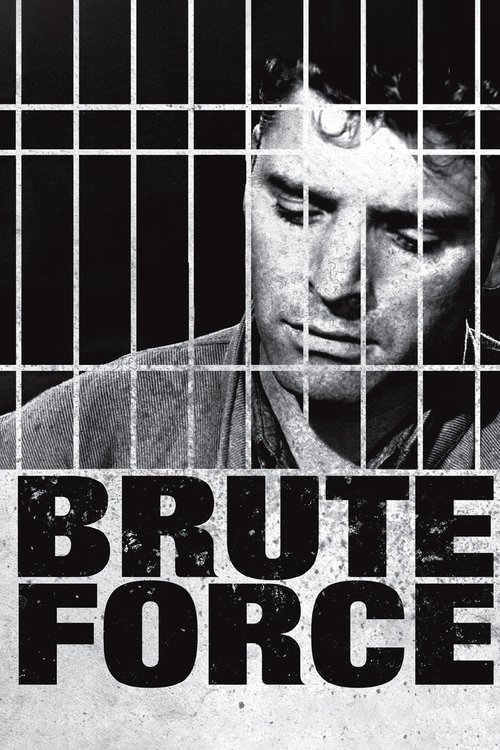
Brute Force
1947 · Jules Dassin
For a hard-boiled night when you want your crime drama black-and-white, angry, and pulling no punches — this is challenge, not comfort. Perfect if you're in the mood for a prison-break story with real moral weight behind the thrills.
What it's about
Inside the walls of Westgate Penitentiary, hardened convict Joe Collins and his cellmates live under Captain Munsey, a soft-spoken, sadistic head guard who runs the prison as his private kingdom. Collins's plan to break out of Cell R17 drives the story, as the pressure between the men in the cells and the man who torments them builds toward an explosion.
The experience
Grim, tightly wound, and startlingly brutal for its era — the film tightens like a fist over ninety-odd minutes. The violence still lands, and the mounting dread of the escape plan makes the last stretch genuinely gripping.
Performances
Burt Lancaster, in only his second film, is all coiled physical force as Collins, but Hume Cronyn steals it as Munsey — a fastidious, cultured sadist who never raises his voice, and is scarier for it.
The craft
Dassin stages the prison as a shadowed, claustrophobic machine, all bars, walls, and rain-slick yards in stark noir black-and-white. The film's set pieces of violence were shocking for a 1947 studio release and still carry a physical charge.
Why it matters
One of the defining postwar prison films, it hardened the template — the sadistic guard, the doomed break, the prison as a mirror of an unjust world — that the genre has drawn on ever since, and it marked Dassin as a major director of tough American crime pictures.
Snapshot
Brute Force is a prison drama and one of the harder, more schematic entries in the postwar American crime cycle later called film noir. Produced by Mark Hellinger for Universal-International and directed by Jules Dassin, it stakes out a claustrophobic world — the fictional Westgate Penitentiary — in which the drama is less about individual guilt than about the machinery of confinement and the men who administer it. Burt Lancaster, in only his second screen role, plays Joe Collins, a taciturn convict whose plan to break out of Cell R17 organizes the film's forward motion; Hume Cronyn plays Captain Munsey, the fastidious, cultured, sadistic chief guard who is the film's true subject and its most enduring creation. The picture is remembered for the ferocity of its violence — unusual for a major studio release of 1947 — and for the explicitness with which it frames prison brutality as a parable of authoritarian power. It marks an early, formative collaboration in the run of urban-realist crime films Hellinger was assembling before his death, and it helped launch both Lancaster's stardom and Dassin's reputation as a director of tense, socially charged melodrama before the blacklist drove him to Europe.
Industry & production
Brute Force was made under the aegis of Mark Hellinger, the former Broadway and newspaper columnist turned producer whose independent unit released through Universal-International. Hellinger had just come off The Killers (1946), the film that introduced Lancaster, and Brute Force continued a short, distinctive producing career — he would follow it with The Naked City (1948, also directed by Dassin) before his death in December 1947. The three films together form a coherent producer's cycle: hard-edged, semi-documentary in ambition, drawn to institutions and cities as characters. Hellinger's imprint — a taste for tough, journalistic subject matter and voiceover framing — is legible throughout Brute Force.
Universal-International in this period was consolidating a middle-budget, adult-oriented slate, and the prison picture was a proven programmer format going back to the early 1930s (The Big House, 20,000 Years in Sing Sing). Brute Force pushed the format toward greater brutality than the Production Code typically permitted; the film's violence, especially in its treatment of informers and its incendiary climax, tested contemporary limits, and the picture is often cited as an example of postwar loosening in what studio product could depict. Precise budget and box-office figures for the film are not something I can state reliably, and the surviving popular record on its exact returns is thin — I will not invent numbers.
The casting reflects the moment. Lancaster was a rising discovery rather than an established star; the supporting bench was deep with character actors — Charles Bickford, Sam Levene, Whit Bissell, Jeff Corey, John Hoyt — and the film served as the screen debut of Howard Duff. The women who appear in flashback (Yvonne De Carlo, Ann Blyth, Ella Raines, Anita Colby) were billed as a draw despite comparatively brief screen time.
Technology
Brute Force was shot on black-and-white 35mm using standard studio sound-era technology of the late 1940s: Academy ratio, incandescent lighting, sound-stage construction augmented by the resources of the Universal lot. There is no technological novelty to claim here — no new format, process, or camera innovation. What matters technically is the film's exploitation of mature tools toward a particular expressive end. Cinematographer William H. Daniels used fast panchromatic stock and low-key lighting setups to render the prison interiors in the deep shadow and hard contrast that define the noir look; the cellblock, machine shop, and the tunnel of the finale are built and lit environments rather than locations, and the film's power comes from the controlled artificiality of that studio space rather than from any documentary apparatus. (The location realism associated with the Hellinger unit would arrive more fully in The Naked City.)
Technique
Cinematography
The choice of William H. Daniels as cinematographer is one of the film's quietly telling decisions. Daniels was best known as Greta Garbo's favored cameraman at MGM, a specialist in glamour lighting — and here that command of the human face is turned toward the opposite of glamour: sweat, fear, and cruelty. He lights the cellblock in hard verticals and heavy overheads, using the bars themselves as a graphic motif that stripes faces and floors. The framing tends to compress the men into tight, crowded compositions, emphasizing the lack of air and privacy. In Munsey's office and the interrogation scenes, the lighting turns theatrically sculptural, isolating the captain against darkness. The climactic escape, staged in and around a drainage tunnel and the guard tower, is shot for maximum chaos and smoke, the image degrading into blur and flame as the uprising collapses.
Editing
Edited by Edward Curtiss, the film alternates two rhythms. The prison-present material builds through accumulation — small humiliations, tightening surveillance, the mechanics of the escape plan — toward a sustained, accelerating climax. Cut against this are the flashbacks, which interrupt the forward drive to explain how four of the men came to be inside, each attached to a woman on the outside. The editing thus toggles between confinement and memory, between the grinding present and a softer, romantic elsewhere; the contrast is deliberate and structural, and the return from each flashback to the cell lands as a small door closing.
Mise-en-scène / staging
The film's staging is built on the opposition between mass and individual. Convicts are repeatedly arranged as crowds — in the yard, the mess, the machine shop — while the guards, and Munsey above all, are staged as singular controlling figures. Munsey's private office, with its record player and its ordered surfaces, is a pocket of bourgeois refinement set against the squalor of the blocks; the mise-en-scène makes his cultivation itself menacing. The drainpipe work detail that becomes the escape route is established early as a physical fact of the space, so that the geography of the prison is legible before it becomes the stage for the finale.
Sound
Sound is central to the film's most notorious sequence, in which Munsey administers a beating while classical music plays — the juxtaposition of high culture and physical brutality is the point, aligning the character's aesthetic refinement with his cruelty. Elsewhere the soundscape is industrial: the clang of gates and cell doors, the din of the machine shop, the mechanical noises of a system. Voiceover and expository dialogue, particularly from the disillusioned prison doctor, carry the film's editorializing register.
Performance
Lancaster's Collins is a study in contained force — physically imposing, verbally economical, his stillness reading as barely governed rage. It confirmed the screen presence The Killers had introduced. But the film belongs to Hume Cronyn, cast against physical type: small, precise, soft-spoken, he makes Munsey terrifying precisely because his sadism is bureaucratic and self-controlled rather than brutish. It is one of the great villain performances of 1940s American cinema. Around them, Charles Bickford brings weary authority as the convict Gallagher, and Art Smith's cynical, alcoholic Dr. Walters functions as the film's chorus, voicing its bleak thesis that no one truly escapes.
Narrative & dramatic mode
The film operates in a naturalist-melodramatic mode with a strong thesis-driven overlay. Its spine is the classic escape narrative — a plan conceived, complicated by informers and by Munsey's manipulations, and executed in catastrophe — but the escape is less a suspense mechanism than a moral demonstration. The flashback structure, distributing backstory across several inmates, broadens the film from a single protagonist's story into an ensemble portrait, insisting that these are men with ordinary attachments rather than abstractions of criminality. The dramatic mode is fatalistic: the doctor's commentary frames events as foredoomed, and the ending withholds the catharsis of a successful break, choosing instead a bleak, near-tragic collapse in which brutality consumes both prisoners and their tormentor.
Genre & cycle
Brute Force sits at the intersection of two traditions: the Hollywood prison picture, a durable genre since the early sound era, and the emerging noir crime cycle of the postwar years. From the prison film it inherits the microcosm structure — the penitentiary as a closed society — and the recurring situations of the yard, the informer, the riot, the break. From noir it takes its visual grammar of low-key shadow, its moral pessimism, its voiceover fatalism, and its interest in men crushed by forces larger than themselves. Within Hellinger's short producing cycle it is the middle term between the fatalistic romanticism of The Killers and the location realism of The Naked City, sharing with both a tough, urban, socially observant sensibility.
Authorship & method
The film is a convergence of strong collaborators. Jules Dassin, then a contract director moving up from shorts and modest features, directs with a muscular attention to tension and to the physical fact of institutional violence; Brute Force is often treated as his breakthrough, the film in which his gift for pressurized, spatially precise suspense first fully emerges — a gift he would perfect in Night and the City (1950) and Rififi (1955) after HUAC and the blacklist forced him out of Hollywood. Richard Brooks wrote the screenplay (from a story credited to Robert Patterson); a novelist — author of The Brick Foxhole — before he became a major writer-director, Brooks brings a taste for social argument and blunt moral rhetoric that shapes the film's parable-like design. William H. Daniels supplies the photography, importing MGM polish into a grimmer key. Miklós Rózsa, the pre-eminent noir composer of the era, provides the score, his idiom of anxiety and menace reinforcing the film's dread. Mark Hellinger as producer gives the project its journalistic toughness and its framing sensibility. The result is genuinely collaborative authorship, with Dassin's staging, Brooks's thesis, Daniels's image, and Rózsa's score pulling in a common direction.
Movement / national cinema
As American studio product, Brute Force is not part of a formal movement, but it belongs to two overlapping tendencies in late-1940s Hollywood: the postwar social-problem film, which turned toward institutions and injustice with new frankness, and the noir style, itself inflected by the European émigré sensibilities then abundant in Hollywood. Rózsa's Central European musical training and the German-expressionist lineage of noir lighting both feed the film's mood. The picture also reads, in retrospect, as a document of its political moment — made on the eve of the anti-Communist investigations that would scatter its director and much of its creative milieu. Dassin's subsequent career abroad makes Brute Force a hinge between American studio filmmaking and the transatlantic exile that reshaped several noir talents.
Era / period
The film is thoroughly a work of 1947, the pivot year of the American postwar. Its brutality speaks to a national mood darkened by the war's violence and by anxieties about authority and mass power; the frequent contemporary and later readings of Munsey as a fascist or Gestapo-like figure make sense only against the fresh memory of European totalitarianism. It arrives at the height of the classic noir period and just as the studio system's confidence was about to be shaken by the Paramount antitrust decree, the arrival of television, and the political purges. In every sense it is a film of the immediate postwar interval — technically mature, morally disillusioned, politically charged.
Themes
The film's governing theme is institutional power and its abuse. The prison is explicitly figured as a system, and Munsey embodies the seduction and cruelty of authority — the sadist who justifies domination as order, whose refinement makes his violence more chilling rather than less. Related to this is the theme of dehumanization and the struggle to remain a man within a machine designed to grind men down; the flashbacks, by tying each convict to love and ordinary longing, argue for the humanity the system denies. Fatalism and the impossibility of escape run beneath everything, crystallized in the doctor's insistence that no one gets out. The film is also a meditation on masculinity under pressure — solidarity, informing, courage, and rage among caged men — and, in its most pointed register, an allegory about fascism and the danger of concentrated, unaccountable power.
Reception, canon & influence
Brute Force was received on release as a tough, well-made, notably violent prison drama, with particular attention paid to its brutality and to the performances of Lancaster and Cronyn; the frankness of its violence was itself part of the conversation around the film. Detailed contemporary numbers and the full spread of individual reviews are beyond what I can reconstruct reliably here, and I won't invent them — but the film's standing has grown rather than faded, and it is now firmly established in the noir canon and routinely cited among the strongest American prison films.
Looking backward, the film draws on the Hollywood prison-picture tradition running from The Big House (1930) onward, on the expressionist visual inheritance of noir, and on the postwar appetite for social realism and institutional critique; the coding of Munsey against the recent European experience of tyranny is the most historically specific of these debts. Looking forward, its influence runs along several lines. It advanced Lancaster's rise to major stardom and confirmed Dassin as a director of note, feeding directly into his later European masterworks. Its vision of the prison as a totalitarian microcosm, and of the guard as a figure of refined sadism, became a template for later prison and institutional dramas that treat confinement as social allegory. And within Hellinger's brief, influential producing run, it helped consolidate the tough, urban, semi-documentary American crime film that shaped the genre into the 1950s. If the picture's schematic, thesis-driven design has drawn some later critical reservation, its ferocity, its central performances, and its fusion of noir style with political parable have kept it durable and widely studied.
A Deleuzian reading
Munsey puts a record on before he goes to work.
The full Deleuzian reading of Brute Force →
Reception
In 1947 it startled critics with a brutality rare for a studio picture — reviewers treated it as shockingly violent pulp. Now it's Criterion-canonised prison noir, read as an early flash of the anger Dassin would carry into Night and the City and, post-blacklist, Rififi.
How Brute Force was received, from release to now →
How to watch Brute Force: what to notice on a first viewing
- Watch cell bars stripe shadows across faces and floors. Daniels lights the cellblock in hard verticals and heavy overheads, letting the bars themselves fall as shadow directly onto skin and concrete throughout the film. The prison's pattern gets stamped onto the men's bodies before anything happens to them.
- Watch convicts move as one crowd, guards as individuals. Inmates are staged in the yard, mess hall, and machine shop as a single mass, while Munsey and the other guards are shot as separate, controlling figures with their own space. Just being filmed as an individual face reads as a kind of privilege in this world.
- Listen for classical music playing during a beating. Munsey puts a record on before he disciplines a prisoner, so refined music plays directly over the sound of violence rather than being interrupted by it. The music makes his cruelty feel scheduled and cultivated instead of impulsive.
- Watch the record player in Munsey's tidy private office. His office is ordered and comfortable, a pocket of refinement set against the crowded, squalid blocks the prisoners actually live in. The contrast in setting makes his cultivation itself feel like part of the menace.
- Watch how quietly Munsey speaks while giving orders. Cronyn plays the captain small, precise, and soft spoken, never raising his voice, which is cast deliberately against Lancaster's physically imposing, barely governed stillness as Collins. The quietest man in the prison is somehow also the most frightening one.
The whole guide to watching Brute Force, with the keys for a rewatch →
Influences: the films it descends from and the films it influenced
- The Big House (1930) — Codified the sound-era prison-picture grammar Brute Force inherits — the cellblock ensemble, the yard as a mapped social geography, and the recurring cut between the anonymous mass of prisoners and the individual face — which Dassin restages as his mass-versus-individual staging.
- I Am a Fugitive from a Chain Gang (1932) — Model for the thesis-driven social-problem film that indicts the penal institution itself rather than the criminal, giving Brooks the parable structure in which confinement is argued as systemic injustice.
- 20,000 Years in Sing Sing (1932) — Warner prison melodrama that fixed the fatalist-melodrama arc — the doomed inmate whose personal decency is crushed by institutional machinery — which Brute Force's flashback structure recycles to seal each convict's fate.
- M (1931) — Source of the expressionist low-key idiom and the trope of the criminal world as a totalitarian society-in-miniature; Munsey's regime is Lang's shadow-carved, self-policing underworld reimagined as a fascist microcosm.
- You Only Live Once (1937) — Lang's American fatalism — the trapped protagonist whose every exit is a closing gate — supplies the deterministic doom-machine logic that governs Brute Force's escape plot.
- The Killers (1946) — Direct progenitor from the same production line: Hellinger's producing, Rózsa's anxiety-score idiom, Lancaster's star-making debut, and the flashback-that-explains-the-doom construction all carry straight into Brute Force a year later.
- The Naked City (1948) — Dassin and Hellinger's immediate follow-up extends the same tough, journalistic, semi-documentary crime aesthetic — shooting the institution/city as a verifiable physical fact rather than a studio abstraction.
- Night and the City (1950) — Perfects the pressurized, spatially precise suspense Brute Force first exposed — Dassin's method of trapping a doomed man inside legible physical space and tightening it around him.
- Rififi (1955) — The drainpipe-escape set-piece's procedural, near-wordless choreography of men executing a plan in cramped space matures into Rififi's celebrated heist sequence — Dassin's signature spatial-mechanics suspense.
- Riot in Cell Block 11 (1954) — Takes over Brute Force's reading of the prison as a political microcosm and its documentary toughness, staging institutional revolt as social allegory with location-shot realism.
- Birdman of Alcatraz (1962) — Reunites Lancaster with the prison-as-confinement study and deepens the low-key, cell-bound portraiture of a man defined against his cage that Brute Force made his breakout.
- The Hill (1965) — Directly extends the guard-as-refined-sadist figure Cronyn originated — the coolly rational authority who tortures within the rules — inside a military prison staged as a fascist totalitarian microcosm.
- Cool Hand Luke (1967) — Inherits the sadistic-institution template: the composed, sunglassed authority whose cruelty is bureaucratic ritual, opposite the martyr-inmate whose defiance the system must break.
- One Flew Over the Cuckoo's Nest (1975) — Transposes Munsey to Nurse Ratched — confinement as totalitarian microcosm ruled by a soft-spoken, procedurally 'reasonable' sadist — carrying Brute Force's institution-as-fascism allegory into the asylum.
- A Clockwork Orange (1971) — Elevates Brute Force's music-brutality juxtaposition — Munsey beating a prisoner to Wagner on the phonograph — into a governing formal device, scoring atrocity to beloved music for maximum ironic dissonance.
- The Shawshank Redemption (1994) — Restates the prison-as-society-in-miniature with a sanctimonious, Bible-quoting warden as the refined-sadist heir to Munsey, and inmate solidarity crushed by institutional power.
- Carandiru (2003) — The prison-as-society architecture that introduces inmates through individual flashback backstories before erupting into a guard-led massacre — precisely Carandiru's dramatic shape.
- Midnight Express (1978) — Establishes the sadistic-guard prison melodrama whose monstrous overseer is the direct template for Hamidou, with institutional cruelty staged as physical torture set-pieces.
- Reservoir Dogs (1992) — Extends the same craft of scoring sadism to incongruously pleasant music — the ear-severing set to 'Stuck in the Middle with You' descends from Munsey's phonograph-accompanied torture.
- Caged (1950) — The definitive male noir prison film, whose oppressive low-angle institutional framing and sadistic authority figure (Cronyn's Capt. Munsey) are exactly rhymed by Caged's Emerson matron and Guthrie's angles.
Similar films
- The Hill (1965) — influence & lineage
- Rififi (1955) — influence & lineage
- I Am a Fugitive from a Chain Gang (1932) — influence & lineage
- The Dirty Dozen (1967) — shared sensibility
- A Man Escaped (1956) — shared sensibility
- White Heat (1949) — shared sensibility
- Out of the Past (1947) — shared sensibility
- Le Trou (1960) — shared sensibility