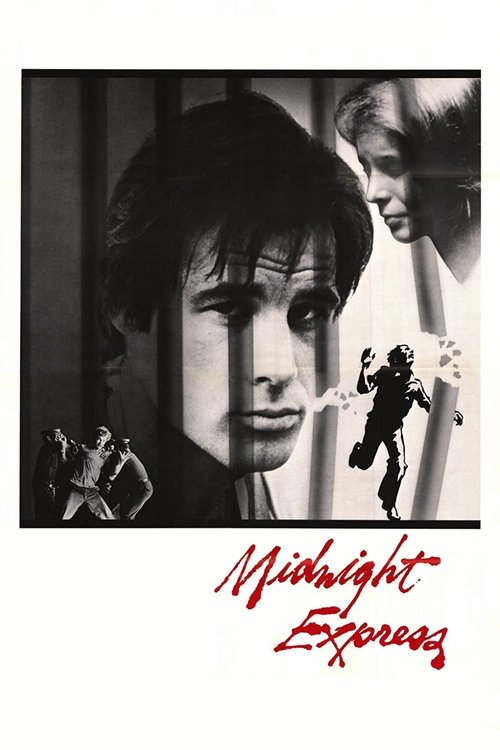
Midnight Express
1978 · Alan Parker
For when you want to be put through the wringer — a white-knuckle true-story ordeal, not an escape-caper romp. Choose it when you're up for intensity; skip it when you need comfort.
What it's about
A young American, Billy Hayes, is caught at the Istanbul airport trying to smuggle hashish out of Turkey. Expecting a fine or a short sentence, he instead becomes a political example: the courts hand down decades, and he disappears into a brutal foreign prison system. With appeals failing and his family powerless, his hopes narrow to one thing — the 'Midnight Express,' prison slang for escape. Based on Hayes's own memoir.
The experience
Relentless and harrowing — a slow-motion nightmare of powerlessness that keeps turning the screws, driven by a pulsing electronic score that gets under your skin. It's a punishing watch by design, with moments of tenderness that make the brutality hit harder.
Performances
Brad Davis is raw and committed as Hayes, charting a young man's disintegration with frightening conviction, and John Hurt is quietly heartbreaking as a wrecked fellow inmate.
The craft
Alan Parker directs with visceral, sweat-and-shadow intensity from a ferocious early Oliver Stone script, and Giorgio Moroder's synthesizer score — an Oscar winner — was revolutionary, proving electronic music could carry a dramatic film. Loud, oppressive, and unforgettable through good speakers.
Why it matters
A defining hard-R shocker of the late 1970s that won two Academy Awards, launched Oliver Stone's screenwriting career, changed film scoring with its electronic soundtrack — and remains controversial for its inflammatory portrayal of Turks.
Snapshot
Midnight Express is a prison drama adapted from Billy Hayes's 1977 memoir of his arrest in Istanbul for hashish smuggling and his subsequent years inside the Turkish penal system. Directed by Alan Parker in only his second feature, scripted by a then-unknown Oliver Stone, scored by Giorgio Moroder, and produced by David Puttnam and Alan Marshall, the film converted a real ordeal into a propulsive, viscerally stylized account of institutional cruelty and a young American's descent into desperation and near-madness. It became one of the defining hard-R exposés of the late 1970s — a commercial success that won two Academy Awards and lodged itself in popular memory, while also drawing sustained and well-founded criticism for its inflammatory portrayal of Turks. Its dual legacy — as a landmark of synthesizer film scoring and a launchpad for major careers, and as a cautionary case study in xenophobic representation — makes it one of the more contested major films of its era.
Industry & production
The picture sits at the intersection of New Hollywood's appetite for tough, true-story material and the emergence of a transatlantic production model built around British creative talent and American studio money. It was financed and released by Columbia Pictures and produced by David Puttnam and Alan Marshall, with Peter Guber attached as an executive producer in the film's development. Puttnam, then building the producing career that would later carry him to Chariots of Fire and a brief tenure running Columbia, was central to assembling the largely British technical crew around an American subject.
Production took place not in Turkey — for obvious reasons given the script — but largely in Malta, whose Fort St. Elmo and surrounding architecture stood in for Istanbul and the Sağmalcılar prison. This relocation, common for politically sensitive subjects, shaped the film's claustrophobic, sun-bleached-turned-shadowed visual world. The budget was modest by studio standards, and the film returned a substantial profit; precise box-office figures vary across sources and should be treated with caution, but its commercial success relative to cost is well established and helped cement the reputations of everyone involved.
The project carried real-world stakes beyond the screen. Billy Hayes, the subject, had escaped Turkish custody in 1975 and published his memoir (co-written with William Hoffer) in 1977; he was a living, public figure whose story the film both dramatized and significantly altered. The production's choices — particularly Stone's compression and intensification of events — would later become the focus of the film's enduring controversy.
Technology
Midnight Express is a conventional 35mm color production of its era, shot anamorphically for a widescreen frame, and its technological significance lies less in the camera than in its score. Giorgio Moroder's music was built on synthesizers and sequencers — the pulsing, electronically generated rhythms that Moroder had pioneered in disco and dance production (notably with Donna Summer). The film is among the earliest major Hollywood dramas to lean its entire emotional architecture on a synthesizer-based score rather than an orchestra, and it demonstrated that electronic instrumentation could carry tension, dread, and momentum across a feature. This technological choice proved enormously consequential for 1980s film scoring.
Technique
Cinematography
Michael Seresin's photography tracks Billy's psychological deterioration through a calculated shift in register. The early Istanbul sequences — and especially the airport — are bright, hot, and exposed, the harsh Mediterranean light underscoring Billy's vulnerability and visibility. As the film moves inside the prison, the palette darkens and grows more expressionistic: pools of shadow, sickly institutional tones, and increasingly subjective framing. Seresin and Parker deploy push-ins, slow motion, and distorting effects at key moments of panic and breakdown, most memorably in sequences where Billy's grip on reality slips and the image itself becomes unstable. The camera's progression from documentary-like clarity to fevered subjectivity is the film's primary visual argument.
Editing
Gerry Hambling, Parker's regular and long-standing editorial collaborator, cut the film, and his work earned an Academy Award nomination. The editing is decisive in two registers. First, the famous opening — Billy taping bricks of hashish to his body and moving through airport security — is built as a sustained suspense set-piece, its cutting locked to Moroder's heartbeat-like pulse so that rhythm and montage become indistinguishable. Second, Hambling uses hard title cards marking the passage of dates and years to structure the long middle of the film, compressing Billy's sentence into a series of escalating episodes while conveying the grinding accumulation of time.
Mise-en-scène / staging
The prison is staged as a descending series of circles, culminating in the lower ward for the "insane," and the production design renders it as a place of physical and moral rot. Parker, true to his background, fills the frame with grimed surfaces, crowded bodies, and oppressive architecture. Staging frequently isolates Billy within the group — singled out, surrounded, or cornered — and the recurring motif of the prison's circular walkway, around which inmates trudge, becomes a literalized image of futility and entrapment that the film returns to at its breaking point.
Sound
Beyond Moroder's score, the film's sound design emphasizes the percussive and the bodily: keys, doors, beatings, the acoustic hardness of stone interiors. The interplay between diegetic prison sound and the non-diegetic synthesizer pulse is central to the film's effect, with the electronic score often entering to externalize Billy's interior state — fear, craving, dissociation — rather than to comment from outside.
Performance
Brad Davis, in his breakthrough lead role, anchors the film as Billy, charting a trajectory from cocky naivety through terror to a hollowed-out, feral survival instinct; it remains the performance for which he is best remembered. John Hurt, as the wasted, opium-addled English prisoner Max, gives the film its most lauded turn and earned an Academy Award nomination for Best Supporting Actor — a study in ruined gentleness and decay. Randy Quaid plays the volatile American Jimmy, Norbert Weisser the Swedish prisoner Erich, and Paul L. Smith the brutal head guard Hamidou, a figure of looming physical menace. The performances collectively pitch the film toward heightened intensity rather than naturalistic restraint.
Narrative & dramatic mode
The film operates in the mode of the escalating ordeal: a survival narrative in which the protagonist's situation worsens by degrees with each apparent chance of relief withdrawn. Its dramatic engine is the cruel deferral of release — the legal appeals by Billy's lawyer, family, and the American government that repeatedly raise and dash hope, set against the prison-slang alternative of escape, the "midnight express." The structure is roughly chronological but elliptical, leaping across the years of Billy's imprisonment via title cards. A key set-piece is the courtroom scene in which Billy, his sentence catastrophically extended, delivers a furious denunciation of the court and the nation that holds him. The film resolves not through the lawful appeal it has dangled throughout but through a violent, almost accidental escape, and it closes — as such true-story films conventionally do — with freeze-frame and on-screen text reporting the real Hayes's flight to freedom.
Genre & cycle
Midnight Express belongs to the prison film, a durable genre it inflects with the specific anxieties of the foreign jail — the American (or Western) traveler swallowed by an alien, lawless penal system. It is also part of the late-1970s cycle of based-on-a-true-story exposés that traded on authenticity and shock. Within the prison-film tradition it sits alongside the institutional-cruelty strain, but its emphasis on cultural displacement — the horror amplified by foreignness, incomprehension, and the absence of recourse — distinguishes it and effectively founded a small "imprisoned abroad" subgenre that later films and television would mine.
Authorship & method
Alan Parker (director) came, like a cohort of his British contemporaries, out of the advertising industry, and Midnight Express — following his debut, the children's gangster musical Bugsy Malone (1976) — announced the abrasive, emotionally maximalist, socially charged sensibility that would mark his career through Mississippi Burning and beyond. Parker's method fused a documentary-derived attention to grimy texture with an unapologetic willingness to manipulate the audience's nerves and sympathies.
Oliver Stone (screenwriter) won the Academy Award for Best Adapted Screenplay, his first Oscar and the breakthrough that established him in Hollywood. The script already bears the hallmarks of his later authorship: the individual raging against a monstrous system, righteous fury, paranoia, and a readiness to heighten and reshape real events for dramatic and ideological force. Stone's compressions and inventions are also the source of the film's gravest criticisms.
Giorgio Moroder (composer) delivered a synthesizer score that won the Academy Award for Best Original Score and became one of the film's most influential elements (see Technology and Influence).
Michael Seresin (cinematographer) and Gerry Hambling (editor) were both core members of Parker's recurring creative team, and their work here — Hambling's earning an Oscar nomination — is inseparable from the director's signature. Producer David Puttnam shaped the project's transatlantic assembly. The film is best understood as the product of a tightly knit British craft unit applied to American material under studio financing.
Movement / national cinema
The film is a revealing artifact of a specific moment in British cinema: the rise of the so-called "ad-men" generation — Parker, Ridley Scott, Adrian Lyne, Hugh Hudson — who moved from commercials into features and brought a glossy, kinetic, image-forward sensibility to international filmmaking. Midnight Express is in this sense a British-made, American-financed, internationally shot film with no single national home, emblematic of how late-1970s production increasingly crossed borders. Its creative DNA is British; its subject, star, and money are American; its locations Maltese standing in for Turkish. That dislocation is part of what enabled — and arguably licensed — its troubling outsider's view of the country it depicts.
Era / period
Arriving in 1978, the film belongs to the tail of the New Hollywood and to a cultural moment marked by post-Vietnam distrust of institutions and authority, an appetite for unvarnished and confrontational cinema, and the loosening of restraint under the ratings system that permitted its frank violence, drug content, and sexuality. It also stands at the threshold of the 1980s, anticipating that decade's high-gloss, music-driven aesthetic — nowhere more than in Moroder's score, which sounds forward into the era it helped inaugurate.
Themes
The film's central theme is the dehumanizing power of the carceral institution and the individual's struggle to retain selfhood within it. Layered onto this is a pointed treatment of American innocence and entitlement abroad — Billy as a naïf who assumes the protections of home will follow him, only to discover their irrelevance — and the terror of being subject to a legal order one cannot comprehend or appeal to. Madness and dissociation form a recurring motif, as the lower ward and Billy's own unraveling stage the loss of reason under prolonged cruelty. The film also gestures, more cautiously than its source reportedly warranted, at desire and intimacy between male prisoners: a scene of tenderness between Billy and Erich that the film stages and then withdraws from, a choice some critics read as Stone's softening of the real Hayes's account and emblematic of the period's discomfort with same-sex intimacy. Underlying everything is the theme that became the film's gravest liability: the framing of an entire foreign people as the embodiment of barbarity.
Reception, canon & influence
Critical reception on release was strong but divided, and that division has only sharpened with time. The film was a commercial and awards success: nominated for six Academy Awards — including Best Picture, Director (Parker), and Supporting Actor (Hurt) — it won two, for Stone's screenplay and Moroder's score, and took multiple Golden Globes. Many reviewers praised its intensity, craft, and performances. Others recoiled. Pauline Kael was among the prominent critics who attacked the film, and the charge that recurred then and dominates assessment now is that Midnight Express is xenophobic — that it renders Turks almost uniformly as brutal, corrupt, and subhuman, with no countervailing humanity. This is not merely a retrospective verdict: both Oliver Stone and Billy Hayes himself have publicly expressed regret over the film's depiction of Turkish people, Hayes in particular distancing himself from how his story was dramatized and acknowledging the harm done to Turkey's image. The episode is a standard case study in how dramatic license can curdle into ethnic caricature, and any account of the film's canonical standing must hold its craft and its prejudice in the same frame.
Influences on the film are best located in the prison-film tradition and in the wave of 1970s true-crime and exposé cinema that prized authenticity and shock, refracted through the commercials-bred visual sensibility of its British makers and the institutional-paranoia mood of post-Vietnam American culture.
Its influence forward is substantial and runs along several lines. Moroder's synthesizer score was the most consequential: it helped legitimize electronic scoring in mainstream cinema and opened the path Moroder himself would walk through the early 1980s (Cat People, Scarface, Flashdance, Top Gun), and that the broader industry would follow toward the synth-driven sound of the decade. The film launched Oliver Stone as a screenwriter of note and consolidated Alan Parker's standing, while giving Brad Davis his signature role and John Hurt one of his most acclaimed. It effectively established the "imprisoned abroad" template that later films and long-running documentary television would draw on. And, more uncomfortably, it became a lasting reference point in debates over national image and cinematic stereotyping — its reputation in Turkey, and among critics of orientalist representation, as durable as its reputation as a piece of bravura, button-pushing filmmaking. The honest summary is that Midnight Express is remembered both for what it did well and for the damage it did, and that the two are inseparable.
A Deleuzian reading
Start with the sweat.
The full Deleuzian reading of Midnight Express →
Reception
A massive hit in 1978 — six Oscar nominations, two wins, and one of the year's most talked-about films — but its lurid demonization of Turks aged badly fast; it's now the textbook case of the acclaimed film that became a national-stereotype scandal, with both screenwriter Oliver Stone and the real Billy Hayes later apologizing to Turkey.
How Midnight Express was received, from release to now →
Influences: the films it descends from and the films it influenced
- I Am a Fugitive from a Chain Gang (1932) — Founds the true-crime prison-exposé mode Midnight Express works in — a wronged innocent indicting a brutal penal system through escalating punishment, ending on a despairing fade rather than redemption.
- Brute Force (1947) — Establishes the sadistic-guard prison melodrama whose monstrous overseer is the direct template for Hamidou, with institutional cruelty staged as physical torture set-pieces.
- Cool Hand Luke (1967) — Supplies the escalating-ordeal architecture: a charismatic prisoner systematically broken by repeated, ritualized punishment, the structural spine Stone's script reproduces beat for beat.
- Midnight Cowboy (1969) — Model of a British director importing gritty subjective deterioration to harsh material, using intercut fantasy/memory fragments to render a protagonist's psychological collapse.
- The French Connection (1971) — Documentary-derived grimy texture and handheld true-crime authenticity that Parker and cinematographer Seresin emulate to lend the carceral squalor verité credibility.
- A Clockwork Orange (1971) — Wendy Carlos's Moog score legitimized electronic music for prestige cinema — the precedent that makes Moroder's all-synth approach thinkable — paired with subjective institutional dehumanization.
- Papillon (1973) — The imprisoned-abroad escape narrative whose solitary-confinement sequences pioneer the sensory-deprivation subjective-deterioration imagery Midnight Express pushes further in Hayes's breakdown.
- American Gigolo (1980) — Moroder carries the Midnight Express synth idiom into a glossy contemporary thriller, consolidating the pulsing electronic sound as a marketable signature.
- Cat People (1982) — Another Moroder synthesizer score extending the textural, mood-driven electronic palette his Oscar-winning Midnight Express work opened up.
- Pink Floyd – The Wall (1982) — Parker, with editor Gerry Hambling, escalates the subjective-deterioration and intercut-fantasy techniques of Midnight Express into a near-wordless visualization of psychic confinement.
- Scarface (1983) — Direct personnel lineage: an Oliver Stone screenplay scored by Giorgio Moroder, fusing Stone's individual-vs-monstrous-system rage with the synth idiom both honed on Midnight Express.
- Flashdance (1983) — British ad-man Lyne plus Moroder's synth-pop scoring mark the commercial apex of the electronic-score 1980s sound Midnight Express helped launch.
- Top Gun (1986) — Moroder's synth-driven scoring and a British-commercials visual gloss fully mainstream the electronic-score template traceable to Midnight Express.
- Platoon (1986) — Stone matures the Midnight Express authorial signature — an individual raging against a dehumanizing system, real events heightened for ideological force — into his own direction.
- Mississippi Burning (1988) — Parker reprises the emotionally maximalist, nerve-manipulating, socially-charged method — and the same charge of flattening an ethnic group into villainy — that defined Midnight Express.
- Brokedown Palace (1999) — Applies the imprisoned-abroad template directly: naive American jailed in a harshly othered Asian penal system, the genre slot Midnight Express effectively established.
- Return to Paradise (1998) — Extends the same Westerner-jailed-abroad ordeal structure, trading on the dread of foreign incarceration that Midnight Express codified for a generation.
- In the Name of the Father (1993) — Shares cinematographer Peter Biziou and editor Gerry Hambling, whose brutal prison-interior lighting and compressive cutting rhythms Sheridan directly reuses for his incarceration and interrogation sequences.
- Sorcerer (1977) — Contemporary pairing of a Tangerine Dream electronic score with a sweat-soaked foreign-set ordeal — parallel proof that synth scoring could underscore Third-World peril and dread.
- Angel Heart (1987) — Parker and editor Gerry Hambling's earlier collaboration establishing the sweat-soaked, percussive, hallucinatory style of physical and psychological degradation that Angel Heart turns toward the occult.
Similar films
- The French Connection (1971) — influence & lineage
- Pink Floyd: The Wall (1982) — influence & lineage
- Mississippi Burning (1988) — influence & lineage
- Sorcerer (1977) — influence & lineage
- The Doors (1991) — shared sensibility
- The Thin Blue Line (1988) — shared sensibility
- Performance (1970) — shared sensibility
- Good Time (2017) — shared sensibility