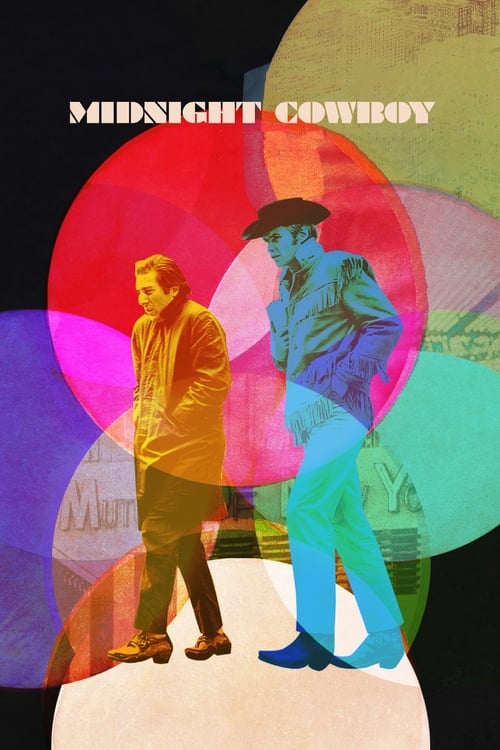
Midnight Cowboy
1969 · John Schlesinger
For when you want a story about friendship at the bottom of the ladder — something raw and human that earns its emotion. It's a challenge more than a comfort, but the kind that stays with you.
What it's about
Joe Buck, a Texas dishwasher with a cowboy outfit and total confidence in his own charm, rides a bus to Manhattan planning to make a living as a companion to rich women. The city eats him alive almost immediately, and the only person who takes him in is Ratso Rizzo, a sickly small-time con man with a limp and a dream of starting over in Florida. What starts as one hustler scamming another turns into an unlikely, stubborn friendship as the two scrape through a New York winter with almost nothing.
The experience
Grimy, funny, and quietly devastating — it swings between street-level comedy and real loneliness, with jagged flashbacks and daydreams cutting through the realism. You end up caring about these two far more than you expected to, and the film never lets you off with easy sentiment.
Performances
Jon Voight plays Joe's naivety without ever mocking it, and Dustin Hoffman disappears into Ratso — wheezing, scheming, oddly dignified — in one of the most imitated performances in American movies. The two together are the whole film.
The craft
Shot on real New York streets, it mixes documentary grit with bold, fragmented editing — memories and fantasies flicker in mid-scene, so you piece together Joe's past as you go. Harry Nilsson's 'Everybody's Talkin'' threads through it, and the whole thing has a scuffed, lived-in texture that studio films of the time rarely allowed.
Why it matters
The only X-rated film ever to win Best Picture, it helped kick open the door for the New Hollywood of the 1970s — proof that a mainstream American movie could be this frank about sex, poverty, and failure.
Snapshot
Midnight Cowboy is the rare film that arrived as both a commercial event and a cultural rupture: a studio release (United Artists) about a Texas dishwasher who reinvents himself as a Manhattan stud-for-hire, only to find that the city's appetites have no use for his fantasy. Adapted by the formerly blacklisted Waldo Salt from James Leo Herlihy's 1965 novel and directed by the British outsider John Schlesinger, it fused the location grit of documentary with the fractured, associative montage of European art cinema. It remains best known by a fact of certification — the only film released with an X rating to win the Academy Award for Best Picture — but its lasting claim is the relationship at its center: the slow, unsentimental tenderness that grows between the gullible hustler Joe Buck (Jon Voight) and the consumptive small-time swindler Enrico "Ratso" Rizzo (Dustin Hoffman). It is at once a New York street film, a portrait of failed masculinity, and one of the foundational texts of New Hollywood.
Industry & production
The film sits at a hinge moment for the American industry. The old Production Code had collapsed, and in November 1968 the MPAA introduced its new ratings system (G/M/R/X). Midnight Cowboy was among the first major-studio productions to test how far an "adult" picture could go and still reach a mass audience. United Artists released it carrying a self-applied X — a rating then still available to mainstream films, before it became synonymous with pornography. Reports of the period attribute the rating largely to the film's sexual content and what the MPAA described as its homosexual frame of reference; UA chose to release it as-is rather than cut. After its awards success and box-office strength, the film was re-rated R, with no changes to the print, an episode often cited as evidence of how arbitrary and shifting the new standards were.
The production was mounted by producer Jerome Hellman with Schlesinger, fresh off the British successes Darling (1965) and Far from the Madding Crowd (1967). Casting was central to the gamble. Hoffman, riding the success of The Graduate (1967), deliberately cast against his clean image to play the grimy, limping Ratso. Voight was a relative unknown, and the role of Joe Buck launched him. The supporting cast drew on New York theater and the downtown demimonde — Sylvia Miles, Brenda Vaccaro, John McGiver, Barnard Hughes — and the Factory party sequence enlisted figures from Andy Warhol's circle, lending the film documentary contact with the very counterculture it depicted.
Technology
Midnight Cowboy is a 35mm color film, but its significance is less in novel apparatus than in how conventional tools were turned toward a rougher, more mobile aesthetic. Shooting extensively on real New York streets — Times Square, Eighth Avenue, the condemned tenement where Ratso squats — the production embraced the lighter, more portable equipment and faster film stocks that by the late 1960s made unobtrusive location work practical. This is the technological substrate of New Hollywood: cameras and crews small enough to steal shots in working city blocks, capturing crowds and weather and signage that no soundstage could counterfeit. The film alternates this handheld immediacy with controlled studio-style setups for fantasy and memory, and the contrast between the two registers is itself part of its method.
Technique
Cinematography
The photography is by Adam Holender, for whom this was a defining American feature debut; a graduate of the Łódź Film School, he came to the project on the recommendation of his friend Roman Polanski. Holender's New York is harshly observed — overexposed daylight on Joe's absurd cowboy outfit, the bleached glare of a coffee-shop window, the cold blue of the squat. He shoots Times Square with an almost ethnographic eye, letting the real crowd press in around the actors. The famous moment in which Ratso pounds the hood of a taxi and snarls "I'm walkin' here!" — widely reported as improvised by Hoffman when a real cab nearly intruded on the take — survives precisely because the camera was working in live, uncontrolled space. Against this, Holender renders Joe's Texas flashbacks and erotic fantasies in a different palette and texture, so that the image itself tells us when we have left the present.
Editing
The editing, by Hugh A. Robertson, is arguably the film's most radical formal achievement, and it earned him an Academy Award nomination — a notable distinction as one of the first African American craftspeople recognized in the category. Robertson and Schlesinger built a structure of associative cutting in which the present is continually interrupted by splinters of memory, anticipation, and fantasy: fragments of Joe's traumatic Texas past, his grandmother, a violent sexual episode, advertising imagery, all flickering in and out before they resolve into legible scenes. The Warhol-Factory party is assembled as a barrage of disorienting jump cuts and superimpositions. This subjective montage, indebted to European models, gives the film a stream-of-consciousness interiority unusual for an American release of its scale.
Mise-en-scène / staging
The film's spaces are organized as a descent. Joe arrives in a Manhattan of gleaming surfaces and quickly slides into its underside — bus terminals, all-night cinemas, derelict buildings. The condemned tenement that Ratso calls home, with its broken plumbing and improvised heat, becomes the emotional center of the movie, a squalid domestic space the two men make their own. Costume is staging here: Joe's rhinestone-cowboy regalia, which reads as virile back home, marks him in New York as a rube and, to those he solicits, as something the city has seen before. The recurring imagery of Florida — sunlit, in advertising-bright color — functions as the staged counter-world to the gray, vertical city, the destination of Ratso's "quixotic fantasy" of escape.
Sound
The soundtrack is one of the most influential in American cinema. The score was supervised and composed by John Barry; its signature element is the plaintive harmonica theme played by the Belgian musician Toots Thielemans, a melody that has become shorthand for urban loneliness. Over the opening — Joe heading east on the bus, the abandoned drive-in screen behind him — plays Harry Nilsson's recording of "Everybody's Talkin'," written by Fred Neil, whose lyric of fleeing toward sun and sea becomes the film's wistful through-line. (It is commonly reported that Bob Dylan submitted "Lay Lady Lay" for the film but did not deliver it in time; this anecdote circulates widely and should be treated as such.) The naturalistic location sound — traffic, crowds, transistor radios — grounds the fantasy passages by contrast.
Performance
The two central performances are the film's engine. Voight plays Joe Buck as a man whose swagger is a costume stretched thin over damage and need; the role demands he be both ridiculous and wholly sympathetic, a naïf whose dream is curdling in real time. Hoffman's Ratso is a feat of physical transformation — the limp, the cough, the greasy hair, the wheedling Bronx cadence — that nonetheless refuses caricature, building toward a fragility that makes the film's final stretch devastating. Both were nominated for the Academy Award for Best Actor. The supporting turns are sharply etched in little screen time: Sylvia Miles, nominated for Best Supporting Actress for a single scene as a Park Avenue client, and Brenda Vaccaro as Shirley, the partygoer whose night with Joe briefly suggests a different life.
Narrative & dramatic mode
The narrative mode is character study rather than plot mechanism. The premise — country boy comes to the city to sell himself — is a picaresque setup, but Salt's screenplay refuses the arc of triumph it seems to promise. Joe's scheme fails almost immediately and keeps failing; the "story" is the erosion of his illusions and the unlikely partnership that fills the vacuum. The film withholds conventional exposition, doling out Joe's backstory only in the elliptical flashbacks, so that the audience assembles his trauma piecemeal. The dramatic engine is the deepening of the two men's mutual dependence, and the destination is not success but a final journey south whose tenderness is shadowed by loss. The mode is tragic and ironic at once, its ending one of the most quietly heartbreaking in American film.
Genre & cycle
Midnight Cowboy belongs to several cycles simultaneously. It is a "buddy film" — perhaps the foundational entry in the cycle of intimate male-pairing dramas that would define the early 1970s — but one that drains the form of macho fantasy. It is a New York street film in a lineage of urban-realist American cinema. And it draws ironically on the iconography of the Western: Joe's cowboy persona is a deliberate evocation of a national myth of frontier masculinity, here exposed as a costume that the modern city renders pathetic. The film's frank treatment of sex-for-money, homosexuality, and bodily decay marks it as part of the late-1960s "adult" cycle that the new ratings system had just made possible.
Authorship & method
The film is the product of a tight creative core. John Schlesinger, the director, came out of the British Free Cinema documentary tradition and the kitchen-sink realism of A Kind of Loving and Billy Liar; his outsider's eye — both as a Briton and as a gay man working in an era of enforced discretion — informs the film's empathy for its marginal characters and its unsentimental view of American myth. Waldo Salt, the screenwriter, had been blacklisted in the 1950s; Midnight Cowboy was a major comeback and won him the Academy Award for Adapted Screenplay, and his fractured, subjective structure is as much an authorial signature as Schlesinger's direction. Adam Holender (cinematography), Hugh A. Robertson (editing), and John Barry with Toots Thielemans (music) complete the collaboration. The method was collaborative and improvisatory at the margins — Hoffman's contributions to Ratso, the documentary capture of real New York — within a rigorously designed formal architecture of present-tense realism interrupted by subjective montage.
Movement / national cinema
Though an American production, the film is a transatlantic hybrid. It is a cornerstone of New Hollywood — the late-1960s/early-1970s renaissance in which younger and foreign-trained filmmakers, freed by the Code's collapse, brought European modernist technique and adult subject matter into the American studio system. But its sensibility is imported: Schlesinger's British social realism, Holender's Polish art-cinema training, and the visible influence of Italian neorealism, the French New Wave, and Andy Warhol's New York underground. The Factory sequence literally films the American avant-garde from inside. The result is a film that absorbs European modernism into a distinctly American story about the failure of the American Dream.
Era / period
Midnight Cowboy is saturated in its moment — 1969, the same year as Easy Rider and the public unraveling of the counterculture's optimism. It captures a New York of urban decay and street hustle, a Times Square at its grimiest, and a youth culture (the Factory party) already curdling toward exhaustion. Its anxieties — about masculinity, sexual identity, money, loneliness, the gap between the country's mythic self-image and its lived reality — are the anxieties of America at the end of the 1960s. That it could win Best Picture signaled how decisively Hollywood's center of gravity had shifted toward this darker, more skeptical national mood.
Themes
The film's governing theme is loneliness and the hunger for connection in a transactional world: nearly every relationship in it is a transaction, and the one that isn't — Joe and Ratso's — is what redeems the bleakness. It interrogates American masculinity and its myths, using the cowboy costume to expose the performance beneath male identity. It treats sexuality with unusual frankness for its moment — Joe's commodified body, the ambiguity of his own desires, the trauma in his past, the homosexuality the MPAA flinched at — and refuses to moralize. It is a study of the American Dream as delusion, the Florida fantasy a sun-drenched mirage. And it is, finally, a film about the body's frailty and mortality, embodied in Ratso's failing health, which gives the buddy story the weight of an elegy.
Reception, canon & influence
Critically, the film was a landmark, and its three Academy Awards — Best Picture, Best Director, and Best Adapted Screenplay — confirmed that the new American cinema had been embraced by the establishment it unsettled; the X-rated-Best-Picture distinction remains one of the most cited facts in Oscar history. It was a substantial commercial success as well, though specific period figures should be checked against primary sources rather than asserted here. It has since entered the canon, including selection by the U.S. Library of Congress for the National Film Registry as a culturally significant work.
Influences on the film (backward): Schlesinger carried in the British documentary and kitchen-sink realism of his own earlier work; the subjective, elliptical montage owes to the European modernism of the French New Wave and to art-cinema interiority; the location ethos descends from Italian neorealism; and the Factory material draws directly on Warhol's underground cinema. Beneath all of it is Herlihy's source novel and the American myth of the frontier cowboy that the film ironizes.
Legacy (forward): Midnight Cowboy helped legitimize adult subject matter in mainstream American film and accelerated the New Hollywood ascendancy. Its model of the intimate, doomed male friendship and its unglamorous vision of New York street life prefigure the urban dramas of the 1970s, the gritty city films associated with the decade's auteurs. Its Thielemans harmonica theme became a permanent piece of cinematic shorthand for urban melancholy, and "I'm walkin' here!" entered the popular vernacular. As an early, sympathetic mainstream engagement with queer and marginal lives — directed by a gay filmmaker working within the constraints of his era — it occupies an important, if much-debated, place in the history of LGBT representation on screen. More than half a century on, it endures less as a certification milestone than as the story of two broken men who, briefly, keep each other warm.
A Deleuzian reading
The first thing Joe Buck does is dress.
The full Deleuzian reading of Midnight Cowboy →
Reception
A sensation on release — it won Best Picture despite (or because of) its X rating — and it's never really fallen out of the canon, though modern viewers now debate its once-shocking edginess as a time capsule of pre-cleanup Times Square. In 1971 the MPAA quietly re-rated it R without a single frame being changed.
How Midnight Cowboy was received, from release to now →
Influences: the films it descends from and the films it influenced
- Bicycle Thieves (1948) — The location ethos descends directly from this — non-studio shooting in real streets with the city itself as documentary subject, the neorealist method Schlesinger transplants to Manhattan's 42nd Street.
- A Kind of Loving (1962) — Schlesinger's own kitchen-sink realism — unsentimental working-class observation and Free Cinema documentary capture — is the directorial signature he carries into the film's empathy for marginal lives.
- Breathless (1960) — The elliptical, jump-cut-adjacent subjective montage and art-cinema interiority owe to the French New Wave's fracturing of continuous time into associative present-tense fragments.
- Hiroshima mon amour (1959) — The intrusive subjective flashback — memory fragments breaking into present action as involuntary image-bursts — is the modernist device Waldo Salt adapts for Joe Buck's traumatic backstory.
- The Chelsea Girls (1966) — The Factory party sequence draws directly on Warhol's underground cinema — its blank, durational capture of real demimonde figures playing versions of themselves under harsh light.
- On the Waterfront (1954) — Schlesinger extends Waterfront's location doctrine into the New Hollywood era: long telephoto lenses filming actual Manhattan crowds without staging them, ambient sound foregrounded against the Nilsson score, and a working-class bildungsroman enacted entirely in authentic urban geography — the Kaufman cinematographic method transplanted to color and new subject matter.
- Darling (1965) — Schlesinger's American breakthrough develops Darling's fantasy-and-memory intercut montage and freeze-frame instincts into a full associative editing style.
- Billy Liar (1963) — Schlesinger again cuts a drifter's flattering fantasies and memories against squalid reality, extending his abiding subject of people who narrate flattering versions of themselves.
- Mean Streets (1973) — Extends the unglamorous, location-shot vision of grimy New York street life and the doomed intimate male friendship as the organizing relationship of an urban drama.
- Scarecrow (1973) — A near-direct descendant: two broken drifters keeping each other warm across an American road, played with the same improvisatory naturalism and elegiac buddy-film structure.
- Panic in Needle Park (1971) — Carries forward the documentary capture of New York's addicted margins, casting the city's real squalor as set and using performance improvisation over plot mechanics.
- Taxi Driver (1976) — Inherits the lonely-man-in-a-hostile-Manhattan portrait, the subjective drift through neon street realism, and a Bernard Herrmann/jazz-tinged theme functioning as urban-melancholy shorthand like Thielemans's harmonica.
- Serpico (1973) — Waldo Salt's fractured, subjective screenplay architecture continues here — Salt again building a New York character study out of associative, non-linear time rather than conventional plot.
- Coming Home (1978) — Waldo Salt's later screenwriting extends the same method — present-tense realism interrupted by trauma, character interiority over genre, the marginalized body as moral center.
- My Own Private Idaho (1991) — Extends the sympathetic portrait of male hustlers and queer-coded street life, fusing documentary location texture with subjective dream-montage interruptions of memory and desire.
- Drugstore Cowboy (1989) — Inherits the anti-western outlaw-on-the-margins study told through associative montage and a non-judgmental, neorealist eye on American subcultures.
- Midnight Express (1978) — Carries forward the overexposed, subjective sensory montage and harrowing flashback editing to render a protagonist's psychological disintegration in unsentimental realist terms.
- Klute (1971) — Schlesinger and Adam Holender's documentary-realist treatment of New York's sex-trade margins — location shooting in actual hotels, parks, and storefronts, available-light textures — establishes the milieu fidelity and anti-sensationalist sobriety Pakula and Willis adopt wholesale for Bree Daniels's world.
- Requiem for a Dream (2000) — Schlesinger's two-protagonist parallel-descent structure culminating in a non-redemptive death, combined with expressionist flash-cut sequences that render psychological overload as editing rupture, is the direct formal and narrative template for Aronofsky's four-way fugue.
- Fear and Loathing in Las Vegas (1998) — British director filming the American Dream's underside through wide-angle handheld and superimposed hallucination sequences; the failed buddy-quest structure collapses into mutual destruction rather than resolution, and Harry Nilsson's needle-drops function as American-myth elegy — the structural template for Duke and Gonzo's double-arc.
- The Graduate (1967) — Shares Dustin Hoffman's interior, anti-leading-man performance method and the New Hollywood use of pop song (Simon & Garfunkel / Nilsson's 'Everybody's Talkin'') as ironic emotional counterpoint to image.
- Easy Rider (1969) — Same end-of-the-sixties anti-western road structure — two outsiders crossing a disillusioned America toward a doomed end — built from location realism and associative, drug-and-memory montage.
- Bonnie and Clyde (1967) — A sibling in the New Hollywood breach of the Production Code, legitimizing adult content and tonal whiplash between comedy and tragedy within a mythic-American genre being ironized.
- Butch Cassidy and the Sundance Kid (1969) — Schlesinger extends the mismatched buddy film's emotional grammar — the voluble schemer (Ratso) opposite the quieter, physically capable figure (Joe Buck) — while deploying Harry Nilsson's contemporary songs over period-inflected montage sequences in the same year and tonal register as Butch Cassidy.
- Born on the Fourth of July (1989) — Pioneers the New Hollywood subjective-flashback montage that intercuts idealized memory against degraded present — the formal basis for Stone's myth-versus-reality dialectic of golden boyhood against the VA's squalor.
- They Shoot Horses, Don't They? (1969) — Contemporaneous New Hollywood naturalism of the dispossessed, marrying mobile handheld grit to subjective flash-inserts and an uncompromisingly downbeat fatalism.
Similar films
- Taxi Driver (1976) — influence & lineage
- Easy Rider (1969) — influence & lineage
- Mean Streets (1973) — influence & lineage
- My Own Private Idaho (1991) — influence & lineage
- Serpico (1973) — influence & lineage
- Bonnie and Clyde (1967) — influence & lineage
- Tootsie (1982) — shared sensibility
- Unforgiven (1992) — shared sensibility
All the films related to Midnight Cowboy →