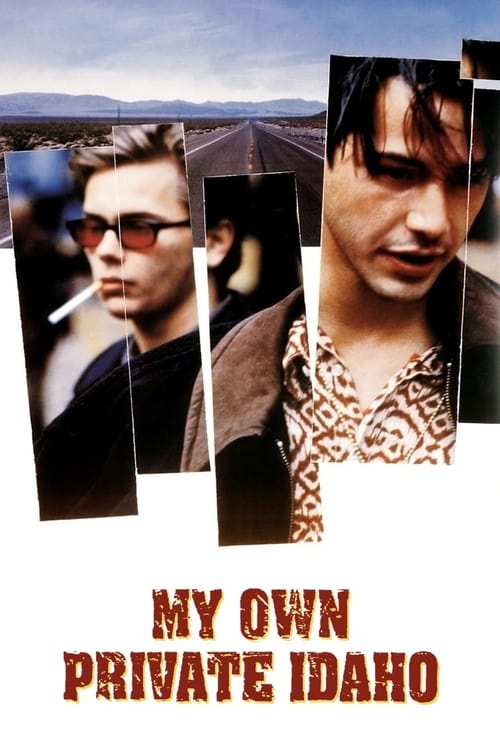
My Own Private Idaho
1991 · Gus Van Sant
For when you want something beautiful and sad to sit with — a late-night film about longing that you'll carry around for days. Challenge more than comfort, but the tender kind.
What it's about
Mike is a narcoleptic street hustler in Portland who blacks out at the worst moments and can't stop searching for the mother who left him. His closest companion is Scott, the mayor's son, slumming among the rent boys until the day he claims his inheritance. Their drift takes them from Pacific Northwest streets to rural Idaho and all the way to Italy — a road movie about chosen family, unrequited love, and the people a city uses and forgets.
The experience
Dreamlike and raw at once — it slides between grungy street realism, gorgeous time-lapse skies, and scenes that suddenly turn Shakespearean, and the loneliness at its center is quietly devastating. Loose, strange, and haunting rather than plotty.
Performances
River Phoenix is extraordinary as Mike — vulnerable, funny, and achingly open, especially in a quiet campfire confession that's become one of the most beloved scenes of 1990s American cinema. Keanu Reeves plays Scott's cool detachment perfectly against him.
The craft
Van Sant fuses documentary grit, experimental lyricism, and actual Shakespearean verse into one deliberately uneven road movie, and somehow it holds. The imagery — empty highways, rushing clouds, a house falling from the sky — is unforgettable, and it rewards a screen big enough to get lost in.
Why it matters
An instant foundational text of the New Queer Cinema of the early 1990s, it pushed Van Sant to the front rank of American independents and fixed River Phoenix's legend.
Snapshot
My Own Private Idaho is Gus Van Sant's third feature and the most formally adventurous film of his early period — a road movie about gay street hustlers in the Pacific Northwest that abruptly grafts itself onto the trunk of Shakespeare's Henry IV. Mike Waters (River Phoenix), a narcoleptic hustler haunted by the absence of his mother, and Scott Favor (Keanu Reeves), the slumming son of Portland's mayor who will one day reclaim his inheritance, drift through a demimonde of rent boys, drugs, and casual prostitution that stretches from Portland to rural Idaho and finally to Italy. The film fuses documentary-flavored realism, lyrical experiment, and verse drama into a deliberately uneven, episodic structure. It became, almost on release, a foundational text of what the critic B. Ruby Rich would shortly name the New Queer Cinema, and it remains the performance for which River Phoenix is most indelibly remembered. Its reputation has only grown: a once-divisive art film now widely regarded as among the essential American independent films of its decade.
Industry & production
The film was produced and distributed through New Line Cinema, then still defining itself as an ambitious independent before its later studio scale. It arrived on the momentum of Van Sant's Drugstore Cowboy (1989), the critical breakthrough that gave him the standing to mount a more idiosyncratic project. Van Sant had been circling the world of Portland street kids for years; the screenplay famously fused several scripts he had been developing separately — material about hustlers drawn partly from his own observation of Portland's Skid Row, and a separate adaptation idea built around Shakespeare's Prince Hal and Falstaff. The decision to interleave naturalistic scenes of street life with passages of (lightly modernized) Shakespearean dialogue was the film's central and riskiest gambit.
Casting River Phoenix and Keanu Reeves — two young actors with significant mainstream visibility — gave a frankly homosexual, sexually explicit independent film unusual commercial reach for its moment. Both took roles that were, by the standards of early-1990s Hollywood, professionally risky. The production was modestly budgeted by studio standards and shot on real Portland locations, in actual single-room-occupancy hotels and on the streets where the milieu existed. Van Sant cast non-professionals and people from that world alongside his leads, a practice carried over from Mala Noche and Drugstore Cowboy. The film premiered at the Venice Film Festival in 1991, where River Phoenix won the Volpi Cup for Best Actor, and it went on to be honored in the American independent awards circuit, cementing Van Sant's reputation as a leading figure of the independent surge.
Technology
The film was shot photochemically on 35mm, but its distinguishing technical signature is its embrace of heterogeneous formats and image sources. Van Sant intercuts the principal photography with time-lapse cinematography, Super 8–style home-movie textures, and other "lower" image registers. The most celebrated technical conceit is the use of time-lapse skies — clouds racing over the open Idaho road — which function as visual punctuation around Mike's narcoleptic blackouts. A recurring effect drops a wooden barn out of the sky to shatter on an empty highway, a piece of in-camera and optical trickery that gives Mike's interior collapse a concrete, almost cartoon-surreal image. The mixing of formats was both an aesthetic and a practical instrument: it let Van Sant move between observed reality and dream without the apparatus of a conventional fantasy sequence. The film belongs to the last era before digital intermediate workflows, so its layered look was achieved through optical and in-camera means rather than post-production compositing.
Technique
Cinematography
The cinematography is credited to Eric Alan Edwards and John J. Campbell, and it is one of the film's great achievements — a photography that holds documentary plainness and lyric beauty in the same frame. The streets, flophouses, and diner interiors are shot with a grainy, available-light naturalism, while the Idaho landscapes open into wide, painterly vistas of road and sky. The single most quoted image is the long, dead-straight two-lane highway running to a vanishing point under a vast sky, an emblem of openness and of nowhere that the film returns to as a refrain. Against this, the campfire scene between Mike and Scott — the film's emotional center — is lit with intimate warmth, the two faces held close in firelight. The visual scheme deliberately refuses a single consistent surface; it shifts texture with the film's shifting modes.
Editing
Editing is credited to Curtiss Clayton, a longtime Van Sant collaborator, and it is fundamental to the film's effect. The cutting has to manage extreme tonal gear-changes — from cinéma-vérité street scenes to Shakespearean staging to dream montage — and it does so by treating narcolepsy itself as an editing principle. When Mike falls asleep, the film falls with him: hard cuts to time-lapse, to home-movie fragments of his mother, to the crashing barn, then an abrupt return to a new location with no transitional logic. This produces a structure that is episodic and elliptical rather than causal, mimicking the punctured, discontinuous experience of its protagonist. A celebrated sequence animates a row of gay pornographic magazine covers, the hustlers on the covers coming briefly to life to talk — a montage idea that compresses exposition and world-building into a single playful conceit.
Mise-en-scène / staging
The staging operates on two registers that the film refuses to reconcile. The street-life material is staged loosely, with the texture of overheard reality. The Shakespearean material, by contrast, is staged with theatrical formality — most overtly in the scenes around Bob Pigeon, the aging derelict who is the film's Falstaff, holding court among the boys in a derelict hotel as if in a tavern in Henry IV. Van Sant lets the artifice show; the seams between modes are part of the design rather than flaws to be smoothed. The film's geography is itself a staging principle, organized around the search for a home that recedes — the flophouse, the family house Scott will inherit, the remembered farmhouse of Mike's mother, and finally Italy, each a station in a journey that the road's vanishing point promises but never delivers.
Sound
The film eschews a conventional orchestral score in favor of an eclectic assembled soundtrack of found and source music, ranging across country and pop registers, with Eddy Arnold's "The Cattle Call" among its most memorable cues — its yodeling Western sentimentality both sincere and ironic against these lost boys. (The precise music credits are best confirmed against the film's titles rather than asserted from memory.) The sound design leans on the ambient textures of street and highway, and on silence and stillness around the narcoleptic episodes. The aural world, like the visual one, is a collage that resists a unifying authorial "voice," reinforcing the film's sense of a consciousness assembled from fragments.
Performance
The performances are the film's enduring legacy. River Phoenix's Mike Waters is a portrait of tenderness and damage — physically slack and vulnerable in his narcoleptic collapses, emotionally open in a way that exposes him constantly to hurt. The campfire scene, in which Mike haltingly tells Scott "I really wanna kiss you" and confesses a love that cannot be reciprocated, is widely understood to have been substantially shaped by Phoenix himself, and it is the performance's high point: a small, unguarded reckoning with unrequited desire that the film treats with complete seriousness. Keanu Reeves plays Scott as a study in withheld warmth — a young man playing at fellowship he intends to renounce, his eventual betrayal of Bob and Mike pre-written into his princely destiny. William Richert's Bob Pigeon supplies the Falstaffian bulk and pathos. The supporting cast, mixing professionals with people from the milieu, sustains the documentary undertow.
Narrative & dramatic mode
The narrative mode is hybrid and intentionally fractured. At base it is a road movie and a quest — Mike's search for his estranged mother — but the quest structure is continually interrupted by narcoleptic ellipses, by dream imagery, and by the parallel, incompatible plot of Scott's Henry IV arc. The Shakespearean overlay supplies a second dramatic register: Scott is Prince Hal, destined to cast off his low companions and assume respectability; Bob is Falstaff, doomed to be rejected; the rejection scene plays out in modern dress with verse cadences. The film does not dramatize a smoothly causal plot so much as a series of stations and returns. Mike's recurring line — "I always know where I am by the way the road looks" — is both literal orientation and a confession of rootlessness, and the film's circular movement (it ends, like it begins, with Mike on the open Idaho road) frames the whole as a loop rather than a resolved arc.
Genre & cycle
The film sits at the intersection of several genres — the road movie, the coming-of-age drama, the Shakespearean adaptation — while belonging most consequentially to a cycle that postdated its making: the New Queer Cinema. As an adaptation it is unusually free, using Henry IV less as a source to be faithfully rendered than as a structuring myth to be collided with contemporary realism. As a road movie it inherits the American tradition of the open highway as a figure of freedom and dispossession, but bends it toward queer longing and the impossible search for home. Its hustler-milieu realism connects backward to a lineage of films about street life and male prostitution, while its formal play places it among the era's art-house experiments.
Authorship & method
My Own Private Idaho is a director's film in the fullest sense: Van Sant wrote the screenplay, and its distinctive method — the fusion of incompatible scripts, the willingness to let artifice and realism coexist unresolved, the prioritizing of mood and image over plot mechanics — is the signature of his early authorship. His key collaborators here are central to the result: cinematographers Eric Alan Edwards and John J. Campbell, who realized the film's split visual personality; editor Curtiss Clayton, who turned narcolepsy into a montage logic; and, crucially, his actors, to whom Van Sant ceded real authorship, most famously in River Phoenix's reworking of the campfire confession. Van Sant's method on this film extended Drugstore Cowboy's interest in marginal, drug-and-survival subcultures while pushing far further into formal experiment, drawing on his background in painting and avant-garde and Super 8 filmmaking. The absence of a traditional composer and the reliance on assembled source music is itself an authorial choice, consistent with Van Sant's collagist sensibility.
Movement / national cinema
The film is a landmark of American independent cinema's late-1980s/early-1990s renaissance, the moment that produced a generation of distinctive directorial voices working outside the studios. More specifically it is a cornerstone of the New Queer Cinema, the loose movement that critic B. Ruby Rich identified and named in 1992 — a wave of films, including Todd Haynes's Poison, Tom Kalin's Swoon, Derek Jarman's Edward II, and Gregg Araki's The Living End, that brought a defiant, formally adventurous, unapologetic queer sensibility to the festival circuit, shaped in part by the AIDS crisis and the activism around it. Within Van Sant's own body of work it forms the third panel of an informal "Portland trilogy" with Mala Noche (1986) and Drugstore Cowboy (1989), films rooted in the city's marginal communities.
Era / period
Released in 1991, the film is a product of and a comment on its early-'90s American moment. It belongs to the height of the independent boom that the success of companies like Miramax and New Line, and festivals like Sundance, had made possible. It is equally a film of the AIDS era: though the epidemic is not its explicit subject, the New Queer Cinema to which it belongs was forged in that crisis, and the film's frank treatment of gay desire and sex work carried a charge specific to the period. The recession-edged Pacific Northwest it documents — the SROs, the drifting young people, the economic precarity — situates it firmly in its time and place, even as the Shakespearean overlay reaches for timelessness.
Themes
The governing theme is home and its impossibility — the longing for a mother, a place, a belonging that the road perpetually withholds. Mike's narcolepsy literalizes this: he loses consciousness, loses his place in the world, and wakes elsewhere, an exile within his own life. Unrequited love is the film's emotional core, embodied in Mike's hopeless devotion to Scott, who can offer companionship but not return. Class and betrayal run through the Henry IV structure: Scott's slumming is a tourism he can end at will, while Mike has nowhere to graduate to; Scott's inheritance is precisely what Mike lacks, and his eventual abandonment of Bob and Mike is a betrayal written into the privilege of his birth. The film also meditates on family — chosen versus biological — and on the commodification of intimacy in sex work, where affection and transaction are continually confused. Underlying all of it is a tension between authenticity and performance, mirrored in the film's own oscillation between documentary truth and theatrical artifice.
Reception, canon & influence
Critically, the film was admired and debated on release — praised for its ambition, its imagery, and above all River Phoenix's performance, while some found its hybrid structure and Shakespearean grafts uneven. Phoenix's recognition was immediate and substantial, including the Volpi Cup at Venice and honors from American critics' bodies, and the film performed creditably for a frankly gay independent feature. Its reputation rose sharply after Phoenix's death in 1993, which lent his Mike Waters an elegiac aura and fixed it as the defining work of his short career.
Looking backward, the film's influences are eclectic and openly worn: Shakespeare's Henry IV as structural myth; the American road-movie tradition; the documentary and underground-film practices Van Sant absorbed in his formation; and a lineage of films about hustlers and street life. Looking forward, its legacy is large. It is canonized as a founding work of the New Queer Cinema and a touchstone of 1990s American independent film, regularly cited in surveys of the era and in scholarship on queer cinema. Its fusion of realism with formal experiment, its collage soundtrack, and its tender, non-sensational treatment of marginal lives influenced subsequent independent and queer filmmakers, and it consolidated Gus Van Sant as a major American auteur — a standing that would carry through Good Will Hunting, his Palme d'Or–winning Elephant, and beyond. The campfire scene in particular has become one of the most-quoted passages in queer film history, an emblem of the film's enduring power to render longing without consolation.
A Deleuzian reading
A man stands on a two-lane highway in the middle of nowhere, looks down its dead-straight run to the vanishing point, and says the road looks like a face he knows.
The full Deleuzian reading of My Own Private Idaho →
Reception
An arthouse curio that divided audiences at its 1991 Venice premiere — where River Phoenix took the Volpi Cup — it has since been canonized as a cornerstone of New Queer Cinema and one of the defining American indies of the 90s, its legend only deepening after Phoenix's death in 1993.
How My Own Private Idaho was received, from release to now →
Influences: the films it descends from and the films it influenced
- Chimes at Midnight (1966) — Supplies the Falstaff-and-Prince-Hal structure lifted from Henry IV, including Welles's condensation of the Henriad into one elegiac mentor-rejection arc that Van Sant grafts onto Bob Pigeon and Scott.
- Mala Noche (1985) — Establishes Van Sant's grainy available-light, Super 8 naturalism and the queer-hustler subject, with non-professional street registers that Idaho directly expands.
- Drugstore Cowboy (1989) — Models the non-moralizing observation of drug-and-survival subculture plus the surreal floating-object inserts (cows, spoons) that prefigure Idaho's time-lapse and stop-motion interludes.
- Flesh (1968) — Provides the Warhol-Factory template of a hustler protagonist (Joe Dallesandro) rendered through flat-affect non-professional performance and an episodic, plotless structure of street transactions.
- Midnight Cowboy (1969) — Originates the male-hustler-and-his-ailing-companion street duo and the location naturalism of urban margins that Idaho transplants to Portland and Rome.
- Easy Rider (1969) — Codifies the road movie as a fragmented American journey scored by assembled rock source music rather than an orchestral composer's cues.
- Un Chant d'Amour (1950) — Pioneers the avant-garde, lyrical rendering of male homoerotic longing as image and reverie rather than incident, a precedent for the campfire scene's unconsummated desire.
- Koyaanisqatsi (1982) — Demonstrates time-lapse cloud-and-sky photography deployed as standalone montage interludes that punctuate, rather than advance, the narrative.
- Rebel Without a Cause (1955) — Develops Rebel's coded-gay adolescent (Plato) and improvised surrogate-family of lost boys into explicit queer cinema, making subtext the text.
- Fox and His Friends (1975) — Extends Fox's insight that queer desire is inseparable from class and money, following a hustler exploited across a stratified social economy without moralizing redemption.
- Gerry (2002) — Pushes Idaho's elliptical, near-plotless landscape drift to an extreme, with long takes and time-lapse skies replacing conventional narrative scaffolding.
- Elephant (2003) — Develops the time-looping elliptical structure, Steadicam available-light naturalism, time-lapse cloud interludes, and ceded authorship to non-professional actors first tested in Idaho.
- Brokeback Mountain (2005) — Stages the campfire-side, firelit confession of unrequited love between men without consolation, inheriting Idaho's signature scene of longing rendered as restraint.
- Mysterious Skin (2004) — Renders the teenage-hustler narrative through lyrical dream interludes and a tender, non-sensational handling of trauma descended from Idaho's treatment of street youth.
- Moonlight (2016) — Builds an elliptical, chaptered coming-of-age of a marginal queer figure out of mood, available light, and withheld tenderness rather than plot, extending Idaho's craft.
- Kids (1995) — Carries forward the documentary-grain naturalism of drifting marginal youth performed by non-professionals, observed without moralizing judgment.
- Urchin (2025) — Van Sant's subjective American cinema — dreamlike fugue/narcoleptic interludes erupting out of street-hustler realism — models Urchin's pairing of lived deprivation with oneiric cosmic ruptures.
- Happy Together (1997) — Elliptical, non-linear queer love story using disrupted chronology and hallucinatory image-insets to externalize desire and displacement — the template for treating queer romance in a formally experimental festival art-cinema register that Happy Together inherits.
- Boys Don't Cry (1999) — Married regional naturalism to lyrical time-lapse-sky interludes around a queer hustler's interior life, the grit-and-reverie register Peirce inherits.
- Good Will Hunting (1997) — Van Sant's tender, naturalist attention to drifting and damaged young men — the authorial sensibility he subordinates here to keep the melodrama unforced.
- L.I.E. (2001) — Lyrical treatment of drifting, hustling youth caught in a predatory adult economy, lending dignity to the endangered boy — a precedent for Howie's vulnerability to Big John.
- Laurence Anyways (2012) — A cornerstone of New Queer Cinema that folds lyrical slow-motion and dreamlike interludes into a queer narrative, the arthouse lineage Dolan explicitly extends.
- Poison (1991) — Shares New Queer Cinema's format collage, splicing incompatible generic registers (horror, faux-documentary, melodrama) and leaving them unresolved, parallel to Idaho's realism/Shakespeare graft.
- The Living End (1992) — Extends the queer road movie of outlaw outsiders shot in low-budget available light, part of the same 1991–92 New Queer Cinema cohort.
- Swoon (1992) — Mixes period and contemporary registers as deliberate anachronism, the same New Queer Cinema willingness to let incompatible stylistic worlds coexist on screen.
- Paris Is Burning (1990) — Brings tender, non-sensational documentary attention to marginal queer survival economies, the same refusal of pathologizing distance Van Sant applies to hustlers.
- The Outsiders (1983) — Extends the operatic-tableau treatment of marginal, beautiful young male outsiders, staging street-kid melodrama with heightened lyricism rather than realism.
Similar films
- Gerry (2002) — influence & lineage · same viewing thread · often watched together
- Drugstore Cowboy (1989) — influence & lineage · often watched together
- Elephant (2003) — influence & lineage · same viewing thread · often watched together
- Easy Rider (1969) — influence & lineage
- Brokeback Mountain (2005) — influence & lineage · often watched together
- Kids (1995) — influence & lineage · often watched together
- Urchin (2025) — influence & lineage · often watched together
- Nomadland (2021) — often watched together
All the films related to My Own Private Idaho →
Watch it with: curated runs of related films
- Adrift and Coming Apart — A run of solitary souls drifting through motels, deserts, and empty apartments and quietly dissolving — they rhyme on stillness, loneliness, and dread.