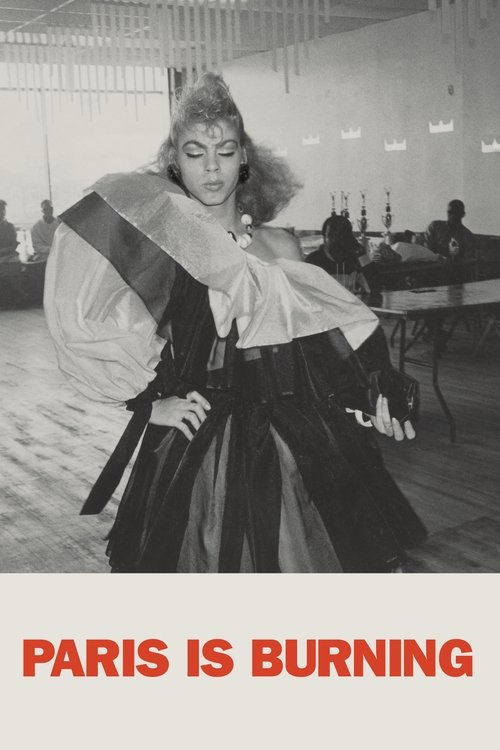
Paris Is Burning
1991 · Jennie Livingston
For when you want a documentary that's alive — funny, glamorous, and devastating in the same breath. Reach for it when you want to understand where half of modern pop language comes from, and to feel the cost and the glory behind it.
What it's about
In 1980s New York, Black and Latino queer performers built a world of their own: competitive balls where contestants walk in categories from high fashion to 'executive realness,' and rival houses led by mothers who take in kids their families threw away. Shot over seven years, the film moves between dazzling competition footage and frank interviews with the scene's legends about fame, money, gender, survival, and what they dream of.
The experience
Electric and heartbreaking at once — the balls are pure joy and wit, the interviews are disarmingly candid, and the shadow of AIDS-era New York gives every laugh a fierce edge. It's endlessly quotable and it stays with you.
The craft
Livingston's patient, seven-year immersion pays off in extraordinary access: the film lets Dorian Corey, Pepper LaBeija, Willi Ninja, and Venus Xtravaganza speak for themselves, and the editing weaves ball spectacle and testimony into a portrait of a whole world. The interview footage is some of the most quoted in documentary history.
Why it matters
A landmark of queer cinema that carried voguing, 'shade,' and 'realness' into the global mainstream — its influence runs through pop music, television, and language itself, and debates about who profits from that crossover are part of its legacy.
Snapshot
Paris Is Burning is a feature documentary about the drag-ball culture of Black and Latino queer New York in the mid-to-late 1980s — a subculture organized around competitive "balls," rival "houses" that functioned as surrogate families, and the vocabulary (voguing, "reading," "throwing shade," "realness") that this world generated and that would later travel far beyond it. Directed by Jennie Livingston and shot over roughly seven years, the film assembles ball footage and intimate talking-head interviews with performers including Pepper LaBeija, Dorian Corey, Willi Ninja, Octavia St. Laurent, Venus Xtravaganza, and Kim Pendavis, among others. It is at once an ethnographic snapshot of a specific milieu and a meditation on aspiration — on how a marginalized community stages fantasies of the wealth, fame, gender legibility, and safety that the surrounding society denied it. The film became a landmark of American independent documentary and of queer cinema, and it remains a central, contested text in debates about representation, authorship, and who profits from the depiction of a subculture.
Industry & production
Paris Is Burning was an independent production made outside the studio system, financed piecemeal over years — a common condition for feature documentary in the 1980s, when the form depended heavily on grants, fellowships, and public arts money rather than commercial pre-sales. Livingston, then a young filmmaker relatively early in her career, built the project incrementally as funds allowed, which partly accounts for the long shooting span and the film's layered sense of time (some subjects are revisited across years). Support came from arts and documentary funding sources of the period; the film is commonly noted as having drawn on public and foundation grant support, though I would flag that the precise ledger of funders and budget is not something to state with false precision here.
The film premiered on the festival circuit and won the Grand Jury Prize for documentary at the 1991 Sundance Film Festival, the validation that carried it to theatrical distribution. It was released theatrically by Miramax, and it became, by the modest standards of documentary, a notable arthouse success — one of the more widely seen nonfiction features of its moment. Exact box-office figures I will not invent; the salient industrial fact is that a low-budget, independently shot documentary about a Black and Latino queer subculture crossed over to a substantial general audience, which was itself unusual.
That commercial afterlife also became the film's central controversy. Several subjects and members of the ball community felt inadequately compensated relative to the film's visibility and the money it generated, and the disparity — a white, comparatively privileged director rendering a poor, largely Black and Latino queer world for a paying audience — became a recurring case study in documentary ethics. The dispute is part of the historical record and should be named plainly, even as the specifics of individual financial arrangements remain partly disputed.
Technology
The film was shot on 16mm, the workhorse gauge of independent and observational documentary in the 1970s and 80s, chosen for its portability and relative economy. Its imagery bears the material signature of that format and of available-light shooting in real ballrooms, apartments, and streets: grain, mixed and often difficult color temperatures, the characteristic look of a small crew working with what the location offered. Sync-sound interview work and location ball footage were captured with the lightweight portable rigs that made intimate vérité documentary possible in the period. The seven-year production also means the film spans a stretch of evolving consumer and semi-professional video culture, but the finished work reads as a 16mm film, and its texture — never slick, always proximate — is inseparable from that choice. Post-production and finishing were conventional for independent film of the era; the ambition of the movie lies not in technological novelty but in the discipline of assembling years of footage into a coherent whole.
Technique
Cinematography
The cinematography is observational and close, prioritizing access and intimacy over polish. Two visual registers dominate. The first is the ball footage: performers captured on the runway amid crowds, in low and colored light, the camera often handheld and reactive, following bodies in motion and catching the theatrical self-presentation of the competitors. The second is the interview register: subjects framed in their own spaces or against plain backgrounds, addressing an off-screen interlocutor, held long enough for personality and thought to unfold. The film's frequent use of on-screen intertitle words — the terms of ball vocabulary rendered as text — organizes the visual material into a kind of illustrated lexicon, letting the images define the language and the language frame the images. The look is unpretentious by design; its expressiveness comes from proximity and duration rather than from composition or lighting effects.
Editing
Editing is arguably the film's most decisive craft, precisely because the raw material was so vast and gathered over so long. The finished film is built as a thematic mosaic rather than a chronological narrative: it moves associatively through concepts — houses, mothers, realness, shade, voguing, the categories of competition — using the intertitle words as chapter-like hinges, then cutting between ball footage that demonstrates a concept and interviews that explain or complicate it. Dorian Corey functions almost as a chorus figure, her reflective monologues threaded across the film to give it a philosophical spine, culminating in the widely quoted meditation on legacy and mortality that closes it. The editing also manages the film's one strong through-line of pathos, the story of Venus Xtravaganza, whose arc the cutting shapes into the film's emotional center of gravity. Turning years of grant-funded footage into this legible, propulsive structure is the essential authorial act of the picture.
Mise-en-scène / staging
Because this is documentary, "mise-en-scène" belongs mostly to the subjects, not the director — and that is part of the point. The balls are self-staged spectacles: the houses and performers design their own costumes, choreograph their own runway presentations, and perform "realness" as a rigorous discipline of self-fashioning. Livingston's contribution is one of selection and framing — choosing which performances and which domestic spaces to record, and how much room to give them. The interview settings (cramped apartments, rooftops, city streets) situate the fantasy of the ballroom against the material reality of the subjects' lives, and that juxtaposition — glamour staged inside poverty — is the film's governing visual argument.
Sound
The soundtrack draws on the dance and club music of the period, the sonic world native to the ballroom itself, and this music both energizes the runway sequences and anchors the film in its time and place. The spoken word is central: the film is carried by voices — the wit, cadence, and idiom of its subjects — and much of its pleasure and its ethnographic value lies simply in listening to people describe their world in their own terms. Sync-sound interviews and location ambience give the film its grounded, present-tense texture. The interplay of music (the fantasy) and interview voice (the reflection) mirrors the film's larger structure.
Performance
The "performers" are real people, and the film's power depends on their charisma and candor. Pepper LaBeija's regal authority, Dorian Corey's aphoristic melancholy, Willi Ninja's kinetic precision as a voguer, Octavia St. Laurent's yearning ambition, and Venus Xtravaganza's vulnerability together form an extraordinary ensemble of self-presentation. There is a doubled sense of performance throughout: these are people performing on the runway, and also performing themselves for the camera — and the film is attentive to that layering, to the way self-invention is both survival strategy and art. The subjects' articulacy about their own lives is what elevates the film above spectacle.
Narrative & dramatic mode
The film operates in an expository-observational documentary mode, but without a voice-of-God narrator; it lets its subjects narrate. Structurally it is thematic and essayistic rather than plot-driven, using its vocabulary intertitles to guide the viewer through a conceptual tour of ball culture. Against this associative structure runs one genuinely dramatic thread — the story of Venus Xtravaganza — which gives the film a tragic arc and a human stake that a purely taxonomic treatment would lack. The dramatic mode, then, is a hybrid: part illustrated ethnography, part group portrait, part elegy.
Genre & cycle
Paris Is Burning sits within American independent documentary and, more specifically, within the tradition of subcultural and ethnographic nonfiction that documents marginalized communities from close range. It is also a foundational text of New Queer Cinema — the loose wave of the early 1990s (roughly coincident with the work of filmmakers like Todd Haynes, Tom Kalin, Gregg Araki, and others) that put queer lives on screen with new frankness and formal energy, much of it emerging under the shadow of the AIDS crisis and activist politics. As a dance and performance film it belongs to a lineage of documentaries about vernacular movement and self-fashioning. It also became, retroactively, a keystone of the ballroom-culture cycle that its own subjects helped seed — a cycle later extended by television and by mainstream pop's borrowings.
Authorship & method
Authorship here is genuinely complicated, and that complication is inseparable from the film's meaning. Jennie Livingston is the director and the organizing intelligence: the film is the product of her sustained access, her interviewing, and above all her shaping of an enormous body of footage into a coherent essay. Her method was long-form and immersive — years of return visits, of building trust, of accumulating material as funding permitted. The editing (the structural authorship of the film) was central to translating that method into form.
But the film is equally authored, in a different sense, by its subjects, who supplied not just their images but the entire conceptual and verbal architecture the film organizes — the categories, the language, the performances, the philosophy. This is the crux of the ethical debate the film provoked: a documentary in which the most valuable creative material originates with a community that stood largely outside the film's authorship and its profits, made by a filmmaker positioned differently by race and class from her subjects. Scholars — notably bell hooks, in an influential critical essay — pressed exactly this question of the outsider's gaze and the politics of looking. The film thus became a permanent reference point in discussions of documentary ethics, appropriation, and the difference between representing a community and speaking for it. On the specifics of individual collaborators beyond Livingston as director, I'd caution against overstating a credited authorial team; the film's making is best understood as one director's long labor over subjects who are its true co-creators in substance if not in credit.
Movement / national cinema
The film is a product of American independent cinema and of the grant-supported documentary infrastructure of the 1980s and early 90s. Its most important movement affiliation is with New Queer Cinema, the early-1990s surge of independent queer filmmaking; Paris Is Burning is frequently cited alongside that wave's fiction landmarks as its major documentary entry. It also belongs to a New York independent tradition of city-specific, subculture-facing filmmaking. Geographically and culturally it is emphatically a New York film — rooted in Harlem and the wider queer geography of the city — and it functions as a record of a distinctly local scene at a specific historical moment.
Era / period
The film documents the mid-to-late 1980s and was released in 1991, and it is saturated by the conditions of that era. It is shaped by the AIDS crisis, which hangs over the entire ball community as an unspoken and sometimes spoken threat; by the racism, homophobia, and transphobia its subjects name directly; and by the poverty and precarity that make the ballroom's fantasies of wealth and glamour so charged. The 1980s aspirational imagery the subjects invoke — of executives, fashion models, and moneyed ease — is itself a period document, a refraction of Reagan-era images of success seen from below. The film's release at the dawn of the 1990s, just as queer independent cinema was cresting, positioned it as both a record of the decade just past and a herald of the cultural conversations to come.
Themes
The film's central theme is aspiration under exclusion — the way a community shut out of wealth, fame, family acceptance, and gender legibility restages those things as achievable, if only for the length of a runway walk. "Realness," the prized ability to pass convincingly as a category one is barred from (an executive, a "real" woman, a straight man), crystallizes the film's meditation on performance, passing, and survival. Closely tied to this is the theme of chosen family: the houses, with their "mothers" and "children," are presented as structures of care improvised by people frequently rejected by their families of origin. Gender and its construction run throughout, as does the intersection of race, class, and sexuality that makes these subjects' exclusions compounding rather than singular. Finally, the film is preoccupied with mortality, legacy, and being remembered — themes made unbearably concrete by the AIDS era and voiced most memorably in Dorian Corey's closing reflection and in the fate of Venus Xtravaganza. The subtext, never resolved, is the very question the film's own history would raise: who gets to be seen, and who benefits from the seeing.
Reception, canon & influence
Critically, the film was widely praised on release and quickly established as a significant work of documentary and queer cinema; its Sundance Grand Jury Prize and its unusually broad theatrical exposure sealed that status. Alongside the acclaim, it generated substantial critical debate — bell hooks's essay is the most cited example — over the ethics of its gaze, the disparity between the film's success and its subjects' circumstances, and the politics of a comparatively privileged filmmaker depicting a marginalized community. That the film could be at once celebrated and rigorously critiqued is part of why it has endured as a teaching text: it is discussed as much for the questions it raises about documentary practice as for its content. It was later selected for preservation in the United States National Film Registry by the Library of Congress, a marker of canonical recognition.
Influences on the film (backward): Paris Is Burning draws on the traditions of observational and ethnographic documentary and of the interview-driven subcultural portrait; its deepest "source," though, is the ball culture itself, which had decades of history behind it and which supplied the film's entire vocabulary and aesthetic. The film records a pre-existing art form rather than inventing one.
Legacy (forward): The film's influence has been enormous and, in a sense, ironic — the vocabulary and imagery it captured have propagated through mainstream culture far more widely than the film or its subjects were rewarded for. Ballroom terminology ("reading," "shade," "realness," "work") entered general and especially online usage; voguing, already moving into pop via early-1990s music culture, became globally legible. Decades later, the ballroom world the film documented was dramatized and celebrated anew in television centered on that culture and in the vogue-and-realness lexicon of televised drag competition, and the film is routinely credited as the foundational screen record that made this later visibility possible. It remains a fixture of film-studies, queer-studies, and documentary-ethics curricula, and a touchstone in ongoing arguments about representation, appropriation, and who owns the image of a community. Its dual legacy — as a beloved cultural landmark and as a cautionary case in documentary ethics — is precisely what keeps it alive.
A Deleuzian reading
Start with a category being called.
The full Deleuzian reading of Paris Is Burning →
Reception
It arrived as a Sundance Grand Jury Prize winner and arthouse sensation in 1991, then spent years shadowed by debates over authorship and compensation — before Pose, Drag Race, and a 2020 Criterion release cemented it as essential queer cinema.
How Paris Is Burning was received, from release to now →
How to watch Paris Is Burning: what to notice on a first viewing
- Watch for ball terms spelled out on screen as text. The film keeps stopping to print a term in white text, like realness or shade, then cuts to footage that shows exactly what the word means. The lexicon lets the images define the language instead of a narrator explaining it for you.
- Watch how closely a competitor's outfit matches a real job. Competitors in the realness categories build a costume so exact, a suit, a briefcase, a collegiate look, that judges score how completely it could pass in the outside world. The prize goes to whoever builds an appearance convincing enough to move safely through a world that excludes them.
- Watch a voguer's hands mime a mirror or a magazine pose. Willi Ninja and the other dancers freeze fashion poses into their hands and spines, turning runway attitude most of them will never be paid to model into dance. The dance turns a shut-out desire into a skill you can watch be mastered in real time.
- Listen for the subjects explaining ball culture in their own words. Livingston never adds a voice-of-God narrator; every definition and judgment in the film comes from Pepper LaBeija, Dorian Corey, Willi Ninja, and the others speaking for themselves. You hear the culture defined entirely by the people who built it, not by an outside expert.
- Notice where each interview happens versus where the balls happen. Interviews happen in small apartments, on rooftops, and on the street, plain settings that sit right next to the glamour of the runway footage cut in around them. Seeing the modest room behind the ball gown shows you exactly what the fantasy is standing against.
The whole guide to watching Paris Is Burning, with the keys for a rewatch →
Influences: the films it descends from and the films it influenced
- The Queen (1968) — The direct template Livingston inherited — an observational record of a drag-ball competition built from pageant judging, backstage prep, and to-camera queen commentary, the exact competition-plus-confessional structure Paris reworks.
- Portrait of Jason (1967) — Establishes the self-fashioning-to-lens mode: a Black gay hustler performing, narrating, and constructing his own persona in sustained direct address, letting the subject author his own myth rather than being narrated over.
- Chronicle of a Summer (1961) — Founds the sync-sound cinéma-vérité interview as a device that provokes subjects into self-reflection, and foregrounds the reflexive ethics of the filmmaker's presence that bell hooks would later press against Paris.
- Salesman (1969) — American direct cinema — handheld, available-light, non-narrated observation of a subculture's daily rituals — supplies Paris's vérité surface and its refusal of authoritative voiceover.
- Grey Gardens (1975) — Models subjects who theatricalize their own identities and private vocabularies for the camera, filmed with intimate sync-sound observation, prefiguring how Paris lets its subjects perform 'realness' on their own terms.
- Word Is Out (1977) — Pioneers the thematically assembled mosaic of sync-sound queer testimony — many interviewees cut together into a collective portrait — the editing architecture Paris uses to build a chorus rather than a single narrative.
- The Times of Harvey Milk (1984) — An interview-driven queer documentary structured as elegy shadowed by death, weaving talking heads into a thematic-mosaic lament — the essayistic-elegy form Paris adopts under the AIDS crisis.
- Nanook of the North (1922) — The foundational ethnographic portrait whose staging and outsider-authorship problems are the ur-case of the 'politics of looking' debate Paris inherited — a privileged filmmaker shaping a marginalized community's image.
- Streetwise (1984) — Immersive available-light vérité of marginalized youth surviving through improvised chosen-family economies, the compassionate-observation-of-the-excluded mode Paris extends to the ball children.
- Funeral Parade of Roses (1969) — Empathetic vérité documentation of a queer/trans ballroom underground whose subjects perform identity directly to camera, extending Matsumoto's respectful observation of a marginalized world.
- The Watermelon Woman (1996) — Deploys faux-documentary interview form to interrogate who is authorized to document Black queer lives, directly metabolizing the appropriation-and-gaze debate Paris provoked into its own reflexive structure.
- The Aggressives (2005) — Extends the identity-category documentation — observational portraits of masculine-of-center queer self-fashioning across years of return visits — the same category-and-realness taxonomy Paris pioneered on screen.
- How Do I Look (2006) — A community-authored ballroom documentary explicitly made as a corrective to Paris's outsider authorship, redistributing the camera and profits to the scene's own participants.
- Kiki (2016) — Revisits the same NYC ballroom world co-written with insider Twiggy Pucci Garçon to answer the ethics critique, carrying the realness/voguing documentation forward into the PrEP-and-activism era.
- Pose (2018) — Dramatizes the ballroom houses using Paris as its foundational screen record — importing its category-announcing lexicon, 'reading,' realness, and chosen-family houses — while casting trans performers to author the story from inside.
- Boys Don't Cry (1999) — Documented gender as an assembled, rehearsed performance — the 'realness' construction that underwrites Brandon's staged masculinity as deliberate self-authorship.
- To Wong Foo, Thanks for Everything! Julie Newmar (1995) — Codified the drag 'house mother'/maternal-queen archetype and ballroom 'realness' that Vida Boheme's poised, protective authority over her younger charges directly draws on.
- The Adventures of Priscilla, Queen of the Desert (1994) — Documents ball-culture drag and the 'chosen family' house structure, whose lip-sync performance and belonging-through-artifice themes Priscilla fictionalizes into narrative form.
- Madame Satã (2002) — Documents self-fashioning through appropriated Hollywood glamour and chosen-family 'houses,' the exact logic of a Lapa hustler renaming himself after an imported movie ('Madame Satã').
- Tongues Untied (1989) — Contemporaneous New Queer Cinema essay on Black gay life that formalizes snap/vogue vernacular into rhythm and first-person poetics — the same subcultural vocabulary and elegiac AIDS-era address, from an insider's authorial position.
- Madonna: Truth or Dare (1991) — Same-year black-and-white vérité tour doc that pushes voguing into global pop legibility, the mainstreaming vector Paris's ballroom aesthetic fed and ran parallel to.
- When We Were Kings (1996) — Livingston's direct cinema observational method — handheld camera given insider access to a Black and queer community's competitive self-staging and identity performance — is a sibling documentary in the Black independent tradition that applies the same American direct cinema grammar to subjects constructing public identity under political pressure.
- My Own Private Idaho (1991) — Brings tender, non-sensational documentary attention to marginal queer survival economies, the same refusal of pathologizing distance Van Sant applies to hustlers.
Similar films
- Chronicle of a Summer (1961) — influence & lineage
- She's Gotta Have It (1986) — shared sensibility
- Jo Jo Dancer, Your Life Is Calling (1986) — shared sensibility
- Looking for Langston (1989) — shared sensibility
- Born in Flames (1983) — shared sensibility
- The Black Power Mixtape 1967-1975 (2011) — shared sensibility
- Vivre Sa Vie (1962) — shared sensibility
- Pariah (2011) — shared sensibility