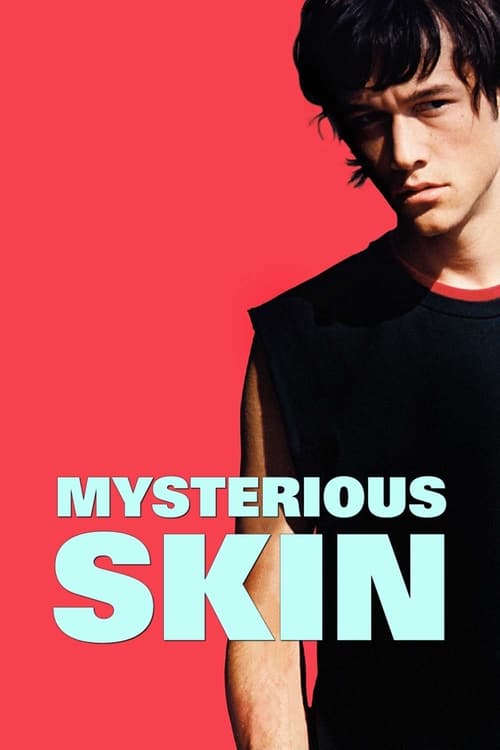
Mysterious Skin
2005 · Gregg Araki
For when you're ready to be wrecked by something honest — a challenge, not a comfort, but one that treats its subject with real care. Save it for a night when you have the emotional room.
What it's about
Two boys from the same Kansas town carry the same buried childhood summer in opposite directions: one grows into a swaggering teenage hustler who thinks he's in control of everything, the other into a fragile young man convinced he was abducted by aliens. The film follows their separate paths toward each other, and toward the truth neither has been able to look at directly. Fair warning: it deals with childhood sexual abuse and its aftermath, head-on.
The experience
Devastating but strangely gentle — the film wraps its horror in dreamy, candy-colored images and an ambient shimmer of a score, keeping the worst at the edge of the frame until it can't anymore. It builds to one of the most quietly shattering endings in American independent film; you'll need a minute afterward.
Performances
A young Joseph Gordon-Levitt is revelatory as the hustler Neil — all dangerous charm and buried damage — in the performance that announced him as a serious actor.
The craft
Gregg Araki renders each boy's memory in the visual language he needs to survive it: dreamlike, tactile, almost beautiful, which makes the underlying horror land harder than any graphic approach could. The score by Harold Budd and Cocteau Twins guitarist Robin Guthrie holds the whole film in a protective glow — headphones or good speakers make a real difference.
Why it matters
The shock of Araki's career — the nineties' resident queer nihilist delivering a film of profound tenderness — and now widely considered one of the most humane films ever made about trauma and survival.
Gregg Araki spent the early nineties as the New Queer Cinema's resident nihilist, all neon apocalypse and disaffected shrugs — which made this adaptation of Scott Heim's novel the shock of his career: a film of devastating tenderness about the aftermath of childhood sexual abuse. Two Kansas boys process the same buried summer in opposite directions — one, played by a revelatory Joseph Gordon-Levitt, becomes a swaggering teenage hustler; the other retreats into a conviction that he was abducted by aliens. Araki's genius is to render memory in the visual language each boy needs: candy-colored, dreamlike, almost tactile, with the horror kept at the frame's edge until it can no longer be. The score — Harold Budd and Cocteau Twins guitarist Robin Guthrie, wrapped around Sigur Rós — holds the film in a protective ambient shimmer. Araki consulted abuse survivors and therapists to get the psychology right, and the care shows; the film walks an almost impossible line between beauty and atrocity without aestheticizing the latter. Its final scene, two boys on a couch as carolers sing outside, is among the most quietly shattering in American independent film.
A Deleuzian reading
Two boys on a couch.
The full Deleuzian reading of Mysterious Skin →
Reception
It premiered at Venice in 2004 as the shock 'mature turn' from the New Queer Cinema provocateur behind The Doom Generation — and two decades on it's fully canonized as Araki's masterpiece, the film even his skeptics concede.
How Mysterious Skin was received, from release to now →
Influences: the films it descends from and the films it influenced
- My Own Private Idaho (1991) — Establishes the queer hustler-drifter whose subjective narcolepsy/dream inserts fracture linear time — the template for Neil's street-hustling and the film's slippage between present and half-buried memory.
- Blue Velvet (1986) — Pioneers the horror lurking at the edge of a candy-colored suburban frame, where saturated Americana surfaces conceal predation — Araki's staging of menace just outside the child's-eye view descends directly from it.
- Poison (1991) — Founding New Queer Cinema text that intercuts parallel narrative strands about transgressive desire and the diseased body, modeling the split-protagonist braid Araki uses for Neil and Brian.
- The Living End (1992) — Araki's own NQC breakthrough, whose queer nihilist road structure and confrontational treatment of endangered bodies is the authorial DNA he later disciplines into restraint here.
- The Doom Generation (1995) — Source of the hyper-saturated, candy-colored dreamlike palette and pop-surreal production design that Araki repurposes to make trauma look seductively beautiful.
- Happiness (1998) — Depicts child sexual abuse in suburbia with unbearable clinical empathy and formal restraint rather than sensation — the beauty-and-atrocity register Araki adopts for the abuser's grooming scenes.
- Kids (1995) — Introduces the unflinching, non-judgmental documentary-adjacent gaze on teenage sexuality and endangerment that Araki inherits while trading Clark's grit for lyricism.
- The Virgin Suicides (1999) — Scores adolescent doom with an ethereal ambient/shoegaze wash (Air) over gauzy dreamlike suburbia, the exact mood-through-texture strategy Araki extends with Robin Guthrie and Harold Budd.
- Velvet Goldmine (1998) — Deploys glam-saturated color and music-as-emotional-narration within a queer memory structure, teaching the shimmer-score-plus-lush-image grammar Araki uses to render recovered memory.
- L.I.E. (2001) — Contemporary indie that renders a predatory adult and a vulnerable boy with disorienting sympathy, sharing Araki's refusal to reduce abuse to simple monstrousness.
- Boys Don't Cry (1999) — Carries New Queer Cinema into Midwestern small-town trauma with restricted dual-protagonist subjectivity and a spare, dread-laced atmospheric score.
- Nowhere (1997) — Araki's own maturation, trading pop-art satire for Robin Guthrie/Harold Budd shoegaze-scored emotional realism while keeping the queer-teen-trauma core.
- Enter the Void (2009) — Pushes the neon dreamlike subjective haze around trauma and abuse into first-person delirium, extending Araki's idea that atrocity can be filmed as shimmering sensory beauty.
- We Need to Talk About Kevin (2011) — Elliptical, hyper-saturated (red-soaked) fractured-memory editing that withholds the traumatic core while flooding the frame with beauty — the same atrocity-through-lush-imagery method.
- White Bird in a Blizzard (2014) — Araki's own return to literary adaptation, unreliable adolescent memory, and a Robin Guthrie/Harold Budd ambient score — a direct self-descendant of this film's craft toolkit.
- Kaboom (2010) — Extends the candy-colored, polysexual apocalyptic aesthetic and shimmering pop surface, showing the same visual grammar redeployed toward comedy rather than trauma.
- Moonlight (2016) — Chaptered queer coming-of-age using saturated candy-neon cinematography and an ambient string score to make tenderness and buried trauma coexist — inheriting Araki's beauty-and-atrocity palette.
- Beach Rats (2017) — Renders closeted queer youth through tactile, grain-and-shadow intimacy and ambient dread, continuing the NQC lineage of desire filmed as both sensual and dangerous.
- I Want Your Sex (2026) — Robin Guthrie and Harold Budd score it directly, making the shoegaze soundworld authored rather than licensed, and it proves Araki's candy palette can carry an unironic dramatic register — the tonal control the new film's twist depends on.
- Donnie Darko (2001) — 2000s-indie sibling built on suburban dread, subjective/unreliable reality, and emotive shoegaze needle-drops carrying meaning the plot withholds.
- Speak (2004) — Same-year twin in method: buried childhood sexual assault surfaced through fragmented flashback disclosure and first-person voiceover, the trauma withheld until memory reassembles it.
Similar films
- Donnie Darko (2001) — influence & lineage
- Happiness (1998) — influence & lineage · often watched together
- Cure (1997) — often watched together
- Nowhere (1997) — shared sensibility
- Perfect Blue (1998) — shared sensibility
- Confessions (2010) — shared sensibility
- Requiem for a Dream (2000) — shared sensibility
- Nobody Knows (2004) — shared sensibility
All the films related to Mysterious Skin →