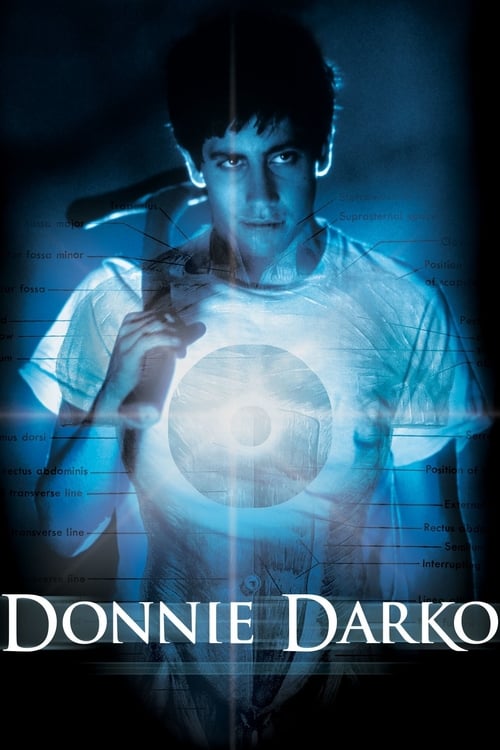
Donnie Darko
2001 · Richard Kelly
For when you want a film to chew on for days — a moody late-night watch that pays you back for thinking about it. Not comfort viewing, but the kind of enigma people get attached to for life.
What it's about
October 1988, suburban America: Donnie, a smart, troubled teenager, narrowly survives a freak accident when a jet engine falls on his house while he's sleepwalking. Afterward he's visited by Frank, a figure in a nightmarish rabbit costume, who tells him the world will end in about four weeks and nudges him toward increasingly serious acts of sabotage. Around him swirl a tender first romance, a family that loves him but can't reach him, and a high school full of hypocrites — all counting down.
The experience
Melancholy and hypnotic, with a thick 1980s soundtrack and a slow undertow of dread — funny about high school one minute, cosmically ominous the next. It ends up somewhere that will either haunt you or send you straight back to the beginning to puzzle it out.
Performances
A young Jake Gyllenhaal carries it, sliding between sweet, medicated vulnerability and something unnervingly blank — the performance that announced him.
The craft
Richard Kelly wrote and directed this in his mid-twenties, and the confidence shows: slow-motion hallway sequences cut to pop songs, a time-travel architecture buried under the teen drama, and a tone that keeps satire, sincerity, and sci-fi in the same frame. The music-driven set pieces reward good speakers.
Why it matters
A flop in theaters, it became one of the defining cult films of its era through DVD and midnight screenings — a template for how a movie could fail commercially and still conquer a generation.
Snapshot
Donnie Darko is the debut feature of writer-director Richard Kelly, completed when he was in his mid-twenties, and one of the defining cult objects of early-2000s American cinema. Set over twenty-eight days in October 1988, it follows a clever, alienated suburban teenager (Jake Gyllenhaal) who survives a freak accident — a jet engine crashes into his bedroom while he is sleepwalking elsewhere — and is thereafter visited by Frank, a figure in a grotesque rabbit costume who tells him the world will end in roughly four weeks and goads him into a series of transgressions. The film braids a tender, melancholic teen drama into an opaque science-fiction architecture of time travel, predestination and sacrifice, scored to a thick layer of 1980s pop. Commercially negligible on first release, it became a phenomenon on DVD and at midnight screenings, and it remains a touchstone for the "puzzle film" sensibility of its era.
Industry & production
Donnie Darko was an independent production made on a modest budget — reported in the region of $4.5 million — and shot in roughly twenty-eight days. The project's survival owed much to Drew Barrymore's company Flower Films (Barrymore and Nancy Juvonen), which came aboard as a producer alongside Adam Fields; Barrymore also took the supporting role of English teacher Karen Pomeroy, lending the unproven Kelly a measure of marquee credibility. Pandora Cinema and Newmarket Films were central to financing and release; Newmarket, soon to be associated with other unconventional 2001 fare, distributed it in the United States.
The film premiered at the Sundance Film Festival in January 2001 to respectful but not rapturous notices, and struggled to find a buyer. Its eventual theatrical release came in late October 2001, weeks after the September 11 attacks — disastrous timing for a film whose central image is an aircraft component falling out of the sky into a family home. The domestic theatrical run was tiny, grossing only a few hundred thousand dollars (commonly cited around half a million), far below its budget. The picture's commercial life properly began afterward, on home video and in repertory: it became a staple midnight movie and a strong DVD seller, the kind of title passed hand to hand among teenagers and students. In 2004 Kelly released a longer Director's Cut (roughly twenty minutes added), which restored excised material, foregrounded on-screen extracts from the in-world book The Philosophy of Time Travel, and reshuffled the soundtrack. The two versions have since been debated as meaningfully different films — the theatrical cut more suggestive and open, the Director's Cut more explanatory. A 2009 sequel, S. Darko, was made without Kelly's involvement and is generally disregarded.
Technology
Donnie Darko is a film of the late-celluloid, early-digital-effects moment, and its technology is deployed sparingly rather than as spectacle. It was shot on 35mm. Its few set-piece visual effects — the translucent, worm-like "spears" of liquid time that issue from characters' chests and lead them toward their futures, and the conduit through which the displaced jet engine travels — were executed as relatively low-cost digital compositing, integrated to feel uncanny rather than slick. The jet-engine crash itself relies on practical destruction and sound design more than on elaborate CGI. The film's technological signature is less about effects than about a tactile evocation of 1988-era consumer technology: bulky televisions broadcasting the Bush–Dukakis campaign, VHS culture, the cassette-tape pop soundtrack, the analog texture of suburban domestic life. The Director's Cut's added intertitles from The Philosophy of Time Travel are themselves a kind of low-tech interface, asking the viewer to read the film's metaphysics as much as watch it.
Technique
Cinematography
Steven Poster, ASC, shot the film, and his work balances naturalistic suburban observation with controlled stylization. The autumnal Southern California locations (standing in for fictional Middlesex, Virginia) are rendered in a cool, slightly desaturated palette that turns the comfortable upper-middle-class milieu faintly sinister. The most celebrated camera gesture is the use of motion-controlled and speed-ramped tracking — the "Head Over Heels" sequence that glides through Donnie's high school, accelerating and decelerating, holding on faces while the world rushes around them. This manipulation of camera speed, married to pop music, became one of the film's most imitated devices. Frank, the rabbit, is staged with a flat, frontal menace; the engine's arrival and the climactic storm are shot for ominous scale against the otherwise grounded photography.
Editing
The film was cut by Sam Bauer and Eric Strand. The editing's principal task is to hold together two registers — intimate teen-drama scenes and elliptical sci-fi visions — without collapsing the ambiguity. Montage sequences set to songs function as emotional and temporal compression, while the countdown structure (Frank's "28 days, 6 hours…") gives the cutting a ticking, predestined momentum. The ending's looping return to the opening morning is an editing problem solved with restraint: the film rhymes its first and last images to suggest that everything between has been folded back on itself. The Director's Cut's revised edit is notably more expository, inserting the book pages at intervals to gloss the mechanics the theatrical version left submerged.
Mise-en-scène / staging
Kelly's staging leans on a Lynchian estrangement of the ordinary: the symmetrical family dinner table, the fluorescent school corridors, the motivational-seminar auditorium, the Halloween party. Production design situates the story precisely in October 1988 — the political television coverage, the Smurfs debate, the costumes — so that the supernatural intrusions feel like ruptures in a meticulously normal surface. Frank's rabbit suit is the film's central designed object, deliberately ugly and abject rather than whimsical. Recurring motifs (the skeleton costume Donnie wears, water, the chest-spears) are staged as visual through-lines binding the literal and the metaphysical.
Sound
Sound is arguably Donnie Darko's most influential dimension. Michael Andrews composed an original score of glassy, processed textures, but the film is defined by its needle-drops: Echo and the Bunnymen's "The Killing Moon," Tears for Fears' "Head Over Heels," Joy Division's "Love Will Tear Us Apart," INXS, Duran Duran. (The cuts open differently — the theatrical version begins with "The Killing Moon," while the Director's Cut opens with INXS's "Never Tear Us Apart" and repositions the Bunnymen track.) The closing sequence is set to Andrews and Gary Jules's stripped-down cover of Tears for Fears' "Mad World," whose plaintive piano became culturally ubiquitous — later a UK Christmas number-one single in 2003 — and is now nearly inseparable from the film's reputation for melancholy.
Performance
Jake Gyllenhaal's performance anchors the film: a mixture of adolescent surliness, intelligence and dawning grief, capable of carrying both deadpan comedy (his classroom debates, his demolition of a motivational guru) and genuine pathos. Jena Malone gives the romance with Gretchen its grounding tenderness. The ensemble is unusually strong for a low-budget debut: Mary McDonnell and Holmes Osborne as warm, baffled parents; Maggie Gyllenhaal as Donnie's sister, lending real-life sibling texture; Patrick Swayze in a daring against-type turn as the sinister self-help figure Jim Cunningham; Beth Grant as the rigid teacher Kitty Farmer; Katharine Ross as Donnie's therapist; Drew Barrymore as the sympathetic English teacher; and Noah Wyle among the faculty. James Duval embodies Frank.
Narrative & dramatic mode
The film operates in a hybrid mode that resists tidy genre placement: a coming-of-age drama nested inside a metaphysical puzzle. Its narrative is built on a paradox — a "tangent universe" that must be corrected, a hero who must die to restore the proper timeline — delivered through deliberate withholding. The theatrical cut leaves the time-travel logic largely unexplained, inviting interpretation (is Donnie schizophrenic, a prophet, a temporal anomaly, a Christ figure?), while the Director's Cut supplies more of the in-world rulebook. Either way the dramatic engine is tragic and predestined: the countdown structure means the audience watches a doomed boy move, with growing knowledge and acceptance, toward a sacrificial end that erases his own life to save those he loves. The mode is at once ironic and sincere, comic and elegiac.
Genre & cycle
Donnie Darko sits at the crossroads of several genres — suburban gothic, teen movie, science fiction, psychological drama — and belongs squarely to what critics, following Thomas Elsaesser, later termed the "mind-game film": narratives that destabilize the viewer's grasp of time, reality and agency. It arrived in an extraordinary year for such films, sharing 2001 with David Lynch's Mulholland Drive and following close on Christopher Nolan's Memento (2000). It also draws on the long tradition of the disaffected-American-teenager picture, refracting John Hughes-era suburbia through dread. Within the cult/midnight-movie cycle, it became a generational successor to titles like The Rocky Horror Picture Show and Harold and Maude as a film whose meaning is partly constituted by repeat viewing and communal decoding.
Authorship & method
Donnie Darko is a strikingly authored debut: Kelly wrote and directed it, and its dense web of motifs, its idiosyncratic 1988 specificity, and its blend of irony and earnest spiritual yearning are recognizably his. His subsequent features (Southland Tales, The Box) extended the same preoccupations — apocalypse, predestination, sci-fi metaphysics grafted onto American anxiety — to more divisive ends, which has retroactively framed Donnie Darko as the moment his sensibility was most successfully disciplined by budget, running time and a strong ensemble.
Among collaborators, cinematographer Steven Poster gave the film its grounded-yet-uncanny look; editors Sam Bauer and Eric Strand managed its tonal and temporal balancing act; composer Michael Andrews supplied both the ambient score and, with Gary Jules, the era-defining "Mad World" cover. The role of producer Drew Barrymore and Flower Films in shepherding an unknown filmmaker's difficult script to completion should be counted as part of the film's authorship in the practical sense of who made it possible.
Movement / national cinema
The film is a product of American independent cinema at the turn of the millennium — the Sundance-incubated, specialty-distributor ecosystem in which a young writer-director could mount an ambitious genre-bender on a few million dollars. It is not affiliated with a formal movement, but it is legible as part of a loose tendency of late-1990s/early-2000s indie filmmakers (alongside figures like Nolan, Darren Aronofsky and Spike Jonze/Charlie Kaufman) who imported structural games and metaphysical ambition into American narrative film. Its sensibility is thoroughly U.S.-suburban, even as its cult afterlife was strongly transnational, particularly in Britain, where the "Mad World" single's success cemented its profile.
Era / period
The film is double-dated: made in 2000–2001 but set with deliberate precision in October 1988. The historical setting is not incidental nostalgia but thematic ground — the Bush–Dukakis election plays on televisions, Reagan-era prosperity and conformity shape the suburb, and the 1980s soundtrack functions as period text. Released into the immediate post-9/11 moment, the film's imagery of a falling aircraft part and a community facing apocalypse acquired an accidental, painful contemporaneity that shaped both its weak theatrical performance and the retrospective sense of it as a film about dread and ending.
Themes
At its core the film concerns mortality, sacrifice and the longing for meaning in an indifferent or incomprehensible universe. It dramatizes adolescence as a state of metaphysical as well as social vertigo: Donnie's intelligence isolates him, and his visions literalize the teenage suspicion that reality is not what adults claim. Time, fate and free will form the explicit philosophical spine — the question of whether Donnie chooses his death or merely fulfills it. Against this run threads of suburban hypocrisy and the critique of authority (the motivational-guru subplot, the censorious teachers), the redemptive force of love (Gretchen) and family, and a quasi-religious vocabulary of sacrifice and salvation. The film's enduring resonance lies in its refusal to resolve whether Donnie is mad, chosen or simply doomed.
Reception, canon & influence
Critical reception at release was mixed-to-warm and modest in reach; the film's reputation was built afterward, through DVD, word of mouth and midnight screenings, until it became one of the canonical cult films of its generation and a frequent fixture on lists of the best films of the 2000s. The "Mad World" cover's chart success extended its cultural footprint well beyond cinephile circles. Online, the film spawned an active interpretive community devoted to decoding its time-travel mythology — a participatory afterlife that prefigured later fan cultures around puzzle narratives.
Looking backward, the film's influences are eclectic and openly worn: Stephen Hawking-flavored popular physics; the suburban surrealism of David Lynch (especially Blue Velvet); the giant-rabbit lineage of Harvey; the time-travel adolescence of Back to the Future; the dystopian whimsy of Terry Gilliam's Brazil; the sacrificial Christ-figure tradition; the John Hughes teen film; and The Twilight Zone. Graham Greene's short story "The Destructors," taught in Donnie's class, is woven directly into the text.
Looking forward, Donnie Darko helped launch Jake Gyllenhaal's career and established Richard Kelly as a singular if uneven voice. More broadly it became a model for the moody indie "mind-bender" — proof that a young filmmaker could build a lasting cult and critical standing on ambiguity, atmosphere and a perfectly curated soundtrack rather than box office. Its needle-drop montage technique, its melancholic-cover-song closing, and its trust in audiences to decode an open structure have been widely echoed in subsequent independent and genre filmmaking. Where the historical record is thin — notably the precise commercial figures and some of Kelly's stated intentions, which vary across interviews and between the two cuts — it is safest to treat the film's "meaning" as deliberately unsettled, which is itself central to why it endures.
A Deleuzian reading
Start with the bed.
The full Deleuzian reading of Donnie Darko →
Reception
A box-office disaster in October 2001 — its plane-crash setup made it nearly unmarketable weeks after 9/11 — it was reborn on DVD and through legendary long-running midnight screenings, becoming THE cult film of the 2000s.
How Donnie Darko was received, from release to now →
Influences: the films it descends from and the films it influenced
- Blue Velvet (1986) — The slow uncanny push-in on a placid suburban surface that curdles into menace — Lynchian estrangement of the ordinary that Kelly transplants onto Middlesex's lawns and hallways.
- Brazil (1985) — Dystopian-whimsy structure in which a put-upon dreamer's fantasy of deliverance ultimately reads as a retreat from (or escape via) death, the imagined salvation indistinguishable from breakdown.
- Harvey (1950) — The benevolent giant-rabbit invisible companion as an ambiguity engine — a figure the audience can read as either gentle madness or genuine visitation.
- Back to the Future (1985) — Pop-physics time-travel made legible to teenagers and anchored in a meticulously period-branded suburban-adolescent 1980s, the exact register Kelly mimics for 1988.
- Jacob's Ladder (1990) — The whole film staged as a dying man's hallucinatory expansion of his final moment, rendered in desaturated dread with intrusions that only retroactively reveal the predestined death.
- An Occurrence at Owl Creek Bridge (1962) — Time dilated in the instant before death so that an apparent escape turns out to be the death-moment itself — the predestination twist Kelly grafts onto the jet-engine frame.
- Carrie (1976) — The telekinetic high-school outcast with a religious household, fusing supernatural power, adolescent humiliation and suburban-gothic violence into a single doomed teen.
- Pretty in Pink (1986) — The John Hughes teen-film grammar — new-wave needle-drops mapping high-school social castes — which Kelly quotes and then subverts, down to the Tears for Fears soundtrack era.
- Twelve Monkeys (1995) — Kelly inherits the predestination loop structure, the psychosis-ambiguity (genuine temporal vision or schizophrenia?), and the recurring costumed animal figure as ominous supernatural messenger — Frank the rabbit serving the same structural role as Twelve Monkeys' animal motifs — resolving in the same tragic self-sacrifice to close the loop.
- Nowhere (1997) — Places a suburban teen ensemble under an apocalyptic countdown, fusing high-school soap with surreal-sci-fi dread and structuring feeling through pop needle-drops.
- Eternal Sunshine of the Spotless Mind (2004) — The indie mind-bender template Darko proved viable: a sci-fi conceit fused with aching melancholy and a curated soundtrack rather than spectacle.
- The Butterfly Effect (2004) — A teen protagonist looping back through time to renegotiate fate, built on the same branching-consequence and predestination mechanics Darko popularized for young audiences.
- Primer (2004) — Micro-budget time-travel puzzle engineered for collaborative fan decoding, extending Darko's model of cult standing earned through ambiguity rather than box office.
- Southland Tales (2006) — Kelly's own follow-up pushing the apocalypse-and-predestination metaphysics and sci-fi-grafted-onto-American-anxiety further, undisciplined by Darko's tighter constraints.
- Take Shelter (2011) — An ordinary suburban man beset by apocalyptic visions held in deliberate ambiguity between prophecy and mental illness — Darko's central undecidability relocated to adulthood.
- It Follows (2014) — Suburban-gothic dread scored with a retro synth pulse and styled in an atemporal 1980s, channeling Darko's mood of melancholic teenage doom.
- I Saw the TV Glow (2024) — Pioneers the millennial-suburban-uncanny register — a withdrawn teen, a doomed private cosmology, and a synth-scored dread that treats the ordinary cul-de-sac as a haunted stage — that TV Glow inherits wholesale.
- Me and You and Everyone We Know (2005) — Direct collaborator lineage through composer Michael Andrews, whose sparse toy-piano, celeste and vibraphone cues are placed as breath between scenes rather than as emotional instruction — the same scoring economy he brings to July's ambient quiet.
- The Sixth Sense (1999) — The reveal-that-reorganizes-the-whole-film design, engineering a melancholy supernatural twist that rewards and demands a second viewing.
- Memento (2000) — Puzzle-film architecture that withholds its ordering principle and offloads reconstruction onto the viewer, seeding the online decode-the-timeline fan culture Darko shared.
- Mulholland Drive (2001) — Same-year dream-logic mind-game that splits its narrative between an idealized fantasy and a grimmer reality, trusting audiences to reconcile the open structure.
- Vanilla Sky (2001) — A turn-of-millennium puzzle film fusing a metaphysical conceit with a curated needle-drop pop soundtrack used as period-coded emotional and narrative scaffolding.
- Mysterious Skin (2005) — 2000s-indie sibling built on suburban dread, subjective/unreliable reality, and emotive shoegaze needle-drops carrying meaning the plot withholds.
- The Garden of Sinners: Paradox Spiral (2008) — Builds a time-loop, free-will-versus-determinism puzzle that withholds its rules until a late reframe, the same fate-mechanics structure the chapter dramatizes.
Similar films
- Back to the Future (1985) — influence & lineage
- Eternal Sunshine of the Spotless Mind (2004) — influence & lineage · same viewing thread
- Waking Life (2001) — same viewing thread
- The Truman Show (1998) — same viewing thread
- Nowhere (1997) — often watched together
- Nightcrawler (2014) — shared sensibility
- Final Destination (2000) — shared sensibility
- Dazed and Confused (1993) — shared sensibility
All the films related to Donnie Darko →
Watch it with: curated runs of related films
- Waking Up Inside the Illusion — Watch these in a run when you want the same jolt over and over — an ordinary man realizing the calm reality around him was built, dreamed, or erased, and clawing his way toward waking up.