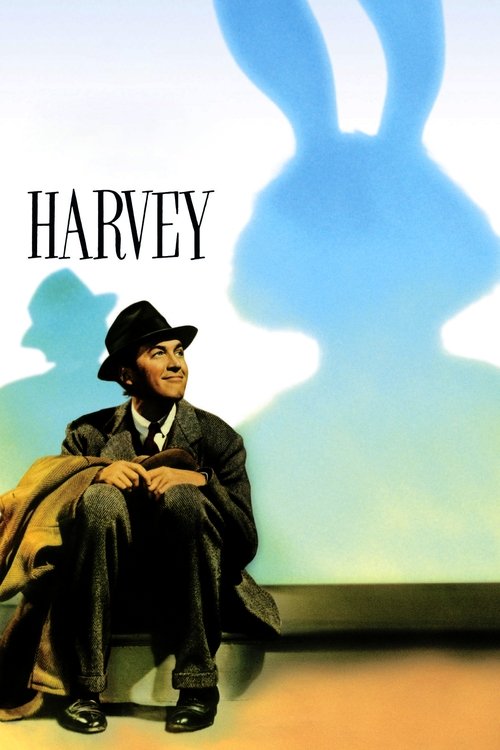
Harvey
1950 · Henry Koster
For a cozy night in when the world has been too much — comfort viewing of the highest order, the kind of film you put on when you need to be reminded that gentleness is a choice. Perfect for sharing with someone who thinks they don't like old movies.
What it's about
Elwood P. Dowd is the most pleasant man in town — unfailingly courteous, generous with his time, happy to invite anyone to dinner. His constant companion is Harvey, a six-foot invisible rabbit only he can see. When his mortified sister decides it's finally time to have Elwood committed to a sanatorium, a gentle comedy of errors takes over, and the question quietly shifts from what's wrong with Elwood to what's wrong with everyone else.
The experience
Warm, funny, and unexpectedly moving — it plays like a screwball farce but keeps landing on moments of real grace. You come out feeling lighter, and a little more inclined to be kind to strangers.
Performances
James Stewart gives one of his most beloved performances, conjuring an invisible rabbit out of pure attention and courtesy — you believe in Harvey because Elwood does. Josephine Hull is a comic marvel as the flustered sister trying to do the respectable thing.
The craft
Adapted from Mary Chase's Pulitzer Prize-winning play, the film makes one brilliant formal bet: never show the rabbit. Staging, sightlines, and Stewart's beatific focus do all the work, turning empty air into the most charming character on screen.
Why it matters
It turned a Broadway sensation into an enduring screen classic and gave Stewart one of his signature roles — the film people still reach for when they want to explain what 'gentle comedy' means.
Snapshot
Harvey is a chamber comedy of gentle metaphysics: the story of Elwood P. Dowd, an unfailingly courteous man whose closest companion is Harvey, a six-foot-plus invisible rabbit — a "pooka" drawn from Celtic folklore. Adapted from Mary Chase's Pulitzer Prize–winning stage play, the film translates a Broadway sensation into a Universal-International picture built almost entirely around James Stewart's performance and the audience's willingness to believe in what it cannot see. Its central formal wager is that Harvey works best when never shown: the film sustains the joke, and the pathos, by keeping the rabbit off-screen and letting staging, sightlines, and Stewart's beatific attention conjure a presence out of empty air. Beneath the farce of a family trying to have Elwood committed lies a quietly subversive proposition — that pleasantness, imagination, and eccentricity may be saner than the anxious social climbing that surrounds them. The film earned Josephine Hull an Academy Award and Stewart a nomination, and it has endured as one of the most beloved American fantasy comedies of the postwar studio era.
Industry & production
Harvey was a Universal-International production, released in 1950, and it belongs to a common midcentury studio strategy: acquiring a proven Broadway property and reproducing its prestige on film. Mary Chase's play had opened on Broadway in 1944 and run for years, winning the 1945 Pulitzer Prize for Drama; a screen adaptation was a natural commercial bet. Chase herself worked on the screenplay, sharing credit with veteran Universal writer Oscar Brodney, which gave the film unusual continuity with its source. Casting was the production's decisive move. Frank Fay had originated Elwood on stage, and James Stewart had also played the role during the Broadway run, so Stewart came to the film already intimate with the character rather than discovering it fresh. Josephine Hull likewise carried her stage performance as Veta Louise Simmons directly into the film. This transfer of theatrical personnel is central to understanding the picture: it is less a reinvention than a careful cinematic preservation of a stage success, with the studio betting on familiarity and pedigree. Henry Koster, a reliable Universal-associated director with a gift for warm, well-managed comedy and fantasy, was a sensible choice to shepherd delicate whimsical material without overplaying it.
Technology
Technologically, Harvey is a conventional black-and-white, Academy-ratio (1.37:1) studio production of its moment, and its most interesting technical dimension is a creative choice rather than a hardware advance: the decision to render Harvey through absence. Rather than deploy optical effects, animation, or a visible costumed figure for the rabbit, the filmmakers rely on performance, blocking, and the occasional practical cue — a door that swings open on its own, a hat with holes cut for ears, a portrait painting depicting Elwood beside the rabbit. This restraint is a deliberate counter to the effects-driven temptations of fantasy filmmaking. The film thus sits at an interesting technological juncture: the tools to depict a giant rabbit existed, but the production judged that suggestion would be more persuasive and more moving than depiction. Beyond this, the picture uses standard postwar sound recording and studio lighting technology; there is no evidence of unusual technical experimentation, and I would not want to overstate innovations the historical record does not clearly support.
Technique
Cinematography
The cinematography is credited to William H. Daniels, a major figure best known for his long association with Greta Garbo at MGM. His work here is polished, unobtrusive black-and-white studio photography in service of performance and legibility. The camera's most consequential job is spatial: it must repeatedly frame empty space as though it were occupied, holding compositions that leave room for Harvey — a chair angled toward nothing, a doorway kept clear, a two-shot that is really a one-shot with an invisible partner. Daniels's framing has to honor Elwood's eyelines so that the audience reads Harvey's "position" consistently, a discipline of sightline continuity that is quietly essential to the film's illusion. The lighting is soft and even, appropriate to comedy, avoiding the expressionist contrast that might have pushed the material toward the uncanny rather than the benign.
Editing
Ralph Dawson is credited with the editing. The cutting is generally classical and restrained, favoring sustained takes that let scenes breathe and let Stewart's monologues land at their own unhurried tempo. Because much of the comedy depends on the audience believing an invisible figure occupies real space, the editing must avoid cuts that would "reveal" the emptiness too baldly or break the spatial logic Elwood establishes; the film tends to hold on Stewart and on reaction shots of the bewildered people around him. The rhythm is theatrical in the best sense — scene-length units of dialogue — rather than aggressively montage-driven.
Mise-en-scène / staging
Staging is where Harvey does its most inventive work, and the film's theatrical origins are visible and productive here. Interiors — the Dowd family home, Chumley's Rest sanitarium — are the primary arenas, and blocking is organized around an absent character. Actors must leave gaps, gesture to empty chairs, react to a presence at a specific height, and move through doorways as if making way. The famous portrait of Elwood and Harvey functions as a mise-en-scène anchor, a visible "proof" of the invisible companion hung within the frame. The staging also encodes the film's social geography: the pretensions of Veta's social world, the clinical spaces of the asylum, and Elwood's serene indifference to both are all expressed through how bodies occupy these rooms.
Sound
The score is credited to Frank Skinner, a prolific Universal composer, and it supports the comedy and sentiment in a broadly classical Hollywood idiom without overwhelming the dialogue. The film's soundtrack is fundamentally verbal — this is a picture of monologues, misunderstandings, and gently absurd exchanges — so the sound design foregrounds speech clarity. Practical sound cues occasionally do quiet illusionistic work, such as a door mechanism, reinforcing Harvey's presence aurally as well as visually.
Performance
Performance is the film's engine. James Stewart's Elwood is a study in unhurried warmth: a slow, gentle cadence, courteous formality, and an unwavering, loving attention directed at empty space that makes Harvey feel real. Stewart resists any wink to the audience; his sincerity is the whole point, and it converts what could be a one-joke premise into something tender and faintly melancholic. Josephine Hull's Veta is the necessary comic engine of anxiety and social embarrassment — flustered, well-meaning, and finally destabilized when she herself seems on the verge of "seeing" Harvey — and her Oscar-winning turn provides the farcical momentum against which Stewart's calm registers. The supporting ensemble (the sanitarium staff, the niece, the doctors) plays the escalating comedy of errors with the timing the material's stage origins demand.
Narrative & dramatic mode
The dramatic mode is farce braided with fable. The plot machinery is classic comedy-of-errors: an attempt to commit Elwood misfires, the wrong person is nearly institutionalized, identities and intentions are mistaken, and the ensuing scramble exposes the vanity and fear of the "sane" characters. But this farcical armature carries a gentler, almost parable-like center. Elwood is a still point around whom everyone else's frantic self-interest revolves, and the narrative gradually inverts our assumptions: the man who talks to a rabbit is the most emotionally intelligent and generous person on screen. The film flirts with genuine ambiguity — is Harvey real, a delusion, or something the film itself half-endorses as real? — and it is careful never to fully resolve the question, which is the source of both its comedy and its lingering resonance. Elwood's celebrated credo about choosing to be pleasant rather than smart gives the film its moral thesis without turning didactic.
Genre & cycle
Harvey sits at the intersection of two Hollywood cycles: the whimsical fantasy comedy and the prestige stage-to-screen adaptation. As fantasy, it belongs to a postwar and 1940s vein of "benign supernatural" American films in which spirits, angels, and imaginary friends intrude gently on ordinary life — a sensibility adjacent to pictures like The Bishop's Wife, which Koster himself had directed. As adaptation, it is part of the steady studio traffic in Broadway properties that promised built-in prestige and pre-sold titles. Within Stewart's own filmography it forms part of a recognizable "everyman with an inner life" persona, though Harvey leans further into eccentric fantasy than most of his work. The film's particular contribution to the fantasy-comedy cycle is its choice to keep the fantastical element invisible, making imagination itself, rather than spectacle, the object of belief.
Authorship & method
Authorship of Harvey is genuinely distributed, and the honest reading gives Mary Chase primacy. The film is first her creation: her play, her characters, her Pulitzer-honored conception of the pooka, and her hand on the screenplay (with Oscar Brodney) preserve the material's voice. Henry Koster's directorial method is one of tasteful facilitation — a director attuned to warmth, comic timing, and fantasy who understood that the material required lightness of touch rather than assertive style; his career, from Deanna Durbin vehicles through The Bishop's Wife and later The Robe, shows a craftsman comfortable across genres and trusted with prestige projects. William H. Daniels brings seasoned cinematographic polish; Frank Skinner supplies a supportive Universal score; Ralph Dawson provides classical editing. Yet the film's true co-author is James Stewart, whose performance is so constitutive of Elwood that the character and the star have become inseparable in cultural memory — a case where authorship passes substantially into acting. The method throughout is fidelity: to the play's tone, its dialogue, and its central refusal to explain Harvey away.
Movement / national cinema
Harvey is a product of the classical Hollywood studio system at maturity, not of any avant-garde or national movement, and it should be described as such. It is mainstream American commercial cinema of the late studio era. One meaningful transnational thread runs through its director: Henry Koster (born Hermann Kosterlitz) was a German émigré who fled Nazi Germany, part of the large wave of European film talent that reshaped Hollywood. His background does not stamp Harvey with obvious Weimar or expressionist markings — the film is thoroughly American in idiom — but it is a reminder that midcentury Hollywood craft was frequently the work of exiled European professionals. Otherwise the film is best understood within the domestic tradition of the studio prestige comedy rather than any stylistic school.
Era / period
The film is firmly of 1950 and of the immediate postwar American moment. Its gentleness and its faith in individual kindness read as of a piece with a period appetite for reassurance and warmth, and its stage-to-screen prestige model is characteristic of the era's production economics, when studios mined Broadway for respectable, presold material. The Academy-ratio black-and-white presentation is standard for a non-spectacle picture of the year, just before the industry's wide-screen and color arms race of the 1950s (a race Koster himself would help launch with The Robe). Harvey thus sits at the tail end of a classical mode of intimate, dialogue-driven studio filmmaking, made just as the industry was about to reorient toward spectacle in response to television.
Themes
The film's governing theme is the value of gentleness and imagination against a world that prizes status, efficiency, and conformity. Elwood embodies a chosen kindness — his oft-quoted preference for being pleasant over being clever — that the film treats not as simplicity but as a hard-won wisdom. Closely related is the theme of sanity and its discontents: Harvey quietly interrogates who gets to define madness, staging a world in which the "well-adjusted" are anxious and self-serving while the "delusional" man is serene and generous. There is a strand about loneliness and companionship — Harvey answers a human need for connection and for being truly listened to. The film also touches social pretension and class anxiety through Veta's mortification, and finally a theme of acceptance: the family's arc bends toward tolerating, even valuing, Elwood as he is. The refusal to resolve whether Harvey is real keeps these themes suspended in productive ambiguity rather than reducing them to a lesson.
Reception, canon & influence
The film arrived with the advantage of a celebrated source and delivered awards recognition: Josephine Hull won the Academy Award for Best Supporting Actress, and James Stewart received a Best Actor nomination for Elwood. Beyond these concrete honors, I would be cautious about asserting precise contemporary box-office figures or specific critical verdicts that the record does not clearly establish; what is firmly documented is that the picture was a well-regarded prestige comedy that has grown steadily in stature.
Looking backward, the film's influences are primarily literary and theatrical rather than cinematic: Mary Chase's play and its grounding in the folkloric figure of the pooka supply the whole conceptual architecture, and the film inherits the shape, dialogue, and even much of the cast of a Broadway hit. The tradition of benign-supernatural American comedy — the angel and ghost pictures of the 1940s, including Koster's own The Bishop's Wife — forms its nearest generic lineage.
Looking forward, Harvey's legacy is substantial and durable. It cemented one of James Stewart's signature roles; Stewart's identification with Elwood was strong enough that he returned to the part on stage later in life. The character of Harvey — the invisible giant rabbit — has become a broad cultural reference point for imaginary companions and for the theme of tolerated eccentricity, and the film is regularly cited as a touchstone for gentle fantasy about the sanity of kindness. Its most instructive formal legacy is the demonstration that an unseen presence, sustained by performance and staging alone, can be more affecting than any visible effect — a lesson in suggestion over spectacle that continues to be invoked whenever filmmakers choose restraint over depiction. The play and film have been revisited in later stage revivals and remakes across decades, testifying to the enduring pull of Chase's premise, though the 1950 picture remains the definitive screen version in the popular imagination.
Reception
A solid hit in 1950 with two Oscar nominations, it was long filed under 'pleasant Jimmy Stewart vehicle' — but decades of TV airings and word-of-mouth have elevated it into one of cinema's great comfort movies, now routinely cited as an antidote to cynicism.
How Harvey was received, from release to now →
Influences: the films it descends from and the films it influenced
- Topper (1937) — Established the benign-supernatural comedy template of staging vanishing spirits sharing the frame with the living — objects moving and dialogue answered by figures others can't fully see — the played-for-gentle-laughs invisible-presence blocking Harvey refines.
- Here Comes Mr. Jordan (1941) — Codified the metaphysical-comedy mode that treats the afterlife and the supernatural as warm bureaucratic whimsy rather than horror, the tonal register of benign fantasy Harvey inherits wholesale.
- Arsenic and Old Lace (1944) — Direct cast and method lineage: Josephine Hull reprised her Broadway sweet-deranged-aunt turn on screen, and its fidelity to stage blocking and single-room farce is the adaptation model Harvey follows.
- You Can't Take It With You (1938) — Pulitzer stage comedy that frames tolerated household eccentricity as the sane response to a money-and-conformity society — the sanity-and-conformity argument Elwood embodies, imported from theater with dialogue intact.
- Blithe Spirit (1945) — Stage-to-screen Coward adaptation whose comedy runs on a spirit only some characters perceive, forcing blocking and reaction shots to sell a presence invisible to others in the room — Harvey's staging problem, one film prior.
- It's a Wonderful Life (1946) — The immediately preceding Stewart-plus-benign-supernatural pairing (Clarence the angel); Stewart's warm, halting everyman method here is the exact performance vocabulary he carries into Elwood.
- The Bishop's Wife (1947) — Koster's own prior angel comedy, rehearsing his signature light-touch facilitation of a supernatural figure moving among ordinary people without stylistic assertion — the directorial restraint he reuses on Harvey.
- Being There (1979) — Peter Sellers' serene simpleton is read as profound and sane by a conformist establishment; the deadpan sanity-and-conformity satire descends directly from Elwood's unbothered gentleness confounding the 'normal' world.
- Beetlejuice (1988) — Extends the Topper–Harvey benign-supernatural comedy where the living and unseen dead share domestic space for laughs, mining the gap between who perceives the spirit and who doesn't for staging gags.
- Fight Club (1999) — Tyler Durden is shot with rigorous eyeline-match and two-shot blocking as a genuine interlocutor who is in fact one man's projection — Harvey's invisible-partner staging inverted into psychological menace.
- Cast Away (2000) — Sustains a whole relationship through eyeline continuity and blocking toward 'Wilson,' an inanimate, silent companion — the purest test of Harvey's lesson that performance and staging alone can conjure an unseen presence.
- A Beautiful Mind (2001) — Stages hallucinated companions with normal eyeline-continuity and shot/reverse-shot so the audience shares the delusion until the reveal, deploying Harvey's blocking-around-the-invisible device as a narrative trap.
- Donnie Darko (2001) — The visionary man-sized rabbit 'Frank' is an explicit descendant of Harvey, weaponizing the same is-he-mad-or-is-it-real ambiguity and the giant-rabbit imaginary-companion iconography.
- Lars and the Real Girl (2007) — An entire community humors one man's benign delusion out of kindness, staging Harvey's ethic — that tolerated eccentricity and gentleness are saner than 'correcting' the sufferer — as straight-faced drama.
- Ruby Sparks (2012) — Takes the one-person's-imagined-companion premise and makes the figure materially present to others, extending Harvey's benign fantasy about a private vision breaking into shared reality.
- Miracle on 34th Street (1947) — Builds an entire film on unresolved ambiguity about whether a 'delusion' (Santa) is literally real and stages a formal sanity hearing to adjudicate it — the courtroom/commitment sanity-and-conformity structure Harvey mirrors.
- The Ghost and Mrs. Muir (1947) — Sustains a supernatural companion perceived by one person through eyeline and intimate reaction rather than effects spectacle, the same suggestion-over-depiction discipline central to Harvey.
Similar films
- It's a Wonderful Life (1946) — influence & lineage
- The Truman Show (1998) — shared sensibility
- The Cow (1969) — shared sensibility
- Harold and Maude (1971) — shared sensibility
- Best in Show (2000) — shared sensibility
- Rear Window (1954) — shared sensibility
- The Royal Tenenbaums (2001) — shared sensibility
- EO (2022) — shared sensibility
All the films related to Harvey →
Watch it with: curated runs of related films
- Unlikely Companions, Gentle Roads — Watch these together for the way a mismatched pair — a yakuza and a lost boy, an old man on a lawnmower bound for his brother, a runaway kid and a grizzled uncle, two frontier drifters with a stolen cup of milk — becomes a whole small world; they rhyme on tenderness carried at walking pace.