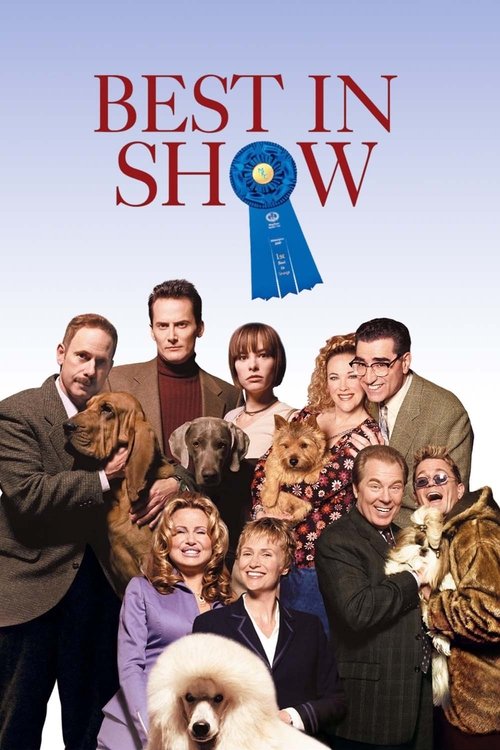
Best in Show
2000 · Christopher Guest
When you need a guaranteed laugh — ideal for a low-stakes night, a group watch, or cheering yourself up. Total comfort viewing that happens to be razor-sharp.
What it's about
A handful of spectacularly obsessive dog owners from across America — and their impeccably groomed animals — converge on the Mayflower Kennel Club Dog Show in Philadelphia, each convinced their pet is destiny's champion. Told as a straight-faced documentary, complete with talking-head interviews and a play-by-play competition finale, it follows the neuroses, marriages, and rivalries orbiting one very serious dog show.
The experience
Deadpan, endlessly quotable, and laugh-out-loud funny — the comedy sneaks up in half-sentences and pained silences rather than punchlines. It skewers its characters and somehow loves them anyway, which is why it holds up on the tenth viewing.
Performances
A murderer's row of improvisers: Fred Willard's cheerfully clueless commentator is one of the great comic performances of its era, and Catherine O'Hara, Eugene Levy, and Parker Posey each build fully lived-in absurd people out of thin air.
The craft
Christopher Guest and Eugene Levy wrote a detailed scene-by-scene outline but not a single line of dialogue — the entire cast improvised every word, and the editing carves the funniest fraction from hours of invention. The faux-documentary style is executed so precisely it plays like the real thing.
Why it matters
Widely regarded as the peak of the modern mockumentary, it cemented Guest's improvised-ensemble method and shaped the deadpan documentary-style comedy that television and film have been imitating ever since.
Snapshot
Best in Show is Christopher Guest's mockumentary of the American dog-show subculture, tracking a handful of obsessive owners and their pedigree animals as they converge on the (fictional) Mayflower Kennel Club Dog Show in Philadelphia. It was the second feature in the loose trilogy of improvised ensemble comedies Guest built with a recurring troupe — following Waiting for Guffman (1996) and preceding A Mighty Wind (2003) and For Your Consideration (2006). The film is structured as a faux documentary: talking-head interviews, observational handheld footage, and a play-by-play competition finale anchored by a deliberately clueless commentator. Its method is its signature — Guest and co-writer Eugene Levy wrote a detailed scene-by-scene outline but no dialogue, and the cast improvised every line. Widely regarded as one of the sharpest American comedies of its era, Best in Show established the template that "mockumentary" would mean for a generation of viewers and gave the form a warmth that distinguished it from more caustic satire. Its ensemble — Levy, Catherine O'Hara, Parker Posey, Michael Hitchcock, Jennifer Coolidge, Jane Lynch, John Michael Higgins, Michael McKean, Guest himself, and Fred Willard — became a repertory company whose chemistry is the film's true subject.
Industry & production
Best in Show was produced and released by Castle Rock Entertainment and distributed by Warner Bros., placing it within the studio-affiliated specialty pipeline of the late 1990s rather than the pure independent sphere. Castle Rock had backed Waiting for Guffman, and the relationship gave Guest unusual creative latitude for a comedy: a modest budget, a short shoot, and the freedom to work without a conventional screenplay. Public budget and box-office figures for the film are not something I can cite reliably from memory, so I will not invent them; the film is generally understood to have been inexpensively produced and to have performed strongly relative to its cost on the arthouse and crossover circuit, becoming a durable catalog and home-video title.
The production's defining industrial fact is its writing-and-casting model. Guest and Levy supplied a "scriptment" — an outline establishing each character's biography, relationships, and the beats a scene needed to hit — and then cast performers capable of sustaining improvisation in character for long takes. Because dialogue was generated on set, the production shot a very high ratio of footage to finished film, shifting the authorial burden downstream to the edit. This is the inverse of conventional studio comedy economics, where the script is fixed and coverage is planned; here, the "writing" continued through principal photography and into post. The repertory casting also functioned as a production efficiency: performers who already knew one another's rhythms from Guffman could establish believable intimacy quickly, which mattered for a shoot that depended on spontaneous interplay rather than rehearsed setups.
Technology
Technologically Best in Show is unobtrusive by design; its tools serve the illusion of documentary. It was shot on film in a flat, available-light-leaning register meant to read as observational rather than composed. The aesthetic choices — handheld camerawork, zooms that "find" their subjects, the slightly imperfect framing of a crew reacting to events — are deliberate evocations of nonfiction technique rather than the product of new equipment. The film does not announce technological novelty; if anything its craft lies in suppressing the polish that the era's studio comedies typically pursued. The competition finale, staged in an arena, leans on multi-camera coverage to mimic live broadcast sports television, including the conventions of the color commentator and the cutaway. Where many films of 2000 were beginning to foreground digital effects, Best in Show pointedly does not; its "effects" are behavioral and performative, captured by a camera pretending to be a documentary crew.
Technique
Cinematography
The cinematography, by Roberto Schaefer, commits fully to the documentary conceit. The camera behaves as if it is discovering its subjects: reframing on the fly, pushing in for emphasis, holding on faces a beat too long to let an awkwardness bloom. Talking-head interviews are lit and composed to evoke the slightly utilitarian look of nonfiction TV — subjects seated in their homes or businesses, environment used as characterization. The handheld grammar is essential to the comedy: by refusing the stability and symmetry of scripted narrative cinema, the camera signals that what we are watching is "real," which makes the absurdity land as documented behavior rather than written joke. The arena sequences shift register toward sports broadcast, with the camera tracking dogs around the ring and cutting to the announcers' booth, importing the visual language of live event television wholesale.
Editing
Editing is where Best in Show is genuinely authored. With hours of improvised material per scene, the cut determines which performance, which line, and which reaction becomes the film. Editor Robert Leighton — a longtime Guest collaborator — shaped the comic timing, the selection of the funniest or truest takes, and the rhythm of intercutting between the parallel storylines as the characters travel toward Philadelphia. The film's structure is essentially editorial: it cross-cuts among several couples and individuals, building each as a self-contained comic portrait before braiding them together at the show. The talking-head interludes function as editorial punctuation, allowing a character to comment, contradict, or undercut the scene we have just watched. Much of the film's celebrated quotability is a product of editorial discovery — finding the gem inside a long improvised run and placing it for maximum effect.
Mise-en-scène / staging
Staging is loose and reactive, prioritizing performer freedom over composed blocking. Environments do heavy characterizing work: the yuppie couple's catalog-perfect home and matching neuroses, the Florida bait-shop and trailer milieu of Harlan Pepper, the genteel surfaces masking the show-world's pettiness. Props and costume signal class and self-image precisely — the "Busy Bee" toy whose loss triggers a marital meltdown, the matching outfits, the grooming rituals lavished on the animals. The dogs themselves are staged as extensions of their owners, a visual thesis the film returns to repeatedly. Because the actors generated behavior in real environments, the mise-en-scène feels lived-in rather than dressed, reinforcing the documentary register.
Sound
Sound design keeps to the naturalism of the documentary frame: location dialogue with its imperfections, ambient arena noise, the texture of real spaces. The score, by Guest's regular musical collaborator Jeffrey CJ Vanston (with Guest himself a credited musician across the trilogy), is restrained, never inflating jokes with comic stings; the humor is left to play dry. The single most important sonic element is the human voice in improvisation — the rhythms, hesitations, and overlaps of unscripted speech — and the film's sound work is largely in service of presenting that voice cleanly. The arena commentary, with its parody of sports-broadcast cadence, is a sound-driven set piece as much as a visual one.
Performance
Performance is the film's reason for being. The ensemble sustains fully realized characters through long improvised takes, generating comedy from behavioral truth rather than gag construction. Fred Willard's Buck Laughlin — the dog-show color commentator who knows nothing about dogs — is the film's most quoted creation, a stream of cheerful non-sequiturs that satirize broadcast inanity. Eugene Levy and Catherine O'Hara play a couple whose marriage is haunted by the wife's improbably vast romantic past; Parker Posey and Michael Hitchcock are the brittle, over-therapized urban professionals; Jennifer Coolidge and Jane Lynch form a couple around a trophy wife and a knowing handler; Christopher Guest's Harlan Pepper is a deadpan Southern bloodhound owner with show-business dreams; John Michael Higgins and Michael McKean play a poised, affectionate gay couple who are among the film's warmest figures. The achievement is collective: no performance is "the lead," and the comedy depends on the troupe's mutual responsiveness.
Narrative & dramatic mode
The dramatic mode is mock-documentary: a fictional story told entirely through the apparatus of nonfiction. The narrative is multi-stranded and convergent — several independent character studies that travel toward a single event, the dog show, where their lines intersect and a winner is crowned. Within that frame the film alternates two registers: observational scenes "captured" by the crew, and direct-address interviews in which characters explain, justify, or unwittingly expose themselves. The dramatic engine is character revelation rather than plot: stakes are emotional and egoistic (status, validation, the need to win) rather than consequential. The competition supplies a clean three-act spine — preparation, journey, contest — onto which the improvised portraiture is hung. Crucially, the mode is comic but not contemptuous; the documentary frame invites us to laugh at the characters while the performances keep them recognizably human.
Genre & cycle
Best in Show sits at the center of the modern mockumentary cycle and, more specifically, within Guest's own self-contained body of "behind-the-scenes-of-an-amateur-passion" comedies. Each film in the trilogy-plus takes a small American subculture — community theater, dog shows, folk-music revival, awards-season Hollywood — and treats its devotees with the same mixture of mockery and affection. As genre, it belongs to the lineage of satirical faux-documentary that runs through Rob Reiner's This Is Spinal Tap (1984), a film on which Guest was both co-writer and star (as Nigel Tufnel) alongside Michael McKean — making Best in Show a direct descendant of that foundational text. The cycle it helped consolidate would soon migrate to television and dominate a decade of single-camera comedy. Within the ensemble-comedy genre, its distinguishing trait is the absence of a scripted joke architecture: it is character comedy of behavior, closer to documentary than to farce.
Authorship & method
The film is authored in an unusually distributed way, with Christopher Guest as the organizing intelligence. Guest directed and co-wrote (with Eugene Levy) the outline that fixed character and structure while leaving dialogue to the cast — a method he had refined on Waiting for Guffman and would carry forward. Authorship is therefore shared between the writer-director who designed the world and the performers who populated it with language. Key collaborators recur across his films and constitute a genuine repertory system: editor Robert Leighton, whose cutting converts improvisation into structure; cinematographer Roberto Schaefer, who supplies the documentary look; and the musical contributions of Guest, Michael McKean, and CJ Vanston, who also write the comic songs that feature in the trilogy. Eugene Levy is the essential creative partner — co-writer and co-star — and the casting of a stable troupe is itself an authorial decision, since the films depend on pre-existing chemistry. The "auteur" here is best understood as a method and a company rather than a single controlling hand imposing dialogue.
Movement / national cinema
Best in Show is a thoroughly American film, both in its industrial home and its subject. It belongs to a native tradition of comic social observation — a survey of regional types, class manners, and the peculiarly American conviction that any pastime can become a vehicle for self-actualization and competition. It is not aligned with a formal avant-garde movement; its lineage is the American comedy of improvisation and the documentary impulse, drawing on the observational nonfiction tradition (the talking head, the vérité camera) and bending it to satire. If there is a "movement," it is the turn-of-the-millennium revival of the mockumentary as a respectable comic form, of which Guest is the central American figure. The film's portrait gallery — Floridian, urban Northeastern, Southern, suburban — functions as a comic atlas of American social niches.
Era / period
Released in 2000, the film captures a specific cultural moment: late-1990s affluence, the therapeutic vocabulary of self-examination, and a media landscape saturated with cable broadcasting of niche events. The Posey-Hitchcock couple's brand-saturated, over-analyzed lifestyle is a precise period satire of yuppie consumer culture; Fred Willard's commentator parodies the era's expansion of televised live-event coverage into ever-smaller subcultures. Stylistically the film arrives at the threshold of the 2000s mockumentary boom — just before the format would become the dominant grammar of television comedy — making it a hinge work between the Spinal Tap lineage of the 1980s–90s and the single-camera sitcom revolution that followed. Its low-fi, anti-spectacle aesthetic also reads as a counter-statement to the effects-driven studio cinema of its year.
Themes
At its core the film is about identity through obsession: people who locate their self-worth in a passion and an animal, projecting their anxieties, vanities, and unmet needs onto their dogs. Competition and the hunger for validation drive nearly every character; the show is a stage on which class, marriage, sexuality, and regional identity are performed. Marriage and partnership are examined across a spectrum — the comic dysfunction of the Posey-Hitchcock pairing, the haunted history of the Levy-O'Hara marriage, the genuine tenderness of the Higgins-McKean couple — so that the film becomes, almost incidentally, a survey of how couples hold together (or fray) under pressure. Class and self-presentation are constant: the gap between how characters wish to be seen and what the camera records is the engine of the comedy. Underlying it all is a gentle thesis about American striving — the conviction that excellence, recognition, and a blue ribbon will confer meaning. The film's tone toward these obsessions is affectionate mockery; it laughs without despising.
Reception, canon & influence
Best in Show was warmly received by critics, who praised its improvisational ensemble, its quotability, and the precision of its social observation; it is frequently cited among the best comedies of its decade and as a high point of the mockumentary form. Fred Willard's performance in particular drew singular acclaim and is often singled out as one of the great comic supporting turns of the era. I cannot cite specific awards tallies or grosses from memory and will not fabricate them, but the film's standing as a durable critical favorite and a perennially rewatched catalog title is well established.
Looking backward, the film's clearest influence is This Is Spinal Tap, whose mockumentary method and several of whose key personnel (Guest, McKean) directly seed it, and behind that the observational documentary tradition whose conventions it parodies. Waiting for Guffman is its immediate predecessor and proof-of-concept. Looking forward, its impact is outsized: Best in Show did more than almost any film to popularize the mockumentary as a mainstream comic mode and to demonstrate that fully improvised, character-driven faux-documentary could sustain a feature. The single-camera, talking-head comedy that came to dominate 2000s and 2010s television — the lineage that runs through shows built on direct-address interviews and observational embarrassment — owes an evident debt to the grammar Guest refined here. Within his own work it anchors a continuing repertory project, and its troupe scattered into a generation of comic performances. Its legacy is thus double: a beloved standalone comedy, and a formative text in the genre's migration from rock parody to a general-purpose language for filming ordinary human absurdity.
A Deleuzian reading
Two people sit on their own sofa and tell the camera how they met: at a Starbucks, across the street from another Starbucks.
The full Deleuzian reading of Best in Show →
Reception
A modest theatrical hit in 2000 that critics liked but nobody called a landmark — a quarter-century on it's widely treated as the peak of Christopher Guest's mockumentary run, the one people rewatch annually when Westminster rolls around.
How Best in Show was received, from release to now →
Influences: the films it descends from and the films it influenced
- This Is Spinal Tap (1984) — The direct ancestor: Guest and McKean carry over its faux-rockumentary method of building characters from improvised dialogue over a fixed outline and filming them through a credulous documentary crew's framing.
- Waiting for Guffman (1996) — Guest's own proof-of-concept for the exact production system reused here — a written character/structure outline with all dialogue improvised by a repertory cast, edited by Robert Leighton into shape, and built around a small-town amateur competition.
- Marcel the Shell with Shoes On (2022) — Perfects the deadpan vérité-comedy interview built on improvised, character-driven digressions and reaction beats, the tonal model for Marcel's naturalistic, half-improvised Jenny Slate line readings.
- Pitch Perfect (2012) — Its deadpan competition color-commentary duo is the direct ancestor of Higgins and Banks's absurdist play-by-play, a mockumentary device grafted onto the a cappella finals.
- Real Life (1979) — Pioneers the feature-length parody of observational documentary (skewering 'An American Family'), establishing the intrusive nonfiction-crew conceit and self-serious talking-head subjects that Guest's grammar refines.
- The Rutles: All You Need Is Cash (1978) — Earlier music mockumentary that fuses straight-faced archival-doc pastiche with comic interviews, modeling the deadpan reportage register Guest's ensembles inhabit.
- Nashville (1975) — Supplies the multi-strand ensemble that converges on a single public event, with restless zoom lenses and overlapping naturalistic talk treated as documentary coverage rather than scripted scenes.
- Grey Gardens (1975) — Direct-cinema portrait of eccentric obsessives whose home becomes a character; its tolerant, unblinking observation of self-mythologizing personalities is precisely the gaze Guest reproduces on his dog owners.
- Dont Look Back (1967) — Codifies the handheld, available-light vérité grammar — verbal subjects trailed backstage by a fly-on-the-wall crew — that Roberto Schaefer's camerawork imitates and the film gently parodies.
- Zelig (1983) — Sustains a feature on faux-documentary apparatus — talking-head experts, mock-archival footage, narrated case study — demonstrating the mockumentary's capacity to carry a whole picture rather than a sketch.
- Drop Dead Gorgeous (1999) — A near-contemporary sibling applying the same competition-mockumentary template — talking-head contestants and handlers chasing validation through a small-stakes pageant — to beauty contests instead of dog shows.
- A Mighty Wind (2003) — Direct sibling from the same troupe and method, again organizing improvised character ensembles around a culminating performance event and original comic songs by Guest, McKean and Vanston.
- For Your Consideration (2006) — Repertory sibling that keeps the company and improvised-outline method while loosening the strict mockumentary frame, extending Guest's anatomy of obsession-and-validation to awards-season delusion.
- Mascots (2016) — Late descendant that re-runs the Best in Show blueprint almost exactly — competing eccentrics, talking-head confessionals, a judged final — confirming the dog-show structure as a reusable craft engine.
- Borat (2006) — Extends improvised mockumentary into the feature mainstream, pushing the embarrassment-comedy and credulous-crew conceit toward real-world ambush while retaining the faux-documentary editorial frame.
- The Office (UK) (2001) — The pivotal TV descendant that inherits Guest's refined grammar wholesale — direct-address interviews, handheld vérité coverage, and comedy of observational embarrassment — as a general-purpose mode for ordinary settings.
Similar films
- Zelig (1983) — influence & lineage
- This Is Spinal Tap (1984) — influence & lineage
- Waiting for Guffman (1997) — shared sensibility
- The Truman Show (1998) — shared sensibility
- The Sheep Detectives (2026) — shared sensibility
- Hundreds of Beavers (2024) — shared sensibility
- A Dog's Will (2000) — shared sensibility
- The Big Lebowski (1998) — shared sensibility