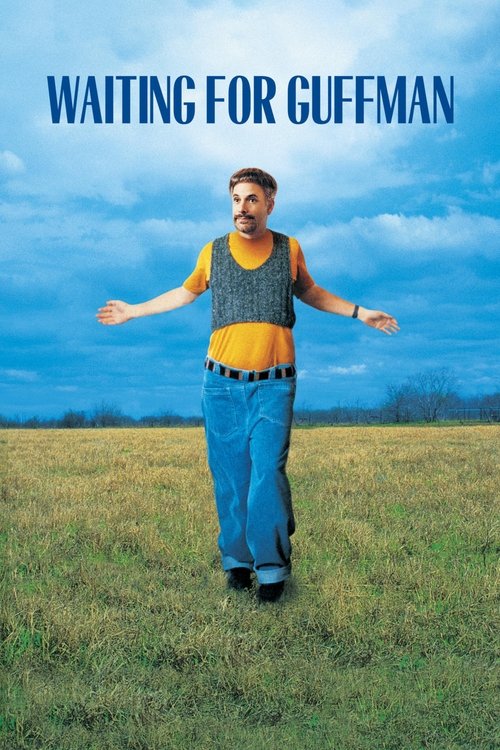
Waiting for Guffman
1997 · Christopher Guest
For when you need a real laugh with zero cynicism required — a comfort comedy that gets funnier on every rewatch and quotes itself into your household vocabulary. Great with friends who'll catch the small stuff.
What it's about
Blaine, Missouri is turning 150, and the town is celebrating with an original amateur musical directed by Corky St. Clair — a flamboyant off-off-Broadway refugee whose ambition dwarfs both his talent and that of his cast of dentists, travel agents, and Dairy Queen employees. When word arrives that a real Broadway agent named Mort Guffman will attend opening night, the company convinces itself that stardom is one performance away. A documentary crew captures every rehearsal, delusion, and jazz hand.
The experience
Deadpan, deceptively gentle, and progressively funnier the longer you sit with it — the laughs come from tiny facial reactions and people saying absurd things with total sincerity. By the time the show-within-the-show arrives, it's both hilarious and weirdly touching.
Performances
Christopher Guest's Corky is a full-body comic creation, delusional and oddly poignant; Eugene Levy, Catherine O'Hara, Fred Willard, and Parker Posey — all improvising their own dialogue — each build small-town dreamers so specific they feel documentary-real.
The craft
Guest and Levy wrote a detailed outline but no script, letting a troupe of master improvisers generate the dialogue on camera, then shaping the results in the edit — a method that produces jokes no screenwriter would dare write. The original musical numbers are pitched at exactly the right level of earnest badness, which is its own kind of precision.
Why it matters
It established the Christopher Guest troupe mockumentary as a distinct American comic form and set the template for the ensemble improvised comedies — his own and many others' — that followed for the next two decades.
Snapshot
Waiting for Guffman is the film that established Christopher Guest as a director and, in retrospect, the founding work of a distinct American comic mode: the troupe-based, largely improvised mockumentary. Set in the fictional small town of Blaine, Missouri, it follows the mounting of Red, White and Blaine, an amateur musical staged to celebrate the town's 150th anniversary, under the direction of Corky St. Clair (Guest) — a flamboyant, failed off-off-Broadway transplant whose grandiose ambitions vastly exceed both his talent and that of his volunteer cast. The narrative engine, announced by the title's nod to Beckett, is the rumored attendance of Mort Guffman, a Broadway agent whose presence the company believes will lift them out of obscurity and onto the New York stage. The film's documentary conceit — a camera crew dutifully recording the town, the auditions, the rehearsals, and the performance — allows Guest and his collaborators to build comedy almost entirely from character, observation, and improvisation rather than gags. What emerges is at once a precise satire of provincial self-regard and show-business delusion and, more unexpectedly, a tender portrait of amateur dreamers whose dignity the film ultimately refuses to mock. Modest in budget and box-office terms but enormously influential, Waiting for Guffman set the template — the ensemble, the talking-head confessions, the affectionate cruelty — that Guest would refine across Best in Show and A Mighty Wind, and that would reshape television comedy in the decade that followed.
Industry & production
Waiting for Guffman was produced by Castle Rock Entertainment, the company co-founded by Rob Reiner, and distributed by Sony Pictures Classics, the specialty arm through which Sony handled independent and art-house releases. The Castle Rock connection is more than incidental: Reiner had directed This Is Spinal Tap (1984), the landmark rock mockumentary that Guest co-wrote and co-starred in alongside Michael McKean and Harry Shearer, and which is the unmistakable formal and tonal ancestor of Guffman. The institutional lineage from Spinal Tap through Castle Rock to Guffman is one of the clearest authorship pipelines in modern American comedy.
The film was made cheaply and quickly, in keeping with its improvisational method and faux-documentary aesthetic. Principal photography took place in Lockhart, Texas, a small town whose period courthouse and main-street architecture stood in for the imagined Missouri of Blaine. The production's economy was a creative asset as much as a constraint: the unglamorous look, the real small-town locations, and the absence of conventional coverage all reinforced the documentary illusion the film depends upon.
The decisive production fact is the working method. Guest and his co-writer Eugene Levy did not produce a conventional screenplay with scripted dialogue. Instead they wrote a detailed outline — establishing the town, the characters, their biographies, and the sequence of scenes — and the cast improvised their lines within that scaffolding. The musical numbers of Red, White and Blaine were, by contrast, fully written and composed in advance, since they had to be performed and repeated; the original songs were the work of Guest and his Spinal Tap collaborators. This division — scripted songs, improvised speech — is the structural signature of the film and of Guest's subsequent work, and it required a particular kind of performer: comic actors with the discipline and backgrounds to invent in character at length.
Casting drew on three overlapping comedy institutions. From the Canadian sketch series SCTV came Eugene Levy and Catherine O'Hara; from This Is Spinal Tap came Guest himself, with McKean and Shearer contributing songs; and from the broader world of American improv and character comedy came Fred Willard, Parker Posey, Bob Balaban, and Lewis Arquette. This ensemble — several of whom Guest would carry forward into his later films — is the company on which the entire enterprise rests.
Technology
Waiting for Guffman makes no claim to technological novelty, and its means are wholly subordinate to the documentary illusion. It is a conventionally photographed mid-1990s production whose visual identity derives from a deliberate refusal of polish: handheld camerawork, available and practical light, plain coverage, and the texture of real locations all serve to mimic the unobtrusive apparatus of a small documentary crew. The aesthetic strategy is one of effacement — the technology must seem to be merely recording, not composing. The staged musical finale, Red, White and Blaine, is the one sequence shot more like a captured performance, with the limitations of a community-theater stage left visibly intact as part of the joke. Beyond this self-effacing documentary craft, the record offers no indication of unusual technical apparatus, and it would be invention to claim otherwise.
Technique
Cinematography
The film's camerawork is built to read as documentary: handheld or loosely mounted, observational, and indifferent to conventional beauty. The camera behaves as though it were following its subjects rather than staging them — catching reactions, holding on faces a beat too long, framing the talking-head interviews in the flat, frontal manner of nonfiction television. This is cinematography as disguise, and its discipline lies in restraint: the lighting is unfussy and motivated, the compositions plain, the overall look closer to local-access broadcast than to feature filmmaking. The deliberate ordinariness is essential, because any overt visual style would puncture the fiction that we are watching a real record of a real town. The contrast between this drab observational register and the gaudy ambition of Corky's production is itself a source of comedy. The record is thin on detailed attribution of the camera department, and I refrain from naming a cinematographer I cannot confirm.
Editing
Editing is, in a film built from improvisation, effectively a second act of writing, and Guffman was cut by Robert Leighton — an editor with a long association with the Reiner–Castle Rock orbit, including This Is Spinal Tap, and who would go on to edit Guest's subsequent mockumentaries. The challenge of the form is that performers improvise far more material than can be used; the comedy is then discovered and shaped in the cutting room, where the funniest beats, the best line readings, and the sharpest reaction shots are selected from a mass of footage. Leighton's editing organizes the film around the talking-head confessional and the observed scene, intercutting interviews with rehearsal and event so that characters comment on action we then watch unfold (or have just watched collapse). The structure follows a simple, propulsive arc — auditions, casting, rehearsal, crisis, performance, aftermath — and the editing's timing is the comic instrument: the held pause, the cut to a deadpan face, the abrupt juxtaposition that exposes a character's self-delusion. The film's economy and pace are achievements of the cut as much as of the script-that-wasn't.
Mise-en-scène / staging
The film's staging operates on two levels: the "documentary" world of Blaine, and the proscenium world of Red, White and Blaine. The town is realized through plain, recognizable American spaces — the Dairy Queen where Libby Mae works, the dental office of Dr. Allan Pearl, the travel agency run by the Albertsons, the community hall and stage — and the production design trades in the specific, slightly dated kitsch of small-town civic life. Costume and décor quietly characterize: Corky's theatrical scarves and affectations mark him as an exotic transplant, while the townspeople's ordinary dress underlines the gap between his metropolitan self-image and his provincial surroundings. The staged musical, by contrast, is a study in deliberate amateurism — flimsy sets, earnest choreography, historically dubious pageantry about Blaine's founding and its odd civic mythology (a visit from a U.S. president, a purported brush with extraterrestrials). The mise-en-scène's comic precision lies in getting the texture of community theater exactly right: not so bad as to be impossible, but recognizably, lovingly, the real thing.
Sound
Sound centers on the original songs of Red, White and Blaine, composed for the film by Guest and his Spinal Tap partners. The numbers are pitched as pastiche — the brassy civic anthem, the wistful ballad, the novelty number — and their craft is double-edged: they are accomplished enough to function as real songs while their lyrics and staging expose the provincial grandiosity of the enterprise. (The recurring refrain that "nothing ever happens" in the town, turned into an up-tempo production number, is emblematic of the film's affectionate irony.) Outside the songs, the sound design favors the naturalism the documentary conceit requires — room tone, the acoustics of small halls and offices, the unpolished ambience of nonfiction. The interplay between the fully realized musical numbers and the verité plainness of everything around them is one of the film's structuring contrasts.
Performance
Performance is the film's reason for being and the summit of its achievement. Because the dialogue was improvised, the actors are effectively co-authors, inventing their characters' speech in real time within Guest and Levy's outline, and the ensemble's shared background in sketch and improv comedy is what makes this possible. Guest's Corky St. Clair is the film's center: a fluttering, wounded, supremely self-serious artist whose talent is invisible to everyone but himself, played without condescension so that his eventual heartbreak registers as genuine. Eugene Levy's Dr. Allan Pearl, a dentist who dreams of stardom, and Fred Willard and Catherine O'Hara's Ron and Sheila Albertson, travel agents convinced of their own showbiz readiness, are studies in cheerful, oblivious aspiration; Parker Posey's Libby Mae Brown, the Dairy Queen employee, brings a blank, deadpan strangeness that became one of the film's most quoted notes. Bob Balaban, as the resentful music teacher forced to share authority with Corky, supplies a register of exasperated officialdom, and Lewis Arquette anchors the proceedings as the local narrator-figure. The performances succeed by playing absolute conviction — none of these characters knows they are funny — which is the discipline the form demands and which separates this kind of comedy from sketch caricature.
Narrative & dramatic mode
The film's dramatic mode is the faux documentary, or mockumentary: a fiction that adopts wholesale the grammar of nonfiction — the observational camera, the talking-head interview, the chronological event-structure — to ironic ends. Its narrative is organized as a process documentary following a single event from inception to outcome: the conception, casting, rehearsal, and performance of Red, White and Blaine, with the promised arrival of agent Mort Guffman as the deferred climax toward which all hope is directed. The Beckett allusion in the title is exact: Guffman, like Godot, is the awaited redeemer whose coming would give the characters' efforts meaning, and the drama turns on the gap between their expectation and what actually arrives. Within this frame the film alternates two registers — the observed scene and the confessional interview — so that characters narrate their own delusions directly to camera even as the action quietly contradicts them. This is comedy of dramatic irony, in which the audience sees what the characters cannot: their limitations, their self-deceptions, the modesty of the stakes they treat as enormous. Yet the film withholds final cruelty. Its aftermath — the dispersal of the company, Corky's return to New York and his small, sad memorabilia shop — tips the satire toward melancholy, granting the dreamers a dignity the form could easily have denied them.
Genre & cycle
Waiting for Guffman is a mockumentary, and it sits at the head of a specific American cycle of improvised, ensemble-driven examples of the form. Its immediate ancestor is This Is Spinal Tap (1984), which had applied the documentary-parody framework to a fictional rock band and which shares Guffman's personnel and method. Behind both lies a longer tradition of documentary satire, including Albert Brooks's Real Life (1979), which had lampooned the premise of the observational nonfiction film, and the broader cultural ubiquity of vérité documentary and, by the 1990s, reality television, whose conventions the mockumentary feeds upon. Guffman also belongs to a venerable subgenre of show-business comedy — the "let's put on a show" narrative of amateurs mounting a production — which it crosses with the documentary frame to fresh effect. Within Guest's own filmography it inaugurates a tightly defined cycle: Best in Show (2000), set in the world of competitive dog showing; A Mighty Wind (2003), on a folk-music reunion; and For Your Consideration (2006), on awards-season hysteria — each using the same troupe, the same improvised method, and the same structure of small communities pursuing disproportionate dreams.
Authorship & method
Waiting for Guffman is most legible as a Christopher Guest film, and it crystallizes the method and sensibility that define his authorship: the detailed-outline-and-improvise approach, the ensemble of trusted comic actors, the documentary frame, and the recurring subject of obsessive amateurs whose passion outruns their ability. Guest's co-authorship with Eugene Levy on the story and structure is fundamental — Levy is both co-writer and performer — and the partnership would continue across the later films. The musical material connects directly to Guest's Spinal Tap lineage, the songs written with the collaborators from that earlier film, underscoring how thoroughly Guffman grows out of that work. Among key collaborators, editor Robert Leighton's role is unusually significant, since in an improvised film the shaping of performance into comedy happens decisively in the cut; Leighton's long association with Guest's films testifies to the importance of that contribution. But the film's authorship is irreducibly collective in a way few films are: because the actors improvised their own dialogue, performers such as Levy, O'Hara, Willard, Posey, and Balaban are genuine co-creators of their characters. The director's authorship here lies less in dictating lines than in conceiving the world, casting the right inventors, setting the frame, and selecting — with Leighton — the truth from the takes.
Movement / national cinema
The film is a product of the American independent and specialty-cinema sector of the 1990s, the period in which distributors like Sony Pictures Classics, Miramax, and Fine Line built audiences for lower-budget, character-driven, and offbeat work outside the studio mainstream. It is not part of a formal movement in the sense of a manifesto-bound school, but it belongs to a recognizable strand of American comedy rooted in the improv and sketch traditions — the Second City and SCTV lineage in particular — and channeled into feature filmmaking. As national cinema it is deeply, specifically American: its subject is small-town civic life, regional self-mythology, and the democratic conviction that anyone might be a star, and its satire is inseparable from that national texture. Its closest kin are less a national movement than a chain of related works in the mockumentary form, anchored by Spinal Tap before it and extending through Guest's own cycle after.
Era / period
Waiting for Guffman is an artifact of the mid-1990s, and its form is bound up with that moment's media environment. The mockumentary's force depends on the audience's total fluency in documentary and, increasingly, reality-television conventions — the confessional interview, the fly-on-the-wall scene — and by the late 1990s those conventions were saturating American screens, making the parody instantly legible. The film's content, however, is pointedly out of time: Blaine is a pocket of unhurried, slightly anachronistic small-town America, its civic pageant and community theater belonging to a tradition of local self-celebration that the film treats with knowing nostalgia. The tension between the contemporary media form and the timeless, almost quaint subject is part of the film's character. It also captures a specifically 1990s independent-comedy sensibility — dry, deadpan, character-based, suspicious of broad gags — that would soon migrate to television and define a generation of comedy there.
Themes
The film's governing theme is the dignity and the delusion of the dreamer. Its characters are amateurs convinced of latent greatness, and the film holds two attitudes toward them in suspension: it sees clearly the gap between their ambitions and their gifts, and it honors the sincerity of their longing. From this spring several related concerns. There is the theme of provincial aspiration — the universal hope, located here in a tiny Missouri town, that recognition from the metropolis (embodied by the awaited Guffman) might confer meaning and escape. There is the satire of small-town self-regard, the civic mythologizing by which an unremarkable place narrates itself as significant. There is the persistent Guest preoccupation with subcultures and the obsessives who populate them, observed with an entomologist's precision and a humanist's mercy. And there is, finally, the theme of waiting itself — the Beckettian structure in which hope is organized around an arrival that may redeem nothing, and in which the act of striving must supply its own value because the awaited validation does not come as imagined. Beneath the comedy runs a melancholy about thwarted creativity and the smallness of most lives measured against their dreams, a melancholy the film treats with notable tenderness.
Reception, canon & influence
Waiting for Guffman was a modest commercial release that earned strong critical respect and, over time, a devoted following that has grown well beyond its initial audience; it is now widely regarded as a comedy of lasting importance and as the foundational entry in Guest's mockumentary cycle. Critics praised the precision and generosity of its satire, the strength of its improvised ensemble, and Guest's confident establishment of a distinctive comic form. Its reputation has only risen with the success of the films that followed it, which retroactively confirmed Guffman as the originating work of a coherent body of authorship.
Influences on the film run backward most directly to This Is Spinal Tap (1984), which supplied the mockumentary framework, much of the personnel, and the musical-pastiche method; further back to documentary-parody precedents such as Albert Brooks's Real Life (1979); and to the improv and sketch traditions of Second City and SCTV from which the cast was drawn. The title's invocation of Beckett's Waiting for Godot signals a literary frame for its structure of deferred, perhaps futile, expectation.
Its influence forward is substantial and twofold. Within Guest's own career it launched the troupe-based cycle of Best in Show, A Mighty Wind, and For Your Consideration, which carried the same actors, method, and comic worldview across more than a decade. More broadly, Guffman and its successors are central to the lineage that reshaped television comedy in the 2000s: the single-camera mockumentary sitcom built on talking-head confessions and observational embarrassment, whose major examples include The Office in its British and American forms and the wave of shows — among them Parks and Recreation and Modern Family — that adopted the format. The improvised, character-driven, faux-documentary comedy that has since become a dominant idiom owes a clear debt to the form Guest consolidated here. Waiting for Guffman thus occupies a double place in the record: as a beloved comedy in its own right, and as a structural ancestor of much of the comedy that came after it.
A Deleuzian reading
A man in a turtleneck and a carefully draped scarf leans toward a camera that is pretending not to be there, and tells you — with total, unguarded sincerity — about the off-off-Broadway life he left behind to come to Blaine, Missouri.
The full Deleuzian reading of Waiting for Guffman →
Reception
A tiny indie that barely made a ripple at the box office in 1997, it quietly snowballed via word of mouth and video into one of the most beloved comedies of the decade — and the founding document of the Guest-troupe mockumentary run that gave us Best in Show and A Mighty Wind.
How Waiting for Guffman was received, from release to now →
Influences: the films it descends from and the films it influenced
- This Is Spinal Tap (1984) — Established the rock-mockumentary template Guest carries forward wholesale — the straight-faced talking-head interview, the unscripted scene improvised against a detailed beat outline, and the affectionate musical pastiche written in-character, with Guest himself performing in both.
- Real Life (1979) — Pioneered the feature-length parody of cinéma-vérité observational documentary, with an on-camera filmmaker-narrator framing ordinary subjects — the documentary-crew conceit and faux-vérité address Guffman adopts as its organizing frame.
- Take the Money and Run (1969) — Built comedy from a mock-documentary structure of deadpan narration and faux-interview testimony about an inept striver, modeling the dramatic-irony engine — earnest subjects undercut by the documentary apparatus — that Guffman runs on.
- David Holzman's Diary (1967) — Invented the fictional first-person confessional shot as observational documentary, the handheld direct-address-to-camera intimacy that underwrites Guffman's talking-head framing and self-revealing interview register.
- The Rutles: All You Need Is Cash (1978) — Sustained a feature mockumentary through meticulous genre-pastiche songcraft and reverent fake-archival interview format, the music-as-affectionate-parody method Guffman's Corky-and-company numbers extend.
- Zelig (1983) — Perfected the mock-documentary's solemn talking-head expert testimony and period-accurate stylistic mimicry, demonstrating how documentary form's authority can be borrowed to deepen, not just mock, a comic subject.
- The Producers (1968) — Inherits the backstage-musical parody's hardest requirement: the terrible show must be staged with total sincerity, written, choreographed and photographed as if it were good, so that the humiliation of the performance plays in real time on an audience's faces in reaction shots.
- Best in Show (2000) — Directly extends Guffman's method — the same Guest/Levy outline-and-improvise authorship, the recurring co-creating ensemble (O'Hara, Willard, Posey, Levy), Robert Leighton's performance-shaping cut, and the obsessive-amateur subject — applied to the dog-show world.
- A Mighty Wind (2003) — Carries forward the Spinal Tap/Guffman musical-pastiche engine most literally, writing in-character folk songs performed by the troupe within the same talking-head documentary frame and improv-from-outline construction.
- For Your Consideration (2006) — Reuses the troupe and improvised-ensemble method on the theme of delusional showbiz aspiration that Guffman's Corky St. Clair originated — the amateur whose self-belief outruns talent, observed through faux-documentary deadpan.
- The Office (UK) (2001) — Translates Guffman's single-camera mockumentary grammar to the sitcom — talking-head confessionals intercut with handheld observational coverage, comedy built on the camera catching characters' self-deluding earnestness.
- The Office (US) (2005) — Institutionalizes the talking-head-confession-plus-vérité-coverage form Guffman consolidated, with editors selecting comic truth from long improvised takes — Leighton's cutting-room authorship method scaled to series television.
- Parks and Recreation (2009) — Adopts the confessional-intercut mockumentary format around a small-town civic dreamer whose passion outruns her circumstances — the generous-satire-of-amateur-idealism tone descended directly from Corky and the Blaine pageant.
- Modern Family (2009) — Carries the faux-documentary sitcom's interview-aside device into the family ensemble, using the to-camera confession as comic-irony counterpoint to staged action exactly as Guest's framing established.
- What We Do in the Shadows (2014) — The Guest-school method of shooting vast quantities of long improvised takes and carving character from them — the ancestor of the film's 125-hours-to-90-minutes edit ratio.
- Rap World (2024) — Models the improvised-ensemble-within-a-doc-frame method: amateurs with outsized artistic delusions in a small town, comedy generated from performers riffing inside a straight documentary structure.
- Drop Dead Gorgeous (1999) — Works the identical mockumentary-of-small-town-pageant terrain contemporaneously — handheld documentary crew, talking-head testimony, and deadpan-conviction performances mining community amateurism for comedy.
- Borat (2006) — Pushes the improvised faux-documentary into the world, retaining the deadpan-conviction performance and observational handheld camera, but extending Guffman's improv-from-outline method against unwitting real subjects.
- Bob Roberts (1992) — Deploys the same documentary-crew-following-a-self-promoting-performer conceit with in-character pastiche songs and talking-head interviews, a parallel early-'90s extension of the Spinal Tap musical-mockumentary line.
- Nirvanna the Band the Show the Movie (2026) — Mockumentary built entirely on improvised performances by small-town dreamers whose earnest overreach the camera observes without mocking commentary.
- Ghostlight (2024) — Amateurs mounting a storefront/community-theater production far beyond their means, mining the specific texture of small-town stagecraft — the same amateur-theater milieu Ghostlight inhabits, in a comic inversion.
- Welcome Back, Mr. McDonald (1997) — Its comic ensemble of amateurs mounting a show skewers the same amateur-vs-professional vanity, mining humor from earnest performers overreaching their competence.
Similar films
- Best in Show (2000) — influence & lineage
- This Is Spinal Tap (1984) — influence & lineage
- The Truman Show (1998) — shared sensibility
- Hundreds of Beavers (2024) — shared sensibility
- Nirvanna the Band the Show the Movie (2026) — shared sensibility
- Rap World (2024) — shared sensibility
- Nashville (1975) — shared sensibility
- Gary (2026) — shared sensibility