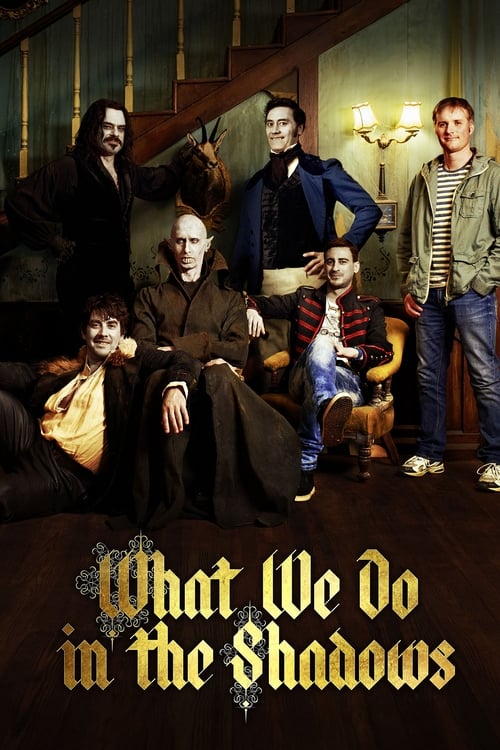
What We Do in the Shadows
2014 · Jemaine Clement
For a night when you want to laugh hard without working for it — a comfort watch that happens to have fangs. Great with friends, great when you're tired, zero emotional homework.
What it's about
A documentary crew follows four vampire flatmates sharing a house in suburban Wellington, New Zealand, where beings centuries old still have to argue about the dishes, hit the nightclubs, and dodge the local werewolves. When a newly turned hipster joins the household, the old guard has to teach him the ropes of being undead — and he has to teach them about the internet.
The experience
Bone-dry, laugh-out-loud funny, and weirdly cozy — the horror is all props and the comedy is all timing. It plays like hanging out with the world's most polite monsters, and the jokes keep landing on rewatch.
Performances
Jemaine Clement and Taika Waititi, working largely from improvisation, deliver some of the driest line readings in modern comedy — Waititi's fussy, wounded politeness is a marvel of sustained character work.
The craft
Improvised from a story outline and carved out of roughly 125 hours of footage, it turns the mockumentary format itself into the engine of the jokes — the unseen camera operators wear crucifixes for protection. The effects are lovingly practical: in-camera transformations and wirework done on a shoestring, pastiching a century of vampire movie looks from silent-era ghouls to ruffled aristocrats.
Why it matters
It became one of the defining cult comedies of the 2010s, spun off an acclaimed American TV series, and helped launch Taika Waititi from New Zealand comedy hero to global filmmaker.
Jemaine Clement and Taika Waititi's mockumentary about vampire flatmates in Wellington is the rare comedy whose premise — centuries-old immortals bickering over dish duty — is actually the least of its riches. Shot largely improvised from a story outline, with the cast mining some 125 hours of footage for the driest possible line readings, it applies the deadpan house style of New Zealand comedy (the lineage of Flight of the Conchords) to the entire archive of vampire cinema: Nosferatu, Lost Boys leather, Interview with the Vampire ruffles, each lovingly reproduced on a shoestring by a crew doing practical wirework and in-camera transformations. The mockumentary form, so often a crutch, here becomes the joke's engine — the camera operators wear crucifixes, and the polite awkwardness of documentary etiquette collides with the undead's ancient grievances. Its afterlife has been enormous: an American series that ran for six acclaimed seasons, the cop spinoff Wellington Paranormal, and a permanent elevation of Waititi to Hollywood's front rank. The werewolves ('not swearwolves') remain among the great throwaway inventions of modern comedy.
A Deleuzian reading
The camera crew wear crucifixes.
The full Deleuzian reading of What We Do in the Shadows →
Reception
A Sundance 2014 word-of-mouth hit that got a famously tiny US release (fans literally Kickstarted a wider one), it snowballed from indie curio into the cornerstone of a whole franchise — spawning Wellington Paranormal and the long-running FX series.
How What We Do in the Shadows was received, from release to now →
Influences: the films it descends from and the films it influenced
- Nosferatu (1922) — Petyr is a direct waxwork of Max Schreck's Count Orlok — rat-fanged, bald, taloned — reviving silent-era practical prosthetics and rigid undead posture instead of the suave-vampire tradition.
- This Is Spinal Tap (1984) — Sets the mockumentary grammar the film runs on: sit-down confessional interviews intercut with fly-on-the-wall vérité, comedy built from straight-faced delivery to an acknowledged offscreen crew.
- Waiting for Guffman (1996) — The Guest-school method of shooting vast quantities of long improvised takes and carving character from them — the ancestor of the film's 125-hours-to-90-minutes edit ratio.
- Man Bites Dog (1992) — Originates the black-comic 'documentary etiquette' gag — a polite camera crew embedded with a serial killer — that the film reworks as journalists solemnly filming vampires who feed on people.
- Zelig (1983) — Pioneers sustaining a faux-documentary register while smuggling in impossible in-camera trickery, the deadpan-doc-plus-visual-effect fusion the film applies to floating and mirror gags.
- Interview with the Vampire (1994) — Establishes the vampire household as domestic melodrama — centuries-old housemates nursing petty grievances — which the film literalizes as chore-wheel flatmate comedy.
- The Lost Boys (1987) — Codifies vampirism as a cool youth subculture with practical flying/levitation gags on wires, the reference for Deacon's hovering and the film's coven-as-clique staging.
- Bram Stoker's Dracula (1992) — Its insistence on in-camera, on-set illusion — disembodied shadows, practical transformations — models the film's rule of doing bat-morphs and levitation with wires and reversed film rather than CGI.
- The Hole (1998) — Extends the NZ deadpan tradition of treating the supernatural as a banal domestic nuisance discussed in flat, mundane tones — the comic register The Hole applies to its uncanny excavation.
- Only Lovers Left Alive (2013) — Extends the same 'vampire as domestic, allusive, marginal cool outsider' premise, mining the mundane textures of immortality through deadpan — Jarmusch's tone turned to comedy.
- Hunt for the Wilderpeople (2016) — Carries the film's deadpan-improv duo dynamic and title-card chaptering forward into a bush-chase buddy comedy.
- Thor: Ragnarok (2017) — Ports the loose improv-driven deadpan (and Waititi's own soft-spoken-monster performance as Korg) into a studio blockbuster, proving the method scales.
- What We Do in the Shadows (2019) — The direct franchise afterlife — serializes the exact mockumentary-vampire-flatmate format, doc-crew conceit and deadpan confessionals intact, across a new coven.
- Wellington Paranormal (2018) — Spins the film's supernatural-meets-documentary-etiquette premise into a police procedural, deadpan officers calmly narrating impossible events to camera.
- Eagle vs Shark (2007) — Waititi's first feature fixes the New Zealand deadpan house style — awkward silences, gentle losers, flat affect held past the point of comfort — that the vampires deliver straight.
- Flight of the Conchords (2007) — Clement and Waititi's laconic two-hander timing and low-status deadpan performance, the comic wavelength both directors carry directly into the flat's interviews.
- Behind the Mask: The Rise of Leslie Vernon (2006) — The closest structural cousin: a doc crew trails a horror monster who cheerfully explains his craft, then the camera's neutral etiquette breaks once the killing actually starts.
- Shaun of the Dead (2004) — Shares the affectionate horror-comedy method of playing genre mechanics dead straight while mining the mundane domestic friction around them, love letter rather than parody.
- Boy (2010) — Extends the same NZ deadpan ensemble and chapter-beat comic rhythm, the tonal bedrock Waititi brings to the coven.
- Best in Show (2000) — Descendant that fuses Guest's improvised ensemble and to-camera interview confessionals with genre pastiche, proving the mockumentary grammar portable to fantastical premises filmed as deadpan documentary.
- Jojo Rabbit (2019) — Codifies Waititi's deadpan comic timing and punchline-via-delayed-cut rhythm, the editing sensibility Jojo applies to genocidal subject matter.
- Marcel the Shell with Shoes On (2022) — Applies the same joke — a documentary crew soberly interviewing a fantastical being about mundane domestic logistics — treating the impossible subject with unblinking naturalism and pathos rather than spectacle.
Similar films
- Shaun of the Dead (2004) — influence & lineage · same viewing thread
- Hunt for the Wilderpeople (2016) — influence & lineage
- One Cut of the Dead (2017) — same viewing thread
- Leviticus (2026) — often watched together
- Hot Fuzz (2007) — often watched together
- Coherence (2014) — shared sensibility
- Fresh (2022) — shared sensibility
- Evil Dead Burn (2026) — shared sensibility
All the films related to What We Do in the Shadows →
Watch it with: curated runs of related films
- The Undead, Played for Laughs — A run of horror comedy — vampire flatmates bickering over the dishes, slackers fumbling through the zombie apocalypse — set against the Romero classic they're all winking back at.