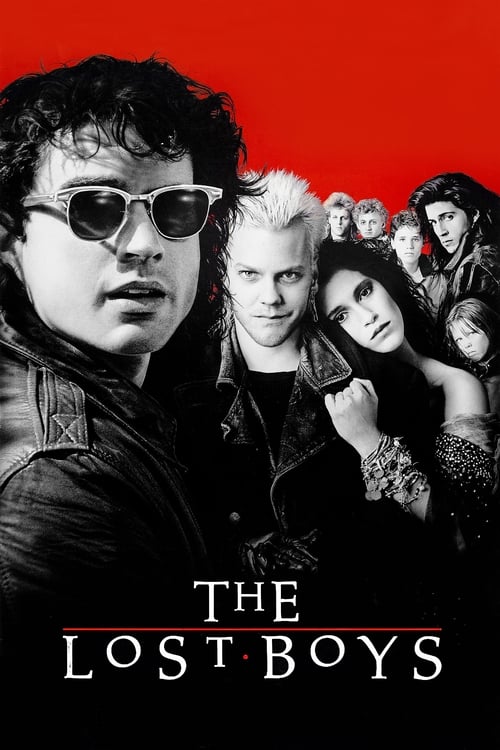
The Lost Boys
1987 · Joel Schumacher
The perfect group watch for a summer night — when you want your scares fun, your vampires gorgeous, and your soundtrack loud. Pure 80s comfort horror: more grin than nightmare.
What it's about
A divorced mother moves her two sons to a California beach town to start over — a boardwalk paradise that happens to be the murder capital of the world. The older boy falls in with a beautiful, dangerous motorcycle gang who only come out at night; the younger one teams up with two comic-shop kids who insist the town's problem is vampires, and that they're the ones to fight them.
The experience
A rock-video fever dream that runs horror, comedy, and teen-movie swagger all at once — neon boardwalk nights, a killer soundtrack, real jolts, and big laughs. It's fast, stylish, and endlessly quotable.
Performances
Kiefer Sutherland's platinum-blond gang leader is all velvet menace — the performance that made vampirism look like the coolest club in town — while Corey Haim and Corey Feldman's vampire-hunting comic-shop kids steal every scene they're in. Dianne Wiest keeps the family half of the movie warmly human.
The craft
Joel Schumacher directs like a stylist unleashed: sunset aerials over the boardwalk, smoke and neon, a shirtless saxophone player working a crowd like a pagan rite, and a soundtrack that fuses gothic choir with 80s rock. The Santa Cruz locations give it a real, salty sense of place.
Why it matters
It made the vampire young, sexy, and American — resetting the template for decades of teen-oriented vampire stories — and turned its cast into the face of late-80s youth cinema.
Snapshot
The Lost Boys is the film that made the vampire a teenager and the teenager a marketing category. Released by Warner Bros. in the summer of 1987, it transplants gothic horror to a Northern California beach town — the fictional Santa Carla, played by Santa Cruz — where a divorced mother and her two sons arrive to start over and discover that the local youth subculture is literally undead. Joel Schumacher, a former costume designer turned studio stylist, directs it as a rock-video fever dream with a family comedy inside it: sunset aerials over a boardwalk, a shirtless saxophonist working a crowd like a pagan rite, a gang of beautiful boys on motorcycles who never age and never sleep at night.
Its real innovation is tonal. Prior vampire films had been either solemn or spoofing; The Lost Boys runs horror, comedy, adolescent romance, and family melodrama simultaneously and refuses to declare a dominant key. It is also a movie about pop consumption that is itself an object of pop consumption — its soundtrack was a hit, its comic-book-reading monster hunters anticipated a decade of genre-literate horror, and its images of eternal youth are inseparable from the star-making machinery that produced them. Nearly forty years on, it remains the template for teen vampire fiction: sexy, funny, mall-adjacent, and quietly serious about the cost of not growing up.
Industry & production
The project began as a very different film. Janice Fischer and James Jeremias wrote a script that read the Peter Pan allusion in its title literally — younger children, vampires as preteen Lost Boys, the Frog brothers conceived as Boy Scouts — pitched closer to the Amblin family-adventure register that The Goonies (1985) had made bankable. Richard Donner, who had directed The Goonies, was attached to direct. When Donner moved to Lethal Weapon (1987), also for Warner Bros., he remained aboard as executive producer and the assignment passed to Schumacher, who had made St. Elmo's Fire (1985) for Columbia and understood exactly what the studio's teen audience was buying.
Schumacher's condition was that the film be aged up. He wanted adolescents rather than children, motorcycles rather than bicycles, and an erotic charge the original draft did not have. Jeffrey Boam — later a key writer on Indiana Jones and the Last Crusade and Lethal Weapon 2 — performed the rewrite that produced the shooting script, and all three writers share credit. Harvey Bernhard, producer of The Omen (1976), produced.
The casting is a snapshot of 1987 Hollywood's succession anxieties. Jason Patric (son of The Exorcist's Jason Miller) and Kiefer Sutherland (son of Donald Sutherland) are second-generation actors playing the seducer and the seduced; Corey Haim and Corey Feldman, both already established child performers, were paired here for the first time in a partnership that would define — and eventually shadow — both their careers. Dianne Wiest, arriving directly from her Oscar-winning turn in Hannah and Her Sisters (1986), supplies the film's emotional ballast; Edward Herrmann's genial video-store owner and Barnard Hughes's taxidermist grandfather supply its two poles of adult authority, one fraudulent and one only pretending to be oblivious. Alex Winter, two years from Bill & Ted's Excellent Adventure, is one of the gang.
Production shot largely on location in Santa Cruz, using the Beach Boardwalk and its Giant Dipper coaster as the film's central image of circular, mechanized pleasure; the town's name was fictionalized to Santa Carla. The sunken-hotel lair — a resort supposedly swallowed by the 1906 earthquake, now a candlelit ruin of chandeliers and Jim Morrison posters — was built as a set, and represents the largest single expenditure of the film's design imagination.
Warner's commercial logic was synergy. The soundtrack album, assembled around Gerard McMann's title theme "Cry Little Sister," Echo & the Bunnymen's cover of The Doors' "People Are Strange" (produced by Ray Manzarek, the Doors' own keyboardist), INXS and Jimmy Barnes's "Good Times," Lou Gramm's "Lost in the Shadows," and Tim Cappello's "I Still Believe," became a durable seller in its own right and functioned as a rolling advertisement on MTV and radio. The film performed strongly in a crowded summer and then performed again, at length, on cable and home video, where its true canonization occurred.
Technology
Technically the film is conventional for a late-studio-era genre picture, and its ambitions are optical and cosmetic rather than mechanical. It was shot on 35mm in scope-format widescreen — a deliberately grand frame for a story about a beach town — and mixed in Dolby Stereo, which by 1987 was standard and which the film exploits hard for its song cues.
The two significant technological investments are makeup and flight. Greg Cannom designed the vampire transformations: pronounced brow ridges, distended jaw and dentition, sulfurous contact lenses, veined and mottled skin. The design decision that mattered most historically was making vampirism a switchable face — a character can flicker between beautiful and monstrous within a shot — which turned the makeup into a dramatic instrument rather than a fixed condition. That template, more than any single film image, propagated through subsequent screen vampirism.
The flying attacks combine wirework, crane and helicopter photography, and subjective camera. Rather than showing vampires in flight — expensive and, in 1987, likely to look it — the film mostly becomes the vampire, rushing at victims from above in unbroken movement, with fog machines and smoke doing the concealing work that digital compositing would later do. It is an economical solution that produces a better effect than a costlier one would have: the horror is in the velocity and the point of view, not in the creature.
Technique
Cinematography
The single most surprising credit on the film is Michael Chapman, who had shot Taxi Driver (1976), Invasion of the Body Snatchers (1978), and Raging Bull (1980). His presence explains a great deal about why the movie's surfaces hold up. Chapman gives Schumacher a coherent color grammar: sodium and neon for the boardwalk, deep blue-black for the night exteriors, firelight and smoke for the lair, and a flat, over-bright naturalism for the daytime domestic scenes that makes the ordinary world feel thin by comparison. Fog is used constantly and unapologetically, both as atmosphere and as a practical concealment device.
The camera is restless in a way that reads as MTV but is closer to classical showmanship — long crane descents into crowds, tracking moves that follow a character through a dense frame of extras, the subjective glides of the attack sequences. Chapman's genre pedigree matters: the film's scares are staged with the same interest in negative space and off-screen threat that Body Snatchers had, even when the surrounding scene is a comedy.
Editing
Robert Brown's cutting alternates between two registers. Set pieces — the boardwalk concert, the railway-trestle hazing, the climactic house siege — are cut for propulsion, with music dictating rhythm and coverage arriving in short, hard bursts. Dialogue scenes, particularly the domestic ones with Wiest, are cut long and loose, letting performance breathe. The film's tonal whiplash is largely an editorial achievement: it can move from a genuinely upsetting hallucination (rice becoming maggots, noodles becoming worms) to a broad comic beat within a few cuts without the audience revolting, because the transitions are timed to laughter rather than fought against.
Mise-en-scène / staging
Bo Welch — soon to design Beetlejuice (1988) and Edward Scissorhands (1990) — is the film's other secret weapon. The design proposes a world of layered adolescent detritus: Sam's bedroom is a wall-to-wall archaeology of comics, posters, and merchandise (including the much-discussed Rob Lowe poster inside his closet); the Frog brothers' comic shop is a bunker of pulp; the vampire lair is a decaying luxury hotel repurposed as a squat, with a Jim Morrison poster presiding over a fountain full of rubble. The joke and the argument are the same: these vampires are curators of a dead culture, living inside a ruin they treat as a clubhouse.
Staging consistently uses vertical space — the boardwalk's rides, the cliffside stairs, the trestle over fog, the ceiling perch where the boys sleep like bats — to encode the vampires' advantage, and horizontal domestic space for the family scenes. The climax collapses the two by bringing the monsters into the house.
Sound
The mix is song-forward to an unusual degree; large stretches of the film run on needle drops rather than score, and the Cappello concert sequence is essentially a music video embedded in the narrative. Thomas Newman's underscore — early in a career that would become defined by delicate ostinati — is here mostly synth-and-choir gothic, providing menace between songs rather than sustained thematic development. It is not characteristic Newman, and the film is not really a composer's film, but the score does the necessary work of unifying tonally incompatible scenes.
Sound design leans on wind, chimes, motorcycle engines, and the mechanical clatter of the boardwalk. The vampires are announced acoustically before they are shown, which is what allows the subjective attacks to land.
Performance
Sutherland's David is the film's engine: a performance built almost entirely on stillness, low volume, and amused patience, which makes his rare escalations frightening. Patric plays Michael as sullen and physically uncomfortable — a smart choice, since the character is being seduced and half wants it. Feldman's Edgar Frog is a full-commitment comic construction, a pubescent commando delivering absurdities in a strangled growl, and it works because Feldman plays it with zero irony. Haim's Sam is the audience surrogate and the film's warmth. Wiest and Hughes are playing in an entirely different, gentler film, and the movie is better for the collision.
Narrative & dramatic mode
The structure is a classic infiltration plot inverted into a coming-of-age story. A fatherless family arrives in a strange town; the elder son is recruited by a charismatic peer group; the younger son discovers the truth and must save him; the head monster turns out to be hiding inside the family's own domestic prospects. The half-vampire mechanic — Michael has drunk but not killed, and can be restored if the head vampire dies — provides the ticking clock and, more importantly, keeps the protagonist suspended between camps for most of the running time.
The dramatic mode is genuinely hybrid rather than alternating. Horror sequences are played straight and often cruelly; comedy is broad; the family material is sincere. The film's most distinctive narrative device is its metafictional exposition: the Frog brothers extract vampire rules from horror comics and hand them to the audience as a manual. This normalizes genre knowledge as usable knowledge nearly a decade before Scream (1996) made that its thesis.
Genre & cycle
The Lost Boys sits at the crest of a mid-1980s revisionist vampire cycle that includes Fright Night (1985), Once Bitten (1985), Vamp (1986), My Best Friend Is a Vampire (1987), and — released within months of it — Kathryn Bigelow's Near Dark. The two 1987 films are the cycle's decisive pair and a useful controlled experiment: both reimagine vampires as a nomadic outlaw family, both treat the condition as addiction and recruitment, both are Western-inflected. Near Dark is austere, regional, and was a commercial failure; The Lost Boys is glossy, suburban, and was a hit. The market chose, and the teen-vampire mode that followed is Schumacher's line, not Bigelow's.
It also belongs to the 1980s teen film as codified by John Hughes and by Schumacher's own St. Elmo's Fire — the ensemble of beautiful young people defined by their subcultural affiliations — and to the "monster kids" strand of Amblin-era adventure, in which children possess competence adults lack.
Authorship & method
Schumacher is best understood as a designer who directs. He came out of costume work on films including Sleeper and Interiors, wrote Car Wash and The Wiz, and arrived at directing with an eye trained on surface, silhouette, and star presentation rather than on narrative architecture. His method is to establish an intensely specific visual world and cast attractive, watchable performers into it, then let tone find itself in the cutting room. This is why his films are often accused of superficiality and why The Lost Boys, where the subject genuinely is surface — glamour, youth, image as trap — is arguably his best work.
Schumacher was openly gay in an industry where that was rare, and the film's homoerotic charge is neither accidental nor deeply buried: David's courtship of Michael is staged as seduction, the boardwalk's oiled saxophonist is presented as spectacle for a mixed gaze, and Sam's bedroom decor has invited decades of reading. Critics have long treated the film as a coded text about desire, initiation, and the terror of being changed by contact — a reading strengthened by its release at the height of American AIDS panic, when blood, contagion, and beautiful young men who bring death into the family carried unavoidable resonance. Schumacher did not, to the extent the record shows, frame the film that way himself; the reading is critical rather than authorial, and worth stating as such.
The collaborators matter as much as the director. Chapman supplies genre craft, Welch supplies the world, Boam supplies structure and jokes, Cannom supplies the face, Newman supplies the connective tissue, and the music supervision supplies the film's actual identity.
Movement / national cinema
This is mainstream American studio cinema, unaffiliated with any movement, but it is a clean specimen of a specific late-1980s Hollywood formation: the emergence of a house style descended from advertising and music video, in which montage, backlight, smoke, and pop cue replace classical scene construction. The Lost Boys is frequently cited as a landmark of that shift, and it is where Schumacher's own visual vocabulary — saturated color, silhouette, spectacle over geography — consolidated into the manner he would later carry to Batman Forever (1995) and Batman & Robin (1997).
It also documents a particular American place-myth: the California beach town as paradise with rot underneath, the carnival midway as the site where the young are consumed. That lineage runs from Bradbury's Something Wicked This Way Comes through the surf-and-biker films of the 1960s, and The Lost Boys is its horror endpoint.
Era / period
Everything about the film is legible as 1987. Corporate synergy between a studio and its sibling record label; the tagline's promise of consequence-free hedonism ("Sleep all day. Party all night. Never grow old. Never die."); the single-mother household as the era's default broken family; the video store as the hub of a town's social life; the mall-and-boardwalk geography of American adolescence at the moment before it moved indoors and then online. The film's monsters are runaways and its adults are absent, credulous, or predatory — a configuration that reads as Reagan-era latchkey anxiety without ever announcing itself as social comment.
Themes
The governing theme is arrested development, taken literally. Vampirism here is not aristocratic contamination but permanent adolescence: a gang that has traded futurity for an endless present of parties and violence, and that recruits by offering belonging to a boy who has just lost his father, his town, and his standing. Peter Pan is the explicit intertext — the title, the flight, the boys who will not grow up, the "family" that must be joined and then destroyed.
Around that cluster: initiation and its irreversibility; blood as both kinship and infection; the family as the only functional defense against seduction from outside; consumption in both senses, with the film's teenagers surrounded by things to buy and themselves positioned as things to be bought. And a quieter theme, unusual for the genre — that the enemy is not the beautiful boys on the bikes but the pleasant adult who wants to marry into the household. The predator that matters is the one that asks permission at the door.
Reception, canon & influence
Contemporary reviews were divided. The film's style, energy, and casting drew praise; a substantial share of critics found it glossy, derivative of music video, and tonally unstable, and read Schumacher as a decorator working above his conceptual weight. It was, however, a solid commercial performer in a competitive summer, and its soundtrack outperformed most expectations for a horror tie-in. The critical estimate has warmed considerably since: the tonal instability that read as incoherence in 1987 now reads as the film's signature achievement.
Backward. Its inheritance is unusually visible. J. M. Barrie supplies the central conceit. Anne Rice's Interview with the Vampire (1976) supplies the vampire-as-family and the eroticized, self-aware immortal. Hammer supplies the rules the Frog brothers recite. The Wild One and the outlaw-biker cycle supply the gang's iconography, and Romero's Martin (1977) stands behind the decision to strip vampirism of aristocratic trappings. Fright Night (1985) supplies the immediate precedent for the amateur-expert monster hunter, and Chapman's own Invasion of the Body Snatchers (1978) supplies the paranoid structure of a town already lost before the protagonist notices.
Forward. The film's influence on teen vampire fiction is close to total. The comedy-horror-romance blend and the notion of vampirism as high-school-adjacent subculture run directly into Buffy the Vampire Slayer (film 1992, series 1997–2003), whose transformable vampire face is a recognizable descendant of Cannom's design. From there the line extends through The Craft (1996) and the teen-gothic boom, into Twilight (2008) and its imitators, True Blood (2008–2014), and The Vampire Diaries (2009–2017). The Frog brothers, meanwhile, are the direct ancestors of horror's genre-savvy specialists — Randy in Scream, the Winchesters in Supernatural — and helped normalize the idea that fandom is a survival skill.
The film also generated its own small franchise: two direct-to-video sequels, Lost Boys: The Tribe (2008) and Lost Boys: The Thirst (2010), both featuring Corey Feldman and Jamison Newlander reprising the Frogs; a comics continuation published by Vertigo in 2016; and repeated, unrealized attempts at a television series. None of these have altered the standing of the original, which survives on the strength of a handful of indelible images and lines — "death by stereo," the grandfather's closing complaint about the damn vampires — and on the fact that it caught a specific American adolescence at the exact moment it was being packaged for sale.
Its afterlife is also inseparable from the biographies of its stars, particularly Corey Haim, whose later struggles and death in 2010 gave the film's fantasy of permanent youth a retrospective weight it did not ask for. That is not a reading the film invites, but it is one audiences now bring, and it has made The Lost Boys a more melancholy object than its own gleaming surfaces intended.
Reception
A solid hit in summer '87 with critics mostly shrugging at its MTV gloss, it's since been fully canonized as the definitive 80s vampire movie — and after Joel Schumacher's death in 2020, widely reclaimed as his most purely enjoyable film.
How The Lost Boys was received, from release to now →
How to watch The Lost Boys: what to notice on a first viewing
- Compare the neon boardwalk at night to the daytime house scenes. Michael Chapman, who shot Taxi Driver and Raging Bull, gives the boardwalk sodium and neon, the night exteriors a deep blue black, the lair firelight and smoke, and the family's daylight a flat over-bright naturalism. The ordinary world is lit to look thin. The film makes the vampires' hours the only ones with any color in them.
- Notice how often the vampires are above everyone else. Bo Welch builds the film around vertical space: boardwalk rides, cliffside stairs, a railway trestle over fog, a ceiling perch where the boys hang to sleep. The family scenes stay flat and horizontal. Height is how the film encodes advantage. You can read who has power in a scene by looking up.
- Watch Kiefer Sutherland stay still and speak quietly. David almost never raises his voice or hurries. Sutherland plays amused patience, so when he does escalate it lands hard. Jason Patric answers it with sullen physical discomfort, because Michael half wants what is being offered. The seduction works on you the way it works on Michael, which is why the recruitment scenes are more persuasive than threatening.
- Notice how much of the film runs on songs rather than score. Large stretches are needle drops, and the Tim Cappello concert is a music video set inside the story. Thomas Newman's synth and choir fills the gaps with menace rather than developing anything. The songs do half the feeling for you. That is also how the film sells the vampire life as a party you want to attend.
- Look at the walls of Sam's bedroom and the Frog brothers' shop. Welch layers comics, posters and merchandise until the rooms read as archaeology. The vampire lair is a sunken luxury hotel with a Jim Morrison poster over a fountain full of rubble. These vampires curate a dead culture and live in its ruin. Everything in the film's world is either bought or left over.
The whole guide to watching The Lost Boys, with the keys for a rewatch →
Influences: the films it descends from and the films it influenced
- Taxi Driver (1976) — Michael Chapman's sodium-and-neon night photography — slow lateral dollies past a sidewalk economy of flesh, steam and colored signage — is the exact grammar Chapman reuses for the Santa Carla boardwalk, where the crowd is shot as predatory display rather than local color.
- Invasion of the Body Snatchers (1978) — Chapman's own precedent for the canted, half-obscured handheld frame and fog-diffused streetlight, plus the structural gambit of a town already colonized before the protagonist looks up — Michael's slow realization is staged with the same foreground-obstruction blocking Chapman used in San Francisco.
- Martin (1977) — Strips the vampire of cape, castle and aristocratic diction and relocates him to a depressed American town in ordinary clothes — the decision that lets Schumacher's vampires be bikers in Santa Carla rather than counts, and lets the kill be a mess rather than a swoon.
- Horror of Dracula (1958) — Hammer codified vampire destruction as on-screen mechanics — stake, holy water, running water, sunlight, each with a visible physical result — and it is that procedural rulebook, not folklore, the Frog brothers recite and the third act executes as a set-piece checklist.
- The Wild One (1953) — Supplies the gang-arrival staging: the pack entering frame in formation on machines, leather silhouette read against light, and the motorcycle used as blocking device to encircle and separate a victim — reproduced almost shot-for-shot in David's boardwalk entrance and the fog-bank ride.
- An American Werewolf in London (1981) — Establishes the tonal-whiplash cut — comedy beat directly into wet prosthetic horror — and the ironic pop needle-drop as scoring strategy rather than decoration; Greg Cannom's appliance work descends technically from Rick Baker's shop on this film.
- The Hunger (1983) — The commercials-trained director's opening reel — Bauhaus performance intercut with a feeding, smoke, fans, backlit venetian slats — proves a vampire film can be built out of music-video cutting and treat immortality as high-fashion surface, which is Schumacher's entire operating premise.
- Fright Night (1985) — The immediate precedent for the amateur-expert hunter who knows monsters only from media, and for the two-stage mechanical vampire face — a human mask that opens into a bat-nosed appliance — which Cannom refines into the switchable, flick-of-a-frame transformation.
- St. Elmo's Fire (1985) — Schumacher's own template for star presentation: young ensembles lit and costumed as fashion plates, introduced in isolating single close-ups, with a pop score cueing emotion the script doesn't earn — the method he transplants intact into a horror chassis.
- The Evil Dead (1981) — The rigged, untethered low-flying camera as the monster's own subjectivity — a POV that travels rather than watches — is the device behind the vampires' aerial attacks, where the frame becomes the predator instead of showing it.
- Flatliners (1990) — Schumacher escalates the Lost Boys method — cathedral-scaled vertical sets, hard colored gels, and Kiefer Sutherland's held stillness as a threat delivery system — into a film where production design and gel work substitute wholesale for exposition.
- Buffy the Vampire Slayer (1992) — Takes the comedy-horror-romance register and the premise that vampirism is a high-school-adjacent subculture; the franchise's brow-ridge face that snaps on and off in a single cut is a direct design descendant of Cannom's switchable makeup.
- Scream (1996) — Randy Meeks is the Frog brothers professionalized: a character whose function is to state the genre's rules aloud so the film can honor or violate them on cue, making fandom itself the diegetic survival skill.
- The Craft (1996) — Inherits the package rather than the plot — costume and styling as legible subculture membership, plus a soundtrack album of licensed alt-rock cut as montage, the marketing-and-scoring hybrid The Lost Boys proved could outsell the film.
- Twilight (2008) — Stages vampire courtship as seduction of the teen audience-surrogate — lingering, backlit two-shots of an immortal presented as object of desire — and, with Elliot Davis shooting, again uses a curated needle-drop soundtrack as the film's emotional spine.
- What We Do in the Shadows (2014) — Codifies vampirism as a cool youth subculture with practical flying/levitation gags on wires, the reference for Deacon's hovering and the film's coven-as-clique staging.
- Near Dark (1987) — Released within weeks, it independently arrives at the vampire clan as itinerant surrogate family with a recruitment plot, scoring the whole thing to synthesizer (Tangerine Dream) rather than orchestra — the same 1987 solution, played as elegy where Schumacher plays it as pop.
- Vamp (1986) — Elliot Davis lights an entire vampire film in saturated magenta and cyan gels, using color as the horror atmosphere instead of shadow — the neon-as-menace palette Schumacher and Chapman run through the boardwalk and the sunken hotel.
- Beetlejuice (1988) — Bo Welch's next design applies the same principle as the Santa Carla cave and Sam's bedroom: vertical, stacked, prop-dense spaces where the set is a climbing frame for staging, and decor is written as character biography rather than backdrop.
Similar films
- Scream (1996) — influence & lineage
- Beetlejuice (1988) — influence & lineage
- Scooby-Doo on Zombie Island (1998) — shared sensibility
- A Nightmare on Elm Street 3: Dream Warriors (1987) — shared sensibility
- The Texas Chain Saw Massacre (1974) — shared sensibility
- Fear Street: 1978 (2021) — shared sensibility
- Stand by Me (1986) — shared sensibility
- Halloween (1978) — shared sensibility