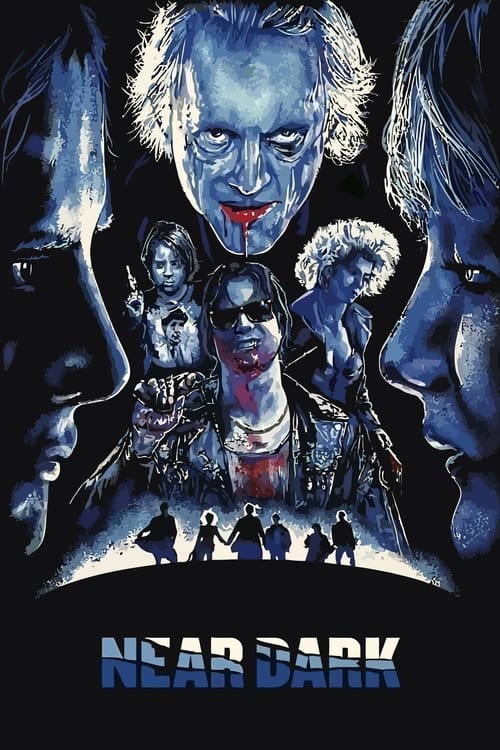
Near Dark
1987 · Kathryn Bigelow
For when you want your horror cool rather than campy — a late-night watch when you're in the mood for outlaws, doomed romance, and the American highway after dark. More brooding than comforting, but seductively so.
What it's about
A farm boy in a small Oklahoma town picks up a pale, pretty drifter one night, and her bite pulls him into her 'family' — a pack of nomadic vampires who roam the Southwest's night highways in stolen cars, kill to feed, and black out motel windows against the sun. Torn between the girl, the brutal clan that wants him to earn his place, and the father and little sister searching for him, he has until each dawn to figure out what he's becoming.
The experience
A moody, violent road movie that runs on neon, dust, and dread — languid and romantic one minute, shockingly feral the next. The famous roadhouse sequence is as nasty and electric as anything in '80s horror, but what lingers is the loneliness of endless night driving.
Performances
Bill Paxton is unforgettable as Severen, all swagger and gleeful menace, and Lance Henriksen gives the clan's patriarch a weary, ancient authority; Jenny Wright makes the vampire girl genuinely tender rather than merely fatal.
The craft
Kathryn Bigelow stages horror with a Western's wide horizons and an action director's precision, shooting the Southwest at night so it glows — headlights, motel signs, the slow burn of sunlight on skin. Tangerine Dream's synth score hums under everything, and the whole thing rewards a dark room and good sound.
Why it matters
A box-office miss that became a defining cult vampire film, it proved the undead could live in dusty American realism instead of Gothic castles and announced Bigelow as a major action stylist.
Snapshot
Near Dark is a vampire film that never uses the word "vampire." Kathryn Bigelow co-wrote it with Eric Red, and it moves the undead out of the castles and fog-bound cities of Gothic tradition and onto the night highways of the American Southwest. Caleb Colton (Adrian Pasdar) is a farm boy in a small Oklahoma town. One night he picks up a pale drifter named Mae (Jenny Wright), and she bites him. That bite pulls him into her nomadic "family": Jesse Hooker (Lance Henriksen), its patriarch, who says he fought on the Confederate side; Diamondback (Jenette Goldstein), his partner; Severen (Bill Paxton), who is gleefully violent; and Homer (Joshua John Miller), an ancient predator trapped in a child's body. They travel in stolen cars, kill to eat, and hide from sunlight in motel rooms with the windows blacked out. Caleb's father Loy (Tim Thomerson) and his little sister Sarah (Marcie Leeds) go after him.
The film was a commercial failure on release. Its distributor was falling apart, and The Lost Boys, a vampire film released the same year, took most of the attention. Its reputation has risen steadily since. It is now treated as one of the key genre hybrids of the 1980s: part horror film, part Western, part outlaw-couple road movie. It is also the film in which Bigelow first showed the kinetic, physical style she would develop over the next four decades.
Industry & production
Near Dark was made as a modestly budgeted independent production. Steven-Charles Jaffe produced, and Edward S. Feldman and Charles R. Meeker were executive producers through Feldman's company. It went to theaters through the De Laurentiis Entertainment Group (DEG), which was then in serious financial trouble and filed for bankruptcy the following year. Most accounts of the release trace its weakness, with limited screens and little promotion, to DEG's collapse. It reached U.S. theaters in October 1987 and earned little.
The project began as a deliberate bit of genre engineering. Bigelow and Red have both described wanting to make a Western, a genre that was close to unfinanceable in the mid-1980s. They put Western elements (horses, spurs, saloons, showdowns, wide open landscape) inside the vampire film, which could still be sold. Red came to the film just after The Hitcher (1986), another nightmare set on the highway, which he had written.
The casting reflects a particular industry moment. Henriksen, Paxton and Goldstein had just appeared together in James Cameron's Aliens (1986), and the reunion gave the vampire clan a ready-made ensemble rapport. Bigelow and Cameron were connected socially during this period and married in 1989. The film was shot largely on location in Arizona, which stands in for the Oklahoma, Kansas and Texas of the story. Production designer Stephen Altman, son of Robert Altman, gave the film its worn interiors: motels, bars, gas stations and farmhouses.
Technology
Near Dark is a 35mm widescreen feature in a 2.35:1 frame. The width serves both the flat horizons of its Western register and the cramped compositions inside cars and motel rooms. It relies on practical effects: burn makeup, prosthetic wounds, and real fire for the scenes where vampires burst into smoke and flame in sunlight. That last effect is less a supernatural dissolve than a physical, combustible destruction, closer to a gasoline fire than to Hammer-era crumbling into dust.
The best-known technical set piece is a daylight siege on a motel. Police bullets punch holes through the walls, and each hole lets in a shaft of sunlight that becomes a weapon. The scene depends on hard, directional light pushed through smoke and dust, and it turns lighting into the threat itself.
The score by Tangerine Dream, the German electronic group, is the other key technological signature. Their synthesizer work was a staple of 1980s American genre cinema (Sorcerer, Thief, Risky Business, Legend). Here it gives the night highway a droning, pulsing ambience, a kind of electronic sublime that sits against the dusty Americana of the images.
Technique
Cinematography
Adam Greenberg was the cinematographer. He was an Israeli DP who went on to shoot The Terminator (1984 — in fact before this film) and Terminator 2: Judgment Day (1991), and his work here is central to the film's identity. The palette splits in two. Night is a saturated cobalt blue, lit by sodium lamps and headlights. Dawn and dusk are violent oranges and reds. Many key scenes take place at the edges of the day, in magic hour or just before sunrise, when light is about to become fatal. That gives the photography a built-in suspense: each brightening of the sky is a countdown.
Greenberg and Bigelow favor low angles, silhouettes against the sky, and backlighting through smoke. They make the figures look iconic, posed like Western gunfighters on a horizon, while the surfaces of the world stay gritty.
Editing
Howard E. Smith edited the film with a rhythm that alternates languor with explosive violence. Long, drifting passages on the road and in cars give way to sudden bursts of fast cutting. In the roadside-bar massacre, the film's most famous sequence, the cutting stretches the menace out over time. It holds on reactions and on the family's slow, theatrical circling of their victims before the violence comes. The cross-cutting between the hunting vampires and Loy and Sarah's search builds the parallel structure of two families that the climax brings together.
Mise-en-scène / staging
Bigelow stages the vampires as a gang, not as aristocrats. Their world is made of stolen cars, cheap motels, truck stops and a smoky bar full of truckers and drifters. The costuming is road-worn Americana: leather, denim, dusters, and Severen's spurs, which he uses as a weapon. The staging of the bar scene is a sustained piece of choreography. The family spreads across the room and turns it into a stage for cruelty, using its geography (the bar, the pool table, the doors) as a predator would.
The film keeps returning to the motif of the enclosed shelter: blacked-out windows, car trunks, blankets thrown over bodies. It contrasts these with the open, deadly daylight landscape.
Sound
The soundscape mixes Tangerine Dream's synthesizer textures with diegetic road sound: engines, tires on asphalt, the rumble of eighteen-wheelers. The climax turns a semi truck into a weapon, and engine noise is used throughout to signal both freedom and threat. The vampires' feeding is played with a frank, wet physicality, so the sound design matters as much as the image to the film's unsentimental view of predation.
Performance
The ensemble is the film's great asset. Henriksen plays Jesse with a gaunt, weary authority, a patriarch who has outlived his own history. Paxton's Severen is the most quoted performance: a hillbilly psychopath with a cowboy's swagger and a stand-up comic's timing, who turns murder into a cruel joke. Goldstein's Diamondback is hard and protective. Miller's Homer is perhaps the film's most disturbing creation, a centuries-old consciousness whose bitterness at being stuck in a child's body comes out as rage and as a predatory fixation on Sarah.
Pasdar plays Caleb as a reluctant initiate, physically sickened by his new hunger. Jenny Wright's Mae is ethereal and melancholy, and her wonder at the night sky gives the film its romantic register. Tim Thomerson's quiet, stubborn father is the human counterweight to Jesse.
Narrative & dramatic mode
The narrative is a conversion story run in reverse. Caleb is turned, refuses to kill, is kept alive only by drinking from Mae's wrist, and has to prove himself to a family that wants to cast him off. He finally earns his place in a crisis, the motel siege, by acting with daylight-defying courage. The story then turns back on itself: Loy, a veterinarian, cures Caleb with a blood transfusion. That restoration is unusual in the genre, and it frames vampirism as an affliction of the blood that can be treated, not a damnation of the soul.
The final act becomes a war between the two families. Caleb has to rescue Sarah from the clan, and Mae is cured as well. In tone the film moves between lyrical romance, black comedy and nihilistic violence, and the ending has a sentimental, almost fairy-tale resolution. Critics have long debated whether that ending is a compromise or a deliberate return to the film's quietly conservative family structure.
Genre & cycle
Near Dark belongs to the 1980s vampire revival, alongside Fright Night (1985), The Lost Boys (1987) and Vamp (1986). That cycle brought vampires into contemporary American settings and youth culture. Near Dark is the most austere and violent of the group. The Lost Boys was glossy, comic and full of rock songs; Near Dark is dusty, rural and sorrowful.
It is equally a Western. The clan rides in cars, not on horseback, but the iconography of spurs, saloons, a frontier town and a showdown is explicit. Jesse's Confederate past ties the clan to the history of the frontier. It is also an outlaw-couple road movie in the line of They Live by Night (1948), Bonnie and Clyde (1967) and Badlands (1973), with doomed lovers moving through a hostile landscape. This hybridity is central to the film's achievement. It treats genres as interchangeable sets of codes that can be combined. That approach would mark the postmodern genre cinema of the following decade.
Authorship & method
Kathryn Bigelow trained as a painter. She attended the Whitney Museum's Independent Study Program and was involved in the New York conceptual art scene before studying film at Columbia, where she made the short The Set-Up (1978). Her first feature, The Loveless (1981, co-directed with Monty Montgomery), was a stylized 1950s biker film starring Willem Dafoe, and it already showed her interest in genre iconography, male groups and violence as spectacle. Near Dark was her first solo feature, and it made her name in genre circles.
The film anticipates the main concerns of her later work: the seductions of violence, the outlaw group as a substitute family, an outsider drawn into a dangerous collective, and an intensely physical, kinetic camera. Those concerns run through Blue Steel (1990), Point Break (1991), Strange Days (1995) and her later war and procedural films, The Hurt Locker (2008), which made her the first woman to win the Academy Award for Best Director, Zero Dark Thirty (2012) and Detroit (2017). Criticism has often looked at how she, as a woman director, works within and examines conventionally masculine genres, and Near Dark is a foundational text for that discussion.
Among the key collaborators, Eric Red brought the bleak highway fatalism of The Hitcher. Adam Greenberg's lighting gave the film its dusk-and-dawn identity. Tangerine Dream's score provided its electronic, dreamlike atmosphere. Howard E. Smith's editing shaped the alternation of drift and violence. Stephen Altman's production design rooted the fantasy in American roadside reality.
Movement / national cinema
Near Dark is an American independent genre film from the period when independent financing, home-video presale markets and mini-majors such as DEG supported mid-budget horror. It sits between the art-world sensibility Bigelow brought from New York and the commercial genre machinery of Hollywood. It belongs to no formal movement. It is part of a broader 1980s tendency among film-school directors to treat genre with formal ambition, and of a wider American cinema of the heartland and the highway, in which the rural Southwest stands for both mythic freedom and moral desolation.
Era / period
The film is a product of late-1980s America: the Reagan years, family-values rhetoric, and the rural economic decline of the decade's farm crisis. Many critics have read its vampires through the AIDS crisis, as a contagion passed through blood and a family of outcasts whose hunger is called monstrous. The film does not state such a reading, and it should be treated as interpretation, not intention. Its ending, a cure by transfusion and a return to the farm family, has been read both as a conservative restoration and as a wishful fantasy of healing.
The Confederate-veteran backstory and Homer's centuries of life also place the film in a long national history. The vampires are relics of the American past, still roaming the present.
Themes
- Family and its alternatives. The film sets two families against each other: the blood family of the farm and the blood-bound family of the road. Each has a patriarch (Loy and Jesse), and each fights to keep its children. The vampire clan is horrifying but also intimate and loyal. That ambivalence is the film's emotional core.
- Initiation and belonging. Caleb's arc is a rite of passage. He has to prove himself to a gang, which is a recurring Bigelow structure (compare Point Break).
- Addiction and appetite. Caleb's sickness without blood and his dependence on Mae have been widely read in terms of addiction and withdrawal.
- Light and time. Daylight is death and night is freedom, which turns time itself into a dramatic force. Mae's speech about starlight that has traveled across ages links the vampires' immortality to cosmic time.
- The American road and frontier. The highway inherits the frontier's promise of mobility and lawlessness, and the film shows both its romance and its violence.
- Childhood corrupted. Homer, an old consciousness locked in a child's body, is a figure of arrested development and dark desire. His pursuit of Sarah gives the climax its peculiar unease.
- Violence as performance. The bar massacre stages killing as entertainment for the killers. That reflexive interest in the spectacle of violence runs through Bigelow's career.
Reception, canon & influence
Critical reception. The film was reviewed respectably on release, and a number of critics praised its atmosphere, its ensemble and Bigelow's command of style. Commercially it did badly. The causes usually cited are DEG's collapse and the competition from The Lost Boys. The detailed critical record from 1987 is thinner than the film's later reputation suggests, and its status was built mainly through home video, repertory screenings, and later critical reassessment after Bigelow's rise.
Influences on the film (backward). Near Dark draws on the Western: the cowboy iconography, the frontier town and the showdown, and the drifter-and-family structures of the classical form. It draws on the outlaw-couple tradition of They Live by Night, Bonnie and Clyde and Badlands. It shares the revisionist vampire cinema of George A. Romero's Martin (1977), which also took vampirism out of its Gothic trappings and set it in decaying contemporary America. And it shares the highway horror of Eric Red's The Hitcher. Behind those sources lies the long tradition of the vampire family and the vampire as outsider, reworked here without capes or crucifixes.
Legacy (forward). Near Dark became a touchstone for the "Western vampire" and for the vampire-as-road-gang. Its DNA is often traced in From Dusk Till Dawn (1996), John Carpenter's Vampires (1998), 30 Days of Night (2007) and Stake Land (2010). It is also traced in the trend of the 2000s and 2010s toward melancholy, naturalistic vampire stories: Let the Right One In (2008), Only Lovers Left Alive (2013), and HBO's True Blood (2008–14), which also put vampires in the rural American South.
Its child vampire and its doomed, romantic undead couple prefigure later variations on both. In visual style, its blue-and-orange dusk palette and its sculpted shafts of light became part of the language of 1990s genre cinema. That influence ran partly through Greenberg's own work with Cameron.
Within auteur criticism, the film has been canonized as the first full statement of Bigelow's sensibility, and her later prestige has sent new generations of viewers back to it. It now regularly appears on critics' lists of the best vampire films and of the best horror films of the 1980s. It occupies the place typical of influential cult films: an original commercial failure that later came to define a lineage.
Influences: the films it descends from and the films it influenced
- They Live by Night (1948) — Ray's template of a naïve young man bound to a doomed lover and a predatory criminal 'family' on rural highways supplies Caleb and Mae's outlaw-couple structure, including the older gang that exploits the couple.
- The Searchers (1956) — The plot of a family member taken by a nomadic band and pursued across the plains by kin is Ford's captivity-narrative engine, which Bigelow restages through Loy and Sarah's search for Caleb and frames with low-angle horizon compositions.
- Bonnie and Clyde (1967) — Penn's way of letting a road gang's playful camaraderie tip abruptly into graphic, bloody violence is the tonal mechanism behind Near Dark's lurch from languor into massacre.
- Badlands (1973) — Malick's magic-hour exteriors, with lovers drifting through empty heartland and silhouetted against flaming skies, are the visual model for Near Dark's dusk-and-dawn palette and backlit figures on Oklahoma and Kansas flats.
- Martin (1977) — Romero took the vampire out of its Gothic trappings, with no fangs, capes or crucifixes, and set it in decaying working-class America, the demystification that let Bigelow write vampirism as a contemporary condition that is never named.
- The Loveless (1981) — Bigelow's debut already shows a fetishistic interest in a menacing drifter gang's leather, poses and roadside-diner intrusions, iconography she turns directly into the vampire clan's bar takeover.
- The Terminator (1984) — Adam Greenberg's steel-blue night lighting and hard sodium sources from Cameron's film carry straight into Near Dark, which Greenberg shot with the same cold-night/warm-practical contrast.
- The Hitcher (1986) — Eric Red's script brings its fatalistic highway horror into Near Dark: lone vehicles on endless two-lane blacktop, roadside stops turned into slaughter, and a young man pulled into an unkillable stranger's orbit.
- Point Break (1991) — Bigelow reruns Near Dark's structure: an outsider initiated into a charismatic, nomadic tribe whose rituals of risk and violence become a surrogate family he must ultimately betray, shot with the same kinetic, eroticized camera.
- The Addiction (1995) — Ferrara makes literal what Near Dark implies by playing blood-hunger as junkie craving, and Caleb's shaking withdrawal and transfusion 'cure' become a full narrative of dependency.
- From Dusk Till Dawn (1996) — It expands the roadside-bar massacre set piece into a whole act, in which outlaws on a Southwest highway walk into a dive bar that turns into a vampire slaughterhouse, keeping Near Dark's crime-road-movie-to-vampire-genre switch.
- Vampires (1998) — Carpenter makes the vampire Western explicit with a nest raid in desert light, a motel massacre, and a road chase pitting a gang of hunters against a nomadic master vampire across the Southwest.
- 30 Days of Night (2007) — Its vampires are a feral, pack-hunting road gang that lays siege to an isolated settlement, built on Near Dark's model of vampires as a roving outlaw band rather than solitary aristocrats, with sunlight as the countdown.
- Let the Right One In (2008) — Its centuries-old predator trapped in a child's body, the tragic dimension Bigelow gave Homer, becomes the emotional core of a naturalistic, unadorned vampire drama.
- Stake Land (2010) — Mickle's vampire road movie across a ruined heartland applies Near Dark's Americana and backroads-Western framing, with a drifter mentor and surrogate family moving through magic-hour landscapes.
- A Girl Walks Home Alone at Night (2014) — Amirpour casts the vampire Western as a lonely genre hybrid: a female vampire romance played in Western iconography, desert-town emptiness, synth-driven score and long nocturnal drifts broken by sudden violence.
- Bones and All (2022) — It follows Near Dark's outlaw-couple design: two young flesh-eaters drift through 1980s Midwest highways, and an older itinerant 'family' of their kind offers seduction and menace while the lovers search for a cure for their hunger.
- Sinners (2025) — Bigelow sets vampires in the rural working-class American landscape and treats them as a predatory economy preying on already-dispossessed communities, staging a roadside-bar siege with genre-as-social-comment logic that Sinners translates directly to 1932 Mississippi and Black sharecropper culture.
- Twilight (2008) — Female-directed relocation of the vampire from castle to American regional landscape as an outsider surrogate-family and contagion-as-romance, dropping gothic trappings for naturalistic Americana.
- Doctor Sleep (2019) — Template for a nomadic clan of immortal predators roaming American backroads as a surrogate family, mirrored in Rose the Hat's caravan of RV-dwelling feeders.
- Aliens (1986) — Bigelow cast Lance Henriksen, Bill Paxton and Jenette Goldstein from Cameron's ensemble, reusing their established screen types (stoic leader, wild-card loudmouth, hard-edged woman) as the vampire family's internal dynamics.
- The Lost Boys (1987) — Released the same summer, it rebuilds the vampire as a youth gang that seduces a newcomer and sets a coven against a mortal family, but in rock-video gloss where Near Dark goes for Western austerity, which makes the pair the twin poles of the 1980s vampire revival.
- Strange Days (1995) — Established her method of repurposing visceral genre spectacle to interrogate violence and the looking body, the throughline that makes Strange Days a critique rather than an indulgence.
- La Bamba (1987) — Greenberg's other 1987 film, and the clearest cross-reference for his method: wide-open highway blacks lit by practicals and firelight, the same anamorphic-feeling isolation of a figure in a dark exterior that La Bamba uses for the crash-premonition and desert-vision material.
- Fright Night (1985) — Bigelow's film belongs to the same 1980s revival that pulled the vampire out of the castle and into present-day America, removing Gothic props such as fangs, coffins and capes and keeping the vampire's lure as an erotic invitation.
Similar films
- A Girl Walks Home Alone at Night (2014) — influence & lineage
- From Dusk Till Dawn (1996) — influence & lineage
- The Hitcher (1986) — influence & lineage
- The Lost Boys (1987) — influence & lineage
- Let the Right One In (2008) — influence & lineage
- Bones and All (2022) — influence & lineage
- Kiss Me Deadly (1955) — shared sensibility
- Night of the Living Dead (1968) — shared sensibility