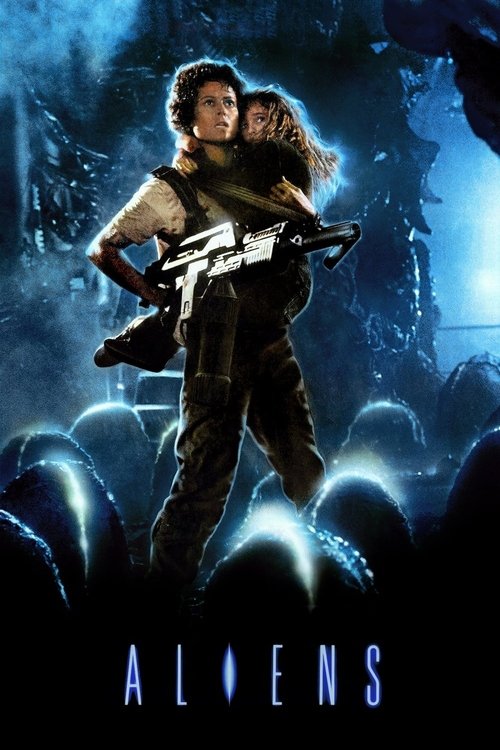
Aliens
1986 · James Cameron
Perpetually doubted, perpetually vindicated: Avatar: The Way of Water's $2.3B silenced "no cultural footprint" jokes without ever quite ending them. His pronouncements on AI, streaming, and running times are treated as oracle statements.
For when you want maximum intensity and a guaranteed great time — the action classic you reach for to remind yourself how thrilling movies can be. Demanding on your nerves, easy on everything else.
What it's about
Ripley, the lone survivor of a doomed deep-space freighter, is found drifting in hypersleep 57 years after her encounter with a lethal alien creature. Nobody believes her story — until contact is lost with a colony on the very planet where it began, and she reluctantly joins a squad of cocky Colonial Marines heading back to face not one monster, but a hive.
The experience
A slow-fuse first hour that detonates into one of the most sustained adrenaline rushes ever put on film. It's a war movie wearing a monster movie's skin — tense, thunderous, and surprisingly emotional, with a mother-tiger fury at its core.
Performances
Sigourney Weaver turns Ripley into one of cinema's defining heroes — flinty, traumatized, and ferociously protective — a performance so complete it earned an Oscar nomination in a genre the Academy usually ignores.
The craft
James Cameron builds escalating set pieces with machine-like precision, and the practical creature effects, miniatures, and industrial production design still hold up decades on. The pulse-pounding score and clattering sound of pulse rifles and motion trackers make it a home-theater showcase.
Why it matters
It redefined what a sequel could be — expanding rather than repeating the original — and its DNA is in practically every squad-versus-monsters story in film and games since.
Snapshot
James Cameron's sequel to Ridley Scott's Alien (1979) is one of the rare instances in Hollywood history where a follow-up not only matches its predecessor but redefines what a sequel can do. Where Scott's film is a haunted-house picture stripped to one monster and claustrophobic dread, Cameron's is a war movie — a platoon action film grafted onto the original's mythology, expanding a singular creature into a swarm and a lone survivor into an armored surrogate mother. Ellen Ripley returns to LV-426 with a squad of Colonial Marines, confronting not only the xenomorphs but the institutional indifference that sent them all into harm's way. The film is a defining text of 1980s genre cinema: technically innovative, formally disciplined, and thematically rich enough to sustain decades of interpretation around gender, corporate malfeasance, and the psychology of survival.
Industry & production
Aliens was produced by 20th Century Fox and Brandywine Productions, the latter a company formed by original Alien producers Walter Hill and David Giler. Cameron, still a first-time director of record following The Terminator (1984), was brought on after the studio and Brandywine sought a different creative direction than a direct continuation of Scott's atmospheric horror. Cameron reportedly demonstrated his seriousness by delivering a detailed, fully drafted screenplay — a document that began, famously, with the word "Aliens" (plural) typed large on the title page, signaling the conceptual shift from singular dread to mass-invasion action.
The production relocated to Pinewood Studios and Acton Power Station in London, an industrial facility whose derelict turbine halls became the alien hive. Cameron clashed persistently with the British crew, many of whom had prior Pinewood experience and were accustomed to working methods different from Cameron's relentlessly prepared, technically specific approach. The first assistant director was replaced, and tensions remained high throughout the shoot. Gale Anne Hurd — Cameron's collaborator on The Terminator and, at the time of production, his wife — served as producer, functioning as a buffer between Cameron's demands and studio anxieties over the schedule.
The budget has been widely cited at approximately eighteen million dollars, a figure contested by various accounts of overruns. What is documented is that post-production was extended and that Cameron personally supervised visual effects work with unusual intensity for a director of his then-standing.
Technology
Stan Winston's studio supplied the xenomorph creatures, building on H.R. Giger's foundational designs from the original film while extending the bestiary. The most consequential addition was the alien queen — a hydraulically operated, multi-operator puppet standing over four meters tall that required a crew of operators to bring to life. The queen established a biological hierarchy for the xenomorphs that the franchise has returned to ever since.
The Power Loader exoskeleton worn by Sigourney Weaver in the climax was a practical hydraulic suit built on-set, designed to be worn and operated by the performer. Its design drew on industrial imagery — it looks like something that actually belongs in a cargo hold — and its use in a physical confrontation between Ripley and the queen remains one of the most sustained practical-effects sequences of the decade.
The film made sophisticated use of miniature photography for the dropship sequences and exterior colony shots, composited with optical printing techniques that were at the outer limit of what 1986 production allowed. Visual effects supervisor Robert Skotak and his team received an Academy Award for their work.
Technique
Cinematography
Adrian Biddle served as director of photography, working in close collaboration with Cameron, who had developed detailed storyboards for nearly every sequence. The lighting philosophy is largely high-contrast industrial — pools of cold blue-white against deep shadow, with strobe and flickering practical sources during combat sequences to create disorientation. Wide lenses keep the ensemble readable in frame while compressing depth, giving the film's corridor action a tunneled, inescapable quality. Biddle and Cameron chose a palette that emphasizes the bleached-out sterility of the Weyland-Yutani operation against the organic darkness of the hive, a visual grammar that reinforces the film's structural opposition between institutional authority and primal biology.
Editing
Ray Lovejoy edited the film, working under Cameron's supervision, and won the Academy Award for Best Film Editing. The editing philosophy is fundamentally clarity-first: even in sequences of chaotic combat, geography is maintained through consistent eyeline and spatial anchors. The film manages the difficult task of sustaining comprehensible action across a large ensemble, ensuring that the audience can track which marine is where and who has been lost. The 1992 special edition, restoring approximately seventeen minutes of excised footage, demonstrates how precisely the theatrical cut was timed: restored sequences, including the automated sentry-gun engagement, are dramatically effective but slacken the theatrical pacing, explaining their removal.
Mise-en-scène / staging
Cameron's staging is distinguished by a choreographic approach to ensemble movement. The marines operate as a collective body, and their early overconfidence — dropping into the processing station with practiced efficiency — is staged to make their subsequent decimation legible as military hubris. Cameron blocks action so that the environment actively works against the marines: tight corridors negate their firepower advantage, and the prohibition on weapons discharge near the cooling systems removes their technological edge at a critical moment. The final act restructures the action around a single defined space — the landing platform, the Sulaco, the loading bay — allowing the film to focus its formal energy as its stakes narrow to one woman and one child.
Sound
James Cameron worked closely with sound designers to produce a sonic world that distinguishes the marine and Weyland-Yutani registers from the alien register. The M41A Pulse Rifle's iconic sound — a hybrid of various mechanical effects — was purpose-designed to function as an audio brand. The film's climactic sequences interweave mechanical hydraulics, creature vocalization, and James Horner's score in a layered mix that was technically ambitious for its era. The film won the Academy Award for Best Sound Effects Editing.
Performance
Sigourney Weaver's performance as Ellen Ripley received an Academy Award nomination for Best Actress — an unusual recognition for a genre action lead in this period, and a signal of the performance's unusual interiority. Weaver grounds the film's escalation in continuous psychological specificity: Ripley's PTSD from the first film is legible in her body language before the marines land, and her protective attachment to Newt (Carrie Henn) develops with enough weight to carry the film's emotional climax. Michael Biehn brings quiet competence to Hicks, Lance Henriksen plays the android Bishop with studied understatement that makes the character's eventual loyalty genuinely moving, and Bill Paxton's Hudson provides the film's comedic release valve — his arc from bravado to panic to desperate courage is compressed but effective. Paul Reiser's Burke functions as the film's institutional villain, and Reiser plays him with precisely calibrated blandness, making his betrayal less a surprise than a confirmation.
Narrative & dramatic mode
The film follows a classical three-act structure with unusual transparency: the institutional act (disbelief, bureaucracy, deployment), the military act (arrival, hubris, near-annihilation), and the personal act (Ripley alone, the queen, the resolution). What distinguishes Cameron's screenplay is the functional integration of theme and action: the Weyland-Yutani Corporation's indifference to the colonists — and to the marines — is not background color but a plot driver, with Burke's attempt to impregnate Ripley and Newt serving as the corporation's literal attempt to exploit the very danger it created. The film is, structurally, about the failure of institutions to protect the people who serve them, and Ripley's survival is coded as a refusal of that logic.
Genre & cycle
Aliens represents the founding document of what might be called the "bug hunt" subgenre — the ensemble marines-versus-alien-swarm action picture that has generated dozens of imitators in film, television, and interactive media. It also belongs squarely to the 1980s Reagan-era action cycle, alongside Predator (1987) and RoboCop (1987): films that dress anxious content — Vietnam failure, corporate impunity, masculinity in crisis — in the language of spectacular action. The shift from Scott's Alien (body-horror, isolation) to Cameron's sequel (action, ensemble, war) established a bifurcation in the franchise that has never been resolved, and which reflects two genuinely distinct genre modes available within the same mythology.
Authorship & method
Cameron's authorial signature — total technical preparation, scriptwriting control, sustained interest in human beings inside mechanical systems — is fully present from his second feature forward. He wrote the screenplay, storyboarded the film exhaustively before production began, and exercised unusual directorial authority over visual effects work. His working method is one of the most documented in contemporary Hollywood: meticulous pre-production as a control strategy, preparation so thorough that the shoot, however difficult, proceeds from a complete blueprint.
Adrian Biddle, whose subsequent career included The Princess Bride (1987) and Thelma & Louise (1991), brought a practical, adaptable skill to Cameron's demanding visual specifications. James Horner's score is muscular and tempo-driven, using orchestral brass and percussion to propel the action sequences while deploying quieter, more elegiac material for Ripley and Newt — though Horner and Cameron's working relationship was reportedly strained, and Horner later expressed frustration with the rushed composition schedule. Their collaboration continued, more harmoniously, a decade later on Titanic (1997). Ray Lovejoy's editing discipline is foundational to the film's success: the action is legible, the geography is clear, and the rhythm builds without becoming mechanical.
Movement / national cinema
Aliens is an American studio production shot almost entirely in Britain, using British below-the-line craft and infrastructure. It belongs firmly to the Hollywood blockbuster tradition rather than to British cinema, though the Pinewood context placed it within a production culture that had absorbed Ridley Scott's original. Cameron's approach to the British crew — impatient, technically specific, culturally alien in its American directness — produced the well-documented on-set friction. The film might be read as a minor episode in the ongoing relationship between Hollywood capital and British craft, a relationship that has defined British studio production since the postwar period.
Era / period
The film sits in the heart of the mid-1980s high-concept blockbuster era and within a specific cycle of post-Vietnam action cinema. The colonial marines are coded, unmistakably, as Vietnam veterans transposed into space: their slang, their gear, their overconfident entry, and their catastrophic engagement replay the decade's ongoing cultural negotiation with American military failure. The film was released in 1986, the same year as Platoon — the first major Hollywood film to engage Vietnam directly and without romantic coding — and the juxtaposition is instructive: Cameron's displacement of Vietnam into genre allowed mass audiences to engage with the same anxieties through the safer register of science fiction.
Themes
Maternity and the maternal body organize the film's most discussed thematic material. Ripley's protection of Newt is explicitly coded as a surrogate mother-daughter bond; the alien queen is simultaneously a biological mother, protecting her eggs, and a monstrous inversion of maternal instinct. The Power Loader confrontation — Ripley in a mechanical exoskeleton, facing the queen — stages a direct conflict between two kinds of maternity, one technological and adoptive, one biological and territorial. This reading has been central to feminist film scholarship on the franchise since Barbara Creed's work on the monstrous-feminine in the late 1980s.
Institutional failure and corporate indifference run as the film's political subtext. Weyland-Yutani's designation of the marines as expendable — their mission structured to extract a specimen rather than protect human life — positions the corporation as the film's deepest antagonist, more systemic and therefore more dangerous than the aliens themselves.
Trauma and recovery are present in Ripley's narrative arc in ways unusual for action cinema of the period. Her hypersleep nightmares, her PTSD presentation before the mission, and her gradual reclamation of agency structure the film as a survivor's story — the action sequences as, among other things, a working-through of what was done to her on the Nostromo.
Reception, canon & influence
Critical reception: The film was received enthusiastically on release as an action spectacle of unusual competence and scale. Critics distinguished it from its predecessor — noting the genre shift explicitly — but the consensus positioned it as an achievement in its own right rather than a diminishment. Sight & Sound and academic film criticism in subsequent years focused heavily on its gender politics, its production design, and its place within Cameron's developing filmography.
Influences on the film: H.R. Giger's xenomorph design from Scott's original is the film's inherited mythology; Cameron expanded and systematized it without substantially revising its visual grammar. Robert A. Heinlein's Starship Troopers (1959) is the clearest literary antecedent for the Colonial Marines concept — the novel's Mobile Infantry provided a template for powered armor, bug warfare, and military SF world-building that Cameron drew on and popularized far beyond Heinlein's readership. Howard Hawks' ensemble adventure films — particularly The Thing from Another World (1951), for which Hawks produced) — offered a structural model for group dynamics under pressure. Vietnam War cinema, from Apocalypse Now (1979) to the contemporaneous Platoon, provided the unit-level grunt's-eye perspective that Cameron applied to space marines.
Legacy and forward influence: The film's influence on science fiction design and military SF as a genre is substantial and largely undiminished. The Colonial Marines' equipment, slang, and tactical culture became the visual and narrative grammar of a subgenre that runs through Predator (1987), the Halo franchise (2001–), Gears of War (2006–), and dozens of imitators. The xenomorph queen became canonical to the franchise and to the broader vocabulary of alien hive biology in popular science fiction. The Power Loader entered the cultural lexicon as the defining image of human-operated mech suits, influencing exoskeleton design in film and games for four decades. Ripley herself — and specifically Weaver's nomination for Best Actress — expanded what the industry and the awards apparatus considered possible for a genre action heroine, a shift whose consequences are still unfolding.
A Deleuzian reading
Ripley steps into the cargo loader.
The full Deleuzian reading of Aliens →
Reception
No reappraisal needed — it was a hit and a critical favorite in 1986 and has simply never left the pantheon. The only shift is that 'action sequel to a horror classic' went from sounding like a cash-in to being the textbook example of how to do a sequel right.
How Aliens was received, from release to now →
Influences: the films it descends from and the films it influenced
- Alien (1979) — Cameron inherits Scott's Weyland-Yutani corporate-indifference structure and Stan Winston's extension of Giger's xenomorph taxonomy, then converts the single-creature Hawksian haunted-house blocking — one entity stalking a corridor — into wide-lens ensemble warfare staging across the identical spatial iconography.
- Them! (1954) — The direct genre prototype for the bug-hunt third act: a squad penetrates an underground warren to locate egg chambers and kill the breeding queen — Aliens reprises this beat-for-beat, including the child-survivor motif and the flamethrower-as-primary-weapon against the nest.
- Zulu (1964) — The outnumbered-garrison siege structure — professional soldiers holding a fortified position against a numerically superior, tactically alien enemy force — is the direct military genre template for the Hadley's Hope defense sequence, including the ritual of soldiers registering the approaching swarm before contact.
- The Magnificent Seven (1960) — Sturges assigns each squad member a single dominant behavioral marker before the mission — the mercenary, the worrier, the kid — so deaths register individually during chaotic action; Cameron applies this exact character-typing system wholesale to the Colonial Marines, ensuring Hudson, Vasquez, Hicks, and Apone are legible during the processing plant decimation.
- The Wild Bunch (1969) — Peckinpah's simultaneous multi-angle intercutting during the climactic battle — maintaining spatial coherence across multiple combatants dying within a single continuous engagement — establishes the editing methodology Cameron and Ray Lovejoy employ to keep the processing plant firefight geographically comprehensible despite its chaos.
- Apocalypse Now (1979) — Cameron directly inherits Coppola's dramatic engine of a military command that dispatches soldiers on a mission with concealed corporate objectives, translating the Kurtz/Willard institutional betrayal into the Burke/Weyland-Yutani axis — the institution that sends people to die is the real antagonist in both films.
- The Terminator (1984) — Cameron developed his high-contrast industrial lighting grammar — pools of cold blue-white against deep shadow, strobe during combat — and his progressive-environment-stripping staging method in this debut feature, carrying both cinematographic and spatial design philosophies into Aliens without modification via the same DP-adjacent supervisory approach.
- The Thing (1982) — Rob Bottin's multi-operator hydraulic creature construction on this film established the practical-effects standard Stan Winston's team directly extended to engineer the alien queen — both productions treat the creature as a physical mechanism operated by specialists rather than a photographic trick, giving the queen the same performance weight as Bottin's organism.
- The Dirty Dozen (1967) — Transposes the individuated-grunt squad — established through banter and signature quirks, then thinned in combat — into science fiction, preserving the ensemble-showcase structure.
- The Guns of Navarone (1961) — Transplants the typed-squad-picked-off-one-by-one structure into science fiction, the clearest proof Navarone's ensemble-mission grammar outlived the war genre entirely.
- Predator (1987) — McTiernan directly borrows Cameron's 'strip the elite military unit of its technological advantage' dramatic structure — the jungle as antagonist environment that negates firepower is the jungle-set variant of Cameron's cooling-system prohibition and corridor-as-weapon staging, and both films deploy the same platoon-typing system before the attrition begins.
- Terminator 2: Judgment Day (1991) — Cameron reprises the maternal-protection-against-institutional-threat structure from Aliens with Sarah Connor replacing Ripley, and Stan Winston's studio builds the T-800 endoskeleton presence using the same multi-operator practical-effects performance philosophy developed for the alien queen — the queen fight is the formal prototype for the steel mill climax.
- Starship Troopers (1997) — Verhoeven extends Cameron's bug-hunt formal vocabulary — wave attacks on fortified positions, underground nest penetration, alien queen biological hierarchy, human military command structure — while inverting the ideological valence, using the identical genre grammar to satirize the military-institutional complex that Aliens critiques more ambiguously.
- Saving Private Ryan (1998) — Spielberg's Omaha Beach sequence operationalizes Cameron's core editing principle — maintaining audience spatial orientation within chaotic ensemble combat through consistent eyeline and spatial anchors — at a naturalistic scale, demonstrating that the clarity-first methodology transfers outside genre when built on the same discipline of pre-planned geography.
- Black Hawk Down (2001) — Scott applies Cameron's sustained-comprehensibility editing standard — consistent spatial anchors and eyeline matching during extended multi-unit combat tracking a large ensemble — to a documentary-realist aesthetic, extending the Aliens principle that audiences can follow simultaneous deaths across a large cast if spatial geography is established and maintained before contact.
- District 9 (2009) — Blomkamp translates Cameron's corporate-indifference-as-plot-driver into an apartheid allegory, using the same monstrous-sympathetic inversion (the bug becomes the victim of bureaucratic violence) and the identical institutional-failure structure — the company that sends Wikus in is the same species of antagonist as Weyland-Yutani — while replacing Cameron's clarity-first editing with found-footage disorientation.
- The Abyss (1989) — Cameron's prior film established his compressed-physicality method: Colonial Marines move, sweat, and exhaust themselves within Hadley's Hope's physical constraints in ways Cameron then applied to the Deepcore crew, using actual fatigue from water-logged shooting days to generate authentic-looking desperation rather than performed distress.
- Edge of Tomorrow (2014) — Defined the colonial-marine-infantry-in-exo-gear staging template and the practical approach to selling powered armor through weight, hydraulic sound, and physical performance; Cameron's mentor-mirror structure — the lone competent combatant dragging a squad of over-confident soldiers through a hostile environment — is the direct prototype for Vrataski's function as teacher to Cage.
- The Matrix Revolutions (2003) — Template for the militarized-verticality siege — grunts in powered loaders defending a chokepoint against an insectile swarm, the direct staging blueprint for the dock defense.
- Elysium (2013) — Provided the 'used future' of grimy industrial hardware and the power-loader exosuit that Max's bolted-on surgical exoskeleton openly echoes, plus long-lens handheld squad-combat coverage.
- Jurassic World (2015) — Provides the corporate-greed-weaponizes-the-organism plot engine (InGen's militarization subplot) and the siege-and-pursuit action set-piece architecture Stitt's crosscutting inherits.
- Alien: Romulus (2024) — The film grafts Cameron's tactical militarized survival staging — motion-tracker dread, multiple-creature siege setpieces, and pulse-rifle/ammunition jeopardy — onto Scott's haunted-house template, the explicit 'Scott-Cameron synthesis' the dossier names.
- Platoon (1986) — Both films emerge simultaneously from the same post-Vietnam cultural formation — Stone's literal representation and Cameron's science-fiction displacement share the same institutional-betrayal structure (command sacrifices soldiers for concealed objectives) and both maintain ensemble spatial geography during combat through wide-lens blocking that keeps multiple bodies readable in frame.
- Jurassic Park (1993) — Cameron's staging of creature encounters in constricted industrial corridors and vents — a controlled facility systematically reclaimed by predators — established the designed-versus-reclaimed-space spatial grammar that Jurassic Park applies to the visitor center, kitchen, and control room sequences.
- The Lost World: Jurassic Park (1997) — The paradigm self-sequel that swaps the original's awe for militarized predation, multiplying the creatures and adding an armed-hunters faction — the same escalation logic Spielberg applies here.
- Gloria (1980) — Recasts the Rowlands template as Ripley — an armed, weary, fiercely competent woman whose maternity-outside-biology toward Newt drives a survival-chase, the same protector-of-a-marked-child engine.
- Godzilla (1998) — Supplies the breeding-threat structure: a hunt that escalates into a hatchery of eggs/offspring stalking the human cast through an enclosed arena, lifted almost wholesale for the climax.
- Pacific Rim (2013) — The power-loader-versus-Queen finale established the human-operated exosuit grappling a monster as kinetic spectacle, plus the militarized-grunt ensemble and industrial-tactile hardware design that the Jaeger combat extends.
- Star Trek II: The Wrath of Khan (1982) — Horner reused Khan's own cues under Cameron's direction, and the film echoes Khan's militarized-tactics-in-a-confined-space staging — professionals fighting a superior predator by maneuver, not firepower.
Similar films
- Terminator 2: Judgment Day (1991) — influence & lineage · same viewing thread
- Alien (1979) — influence & lineage
- The Terminator (1984) — influence & lineage
- Predator (1987) — influence & lineage
- The Thing (1982) — influence & lineage
- Planet of the Apes (1968) — same viewing thread
- Star Trek II: The Wrath of Khan (1982) — same viewing thread
- Star Wars: The Force Awakens (2015) — same viewing thread
All the films related to Aliens →
Watch it with: curated runs of related films
- The Blockbuster Sci-Fi Canon — A run of the effects-driven epics that taught modern audiences what a movie could feel like — from the desert planets of Star Wars to the rain of Blade Runner and the sands of Arrakis.