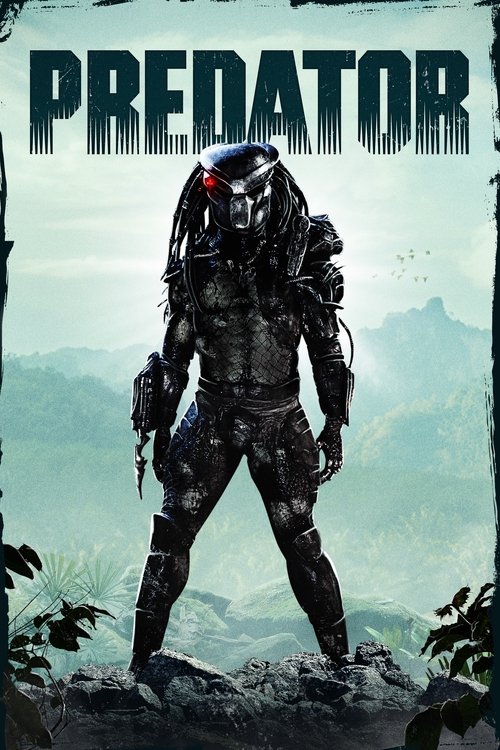
Predator
1987 · John McTiernan
For when you want a full-throttle action night that turns into a monster movie halfway through — big muscles, big guns, real tension. Pure adrenaline comfort food with actual craft behind it.
What it's about
An elite commando team is dropped into a Central American jungle for what looks like a routine rescue-and-extraction job. The mission goes fine — until the men realize something is tracking them through the trees, something that can't be seen, doesn't miss, and takes trophies. What starts as a war movie flips into a survival story, as the best-armed soldiers on Earth discover firepower means nothing against a hunter from somewhere else.
The experience
Lean, sweaty, and relentless — it starts as macho swagger and slowly tightens into pure dread, with long stretches of silence in the foliage broken by sudden bursts of chaos. By the final act it's stripped down to one man, mud, and improvised traps, and it's genuinely primal.
Performances
Arnold Schwarzenegger at the peak of his physical stardom, and the film is smart about him — it builds up his invincibility precisely so it can strip it away, leaving him running, bleeding, and thinking for the first time.
The craft
John McTiernan, a year before Die Hard, directs with ruthless economy: the jungle becomes a character, the creature's shimmering camouflage and heat-vision point-of-view shots were landmark effects, and Alan Silvestri's percussive score drives the stalking sequences. It rewards a big screen and loud speakers — the sound design of the unseen hunter does half the scaring.
Why it matters
It took the invincible-strike-team action movie of the mid-80s and dismantled it from the inside, spawning a franchise, an iconic movie monster, and decades of imitators in the soldiers-versus-something-worse mold.
Snapshot
Predator is a lean, brutally efficient hybrid of combat picture, science fiction, and stalk-and-kill horror, in which a squad of elite mercenaries dropped into a Central American jungle discover that they are not the hunters but the hunted. Directed by John McTiernan a year before Die Hard would make him the defining action stylist of his era, the film takes the muscular, imperial swagger of the mid-1980s Reagan-era war movie — the Rambo and Commando template that Arnold Schwarzenegger himself had helped establish — and systematically dismantles it. Its central gambit is a genre inversion: the invincible American strike team is picked apart one by one by a technologically superior extraterrestrial trophy hunter, until the last man survives not through firepower but through cunning, mud, and improvisation. The result is one of the most durable action films of the decade, spawning a franchise, an instantly legible pop-culture icon, and a creature design that remains a touchstone of practical monster effects.
Industry & production
Predator was a studio genre picture produced for 20th Century Fox by a constellation of producers associated with the muscular action cinema of the period — Lawrence Gordon, Joel Silver, and John Davis are the names most consistently attached to it, the same Gordon–Silver axis that would shortly deliver Die Hard. The screenplay was written by the brothers Jim Thomas and John Thomas, and by a widely repeated industry anecdote the project germinated from a joke — that after Rocky IV, the only remaining opponent for a Hollywood hero was a space alien. Whatever the truth of that origin story, the pitch that survived was elegantly high-concept: an action-star ensemble film that turns into a monster movie.
The production is famous for a near-catastrophe that reshaped the film. The creature was originally conceived and built to a very different design, with the martial artist Jean-Claude Van Damme cast to perform inside the suit; that approach was abandoned during production, the original creature deemed unworkable on screen. Fox brought in Stan Winston's studio to redesign the monster from scratch, and the towering actor Kevin Peter Hall — chosen in part for his physical scale — was cast to play the final Predator. By a much-retold account, James Cameron, sharing a flight with Winston, suggested the creature ought to have mandibles; that detail became the signature of the design. The shoot itself took place in the jungles of Mexico — locations near Palenque and around Puerto Vallarta are cited — under punishing conditions of heat, humidity, and difficult terrain that the finished film converts into atmosphere.
For Schwarzenegger, Predator consolidated his standing as the era's dominant action lead; the ensemble around him drew on recognizable tough-guy casting, including Carl Weathers, fresh from the Rocky films, and the wrestler-turned-actor Jesse Ventura. The film is a footnote of American political trivia in that two of its cast members — Schwarzenegger and Ventura — would later become elected state governors.
Technology
Predator's technological signature lies in its optical effects work, executed at the tail end of the pre-digital era with photochemical ingenuity. The two enduring innovations are the creature's thermal-imaging point of view and its optical camouflage — the shimmering, semi-transparent "cloak." The heat-vision passages render the human world as a psychedelic thermal map, a formal device that both motivates the plot (it explains how the Predator tracks warm bodies, and why mud eventually conceals Dutch) and estranges the familiar jungle into an alien perceptual field.
The invisibility effect, credited to the optical house R/Greenberg Associates, was achieved without any digital compositing: by filming the empty background, then a performer in a bright suit whose image was used to create a distorting, refractive "window" that carried the scene behind it, the filmmakers produced a mobile smear of displaced jungle rather than a simple transparency. It reads as a body-shaped ripple in space — a solution that has aged far more gracefully than many later digital equivalents precisely because it is grounded in real photographed light. Alongside these effects, the creature itself is a triumph of practical, on-set technology: Winston's animatronic head, articulated mandibles, and full-body suit for Kevin Peter Hall, supplemented by the alien's arsenal of prop weaponry — the shoulder cannon, wrist blades, and self-destruct device that extend its characterization as a ritual hunter.
Technique
Cinematography
Donald McAlpine's widescreen photography is fundamental to the film's effect. The jungle is shot as a saturated, humid green labyrinth, dense with foliage that conceals sightlines and swallows the frame's depth — a landscape that is legible enough for the squad's professionalism to register early, then progressively disorienting as the Predator turns the terrain against them. McAlpine exploits the interplay of harsh tropical sunlight, backlit steam, and deep shadow, so that the same environment reads as a soldier's operational field in the first act and a horror-movie maze in the last. The frequent low and canopy-height angles keep reminding us of an unseen watcher above and around the men, and the film repeatedly cuts to the Predator's thermal POV, embedding a second, alien visual grammar inside McAlpine's naturalistic one.
Editing
The cutting, credited to John F. Link and Mark Helfrich, is built for escalation and concealment. In the film's set-piece assault on the guerrilla camp, the editing is kinetic and overwhelming — a barrage of gunfire and detonations that establishes the squad's lethal competence, capped by the notorious sequence in which the men, spooked, unload their entire arsenal into the treeline and shred the jungle to no effect. That excess is a structural joke: the film spends its first act demonstrating that conventional firepower is total, so that its exhaustion in the second act lands harder. From there the rhythm slows and tightens into a stalking cadence, the editing withholding clear views of the creature and doling out its presence through rustles, glimpses, and the aftermath of its kills.
Mise-en-scène / staging
McTiernan stages the film as a steady contraction of space and numbers. It opens with the full squad as a coordinated unit — a moving formation of bodies, weapons, and banter — and methodically isolates them, thinning the ensemble until Dutch stands alone. The Predator is introduced obliquely: as a distortion in the air, a thermal blur, a skinned corpse strung in the trees, its full form withheld until the film has earned the reveal. The famous flexed-forearm handshake between Dutch and Dillon that opens the film is a piece of pure physical staging that plants the picture's preoccupation with masculine display — an idea the Predator, a creature that hunts for trophies and honors a worthy opponent, ultimately mirrors back.
Sound
Sound is central to the film's dread. The Predator is characterized aurally as much as visually — by a distinctive clicking, chittering vocalization and, crucially, by its capacity for mimicry, throwing back scraps of the men's own speech and laughter to unnerve them. The jungle soundscape of insects, water, and wind is worked into a bed of ambient tension, and the creature's cloak is often signaled by a subtle acoustic shimmer. Alan Silvestri's score supplies a driving, percussive military march for the squad and a brooding, dissonant palette for the hunt, and his main theme became one of the more recognizable action-film cues of the decade.
Performance
Schwarzenegger anchors the film with a performance calibrated to his physical presence and his terse authority; Dutch is written and played as a leader whose competence is total until it is rendered useless, and Schwarzenegger convincingly carries the arc from confident command to primal, mud-caked improvisation. The ensemble is defined through economical archetypes — Carl Weathers's slick company man Dillon, Bill Duke's unraveling Mac, Jesse Ventura's cigar-chewing Blain, Sonny Landham's tracker Billy, Richard Chaves's Poncho, and Shane Black (himself a screenwriter) as the wisecracking Hawkins. Kevin Peter Hall's physical performance inside the Winston suit gives the creature a deliberate, ritualistic bearing that reads as intelligence rather than mere animal menace. Elpidia Carrillo, as the captured guerrilla Anna, provides the film's principal outside perspective on the hunter, and effectively its only substantial role for a woman.
Narrative & dramatic mode
Structurally, Predator executes a genre bait-and-switch. Its first act operates in the register of the men-on-a-mission war film: a covert rescue operation, a squad of specialists, a compromised assignment (the mission turns out to be a pretext), and a virtuoso raid on an enemy camp. Around its midpoint it converts into survival horror organized on a slasher logic — an unseen predator eliminating an isolated group one at a time, in order of expendability, until a lone survivor confronts it directly. The final act strips the film down to an almost silent, primal duel between Dutch and the creature, in which language, technology, and teamwork fall away and the contest reduces to trap-craft and endurance. The dramatic engine is the progressive invalidation of the squad's assumptions: their firepower, their training, and their machismo are each shown to be insufficient against an adversary that plays by different rules.
Genre & cycle
The film sits at the confluence of three cycles. It belongs to the 1980s American action-spectacle boom — the Schwarzenegger/Stallone strongman cinema of Commando, Rambo, and their kin — while simultaneously critiquing it from within. It draws on the "monster hunts a group in an enclosed environment" science-fiction-horror lineage that Alien had recently codified, transposed from the haunted spaceship to the jungle. And its second half deploys the countdown-and-elimination structure of the slasher film. What makes Predator distinctive within these cycles is the way it fuses them: it lets the action genre run at full power precisely so it can be defeated, converting the invincible commando fantasy into raw material for horror.
Authorship & method
Predator is best read as the pivotal early statement of John McTiernan's authorship. It was his second feature, following Nomads (1986), and it establishes the concerns that Die Hard and The Hunt for Red October would refine: the lone competent man against a superior adversary; the meticulous exploitation of a single confined environment; and a preference for spatial clarity and suspense over incoherent spectacle. McTiernan's method here is one of controlled withholding and geographic legibility — the audience always understands the terrain and the stakes, which is what makes the creature's violation of that terrain frightening.
His key collaborators shaped the film's identity in specific ways. Cinematographer Donald McAlpine defined its humid, chiaroscuro jungle look. Composer Alan Silvestri supplied a militaristic, propulsive score that became inseparable from the property. The editors John F. Link and Mark Helfrich engineered its escalation from firefight to stalking dread. The screenwriters Jim and John Thomas provided the high-concept structural inversion at the film's core. And, at the level of design authorship, Stan Winston's creature — with the mandibled, dreadlocked hunter that his studio built after the original approach collapsed — is arguably as responsible for the film's cultural afterlife as any element of the direction.
Movement / national cinema
Predator is a product of mainstream American studio filmmaking at its most commercially confident, and it does not belong to any avant-garde or art-cinema movement. If it participates in a "movement," it is the industrial cycle of high-budget, star-driven action spectacle that Hollywood exported globally in the 1980s. Its production straddles national lines only in the mundane sense that, like many American films of the period, it was shot on location abroad — in Mexico — for landscape and economy, while remaining wholly a Hollywood genre picture in conception, financing, and address.
Era / period
The film is deeply of its moment: the late Cold War, mid-Reagan era, with its anxieties and fantasies about American military power projected into Central America. Its premise — a covert U.S. team operating in an unnamed Central American conflict zone against guerrillas — sits squarely against the backdrop of the region's proxy wars, and the film gestures at the murky, deniable nature of such operations through the revelation that the rescue mission is a cover story. Yet Predator uses this charged setting more as atmosphere and pretext than as sustained political argument; the specifics of the conflict recede once the alien arrives. The film's fascination with hard bodies, ordnance, and martial competence is quintessentially 1980s, which is exactly why its demolition of those values reads as a knowing commentary on the decade's action cinema.
Themes
The film's governing theme is the collapse of technological and masculine supremacy. The squad embodies a fantasy of total dominance — superior weapons, superior training, superior physiques — and the Predator functions as a mirror that exceeds them on every axis: better armed, better camouflaged, and governed by its own code of the hunt. In stripping Dutch down to mud and handmade traps, the film argues that survival lies in shedding the very apparatus that defined the men's identity. Related themes cluster around this core: the hunter and the hunted as reversible positions; violence as ritual and trophy-taking rather than mere combat; and a certain skepticism toward the machismo the film simultaneously celebrates. There is also a recurring interest in seeing and being seen — the creature's thermal and cloaked vision versus human sight — that makes perception itself a weapon and a vulnerability.
Reception, canon & influence
Predator opened in 1987 as a commercial action release and, while some contemporary critics received it as an efficient but conventional Schwarzenegger vehicle, its reputation has grown substantially over the decades into that of a genre classic — routinely cited among the strongest action-horror hybrids and among McTiernan's finest work. Its dialogue ("If it bleeds, we can kill it"; "Get to the chopper") and images (the opening handshake, the minigun barrage, the mud-camouflaged final duel) have become thoroughly embedded in popular culture. A full accounting of its precise original box-office and critical metrics is beyond what should be asserted here without the figures in hand; what is not in doubt is the film's trajectory from solid genre hit to enduring canonical status.
Its backward-facing influences are legible: the enclosed-monster-hunt architecture of Alien, the men-on-a-mission war film, the elimination logic of the slasher, and the broader Reagan-era strongman action cinema that it both extends and subverts. Its forward influence is expansive. The creature became one of the most recognizable original monster designs in modern cinema and anchored a lasting franchise — Predator 2 (1990), the Alien vs. Predator crossovers, Predators (2010), The Predator (2018), and Dan Trachtenberg's Prey (2022), which relocated the hunt to a period Comanche setting to wide acclaim. Beyond its own series, the film's template — an elite team undone by a superior, largely unseen adversary in hostile terrain — has been widely imitated across action and horror, and it stands, alongside Die Hard, as evidence of the moment when John McTiernan defined the grammar of the modern American action film. For Stan Winston's studio, meanwhile, the Predator ranks among the signature creations that cemented its stature in practical creature effects.
A Deleuzian reading
They fire everything into the treeline.
The full Deleuzian reading of Predator →
Reception
Dismissed by many 1987 critics as loud macho schlock riding Schwarzenegger's brand, it's since been fully canonized — now routinely ranked alongside Die Hard and Aliens as peak 80s action, with McTiernan reappraised as a genuine craftsman.
How Predator was received, from release to now →
Influences: the films it descends from and the films it influenced
- The Most Dangerous Game (1932) — Establishes the foundational device Predator inverts a war film into: a being hunts humans for sport, and the story turns on the quarry recognizing the rules and becoming the hunter.
- The Naked Prey (1965) — A near-wordless man-stripped-of-weapons-and-run-down-across-hostile-terrain structure; survival becomes a matter of reading the land and improvising traps, exactly Dutch's final-act reversal.
- Jaws (1975) — The subjective predator-POV shot and the discipline of withholding the creature's full reveal to build dread — Predator's thermal-vision gaze is the direct sci-fi descendant of Jaws' underwater eye.
- Halloween (1978) — Supplies the slasher-elimination grammar and the roaming killer-POV; McTiernan re-skins the stalker's optical subjectivity as the Predator's heat-signature sightline.
- Alien (1979) — The enclosed hunting-ground architecture in which an unseen, superior organism picks off an ensemble one by one — Predator transplants this attrition structure from a spaceship's corridors to jungle canopy.
- Apocalypse Now (1979) — Its humid, chiaroscuro jungle photography and war-as-primal-regression atmosphere directly inform Donald McAlpine's steaming, backlit low-canopy look for the film.
- Southern Comfort (1981) — An over-armed military squad is dismantled by an unseen enemy who owns the swamp terrain — the template of professional soldiers' hardware proving useless against a guerrilla adversary in his own ground.
- The Thing (1982) — An isolated all-male team, escalating paranoia-to-attrition, and a commitment to elaborate practical creature effects as the shock centerpiece — the studio-built-monster ethos Stan Winston carries into Predator.
- Rambo: First Blood Part II (1985) — Codifies the Reagan-era jungle-warrior iconography — mud-camouflage, improvised weapons, guerrilla stealth against a superior force — that Predator both borrows for Dutch and then turns against its own muscled hero.
- Aliens (1986) — The gung-ho, banter-heavy militarized squad loaded with heavy ordnance and bravado, systematically whittled down; Predator inherits both the ensemble type and the deflation of its macho self-assurance.
- The Invisible Man (1933) — Its optical-distortion 'camouflage' creature is a direct successor to Fulton's empty-space compositing problem — making a present body read as absent in-frame.
- Tremors (1990) — Attrition by an unseen, sensory-specialized predator whose rules the survivors must decode mid-hunt — the 'learn the monster's perception to beat it' structure Predator crystallized.
- Predator 2 (1990) — Direct franchise continuation that relocates the thermal-POV, optical-camouflage stalking hunt from jungle to vertical urban terrain while preserving the elimination logic.
- Dog Soldiers (2002) — A banter-heavy soldier squad besieged and picked apart by creatures in the wilderness — an explicit riff on Predator's men-on-a-mission-turned-prey attrition and macho-unit deflation.
- A Quiet Place (2018) — Contraction of space around a predator that hunts through a single heightened sense, forcing survivors to weaponize its perceptual blind spot — the same 'exploit how it sees/hears' resolution as Dutch's mud.
- Prey (2022) — Franchise entry that strips the hunt back to minimalist stalking, thermal-vision and optical-camouflage set-pieces, and a protagonist who defeats the creature by studying and turning its own technology against it, in a period frontier.
- Nope (2022) — An unseen aerial apex-predator is withheld and studied like McTiernan's creature, and victory comes from decoding its hunting behavior — the hunter-becomes-studied-prey inversion extended to a widescreen open-terrain spectacle.
- The Hunt for Red October (1990) — McTiernan developed his geometry-of-threat staging in open jungle — triangulating predator and prey through sightline and negative space — before transposing the same spatial intelligence to submarine corridors, where the horizontal axis of pursuit replaces the canopy's three-dimensional field.
- The Darkest Hour (2011) — Supplies the template for framing an optically camouflaged enemy through heat-shimmer distortion and environmental displacement rather than a visible body — the same invisible-enemy framing The Darkest Hour applies to its energy aliens.
- The Descent (2005) — Pioneers the thermal/night-vision POV as a monster's-eye reveal device, the direct forebear of the camcorder night-vision shot that finds a crawler buried in the frame.
- Die Hard (1988) — McTiernan's next statement of the same authorship: a lone competent man versus a superior adversary inside one meticulously mapped space, prizing geographic legibility and suspense over incoherent spectacle.
- The Terminator (1984) — Reuses Stan Winston creature animatronics and a thermal/heads-up hunter-vision POV for a single, unrelenting pursuer stalking outmatched humans.
- Lethal Weapon (1987) — Same-year entry under Joel Silver's franchise-action model, consolidating the house style of muscular spectacle braided with terse quips and a tight-knit, expendable male unit.
Similar films
- The Thing (1982) — influence & lineage · same viewing thread
- Aliens (1986) — influence & lineage
- Alien (1979) — influence & lineage
- Die Hard (1988) — influence & lineage
- Apocalypse Now (1979) — influence & lineage · same viewing thread
- Mad Max 2 (1981) — same viewing thread
- Apocalypto (2006) — same viewing thread
- Mandy (2018) — same viewing thread
All the films related to Predator →
Watch it with: curated runs of related films
- Into the Heart of Darkness — A run of grueling journeys into hostile country — jungle, ice, desert, occupied forest — where the ordeal strips men down to something primal, hallucinatory, and often unrecoverable.