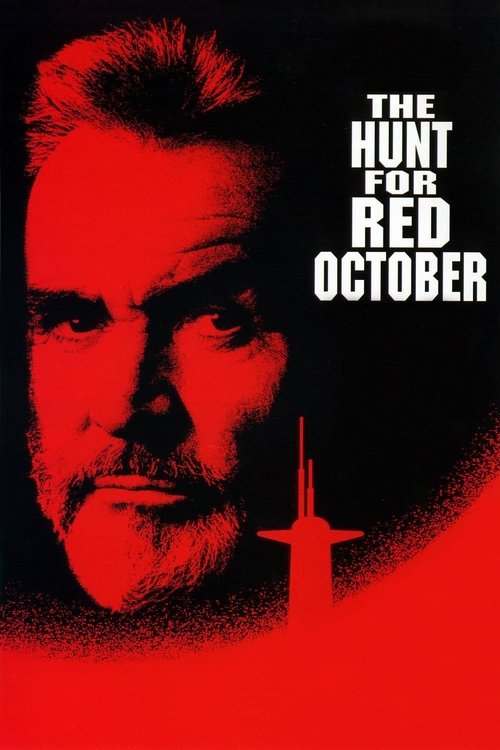
The Hunt for Red October
1990 · John McTiernan
For a meat-and-potatoes thriller night when you want intelligence with your suspense — dads recommend it for a reason. Pure comfort viewing that never insults you.
What it's about
The Soviet Navy's newest nuclear submarine — equipped with a silent propulsion system that makes it nearly undetectable — goes off course toward the American coast under its revered captain, Marko Ramius. Washington assumes an attack; one CIA analyst, Jack Ryan, becomes convinced Ramius intends to defect. Ryan has days to prove it while the entire Soviet fleet hunts the Red October and jumpy American commanders decide whether to sink her first.
The experience
A slow-tightening grip rather than an explosion — the tension comes from sonar pings, chess-move deductions, and men in cramped steel rooms trying to read each other's intentions across an ocean. It's the rare thriller that makes thinking feel exciting, and it's endlessly rewatchable.
Performances
Sean Connery gives Ramius an iron calm that makes every quiet order feel loaded, and a young Alec Baldwin plays Ryan as convincingly smart — a desk analyst improvising far out of his depth. Sam Neill adds unexpected warmth as Ramius's second-in-command.
The craft
John McTiernan, fresh off two of the best action films ever made, chose dread over detonation: the camera glides through submarine interiors like a periscope, and the sound design turns silence itself into the weapon. The rumbling male-choir score is a genuine speaker-shaker — this one rewards a good sound system.
Why it matters
It landed in theaters just as the Cold War was visibly ending, giving the era a kind of elegy, and it launched the Jack Ryan franchise that Hollywood has kept rebooting for three decades.
Snapshot
A Soviet submarine captain steers his vessel toward America not to launch a war but to end one — on his own terms. Released in March 1990 with the Cold War visibly crumbling around it, The Hunt for Red October arrived at the precise historical moment that made its premise both thrillingly plausible and already elegiac. Adapted from Tom Clancy's debut techno-thriller novel, the film balances two simultaneous hunts: the American effort to locate and understand Ramius, and Ramius's own quiet defection, which unfolds in near-silence beneath thousands of feet of ocean. John McTiernan brought the action-thriller command he had demonstrated in Predator (1987) and Die Hard (1988) into a dramatically confined space, producing a film that favors dread over detonation and earned its place as the foundational text of the Hollywood techno-thriller.
Industry & production
Tom Clancy's novel, published in 1984 by the Naval Institute Press — its first work of fiction — became a word-of-mouth phenomenon before crossing over to mainstream bestseller status. President Reagan reportedly praised it as "the perfect yarn," a blurb that gave the book unusual cultural traction and made it immediately attractive to Hollywood. Paramount Pictures acquired the rights and spent several years developing the property; the film eventually moved forward with producer Mace Neufeld, who would shepherd the Jack Ryan franchise through multiple sequels.
McTiernan was brought on following the extraordinary commercial success of Die Hard, making him one of Hollywood's most sought-after action directors. The studio cooperation with the United States Navy gave the production access to real vessels, lending the surface sequences a documentary weight that contrasts productively with the pressurized artificiality of the submarine interiors. The submarine sets themselves — built to represent both the technologically advanced Red October and the American fast-attack USS Dallas — were among the most elaborate practical constructions in the production, designed to give the cast and crew a visceral sense of enclosure and mechanical intricacy.
The casting of Sean Connery as Ramius was a significant commercial and symbolic decision. Connery's own history with James Bond, the defining Cold War spy franchise, gave his presence an intertextual weight: the former 007, now playing a Soviet officer choosing the West. Alec Baldwin took the role of Jack Ryan, his performance establishing the character's blend of intellectual confidence and physical unease — an analyst out of his depth in operational settings. Baldwin would be the first and, as it turned out, only actor to play Ryan in this iteration; Harrison Ford assumed the role for Patriot Games (1992) after what have been described as creative and scheduling disagreements, though the precise circumstances remain a matter of incomplete public record.
Technology
The film's central technological conceit — the Red October's caterpillar magnetohydrodynamic drive, a silent propulsion system undetectable by sonar — gave the sound department a structural challenge and a creative opportunity. If the submarine is silent, how does cinema render that silence as dramatic rather than merely empty? The answer lies in the careful layering of interior sound against exterior absence: the hum of the vessel's machinery, the creak of hull plates under pressure, the suppressed breathing of the crew, placed against a near-total subtraction of the propulsion noise that typically defines the submarine film's acoustic texture.
The production's sound work won the Academy Award for Best Sound Editing, a recognition that points to how technically sophisticated the film's auditory design was. The shift between "silent" and "conventional" running becomes one of the film's primary sources of suspense, translated entirely through audio engineering.
Jan de Bont, who had served as McTiernan's cinematographer on Die Hard, returned in that capacity here, a collaboration that brought a consistent visual grammar to the two films even as their settings differ dramatically. The challenge for de Bont was twofold: first, to shoot in a palette of compressed blues, greens, and the amber warmth of instrument panels that would communicate the difference between Soviet and American interiors; second, to maintain spatial clarity for the audience within environments that are inherently disorienting — cylindrical corridors, low overhead clearances, control rooms dense with instrumentation. He achieved this through selective depth of field, careful staging of actors in relation to machinery, and a restrained use of handheld movement that registers tension without collapsing into chaos.
Technique
Cinematography
De Bont's work here is less kinetic than on Die Hard and more deliberately architectural. The interior submarine spaces are lit to feel simultaneously claustrophobic and legible — the audience always knows roughly where they are in the vessel's hierarchy even as the physical geography compresses. The Soviet and American submarines are subtly color-coded: the Red October leans toward cooler, more diffuse light that gives Connery's quarters an almost ecclesiastical quality, particularly in the early sequences establishing Ramius's solitary decision-making. The Dallas runs warmer and more chaotically lit, matching the reactive energy of Scott Glenn's Mancuso against Connery's stillness.
The surface sequences and the brief Washington political interiors use a more conventional photojournalistic grammar — brighter, harder-edged — that reinforces the thematic contrast between the world of policy and the world of action.
Editing
The film's editing structure is one of its most underappreciated achievements. At roughly two hours and fifteen minutes, Red October maintains an unusual tonal patience for a mainstream action-thriller. McTiernan and his editors resist the impulse to cut away from a scene at the moment tension crests; instead, the camera lingers on faces and instrumentation, letting comprehension arrive slowly. The intercutting between Ramius's submarine, the Dallas, and the American intelligence establishment requires the audience to track multiple threads simultaneously — a structural demand that respects the viewer's attention in a way that distinguishes the film from the genre's more frenetic entries.
Mise-en-scène / staging
McTiernan's staging in confined corridors and control rooms demonstrates his consistent mastery of what might be called the geometry of threat. In Die Hard, that geometry was vertical — the skyscraper as a game board of floors and shafts. In Red October, it is horizontal and compressive: the frame is always occupied by machinery, by bodies that cannot fully extend, by doorways that require ducking. This physical compression extends to the performances McTiernan draws from his cast. Connery moves through the submarine as though he owns its every centimeter; Baldwin moves through the same spaces as though they might close around him. The staging makes the contrast visible without dialogue.
The film's most celebrated single scene — Ramius gathering his officers to read them the letter he has sent to Soviet command, thereby binding them irrevocably to his plan — is shot and staged with a deliberate formality that evokes Soviet ritual and theatrical tragedy simultaneously. McTiernan holds the scene longer than a purely commercial instinct would suggest, trusting Connery and Sam Neill to carry the weight.
Sound
Beyond the Oscar-winning sound editing, the score by Basil Poledouris deserves particular attention. Poledouris opens the film with "Hymn to Red October," a men's choral piece in Russian that draws on the Orthodox choral tradition — grand, solemn, deeply strange in the context of a Hollywood action film. The choice to open not with orchestral fanfare but with unaccompanied (or lightly accompanied) male voices singing in the enemy's language performs the film's central ethical pivot before a single image appears: this is not a film about the Soviet enemy, but about a Soviet protagonist. Poledouris's full score alternates between this choral grandeur and more conventionally tense orchestral writing, with the Soviet material always carrying a weight and complexity that the American scoring never quite matches — a subtle tonal argument in favor of Ramius.
Performance
Sean Connery performs Ramius with a stillness that is itself a form of power. The character's motivation — grief for his wife, contempt for a system that wasted her life, a desire to hand Gorbachev's reformers a "little embarrassment" — is communicated more through carriage and silence than exposition. Connery speaks English throughout (an early scene lampshades this with a deliberate language-shift device), allowing the performance to operate without the additional layer of accent performance that would have distanced the audience.
Alec Baldwin's Ryan works primarily through reactive intelligence — the slightly disheveled academic who is also, it gradually emerges, physically brave. Baldwin's performance has a specificity of nervous energy that later Ryan portrayals did not always sustain; his analyst is genuinely unsure of his ground throughout, which makes his eventual vindication feel earned rather than inevitable.
Scott Glenn, Sam Neill, James Earl Jones, and Tim Curry contribute performances that are disciplined in their economy — the film has a large cast and McTiernan does not allow any of them to overbalance the ensemble.
Narrative & dramatic mode
Red October is structured around an information asymmetry that is peculiar even within the spy-thriller genre. The audience is given the truth — Ramius is defecting — in the film's opening movements. What follows is not a mystery but a dramatic irony: we watch the American and Soviet establishments misread a situation we understand, and we follow Ryan's effort to bring institutional knowledge into alignment with reality. This is less the whodunit or the countdown thriller than it is a procedural about the friction between individual perception and bureaucratic certainty.
The film's resolution is partly political (Ramius reaches American hands) and partly intimate (the quiet exchange between Ryan and Ramius on the submarine's deck as dawn breaks). McTiernan resists the pyrotechnic climax that the genre typically demands; the final confrontation with the Soviet officer attempting to sabotage the submarine is violent but contained, almost perfunctory, as though to signal that the real drama was always the chess game of Cold War epistemology rather than its physical resolution.
Genre & cycle
The film belongs to the Cold War submarine thriller, a subgenre with deep roots in both American and European cinema: Run Silent, Run Deep (1958), The Enemy Below (1957), and most significantly Wolfgang Petersen's Das Boot (1981), which had established that the submarine film could sustain moral ambiguity and psychological depth at an art-cinema level. Red October is the Hollywood mainstreaming of that ambition — it takes the Soviet protagonist seriously, it treats the technology with near-documentary respect, and it refuses the simple ideological satisfactions of the Cold War thriller even as it deploys its conventions.
More broadly, the film belongs to the late-1980s cycle of "smart action" films that McTiernan himself had helped define — narratively intricate, spatially intelligent thrillers that treated their audiences as capable of tracking complex information. This cycle would reach its commercial apogee in the early 1990s before migrating largely to television.
As the foundational Jack Ryan film, Red October also initiated the "Clancy adaptation" subgenre, which continued through Patriot Games, Clear and Present Danger, and several subsequent iterations. The franchise's pattern — a Washington-adjacent analyst thrust into operational crisis — became a recognizable template.
Authorship & method
John McTiernan had, by 1990, established himself as perhaps the most spatially gifted director in mainstream American action cinema. His signature is the legible action space: environments conceived as three-dimensional game boards whose rules the audience internalizes before the dramatic conflict begins. In Die Hard, the Nakatomi Plaza; in Red October, the submarine's corridors and control room. McTiernan's direction is notable for its restraint as much as its command — he does not overcut, he does not rely on the close-up to generate emotion, and he trusts staging and sound to do work that other directors assign to editing.
Jan de Bont as cinematographer brought a European tightness of frame to the submarine material — de Bont had trained under Dutch cinematographers before establishing himself in Hollywood, and his work here shows the influence of that tradition's precision. His subsequent career as a director (Speed, Twister) would demonstrate the action-film intelligence he had been contributing to other directors' work.
Basil Poledouris was at the height of his career's distinctive voice, which combined large orchestral forces with vernacular and ethnic musical materials. His work on Conan the Barbarian (1982) and RoboCop (1987) had demonstrated an ability to invest genre material with a sonic grandeur that felt genuinely mythic rather than merely loud. The choral opening of Red October is among the finest sequences in his filmography.
The screenplay adaptation by Larry Ferguson and Donald Stewart — the latter an Oscar-winning screenwriter (Missing, 1982) — required significant compression of Clancy's dense technical novel, which spends considerable time on submarine mechanics and Cold War political minutiae that do not translate directly to screen time. Their solution was to concentrate on the personal drama of Ramius's decision while preserving enough of the procedural texture to satisfy Clancy's existing readership.
Movement / national cinema
The film is squarely within the tradition of large-scale Paramount entertainment — a studio picture of the old ambition, made by a director given significant latitude because of his preceding commercial success. It does not belong to any particular national cinema movement in the auteurist sense, though it participates in the late-1980s American action-cinema renaissance that included McTiernan's own prior work, Richard Donner's Lethal Weapon pictures, and Tony Scott's Top Gun (1986). This cycle is characterized by high production values, strong ensemble casts, and a genre sophistication that reflects the influence of European and independent American cinema on mainstream Hollywood storytelling.
Era / period
Red October was released in March 1990. The Berlin Wall had fallen in November 1989. The Soviet Union would not formally dissolve until December 1991, but its ideological authority was visibly collapsing throughout the period of the film's production and release. This timing gives the film an inadvertently historical character: it is among the last major Hollywood productions to treat the Soviet Union as a fully operative antagonist, and it does so by declining to make the Soviets straightforwardly antagonistic. Ramius's defection is not framed as an ideological conversion — he does not become an American — but as a human act of conscience and grief within a system he has served and come to understand too well.
The film was also released at a moment when the "smart action" blockbuster was the dominant prestige product of Hollywood's commercial tier, and it benefited from the cultural legitimacy that Die Hard and its contemporaries had built for the form.
Themes
The film's deepest theme is the unreliability of institutional knowledge. Every organization in the film — the CIA, the Pentagon, the Soviet Navy, the Soviet political hierarchy — reads Ramius's actions through the lens of its own assumptions, and every one of them is wrong except the individual analyst who reasons from first principles. Ryan's insight is not intelligence-community expertise but a kind of imaginative sympathy: he asks what Ramius would be thinking, rather than what Soviet military doctrine would predict. The film is, at one level, an extended argument for humanistic reasoning over systemic analysis.
The related theme is the weight of individual agency within bureaucratic systems. Ramius makes his decision alone, before the film begins, and the narrative is entirely the consequences of that decision rippling outward through two superpowers' institutional machinery. His officers are implicated by his single act; Ryan's career is staked on his single interpretation. The submarine itself — sealed, self-contained, operating beneath all communication — becomes a figure for the isolating nature of consequential choice.
There is also an implicit argument about the Cold War itself. The film presents the conflict not as a struggle between freedom and tyranny but as a mutual misreading, a system of mirrored misperceptions in which capable, serious people on both sides are trapped. Ramius and Ryan reach the same conclusion — defection is possible, war is not inevitable — but they arrive there by separate paths that the Cold War's architecture has prevented from connecting. The film's resolution, when they finally speak on the same boat, has the quality of two isolated reasoners discovering they have been thinking the same thought.
Reception, canon & influence
Critical reception at the time of release was broadly favorable, with particular attention to Connery's performance and McTiernan's control of pacing and spatial narrative. The film was recognized as a serious-minded entry in the action-thriller genre, and its commercial performance confirmed Clancy's adaptability to the screen and McTiernan's status as a director who could be trusted with prestige properties.
Influences on the film (backward): Das Boot is the essential precursor, having demonstrated that the submarine film could accommodate genuine moral complexity and a non-Anglo protagonist without sacrificing dramatic tension. Beyond the submarine tradition, the Cold War spy thrillers of John le Carré — adapted through The Spy Who Came in from the Cold (1965) and the Smiley pictures — established the template of the weary professional whose expertise brings them into conflict with the institutions they serve. Clancy's novel itself drew on both traditions while adding a technocratic specificity that was new to mainstream American fiction; the screenplay preserves this register of insider technical knowledge, which distinguishes the film's dramatic texture from the more overtly fantastical James Bond cycle.
Legacy and forward influence: Red October is the founding document of the Jack Ryan film franchise, a lineage that has proved unusually resilient — surviving recasting, shifting historical contexts, and migration to streaming television. Its establishment of Ryan as a type (the intellectual hero, constitutionally unsuited to field work, who turns out to be physically brave when required) has shaped subsequent iterations of the character across multiple media.
More broadly, the film contributed to the Hollywood legitimization of the techno-thriller as a genre capable of supporting A-list productions with genuine dramatic ambition. The cycle of Clancy adaptations it initiated — Patriot Games, Clear and Present Danger — forms a coherent strand of 1990s political thriller filmmaking. The film's treatment of Soviet characters as fully human agents with comprehensible motivations, rather than ideological abstractions, anticipated the post-Cold War cinema's more nuanced engagement with former antagonists.
McTiernan's spatial intelligence, demonstrated across Predator, Die Hard, and Red October, influenced a generation of action directors working in constrained environments. The film's particular contribution — the idea that a submarine's architecture can be made as dramatically legible as a skyscraper's — has been felt in subsequent underwater and enclosed-space thrillers, though few have matched the precision with which de Bont and McTiernan integrated physical space into narrative logic.
The sound design, recognized by the Academy, influenced the subsequent approach to representing sonic absence in technical thrillers — the productive use of near-silence as a suspense device rather than merely a pause between louder moments.
A Deleuzian reading
Sean Connery's Ramius gathers his officers into a cramped compartment and reads them, aloud, the letter he has already mailed to Soviet fleet command — the letter announcing where he is taking their submarine.
The full Deleuzian reading of The Hunt for Red October →
Reception
A hit right out of the gate in 1990 — big box office, an Oscar for sound editing — and its reputation has only hardened since, now routinely called the best submarine thriller ever made and the capstone of McTiernan's untouchable Predator–Die Hard run.
How The Hunt for Red October was received, from release to now →
Influences: the films it descends from and the films it influenced
- Das Boot (1981) — Petersen codified the acoustic grammar of submarine silence — layering hull-creak and mechanical hum against near-total propulsion absence — the precise model McTiernan and the sound editors adapted for the caterpillar drive sequences, where interior noise persists while exterior signature vanishes.
- The Enemy Below (1957) — Establishes the mutual-tracking structure — two commanders inferring each other's geometry through tactical reasoning rather than direct contact — that defines Red October's cat-and-mouse plotting; McTiernan inherits the device of dramatizing threat through inference and negation.
- Run Silent, Run Deep (1958) — Clark Gable's command performance in the conn — authority conveyed through economy of gesture, suppressed emotion readable only in fractional physical adjustments — is the direct template for Connery's Ramius; stillness-as-authority enters the submarine genre here.
- Fail Safe (1964) — Lumet's patient intercutting between geographically isolated command centers — Pentagon, SAC, Moscow — each operating on incomplete information toward catastrophic misunderstanding, provides the editing template for Red October's multi-location dramatic irony structure.
- The Spy Who Came in from the Cold (1965) — Richard Burton's Leamas established reactive intelligence as Cold War performance register — reading new information, recalibrating silently, never betraying the speed of thought — the model McTiernan draws on for both Connery's Ramius and Baldwin's Ryan operating under different cognitive pressures.
- The Bedford Incident (1965) — Harris prefigured the Jack Ryan template: a civilian intelligence observer (Sidney Poitier's journalist) embedded aboard a military vessel, piecing together incomplete information under operational pressure — the procedural epistemology structure Red October inherits and centers.
- Ice Station Zebra (1968) — Sturges built his Cold War submarine thriller around the dramatic irony of hidden competing agendas aboard a vessel where allegiances are uncertain; the procedural uncovering of true intent through behavioral inference is the same epistemological game McTiernan plays with Ramius's defection.
- Conan the Barbarian (1982) — Basil Poledouris's wordless choir deployed as thematic identity rather than emotional underscoring — the Anvil of Crom's choral surge establishing cultural voice before narrative begins — is the direct compositional model for Red October's Lithuanian folk chant opening.
- Predator (1987) — McTiernan developed his geometry-of-threat staging in open jungle — triangulating predator and prey through sightline and negative space — before transposing the same spatial intelligence to submarine corridors, where the horizontal axis of pursuit replaces the canopy's three-dimensional field.
- Die Hard (1988) — Jan de Bont's management of depth of field in confined spaces — Nakatomi stairwells and air ducts where background architecture reads as legible but compressed — carries directly into the submarine interiors; same director, same cinematographer, same spatial problem at reduced scale.
- Patriot Games (1992) — The franchise continuation directly extends Baldwin's reactive-intelligence performance template into Harrison Ford's body, while Noyce preserves McTiernan's patient intercutting between the analyst's interpretive world and the operational field he cannot control.
- Crimson Tide (1995) — Scott inherits Red October's submarine command-space staging wholesale — the conn as theatrical arena, spatial compression encoding hierarchy and challenge — but replaces McTiernan's deliberate stillness with rapid-cut kinetic editing, a conscious stylistic argument with the source film.
- U-571 (2000) — Mostow builds his suspense architecture entirely around the acoustic design vocabulary McTiernan's sound editors established: the silent-running set piece, where the audience hears precisely what the enemy might detect, as the primary and non-negotiable mechanism of submarine thriller tension.
- K-19: The Widowmaker (2002) — Bigelow's Soviet submarine film echoes Red October's color-coded interior lighting and Harrison Ford's Vostrikov consciously channels Connery's stillness-as-authority register — command communicated through withheld expression — while reframing the nuclear scenario as institutional tragedy rather than individual escape.
- Zero Dark Thirty (2012) — Bigelow extends Red October's procedural epistemology — intelligence gathering rendered as cinematic suspense through the patient assembly of incomplete information toward a single actionable conclusion — from Cold War submarine thriller into post-9/11 counterterrorism, the same formal template in a new historical register.
- The Sum of All Fears (2002) — Sets the Paramount Ryan house style the seed restarts: parallel cross-cutting across rival navies and agencies, procedural decoding of ambiguous signals, and institutional-thriller restraint over set-piece spectacle.
- Mayday (2026) — Its mid-sentence push-in that dissolves spoken Russian into English is the canonical formal solution to the language-barrier problem, and its humane, superior Soviet professional is the character type the American half of a Cold War pairing is now written against.
- The Abyss (1989) — Cameron and McTiernan were working the same problem simultaneously: how to shoot underwater confinement so depth is felt rather than illustrated, and how to score near-silence — through Alan Silvestri and Poledouris respectively — so its absence registers as dread rather than emptiness.
- Clear and Present Danger (1994) — Sibling franchise entry that set the procedural texture (co-writer Donald Stewart carried over) of treating naval/intelligence paperwork and chain-of-command verbal sparring as suspense, which CAPD extends to Washington bureaucracy.
- Star Trek II: The Wrath of Khan (1982) — Sibling that returns the submarine-duel-as-character-drama tradition to actual water — the same silent, sensor-blind cat-and-mouse and captain-vs-captain tension Khan had translated to the nebula.
Similar films
- Fail Safe (1964) — influence & lineage · same viewing thread
- Crimson Tide (1995) — influence & lineage
- Das Boot (1981) — influence & lineage
- Predator (1987) — influence & lineage
- The Abyss (1989) — influence & lineage
- Die Hard (1988) — influence & lineage
- The Spy Who Came In from the Cold (1965) — influence & lineage
- The Conversation (1974) — often watched together
All the films related to The Hunt for Red October →
Watch it with: curated runs of related films
- The Shadow of the Bomb — Watch these when you want the Cold War's dread the way it actually landed — not in war rooms but at kitchen tables — the same annihilation refracted from pulp sci-fi to a submarine standoff to a retired couple brewing tea as the fallout arrives.