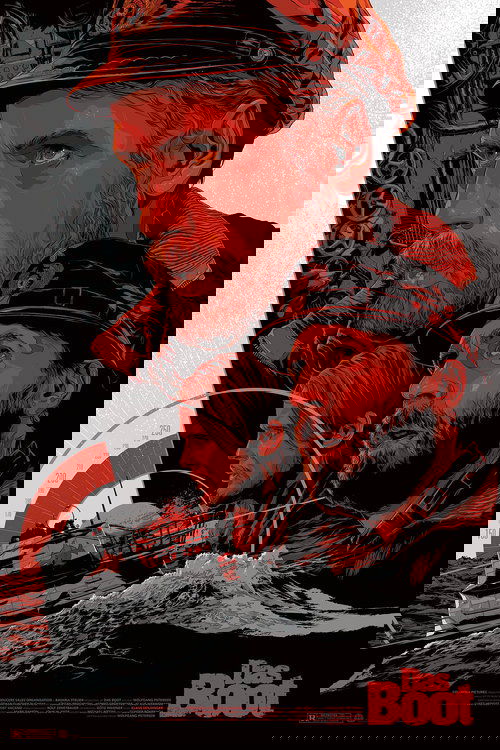
Das Boot
1981 · Wolfgang Petersen
For when you want to be put through the wringer — a tense, immersive night where you surface three hours later drained and grateful for open air. Not a comfort watch; a total-commitment one.
What it's about
Autumn 1941, the Battle of the Atlantic: a German U-boat leaves port to hunt Allied convoys with a young war correspondent aboard to document the patrol. What he finds is not glory but forty-odd men crammed into a steel tube, alternating between stupefying boredom and pure terror as the hunters become the hunted. The film stays inside the boat with them, week after week, as machine and crew are pushed past their limits.
The experience
Claustrophobic and physically exhausting in the best way — long silences broken by sonar pings and depth-charge barrages that make you flinch, with the pressure ratcheting until you realize you've been holding your breath. It's less an action movie than an endurance test you share with the crew.
Performances
Jürgen Prochnow as the captain is the film's anchor — weary, ironic, and quietly humane, a commander who believes in his crew far more than in the war he's fighting.
The craft
The camera hurtles handheld through the real cramped interior of the boat, so you feel every ladder, hatch, and dive alarm in your body, and the sound design — creaking hull, pinging sonar, distant explosions — is among the most celebrated in war cinema. This one genuinely demands good speakers; the terror arrives through your ears.
Why it matters
The most internationally successful German film of its era and the benchmark every submarine movie since has been measured against; it made Wolfgang Petersen's Hollywood career.
Snapshot
Das Boot is a West German war film that renders the Battle of the Atlantic from inside the steel coffin of a German U-boat, following the crew of U-96 on a single Atlantic patrol in the autumn of 1941. Adapted from Lothar-Günther Buchheim's 1973 autobiographical novel — Buchheim had served as a propaganda war correspondent aboard the real U-96 — the film fuses claustrophobic procedural realism with a relentless tension-and-release rhythm built around sonar contacts, depth-charge attacks, and the long, nerve-grinding silences between them. Directed by Wolfgang Petersen, it became the most internationally successful German film of its era and one of the most influential submarine pictures ever made, prized for its documentary fidelity, its restless handheld camerawork, and its insistence that the men below the surface were less heroes or villains than expendable cargo in a war machine that had already abandoned them. Its enduring reputation rests on a paradox: a film that humanizes the sailors of a regime's navy while withholding any consolation, ending not in triumph but in pointless annihilation in a "safe" harbor.
Industry & production
Das Boot was a Bavaria Film production, shepherded by producer Günter Rohrbach, and it represented an unusually large gamble for the West German industry. Its budget — widely reported as roughly 32 million Deutschmarks — made it among the most expensive German films produced up to that point, a scale far removed from the modestly funded auteur cinema that had defined the country's international profile through the 1970s. The financing model was hybrid and pragmatic: the production was conceived from the outset to yield both a theatrical feature and a television miniseries, spreading risk and exploiting the broadcast subsidy structures (television co-financing) that underwrote much German filmmaking of the period.
This dual mandate is central to understanding the film's many forms. The version released theatrically in 1981 ran roughly 149 minutes; a six-part television miniseries running close to five hours aired subsequently; and in 1997 Petersen assembled a Director's Cut of approximately 209 minutes that restored material and is now often regarded as the definitive version. The same footage, recut at different lengths, served a feature audience, a broadcast audience, and later a home-video and restoration market — an early and influential demonstration of how a single expensive production could be monetized across windows.
The shoot was long and physically demanding, and its difficulty is part of the film's lore. Production stretched across an extended schedule, and Petersen has discussed the deliberate strategy of shooting in chronological sequence so that the actors' physical deterioration — pallor, beards, exhaustion, weight changes — would track the narrative's descent. The cast was kept largely out of sunlight to preserve the underwater pallor. The result is a film whose realism is partly a record of genuine, accumulated strain on the people making it.
Technology
The film's technical achievement is inseparable from its sets and its camera. The interior of U-96 was reconstructed as a full-scale, dimensionally accurate replica of a Type VIIC U-boat — narrow, cluttered, and unforgiving — and this set was mounted on a hydraulic rig that could pitch, roll, and shudder, allowing the boat to "dive," list, and convulse under depth-charge concussion. Exterior work relied on large-scale models, including a substantial full-size mock-up of the boat's exterior used for surface and conning-tower sequences, photographed to disguise scale.
The signature instrument, however, was the camera carried by cinematographer Jost Vacano. To move fluidly through a set too cramped for conventional dollies or cranes, Vacano employed a hand-carried, gyro-stabilized camera system that let an operator run the full length of the boat during action scenes — surging from the bow torpedo room to the control room as the alarm sounds. The effect is a kinetic, embodied point of view that places the viewer bodily inside the crew's panic and routine alike. Vacano's solution to the problem of fast, stabilized movement through tight, hostile interiors became one of the film's most copied techniques, and it anticipated the aggressive, run-and-gun interior camerawork he would later bring to his Hollywood collaborations with Paul Verhoeven (RoboCop, Total Recall, Starship Troopers).
Technique
Cinematography
Jost Vacano's photography is the film's defining stylistic signature. He works almost entirely in available-feeling, low-key light — the sickly green of instrument panels, the harsh white of the control room, the amber gloom of the bunks — so that the boat reads as a lived-in machine rather than a lit set. The mobile camera privileges immersion over composition: rather than framing the crew in stable, legible tableaux, Vacano shoves the lens into the action, letting bodies block the frame and the camera careen down the boat's spine. When the boat is under attack, the photography becomes a barrage of motion and reaction shots; when it sits silent on the seabed evading sonar, the camera holds on faces, sweat, and the slow accumulation of dread. The contrast between these registers — frenetic mobility versus near-static endurance — structures the visual experience.
Editing
Hannes Nikel's editing is the film's tension engine. The set-piece grammar of the submarine film — contact, dive, silence, depth charge, damage, repair — is built almost entirely in the cutting room, alternating the crew's faces with the abstract data of the attack (the sonar man's reports, the depth gauge, the creaking hull). The pacing is deliberately patient: long stretches of waiting and routine make the eruptions of violence more shocking, and the film is unafraid to let silence run until it becomes unbearable. The existence of three substantially different runtimes is itself a statement about the material's editorial elasticity; the longer cuts lean further into duration and procedural detail, deepening the sense of time as the crew's true antagonist.
Mise-en-scène / staging
The confinement is the mise-en-scène. Every composition is constrained by the physical reality of the Type VIIC interior — pipes, valves, hammocks slung between torpedoes, men squeezing past one another. The staging emphasizes density and proximity: the crew is rarely afforded private space, and the camera's movement through them maps the boat as a single continuous organism. Production design (the precise replica) and blocking work together so that the audience comes to know the boat's geography intimately — where the control room sits relative to the engine room, the bow, the conning tower — which is what makes the attack sequences legible despite their chaos. The grime, condensation, and progressive squalor are staged details that mark the passage of time and the erosion of the men's bearing.
Sound
Das Boot is, with justification, regarded as a landmark of sound design. The submarine is an aural environment before it is a visual one: the ping of enemy sonar sweeping the hull, the groan and shriek of the pressure hull under depth, the percussive thump and rattle of depth charges, the hiss of leaks, the catastrophic sound of rivets and joints failing. Silence is weaponized — the crew falling mute to avoid detection turns the soundtrack into a held breath, every dripping valve magnified into a threat. Klaus Doldinger's score is used with restraint against this, surfacing chiefly at moments of release and motion; its driving main theme became widely recognized and detached from the film into popular culture. The film's reputation as a benchmark for immersive sound is reflected in its recognition by the Academy in the sound categories.
Performance
The performances are grounded and unshowy, calibrated to ensemble realism rather than star turns. Jürgen Prochnow anchors the film as the Captain (the "Old Man," addressed as Kaleun), a battle-weary professional whose competence is shadowed by open contempt for the Nazi leadership and the propaganda that sent these boys to sea. Herbert Grönemeyer plays Lieutenant Werner, the war correspondent who functions as Buchheim's surrogate and the audience's point of entry — initially naïve, progressively appalled. Klaus Wennemann's Chief Engineer embodies frayed endurance. The chronological shoot pays off in the cast's collective physical transformation, and the acting's chief virtue is its refusal of heroics: these are men managing fear, fatigue, and boredom, and the film's emotional power comes from watching ordinary competence pushed past the breaking point.
Narrative & dramatic mode
The film operates in a semi-documentary, episodic mode rather than a tightly plotted one. Its structure follows the rhythm of a real patrol — long stretches of tedium, drink, and homesickness punctuated by sudden, terrifying engagements — and it resists conventional dramatic arcs of objective and victory. There is no triumphant target to destroy, no clean mission accomplished; the "story" is survival and the toll of survival. Werner's outsider perspective gives the film a quasi-observational frame, and the narrative withholds the catharsis the genre usually supplies. The ending is the film's decisive dramatic gesture: after the boat improbably survives a crushing depth and limps home to its base at La Rochelle, it is destroyed in an Allied air raid in the harbor, the men killed on the dock or as the boat sinks at its mooring — survival rendered meaningless, the sea's ordeal mocked by death in port.
Genre & cycle
Das Boot belongs to the submarine-warfare film, a venerable subgenre, but it is also a war film in the anti-war tradition and a confinement thriller. Within the submarine cycle it stands as arguably the genre's defining modern work, codifying conventions — the sonar duel, the silent-running sequence, the slow dive past crush depth, the pinging hull — that later films would inherit almost wholesale. Crucially, it reframes the genre from the perspective of the side conventionally cast as the enemy, joining a small set of works that humanize German servicemen by separating the conscripted crew from the regime they serve. It sits adjacent to the broader anti-war canon in treating combat as ordeal rather than adventure.
Authorship & method
The film is the signal achievement of Wolfgang Petersen's German career and the launchpad for his subsequent Hollywood trajectory (In the Line of Fire, Outbreak, Air Force One, The Perfect Storm, Troy). Petersen both wrote the screenplay adaptation and directed, and his method — chronological shooting, obsessive set fidelity, the marriage of immersive camera and engineered sound — defines the film's character. He worked with a core of collaborators whose contributions are central: cinematographer Jost Vacano, whose gyro-stabilized handheld system created the film's visual language; composer Klaus Doldinger, the jazz musician (of the band Passport) whose theme became iconic; editor Hannes Nikel, who built the film's tension architecture; and, at the origin, novelist Lothar-Günther Buchheim, whose lived experience aboard U-96 supplied the authenticity — though Buchheim was famously critical of the adaptation, a tension worth noting in any account of the film's authorship. The source material's documentary basis is the bedrock of the production's claim to realism.
Movement / national cinema
Das Boot occupies an interesting position relative to New German Cinema. It emerged from West German cinema at the tail end of the period dominated internationally by Fassbinder, Herzog, Wenders, Kluge, and Schlöndorff — but it was not an auteurist art film. It was a large-scale, commercially ambitious, internationally oriented production that pointed toward a different model of German filmmaking: one capable of competing with Hollywood on Hollywood's own terms of spectacle and craft. In doing so it helped reopen a path for German talent into the American industry, a path Petersen and Vacano both took. Its reckoning with the Nazi past also connects it to a broader West German cultural project of confronting wartime history, though it does so through genre and physical experience rather than overt political essayism.
Era / period
The film is set in the autumn of 1941, a turning point in the Battle of the Atlantic when the early successes of the U-boat arm were giving way to mounting Allied countermeasures and catastrophic German submarine losses. This historical positioning is essential to its tone: these men are fighting a campaign that is already curdling, and the film's fatalism reflects the broader reality that the U-boat service suffered among the highest casualty rates of any branch of the German military. As a 1981 production, it also belongs to a moment when West Germany was prepared to spend at a scale that signaled new commercial confidence, and when the technological tools — stabilized cameras, sophisticated sound and modelwork — had matured enough to deliver its immersive ambitions.
Themes
The film's dominant theme is the gulf between propaganda and reality — the slogans and bravado that launch the patrol against the squalid, terrifying, often pointless experience of actually waging it. Closely bound to this is the theme of men as expendable matériel: the crew are not ideological warriors but conscripts and professionals, sacrificed by a leadership the Captain openly disdains. Endurance and confinement supply the film's experiential core — the body and mind under sustained pressure, literal and psychological. The sea functions as an indifferent adversary larger than any human enemy. And the film advances a bleak vision of war's futility, crystallized in an ending that denies its survivors any reward, suggesting that the only victory available is bare, temporary survival, and that even that can be erased in an instant by an arbitrary bomb.
Reception, canon & influence
Das Boot was a major critical and commercial success, achieving rare international reach for a German-language film and performing especially strongly in the United States. Its standing was confirmed by recognition from the Academy of Motion Picture Arts and Sciences, which nominated it across six categories including Best Director for Petersen, Best Adapted Screenplay, Best Cinematography, Best Film Editing, and the sound categories — an unusual breadth of technical and creative recognition for a foreign-language film, and a clear signal of how seriously its craft was taken. (Exact award and box-office figures should be treated with care; the precise gross varies by source.)
Looking backward, the film draws on the established submarine-warfare tradition — Anglo-American precedents such as The Enemy Below (1957) and Run Silent, Run Deep (1958) supply genre grammar — while its deepest debt is to Buchheim's autobiographical novel and, through it, to the documented reality of the U-boat service. Its claim to authenticity is what distinguishes it from the more conventionally heroic war pictures it follows.
Looking forward, its influence is pervasive. It is the modern template for the submarine film, and its DNA is visible in The Hunt for Red October, Crimson Tide, U-571, and beyond; its sound design set a standard the genre still measures itself against; and Vacano's mobile-camera approach to confined spaces reverberated through subsequent action and war filmmaking. It propelled Petersen and Vacano into Hollywood, reshaping the careers of both. The property itself proved durable, generating renewed attention through the 1997 Director's Cut and a 2018 television series extending the world of the original. Within the canon, Das Boot endures as both a benchmark of technical immersion and a humane, unsparing war film — one that earned its place less by what it asserts than by what it makes the viewer feel: the weight of the water, the pressure on the hull, and the cost paid by men sent to fight a war their commanders had already lost faith in.
A Deleuzian reading
The men stop moving.
The full Deleuzian reading of Das Boot →
Reception
A hit from the start — six Oscar nominations, then a record for a German film — but its stature has only grown as successive cuts (the 1997 Director's Cut, the uncut miniseries) turned it into the consensus benchmark every submarine movie gets measured against.
How Das Boot was received, from release to now →
Influences: the films it descends from and the films it influenced
- The Enemy Below (1957) — Supplies the genre grammar of the surface-vs-submarine sonar duel — the cat-and-mouse intercutting of hunter and hunted by sound contact that Das Boot inherits and intensifies into its depth-charge sequences.
- Run Silent, Run Deep (1958) — Establishes the cramped-control-room ensemble under a fraying captain, and the 'silent running' protocol — crew frozen in held breath as the hull is pinged — that Das Boot's sound design literalizes.
- The Cruel Sea (1953) — Models the unglamorous, semi-documentary naval-war realism of attrition and tedium punctuated by terror, rejecting heroics for the procedural grind that Petersen adopts.
- All Quiet on the Western Front (1930) — Founds the anti-war template of men-as-expendable-materiel and the anti-cathartic ending, where survival through the ordeal is annulled by an arbitrary final death — the exact structural move of Das Boot's dockside finale.
- Lifeboat (1944) — Pioneers the single-vessel confinement experiment — an entire film staged within one cramped craft, forcing performance and camera to extract variety from a fixed claustrophobic volume.
- The Battle of Algiers (1966) — Provides the episodic, newsreel-textured semi-documentary handheld idiom and grainy available-light look that Vacano translates into the U-boat's low-key interior.
- A Bridge Too Far (1977) — Extends the institutional-failure military narrative with the same ensemble-no-protagonist structure and chronological escalation toward sealed catastrophe, but inverts A Bridge Too Far's wide-frame spatial dispersal into claustrophobic compression — the shrinking U-boat hull a structural echo of the contracting Arnhem perimeter, catastrophe as enclosure rather than overextension.
- Cross of Iron (1977) — Continues the German-perspective WWII drama with a restless handheld camera racing through cramped interiors and a de-glamorized doomed crew bound by professional duty rather than ideology.
- The Bridge (1959) — German-perspective war realism built on claustrophobic proximity and mounting futility, denying its soldiers glory and heroism in the tradition Wicki established for postwar German cinema.
- Kanal (1957) — Inherits the trapped-in-a-labyrinth dramaturgy — a doomed crew inside a constructed confined vessel with the camera prowling cramped purpose-built sets, the claustrophobic-tunnel ordeal Kanal pioneered with its sewer sets.
- The Flight of the Phoenix (1965) — Extends set-degrades-with-story to its limit — one hull, progressively wrecked, shot on extreme wide lenses that bend the confinement — and stakes long passages on repair procedure understood by the audience before it becomes suspenseful.
- 49th Parallel (1941) — Petersen's tracking camera driven the full length of the boat, and the sustained low-ceiling claustrophobia of a hull under depth charge, is the seed's submarine prologue expanded to a feature — with the same premise that a German crew's interiority is the point, not a transgression.
- RoboCop (1987) — Directly extends Jost Vacano's self-built gyro-stabilized handheld rig — the same fluid, body-mounted mobility he engineered for Das Boot's corridor runs — into Hollywood action staging.
- Starship Troopers (1997) — Carries Vacano's mobile-camera-in-tight-quarters technique and his anti-war irony forward, framing ensemble soldiers as propaganda-driven expendable materiel — the same theme/propaganda-versus-reality lens.
- The Hunt for Red October (1990) — Inherits Das Boot's engineered submarine sound-design vocabulary — hull groans, sonar pings, depth pressure — as the genre's new baseline for acoustic tension architecture.
- Crimson Tide (1995) — Extends the claustrophobic control-room ensemble and command-conflict-under-pressure staging, building its drama from the same tension-and-release editing rhythm of alert-to-silence cycles.
- U-571 (2000) — Lifts Das Boot's WWII U-boat production-fidelity and immersive interior camerawork almost wholesale, down to the depth-charge endurance set-piece as the genre's signature ordeal.
- Saving Private Ryan (1998) — Generalizes the visceral first-person-handheld combat immersion and chronological ensemble realism into infantry warfare, pursuing the same goal of making the audience feel bodily endangerment.
- Master and Commander: The Far Side of the World (2003) — Applies the obsessive period set-fidelity and below-decks ensemble realism to age-of-sail naval warfare, treating the ship's confined community and its physical labor as the true subject.
- Greyhound (2020) — Distills the Battle-of-the-Atlantic procedural — sonar contacts, bridge commands, sustained sound-driven dread across a convoy crossing — directly from the template Das Boot set for Atlantic naval suspense.
- Apollo 13 (1995) — Developed the grammar of progressive claustrophobia in a confined vessel — progressively tighter frames, interiors darkening as power drains, diegetic mechanical sounds as mortal-threat indicators — that Apollo 13 directly applies to the command module crisis, including the rhythm of equipment failure heard before it is seen.
- Total Recall (1990) — Jost Vacano developed his signature handheld-destabilization technique in Das Boot's submarine corridors — the same restless, lunging camera style he carried directly into Total Recall's Martian tunnel chase sequences and Rekall facility interiors.
- The Abyss (1989) — The Abyss's interior acoustic design—the pressure groans of the hull, differential registers between mechanical noise and human breath, sonar pings as psychological instrument—inherits directly from Petersen's deployment of underwater vessel acoustics to generate dread from the sounds the sea makes against metal.
- The Hurt Locker (2008) — Petersen's staging of repeated technical procedural sequences — pressure readings, valve operations, instrument checks — as the primary carrier of suspense rather than dramatic confrontation directly prefigures Bigelow's EOD disarmament blocking, where the mechanics of the task are the drama.
- Aguirre, the Wrath of God (1972) — Shares the post-New-German-Cinema method of chronological shooting and real physical deterioration of an ensemble trapped in a confined vessel, privileging endured experience over staged spectacle.
- The Perfect Storm (2000) — Petersen restages his own Das Boot method — a doomed all-male crew sealed in a pitching vessel against overwhelming nature, with an anti-cathartic drowning ending and immersive engineered sound.
- Full Metal Jacket (1987) — Petersen's year-long physical transformation of his entire ensemble through submarine confinement, his episodic structure fragmenting a military mission into discrete ordeals, and his anatomy of a hierarchical institution destroying individual selfhood are FMJ's structural siblings in a non-American military tradition — both films treat physical deterioration as the legible evidence of institutional damage.
- Outbreak (1995) — Petersen's own foundational sealed-hierarchical-space film: claustrophobic sound design of enclosure and competent professionals under command pressure, directly reworked into Outbreak's containment labs and chain-of-command ethics.
- Letters from Iwo Jima (2006) — Enclosed subjective sound design of a doomed crew in claustrophobic metal interiors — the submarine-as-tomb acoustics Letters transposes to its tunnel-and-cave staging.
Similar films
- Lifeboat (1944) — influence & lineage
- The Hunt for Red October (1990) — influence & lineage
- Crimson Tide (1995) — influence & lineage
- All Quiet on the Western Front (1930) — influence & lineage
- Saving Private Ryan (1998) — influence & lineage
- The Battle of Algiers (1966) — influence & lineage · same viewing thread
- All Quiet on the Western Front (2022) — same viewing thread
- The Bridge (1959) — same viewing thread
All the films related to Das Boot →
Watch it with: curated runs of related films
- The Futility of War — A run of films about ordinary men fed into war's machinery — from the trenches to the Casbah to the Warsaw sewers — where the futility and human cost rhyme across a century and a dozen conflicts.