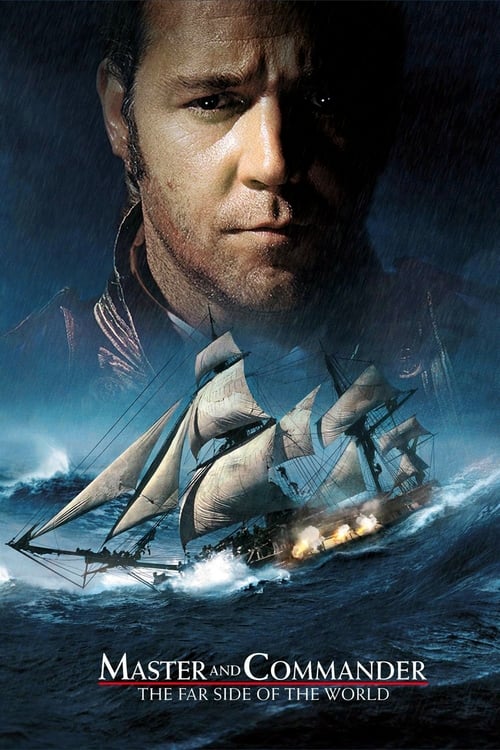
Master and Commander: The Far Side of the World
2003 · Peter Weir
For when you want to be transported somewhere completely — a full evening's voyage to another world, adventure with real weight and no cheap thrills. Comfort viewing for people who like their comfort earned.
What it's about
In 1805, at the height of the Napoleonic Wars, a British frigate is ambushed and badly mauled by a larger, faster French privateer off the coast of Brazil. Its captain, Jack Aubrey, refuses to limp home — he chases the enemy around Cape Horn and into the Pacific, pushing his ship and crew to the edge. At the heart of it is his friendship with the ship's surgeon, a naturalist who'd rather be collecting specimens than fighting, and who keeps asking whether the pursuit of glory is worth what it costs the men.
The experience
Immersive is the word — you feel the salt spray, the cramped decks, the boredom and terror of months at sea. It moves at the rhythm of the voyage itself, long stretches of shipboard life punctuated by cannon fire that hits like a thunderclap, and the friendship at its center gives the whole thing unexpected warmth.
Performances
Russell Crowe makes Aubrey a born leader who's also a bit of a ham — charming, stubborn, quietly burdened — and Paul Bettany matches him as the surgeon Maturin, all skeptical intelligence; their scenes together, arguing or playing music in the captain's cabin, are the film's soul.
The craft
Peter Weir's obsessive period detail makes the ship feel like a real, working, creaking world, and the sound design — groaning timbers, wind in the rigging, the shattering violence of a broadside — is among the best ever put on a warship. Demands the biggest screen and best speakers you can find.
Why it matters
Widely considered the high-water mark of the naval adventure on film — the movie every seafaring epic since gets measured against — and a beloved cult object whose fans have campaigned for a sequel for two decades.
Snapshot
Master and Commander: The Far Side of the World is Peter Weir's adaptation of Patrick O'Brian's beloved Aubrey–Maturin novels, a sea-faring adventure set during the Napoleonic Wars and built around the friendship between Captain Jack Aubrey (Russell Crowe) and the ship's surgeon-naturalist Stephen Maturin (Paul Bettany). In 1805, Aubrey's frigate HMS Surprise is ambushed and badly mauled by the larger, faster French privateer Acheron off the coast of Brazil; the film follows Aubrey's obsessive pursuit of the enemy around Cape Horn and into the Pacific, culminating near the Galápagos Islands. It is at once a meticulously researched evocation of life aboard a Royal Navy man-of-war and a chamber drama about duty, command, and the tension between a warrior's hunger for glory and a healer's humanism. Released by 20th Century Fox in November 2003, it won two Academy Awards and stands as one of the most admired — and, commercially, one of the most frustratingly under-rewarded — prestige adventures of its era.
Industry & production
The film was a large-scale, multi-studio undertaking, co-financed by 20th Century Fox, Miramax, and Universal, with a budget widely reported in the neighborhood of $150 million — substantial for a project with no romance plot, no female leads, and a literary pedigree better known to readers than to mass audiences. Weir had courted O'Brian's twenty-novel cycle for years; the screenplay, credited to Weir and John Collee, conflates incidents from several books (taking its subtitle from the tenth novel, The Far Side of the World, and the principal title from the first) rather than adapting a single volume.
A consequential dramatic alteration was the change of antagonist. In O'Brian's The Far Side of the World, Aubrey pursues an American frigate during the War of 1812; the film, mindful of a contemporary American audience and a transposed period (1805), recast the adversary as the French Acheron. This let the production retain the chase structure while sidestepping the awkwardness of casting the United States as the villain.
Principal photography centered on the vast water tanks at Fox's Baja Studios in Rosarito, Mexico — the same facility built for Titanic (1997), including the enormous exterior tank that opens onto the horizon of the Pacific. A full-scale, largely seaworthy replica of HMS Surprise was constructed, supplemented by scale models and a working section ship on gimbals for storm and battle work. Location shooting in the Galápagos Islands lent the late naturalist passages an authenticity no set could supply. The shoot was demanding and lengthy, in keeping with Weir's reputation for exhaustive preparation.
Technology
The picture was photographed on 35mm film, in the anamorphic widescreen tradition appropriate to a sweeping period epic. Its technological achievement lies less in novelty than in the seamless marriage of large-scale practical filmmaking with then-state-of-the-art digital effects. The Surprise and its sister vessels were physical objects whenever possible, but the most extreme moments — the Cape Horn storm, the dismasting, the cannon fire tearing through hull and rigging, and the wider seascapes — relied on visual-effects work from houses including Weta Digital, Industrial Light & Magic, and Asylum. The blend is notably restrained: the digital water and ships are deployed to extend reality rather than to stage impossible spectacle, which is a large part of why the film still reads as tactile and weighty rather than weightless. Sound technology was equally central; the film's immersive cannon-fire, creaking timber, and storm work pushed contemporary sound design and mixing toward a heightened physical realism.
Technique
Cinematography
Russell Boyd, Weir's longtime Australian collaborator (their association reaches back to Picnic at Hanging Rock and Gallipoli), won the Academy Award for Best Cinematography. His work favors available and naturalistic light — candle and lantern interiors below decks, hard tropical sun and gray storm light above — producing images that feel observed rather than illuminated for effect. The camera is frequently handheld and embedded among the crew, threading the cramped wooden warren of the ship to convey both claustrophobia and community, then opening to wide, painterly vistas of sea and sky. The opening battle, fought in fog and confusion, is a model of orienting the audience through controlled disorientation. Boyd's palette — weathered wood, brass, blue-gray ocean, the bleached light of the doldrums — became one of the film's signatures.
Editing
Lee Smith, another key Weir collaborator, cut the film (he earned an Oscar nomination). The editing balances long, patient passages of shipboard routine and conversation against sharply compressed action. The battle sequences are kinetic without descending into incoherence: Smith maintains spatial logic — who is where, which ship has the wind, where the next shot will land — so that the violence is legible as tactics and consequence, not just noise. The film's overall rhythm is unhurried by blockbuster standards, allowing tension to accumulate through pursuit and waiting.
Mise-en-scène / staging
The production design by William Sandell and costumes by Wendy Stites (Weir's wife and frequent collaborator) are exacting in their period detail, from the surgeon's instruments to the worn, individuated uniforms and slop clothing of the crew. Weir stages the ship as a complete, stratified society — officers, midshipmen (some of them children), warrant officers, and hands — and choreographs the bodies in that confined space with documentary attention to labor: hauling, climbing, gun drill, mess, surgery. The deliberate texture of grime, sweat, and wear grounds every frame.
Sound
Richard King won the Academy Award for Best Sound Editing, and the achievement is fundamental rather than decorative. The world is built sonically — the constant groan of stressed timber, wind in rigging, the percussive shock of broadsides, the eerie quiet of the becalmed Pacific. The sound design makes the ship a living organism and the cannon fire a genuinely frightening force, and it does much of the work of immersing the viewer in a vanished material reality.
Performance
Russell Crowe anchors the film as "Lucky Jack" Aubrey — commanding, charismatic, and driven, but shaded with vanity and ferocity. Paul Bettany's Maturin supplies the necessary counterweight: cerebral, principled, ironic, a man of science and conscience whose loyalties to friendship and to natural curiosity pull against Aubrey's martial single-mindedness. Their rapport, expressed partly through the duets they play together (Aubrey on violin, Maturin on cello), is the film's emotional core. The large ensemble — including the youthful midshipmen and the ship's company — is directed toward an unforced naturalism that makes the crew feel like a real, hierarchical, interdependent community.
Narrative & dramatic mode
The film operates in the mode of the realist adventure-epic, but its dramatic engine is character rather than plot mechanics. The pursuit of the Acheron provides forward momentum, yet the picture is structured episodically, in the manner of its source novels: a battle, a repair, a storm, a stretch of becalmed tedium, a stop for naturalist observation, a crisis of morale, a final stratagem. Two ethical questions recur and braid together: how far a captain may push his men in pursuit of an objective, and where the line falls between necessary command and ruinous obsession. The Maturin subplot — his wounding, his surgery upon himself, and his thwarted then granted longing to explore the Galápagos — both humanizes Aubrey and offers an alternative value system (knowledge, life, observation) set against the warship's machinery of destruction. The film notably withholds conventional resolution and romantic consolation; its closure is a clever feint and a renewed pursuit, leaving the friendship, not victory, as the abiding subject.
Genre & cycle
The picture belongs to the venerable tradition of the nautical war film and the Age-of-Sail adventure — a lineage running through earlier Hornblower and Errol Flynn swashbucklers and the seafaring pictures of the studio era. It arrived during a brief early-2000s revival of large-scale historical and seafaring spectacle (the same year as Pirates of the Caribbean: The Curse of the Black Pearl), but it pointedly rejects the genre's romantic and fantastical conventions in favor of sober realism. In that sense it is closer to the "process" war film — concerned with the texture of work, discipline, and survival — than to the swashbuckler, and it functions as a deliberate corrective to the genre's traditional gloss.
Authorship & method
Peter Weir is the film's decisive author, and it bears the hallmarks of his career-long preoccupations: the encounter between rational, ordered systems (here, naval discipline and command) and the vast indifferent forces of nature; closed, hierarchical male institutions observed with anthropological care (cf. Gallipoli, Dead Poets Society); and a fascination with characters tested at the edge of the known world. His method is one of immersive research and patient construction, prizing authenticity and ensemble realism over star-vehicle convention.
His key collaborators form a recognizable Weir circuit. Cinematographer Russell Boyd and editor Lee Smith were long-standing partners; costume designer Wendy Stites is his wife and frequent creative collaborator. The screenplay was written with John Collee. The musical authorship is unusually distributed: rather than a single composer, the film's score was assembled chiefly by Iva Davies, Christopher Gordon, and Richard Tognetti (the violinist and director of the Australian Chamber Orchestra, who also coached the actors' playing), woven together with period classical works — Boccherini, Corelli, and Bach among them — that the characters perform or that score key passages. This curatorial, part-original, part-canonical approach to music is itself an authorial choice, binding the soundtrack to the film's themes of culture, friendship, and civilization carried into the wilderness.
Movement / national cinema
Weir is a central figure of the Australian New Wave of the 1970s, and although Master and Commander is a Hollywood-financed production with a British-set story, its creative DNA is substantially Australian: Weir, Crowe (raised in Australia and New Zealand), Boyd, Smith, Stites, and Tognetti all belong to that orbit. The film thus sits at the intersection of the international Hollywood prestige picture and the export of Australian craft talent that had, by the 2000s, become a major current in global filmmaking. It is "British" in subject and "American" in financing, but its sensibility — outdoorsy, unsentimental, attentive to landscape and institution — is recognizably of Weir's national tradition.
Era / period
Made and released in 2003, the film belongs to a moment when studios still mounted adult-skewing, mid-to-high-budget historical epics with serious craft ambitions — a window that would narrow considerably in the following decade as franchise tentpoles consolidated. Its fastidious realism can also be read against the cultural backdrop of its release, two years after September 11 and amid renewed conflict: a study of leadership, duty, sacrifice, and the moral costs of pursuing an enemy, presented without easy triumphalism. Its diegetic period — 1805, the high Napoleonic Wars — is rendered with a near-fetishistic commitment to material accuracy that itself reflects the early-2000s prestige cinema's faith in authenticity as a value.
Themes
The film's enduring themes are several and interlocking. First, command and its burdens: the loneliness of authority, the calculus by which a leader spends his men's lives, and the seductive danger of glory. Second, the friendship of opposites: Aubrey the man of action and Maturin the man of thought, whose mutual respect models a civilized accommodation between war and learning, force and conscience. Third, nature and science: Maturin's naturalism — explicitly evoking the spirit of discovery that the Galápagos would later make famous through Darwin — sets curiosity and the preservation of life against the warship's purpose of destruction. Fourth, the ship as society: a self-contained, stratified world that dramatizes duty, class, superstition, discipline, and belonging. And running beneath all of it, the smallness of human enterprise against the immensity of sea and weather — the characteristic Weir confrontation between human order and natural vastness.
Reception, canon & influence
Critically, the film was widely and warmly received, praised for its intelligence, craftsmanship, performances, and refusal of genre cliché; it became a touchstone for viewers who valued grown-up spectacle. It earned ten Academy Award nominations — including Best Picture and Best Director — and won two, for Russell Boyd's cinematography and Richard King's sound editing. Its awards fortunes were blunted by competing against The Lord of the Rings: The Return of the King, which swept that year. Commercially, despite respectable returns, the film is generally regarded as having underperformed relative to its very large budget, and the hoped-for series of Aubrey–Maturin adaptations never materialized — a fact frequently lamented in later appreciations.
Its influences flow backward from a deep well: Patrick O'Brian's novels above all, but also the long tradition of naval fiction and film, the visual culture of maritime painting, and Weir's own prior work on closed institutions and nature's indifference. Looking forward, the film's legacy is one of esteem more than imitation. It has acquired a durable reputation as the gold standard for Age-of-Sail authenticity and is regularly invoked as a benchmark whenever later filmmakers attempt naturalistic period adventure or immersive, weather-beaten realism. Its commercial disappointment is itself often cited in discussions of how the studio appetite for serious, mid-budget historical drama contracted in the years that followed. The full-scale Surprise replica and the film's craft reputation have given it a strong afterlife among enthusiasts, and renewed interest — including reported development of further screen treatments of O'Brian's world — testifies to the singular place this single, unrepeated film holds. Where the historical record on its long-term industrial influence is genuinely thin, it is fairer to say that Master and Commander endures less as a template that others copied than as an admired, slightly orphaned high-water mark of its kind.
A Deleuzian reading
Out of the fog comes a shape that shouldn't be there, and then the side of the world tears open.
The full Deleuzian reading of Master and Commander: The Far Side of the World →
Reception
Respected on release — 10 Oscar nominations, wins for cinematography and sound editing — but it underperformed against its huge budget and had the misfortune of hitting awards season the same year as Return of the King. Two decades on it's been fully canonized as the gold standard of grown-up adventure filmmaking, the movie every 'they don't make them like this anymore' lament is secretly about.
How Master and Commander: The Far Side of the World was received, from release to now →
Influences: the films it descends from and the films it influenced
- Lawrence of Arabia (1962) — Establishes the anamorphic-widescreen language of dwarfing men against an indifferent natural vastness, with real-location ordeal substituted for studio spectacle — the template for M&C's scale and authenticity.
- Barry Lyndon (1975) — Pioneers naturalistic available-light 18th-century imagery wedded to diegetic period classical music (Boccherini, Bach); M&C borrows both the unlit-interior look and the very Boccherini/Bach idiom for its culture-carried-into-wilderness score.
- Das Boot (1981) — Codifies the embedded handheld camera moving through the cramped interior of a single fighting vessel and the immersive sound of a closed crew at war — the direct model for M&C's process-war realism below decks.
- Aguirre, the Wrath of God (1972) — Stages European rational order and command unraveling against nature's indifference at the edge of the known world, shot as an actual location ordeal rather than a constructed adventure.
- Picnic at Hanging Rock (1975) — Weir and DP Russell Boyd's own seedbed: diffuse naturalistic light and the recurring motif of nature serenely indifferent to human systems, carried directly into M&C's visual ethic.
- Gallipoli (1981) — Weir's anthropological observation of a closed, hierarchical male institution tested to destruction by war — the same stratified-society gaze he turns on the Surprise's command structure.
- Mutiny on the Bounty (1935) — Founds the age-of-sail cinema of stratified ship society and the drama of command authority and its discontents, the genre grammar M&C inherits and refines toward realism.
- Moby Dick (1956) — Full-scale practical ship work and the obsessive captain pursuing a single quarry across the open sea — Aubrey's relentless hunt for the Acheron echoes the whale chase as monomaniacal process.
- Run Silent, Run Deep (1958) — Establishes the two-man command duet — captain and skeptical second-in-command — as the dramatic engine inside a closed vessel, the structural ancestor of the Aubrey–Maturin pairing.
- The Man Who Would Be King (1975) — The two-hander of competing temperaments — command-hubris versus rational counsel — in an adventure-epic frame, with John Seale's harsh top-lit anamorphic cinematography in extreme oceanic terrain and the ellipsis editing of extended voyages, inherits Huston's template directly; Weir also shares TMWWBK's elegiac relationship to a genre its maker knows is obsolescent.
- Twelve O'Clock High (1949) — Modern heir to the cost-of-command drama built on naturalistic ensemble and procedural authenticity, where leadership means husbanding a depleted crew's endurance under relentless attrition.
- The Revenant (2015) — Extends M&C's handheld-embedded camera in natural light and its theme of nature's brutal indifference into a punishing, weather-beaten survival realism.
- In the Heart of the Sea (2015) — Revives the age-of-sail whaling adventure with the same practical-digital ship blend, and was explicitly measured by critics against M&C's authenticity benchmark.
- 1917 (2019) — Carries forward the embedded camera tracking soldiers through continuous, legible space, making war an immersive procedural experienced from inside the ranks.
- Greyhound (2020) — A naval process-war film built entirely around the burden of command and the captain's isolation on the bridge — M&C's 'command and its burdens' theme distilled to a single duty watch.
- Black Sails (2014) — Rigging-accurate, full-scale age-of-sail production design that openly treats M&C as the gold standard for shipboard authenticity it must match.
- Pirates of the Caribbean: At World's End (2007) — Its meticulously researched tall-ship broadside gunnery and rigging realism set the contemporary bar for period naval combat that Verbinski's fantasy sea battles build spectacle atop.
- The New World (2005) — Shares the available-light naturalism and tactile period immersion that privileges weather, texture and process over conventional plot mechanics.
- Dunkirk (2017) — A process-war film of near-wordless military procedure with legible action geography and design-forward, immersive sound — M&C's craft values transposed to ships, beach and air.
- Apocalypto (2006) — Pursues total period immersion as visceral, naturalistic chase at the edge of a vanishing world, prizing embodied authenticity over expository historical framing.
- Titanic (1997) — Pursues the same near-full-scale period ship built on a gimbaled tank rig, prioritizing physical-set authenticity and on-deck immersion over green-screen for shipboard drama.
- Pirates of the Caribbean: The Curse of the Black Pearl (2003) — Released the same year, it pursues the same practical tall-ship craft — real rigging, deck-level camera, physically staged naval combat — as the authenticity counterpart to Pirates' fantasy.
Similar films
- Dunkirk (2017) — influence & lineage
- Gallipoli (1981) — influence & lineage
- Pirates of the Caribbean: The Curse of the Black Pearl (2003) — shared sensibility
- Pirates of the Caribbean: Dead Man's Chest (2006) — shared sensibility
- Pirates of the Caribbean: At World's End (2007) — shared sensibility
- The Lord of the Rings: The Return of the King (2003) — shared sensibility
- The Life Aquatic with Steve Zissou (2004) — shared sensibility
- Pearl Harbor (2001) — shared sensibility
All the films related to Master and Commander: The Far Side of the World →