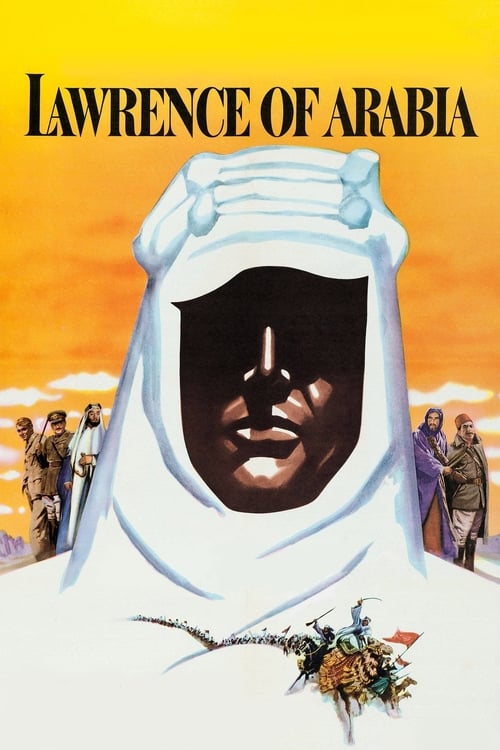
Lawrence of Arabia
1962 · David Lean
For when you want to be swallowed by a movie — a full-evening commitment, ideally on the biggest screen and best sound you have. Reach for it when you're craving old-school epic sweep with a dark, thinking core.
What it's about
During World War I, a restless young English officer named T.E. Lawrence is sent from a Cairo map room into the Arabian desert, where he sets out to unite rival Arab tribes in revolt against the Turks. What begins as a military mission becomes a story of self-invention: Lawrence remakes himself as a desert legend, and the film watches, with growing unease, what that legend costs the man and the people he claims to fight for.
The experience
Vast and immersive — three-plus hours that move with surprising momentum, alternating overwhelming desert spectacle with an increasingly troubling character study. You come for the scale and stay for the disquiet; it's thrilling and unsettling in the same breath.
Performances
Peter O'Toole's Lawrence is one of the great screen debuts in a leading role — magnetic, theatrical, and slowly cracking, a hero performance that curdles into something stranger. Omar Sharif's entrance alone, materializing out of a desert mirage, became instantly iconic.
The craft
David Lean's widescreen desert photography is arguably the high-water mark of landscape filmmaking — sun, sand, and tiny human figures composed like moving paintings, with one match-cut so famous it's taught everywhere editing is taught. Maurice Jarre's sweeping score is inseparable from the images. If any film justifies a cinema screen and proper speakers, it's this one.
Why it matters
A towering influence on generations of filmmakers who cite it as the reason they make movies, and the standard against which every screen epic since has been measured.
Snapshot
David Lean's Lawrence of Arabia is a character study masquerading as an imperial epic, or an imperial epic hiding inside a character study — the ambiguity is the point. Across roughly three and a half hours (in its restored form), it traces the arc of T.E. Lawrence from obscure cartographic officer to self-fashioned desert legend to broken, hollowed-out man, and it does so through the most sustained deployment of widescreen landscape imagery in the history of English-language cinema. The film sits at an almost unrepeatable intersection of industrial ambition, pictorial intelligence, and psychological unease. It is routinely cited, across multiple decades and critical generations, as one of the two or three greatest achievements in the epic form.
Industry & production
The project originated with producer Sam Spiegel, who had just delivered The Bridge on the River Kwai (1957) with Lean and was determined to surpass it in scope. The rights to T.E. Lawrence's memoir Seven Pillars of Wisdom were acquired, and playwright Robert Bolt was brought in to write the screenplay after an initial draft by Michael Wilson — who, because he had invoked the Fifth Amendment before the House Un-American Activities Committee, was blacklisted and went uncredited at release. Wilson's substantial contribution to the script went unacknowledged for decades; the Writers Guild of America restored his credit posthumously in 1995.
Albert Finney screen-tested for the title role and declined to commit to the multi-year contract Spiegel required. Peter O'Toole, then a stage actor with minimal film work, was cast instead — a gamble that made him an international star. The supporting cast assembled a remarkable group: Alec Guinness as Prince Faisal, Anthony Quinn as Auda abu Tayi, and Omar Sharif — then unknown outside Egypt — as Sherif Ali, a role that launched Sharif's international career. Jack Hawkins, Claude Rains, Anthony Quayle, and Arthur Kennedy filled out the British officer corps.
Filming began in Jordan in May 1960, centered on the extraordinary red sandstone formations of Wadi Rum, then moved to Morocco and the Saharan margins, and finished with interior and Spanish location work (the sequences representing Aqaba were shot near Almería). Production stretched into 1962. The budget, which ran to approximately thirteen to fifteen million dollars by completion, was among the largest in British film history at the time, financed through Columbia Pictures. The film premiered in London on 10 December 1962.
Technology
Lawrence of Arabia was shot in Super Panavision 70, using 65mm negative stock that printed to 70mm for roadshow engagements — a format chosen explicitly because Lean and cinematographer Freddie Young felt that the canvas of the Arabian desert demanded a frame wider and taller than any standard ratio. The resulting 2.20:1 aspect ratio was projected in premiere venues with six-track stereo sound. The scale of the image, the grain structure of 65mm in direct sunlight, and the sheer volume of atmospheric haze captured by the lenses created a photographic texture that 35mm could not have reproduced.
For the restoration of 1989, led by film preservationist Robert A. Harris in close collaboration with Lean, original negative elements were used to reconstruct footage trimmed after the initial roadshow release and lost from circulation. The soundtrack was remixed from original masters. This restoration — running approximately 228 minutes — is now the canonical version and the basis for most subsequent releases.
Technique
Cinematography
Freddie Young, who won the Academy Award for his work here, constructed a visual language grounded in extreme scale contrasts and the behavior of light in desert air. The most discussed single image is Lawrence's first emergence into the Nefud: a shimmering mirage-like figure distorted by heat convection, rendered visible by a long telephoto lens that compresses depth and makes distance tactile. Young used very long focal lengths throughout the desert sequences to emphasize isolation and to record the distorting thermal haze as a spatial fact rather than an atmospheric effect.
The opposition between the cool, cluttered browns of the Cairo interiors and the bleached vastness of the desert is carefully maintained: indoor scenes are shot at angles that suggest enclosure; exterior scenes consistently place figures against open sky or receding dunes to emphasize smallness and exposure. Night sequences in the desert use a cooler palette and lower contrast ratios, giving the film a visual rhythm that tracks Lawrence's psychological states.
Editing
Anne V. Coates, who won the Academy Award for this film, made what is perhaps the most analyzed single cut in cinema history: Lawrence blows out a match, and the frame dissolves — via a hard cut — to the blazing orb of the desert sun rising over the horizon. The cut works spatially (flame to sun), temporally (England to Arabia), and thematically (the extinguishing of the man he was, the ignition of the one he will become). It is a cut that does narrative work, tonal work, and structural work simultaneously, and it has been studied and cited by editors and directors ever since.
Coates's broader strategy is to let scenes breathe long enough to register landscape scale before cutting, and to time the cuts in the action sequences — the massacre at Deraa, the attack on the Turkish column — to rhythms of violence that feel chaotic rather than choreographed.
Mise-en-scène / staging
Lean stages the film's key confrontations in depth, using the full width of the widescreen frame to distribute figures in ways that encode power relations spatially. The council scenes with Faisal frequently place O'Toole at one edge of the frame, isolated from the Arab commanders who occupy its center, a recurrent visual metaphor for Lawrence's position as both inside and outside the enterprise. The attack on Aqaba is staged with the camera at almost ground level, the cavalry charge filling the frame in a horizontal rush that exploits the full 2.20:1 field.
The film's most disturbing staging is in the massacre of the retreating Turkish column, where the camera observes from a slight distance as Lawrence's forces kill wounded soldiers. Lean does not look away, and the staging resists editorializing: it places the viewer in the position of witness to an act that the narrative has been building toward with growing dread.
Sound
Maurice Jarre was brought in to compose the score after Malcolm Arnold, originally engaged, departed the project. Jarre — composing under considerable time pressure, reportedly in a matter of weeks — produced one of the most recognizable film scores of the decade: the main theme, built on a rising five-note motif and scored for brass and strings with occasional exotic percussion, became immediately iconic. The score won the Academy Award and established Jarre as a major composer for international cinema; he would go on to score Lean's Doctor Zhivago and A Passage to India.
Sound design for the desert sequences is notable for its strategic use of silence. Wide shots of Lawrence moving through the Nefud are frequently stripped of ambient noise, creating an unnerving void that the score is made to fill. The subjective use of sound — close to silence in exposed moments, sudden crashes in violent ones — anticipates the kind of sonic psychology that would become standard in later epics.
Performance
Peter O'Toole's Lawrence is built on contradiction: theatrical and introspective, charismatic and masochistic, heroic in gesture and repellent in appetite for violence and self-mythology. O'Toole plays the man as someone who does not understand himself but is acutely aware that others are watching, a dynamic he sustains through micro-expressions — the slight narrowing of the eyes when he is caught performing — that reward close viewing. It is a large-scale star performance that also works as psychological portraiture.
Omar Sharif's Sherif Ali undergoes the film's secondary arc, from adversary to companion to disillusioned witness, and Sharif manages the transformation across a runtime that keeps the character largely reactive. Alec Guinness's Faisal is the film's most politically sophisticated performance, calibrated to give the impression of a man managing a colonial encounter from a position of clarity he cannot reveal.
Narrative & dramatic mode
The film is structured as a classical three-act rise and fall, punctuated by an intermission that falls at roughly the moment of Lawrence's greatest triumph (the capture of Aqaba) and greatest ambiguity (the beginning of his disintegration). The framing device — Lawrence's death by motorcycle accident, observed by strangers who register only the reputation — announces from the outset that the film is about a legend rather than a life, and that the legend is hollow.
Bolt's screenplay is attentive to the film's central dramatic paradox: Lawrence seeks to free the Arabs by placing himself at their head, which means he cannot free them — or himself — because the authority he wields over them is an extension of the British colonial project he nominally serves. The screenplay stages this paradox through dialogue that is carefully non-didactic; the political analysis is distributed across scenes rather than concentrated in speeches.
Genre & cycle
Lawrence of Arabia belongs to the cycle of widescreen roadshow epics that dominated Hollywood and Anglo-American cinema between the mid-1950s and the late 1960s — the cycle that includes Ben-Hur, Spartacus, El Cid, The Fall of the Roman Empire, and Doctor Zhivago. These films were distinguished by intermissions, specially printed programs, reserved-seat engagements, and runtimes over three hours; they were designed as theatrical events competing with a television industry that could not replicate their scale.
Within this cycle, Lawrence stands apart by its skepticism toward its own hero. Where most roadshow epics celebrate their protagonists' grandeur, Lawrence systematically deconstructs Lawrence's self-image, arriving at a portrait of heroism as pathology. This made it an unusual object — a film marketed on spectacle that delivers critique — and partly accounts for its longevity after the cycle itself collapsed.
Authorship & method
David Lean had, by 1962, developed a working method characterized by extreme location fidelity, very long preparation, and meticulous storyboarding of sequences well in advance of shooting. He was known on set for demanding multiple takes and for making decisions about shot composition himself, in dialogue with his cinematographer rather than simply delegating. His relationship with Freddie Young was a genuine creative collaboration that deepened across three films (Lawrence, Doctor Zhivago, Ryan's Daughter).
Robert Bolt, whose stage play A Man for All Seasons had established him as a writer of historical-moral drama, gave the screenplay its verbal texture: the dialogue is elevated without being archaic, and the political exchanges between Lawrence and his British superiors have the quality of arguments in which both sides understand the stakes. The restoration of Michael Wilson's credit requires acknowledging that the structural architecture of the screenplay — the episodic organization, the placement of the intermission, the management of the Arab politics — reflects Wilson's draft as well as Bolt's revision.
Maurice Jarre's score and Anne Coates's editing complete the key creative constellation. It is worth noting that Lean oversaw the 1989 restoration with his usual control, expressing satisfaction with the recovered footage and dissatisfaction with certain elements of the original that had been altered against his wishes after the initial release.
Movement / national cinema
Lawrence of Arabia is a British production in every formal sense — financed through British channels, shot primarily by British crew, directed by the most prominent British director of prestige cinema of his generation — yet it belongs also to the tradition of the Hollywood-backed international epic, financed and distributed by Columbia Pictures and intended for the American market first. It occupies the same liminal position as the postwar British cinema broadly: formally British, industrially transnational.
The film's treatment of the Arab Revolt raises questions that British cinema of the period rarely addressed directly: it depicts British policy toward its Arab allies as cynical and duplicitous, and it gives its Arab characters sufficient agency and intelligence to register how they are being used. This was not, in the early 1960s, a conventional posture for British imperial cinema, though the film still views the Arab world primarily through a European lens.
Era / period
The film arrives in 1962 at the precise moment when the British Empire's postwar dissolution is essentially complete — two decades of decolonization have rendered the moment it depicts, 1916–1918, newly visible as historical myth-making rather than simple history. The film's implicit subject is the making and unmaking of colonial heroism, a theme that resonated differently in 1962 than it would have in 1945 or 1952.
The early 1960s were also the last moment in which the roadshow epic was a dominant form rather than a fading one. Lawrence arrived near the peak of this cycle; its critical and commercial success contributed to a continued investment in the form through the mid-decade, before the failure of Cleopatra and other costly productions reshaped Hollywood economics by the later 1960s.
Themes
The film's organizing theme is the performance of identity — the gap between the man and the legend, between Lawrence's stated motives and his deeper appetites. Lawrence's famous statement that he "enjoyed" violence, inserted into the film after the Deraa massacre sequence, is the line around which its moral architecture pivots. The film does not condemn Lawrence, but it refuses to excuse him, and it treats the construction of heroic identity as a form of self-deception requiring collaborative maintenance by both the hero and his audience.
Imperialism and its costs are present throughout but handled obliquely: the British side-deal over Arab sovereignty (the Sykes-Picot Agreement is referenced but not named in detail) is staged as private cynicism among officers, not systemic critique. The film is more interested in what Lawrence costs himself than in what Britain costs the Arabs, which is a limitation and also, for 1962 British cinema, a measure of how far the film was willing to go.
Scale and solitude constitute a persistent visual-thematic pair: the desert is both the place where Lawrence finds himself and the place where he loses himself, and the film's final image — Lawrence in a military car, glimpsed in a mirror, disappearing into dust — completes the logic of the opening motorcycle sequence: the legend consumes the man.
Reception, canon & influence
Lawrence of Arabia won seven Academy Awards at the ceremony for 1962 films, including Best Picture, Best Director, Best Cinematography, Best Film Editing, and Best Original Score. It received ten nominations total. Critical reception at release was largely admiring, though some reviewers noted the film's ambivalence toward its subject as a form of confusion rather than complexity — a minority view that has not survived the test of time.
Influences on the film: Lean's own The Bridge on the River Kwai (1957) established the template for the psychological epic in widescreen format that Lawrence deepens and complicates. John Ford's habit of treating landscape as a moral register — most fully realized in the Monument Valley westerns — is a formal precedent for Lean's use of Wadi Rum, and the analogy between the western and the desert epic (both genres concerned with a solitary figure mediating between civilization and its outside) is structurally legible throughout. The theatrical tradition of the biographical drama, as practiced in the West End and on Broadway in the postwar years, inflects Bolt's screenplay. Lawrence's own Seven Pillars of Wisdom, with its ornate self-mythologizing prose, is both source material and implicit object of critique.
Legacy and forward influence: The film's direct influence on subsequent epic filmmaking is substantial and well-documented. Lean himself returned to the epic form with Doctor Zhivago (1965), employing the same core creative team and many of the same formal strategies. Steven Spielberg has cited Lawrence repeatedly as a foundational influence on his approach to landscape and spectacle, and the film's use of the desert as psychological space is legible in Raiders of the Lost Ark and elements of his later historical films. Ridley Scott's interest in physical environment as dramatic character — developed across Alien, Blade Runner, and eventually Gladiator — has been discussed in relation to Lean's methods by Scott himself, though the specific degree of influence is a matter of critical interpretation rather than documented record.
Anne Coates's match cut has been analyzed in virtually every serious study of film editing technique published since the 1970s; it has become the canonical example of a cut that works simultaneously at multiple levels of meaning, and its influence on how editors conceive the possibilities of the cut is impossible to measure precisely but clearly pervasive.
The 1989 restoration brought the film back to wider circulation after decades in which it had been primarily available in compromised versions, and the restoration coincided with a renewal of critical attention that consolidated its canonical position. It appears near the top of the British Film Institute's Sight & Sound critics' poll in multiple decennial editions and on the American Film Institute's lists of the greatest American films — the latter a classification that reflects its joint British-American identity. Its reputation has not declined in over sixty years of circulation, which places it among a small group of films for which the consensus of successive critical generations has been essentially continuous.
A Deleuzian reading
A man strikes a match, holds it, watches the little flame, and puffs it out.
The full Deleuzian reading of Lawrence of Arabia →
Reception
A sensation on release — seven Oscars including Best Picture — but the film we revere today is really the 1989 restoration, which rebuilt Lean's cut after years of butchered TV and reissue prints and turned it into the eternal 'see it on the biggest screen you can' event.
How Lawrence of Arabia was received, from release to now →
Influences: the films it descends from and the films it influenced
- Citizen Kane (1941) — The structural device of opening on the protagonist's death and then reconstructing his mythic public self through testimonial investigation is the direct model for Lawrence's opening motorcycle crash and the inquiry into who he was — both films use the framing death not to solve a mystery but to expose the impossibility of knowing a self-constructed man.
- The Searchers (1956) — Ford and Winton Hoch's compositions placing lone figures against Monument Valley's sandstone formations established the visual grammar — human form as punctuation against geological vastness — that Freddie Young systematically extended to Wadi Rum in 65mm, including the technique of cutting between extreme-close and extreme-wide to make scale a psychological rather than merely spatial fact.
- Ben-Hur (1959) — Robert Surtees's cinematography in MGM Camera 65 — 65mm negative printed to 70mm for roadshow projection — directly demonstrated the format's viability for prestige spectacle; Lean and Spiegel chose Super Panavision 70 explicitly in response to Ben-Hur's technical grammar, inheriting both the reserved-seat roadshow release model and the expectation that 65mm grain in sunlight could render landscape as a character.
- The Bridge on the River Kwai (1957) — The Lean/Spiegel production partnership, Jack Hawkins's presence in the British officer corps, and the compositional principle of using dense jungle or open terrain as an index of psychological confinement versus exposure were carried directly from Kwai into Lawrence; Sam Spiegel's determination to exceed Kwai's scope drove the decision to shoot in 65mm rather than CinemaScope.
- Intolerance (1916) — The commercial infrastructure of the roadshow epic — reserved-seat pricing, program booklets, orchestral accompaniment, the intermission as structural pause — was institutionalized by Griffith's four-strand historical spectacle and remained the template for prestige cinema through Lawrence's 1962 premiere engagements.
- Gone with the Wind (1939) — Roadshow historical super-production whose extreme-wide tableau grandeur and crane vistas inherit GWTW's epic-scale staging ambition.
- Great Expectations (1946) — The match-blown-out-to-sunrise cut is the mature form of the graphic match Lean and Harris practice here — the editor's principle of cutting on shape and sound survives intact into the epics, with the studio simply removed.
- 49th Parallel (1941) — Both graduates of this production complete their apprenticeship here — Freddie Young's horizon-line compositions in which scale itself makes the argument, cut by Lean with the hard geographic transitions he first practiced turning an anthology of Canadian provinces into a continuous chase.
- Doctor Zhivago (1965) — Freddie Young's direct continuation of his Lawrence technique: the extreme telephoto compression applied to the Nefud's thermal distortion is here applied to the Russian steppe's snow haze, demonstrating that the method was a portable optical principle rather than a desert accident; Maurice Jarre returned to score, and the framing device of a dead man reconstructed through memory repeats Lawrence's structural model.
- Once Upon a Time in the West (1968) — Tonino Delli Colli's extreme telephoto compression of figures in arid landscape — making distance a tactile weight — and Ennio Morricone's score built on strategic silence broken by sudden orchestral violence both directly adapt Lawrence's visual-sonic grammar to the Western; Leone's pre-title sequence of sustained ambient sound building toward a single violent event is a formal transposition of Young and Jarre's desert restraint.
- Patton (1970) — Fred Koenekamp's Super Panavision 70 cinematography isolates the general against vast military landscapes using widescreen compositions that cite Lawrence's staging of O'Toole against the Nefud; Francis Ford Coppola's screenplay structures Patton as a self-mythologizing figure incapable of surviving the conclusion of his own legend, the identical psychological arc Lawrence traces from the Aqaba charge to the bicycle accident.
- Ryan's Daughter (1970) — Lean and Young's direct continuation of the Lawrence telephoto grammar applied to Irish coastal landscape — the Dingle Peninsula cliffs photographed with the same extreme focal lengths Young used for Wadi Rum, making atmospheric oceanic haze as spatially present as desert heat convection, and using extreme scale contrast between figures and landscape to render interior states as topographic facts.
- Barry Lyndon (1975) — John Alcott's extreme telephoto compositions flatten natural candlelight and landscape into Old Master pictorial planes, extending the formal principle Young established in the Nefud sequences — focal length as a device to make psychological distance literal — while the film's ironic treatment of a self-constructed social climber consumed by the myth he performs is a direct descendant of Lawrence's anti-heroic deconstruction.
- Apocalypse Now (1979) — Vittorio Storaro's telephoto compression of figures in jungle atmospheric haze directly extends Young's technique of using long focal lengths to make distortion tactile rather than decorative; Walter Murch's strategic silences before violence echo Lawrence's sound design, and Willard's retrospective voice-over narrating his own complicity in the colonial mission it analyzes is the Lawrence framing device inverted to first person.
- Dances with Wolves (1990) — Dean Semler's Super 35 anamorphic compositions of the lone white soldier against the Great Plains directly cite the Lawrence visual grammar of the isolated Westerner in non-Western vastness; the narrative of a U.S. Army officer who assimilates into the culture he is institutionally tasked with destroying, then is expelled from both worlds, is the Lawrence colonial paradox transposed to the American frontier, including the ironic epilogue of erasure.
- The English Patient (1996) — John Seale's cinematography of the North African desert — particularly the telephoto shots of a lone figure crossing Saharan terrain in shimmering heat — is the most explicit visual quotation of Young's Lawrence technique in post-restoration cinema; the framing device of a dying man reconstructed through memory, withholding and disclosing identity across non-linear flashbacks, directly inherits Lawrence's structural model.
- There Will Be Blood (2007) — Robert Elswit's extreme telephoto lenses in the California oil-field sequences produce the same distorting heat-compression as Young's Nefud shots — figures reduced to heat-bent silhouettes against bleached terrain — while Jonny Greenwood's score uses strategic silence and sudden atonal orchestral attack in the same structural role as Jarre; Daniel Day-Lewis's self-manufactured identity progressively consumed and destroyed by its own performance is the closest contemporary analog to O'Toole's Lawrence arc.
- Star Wars (1977) — Lean's Super Panavision anamorphic desert cinematography established the visual precedent Lucas required: an arid, vast, sun-bleached terrain photographed in scope ratio that renders solitude as spiritual condition, and a leitmotif orchestral score (Maurice Jarre) mapped to landscape rather than to action.
- The Lord of the Rings: The Return of the King (2003) — Freddie Young's Super Panavision compositions of figures reduced to near-invisibility against desert terrain established the landscape-as-character grammar Andrew Lesnie applied to New Zealand's volcanic plateaus for Mordor; Lean's extended multi-part denouement — Lawrence's disillusionment resolved across three discrete act-endings — is the structural precedent for ROTK's multiple codas.
- Braveheart (1995) — Lean and Young's anamorphic CinemaScope grammar — the solitary protagonist dwarfed within immense terrain, the wide horizontal ratio making landscape a force rather than backdrop — established the visual vocabulary John Toll adapted for the Scottish Highlands.
- El Cid (1961) — Shot in Super Technirama 70 partly on the same Almería locations used for Lawrence's Aqaba sequences, with Robert Krasker using extreme telephoto focal lengths to monumentalize the protagonist against Castilian plains; Miklós Rózsa's score uses extended silences before orchestral surges in the same structural role Jarre exploits in Lawrence, and the film shares the roadshow epic's interrogation of heroic mythology through physical and psychological dissolution.
- Spartacus (1960) — Russell Metty's Super Technirama 70 cinematography distributes Roman legions and enslaved crowds across the full widescreen frame to encode power spatially — small figures at frame edges, massed authority at center — using the same compositional logic Lawrence employs in Faisal's council scenes; the anti-heroic protagonist who becomes a mythologized symbol of resistance he can no longer control mirrors Lawrence's colonial paradox.
- Mad Max: Fury Road (2015) — Freddie Young's Super Panavision 70 desert photography — horizontal punishing sunlight transforming Wadi Rum into a moral landscape where environment registers ethical stakes — is the direct cinematographic precedent for John Seale's Namibian work, where the Namib simultaneously functions as setting and ethical arena.
- Napoleon (2023) — Lean's model of the episodic great-man biopic — large-format spectacle organized around an enigmatic, psychologically opaque figure whose ambition the film refuses to simply celebrate — underlies Napoleon's elliptical, chapter-like structure and ironized hero.
- Walkabout (1971) — Roeg worked second unit; its telephoto-compressed desert verticals and tiny human figures dwarfed by landscape model Walkabout's figure-in-landscape framing.
Similar films
- Spartacus (1960) — influence & lineage · same viewing thread · often watched together
- Barry Lyndon (1975) — influence & lineage · often watched together
- The English Patient (1996) — influence & lineage
- Doctor Zhivago (1965) — influence & lineage
- The Bridge on the River Kwai (1957) — influence & lineage
- Ben-Hur (1959) — influence & lineage
- Dances with Wolves (1990) — influence & lineage
- The Battle of Algiers (1966) — same viewing thread · often watched together
All the films related to Lawrence of Arabia →
Watch it with: curated runs of related films
- The Futility of War — A run of films about ordinary men fed into war's machinery — from the trenches to the Casbah to the Warsaw sewers — where the futility and human cost rhyme across a century and a dozen conflicts.