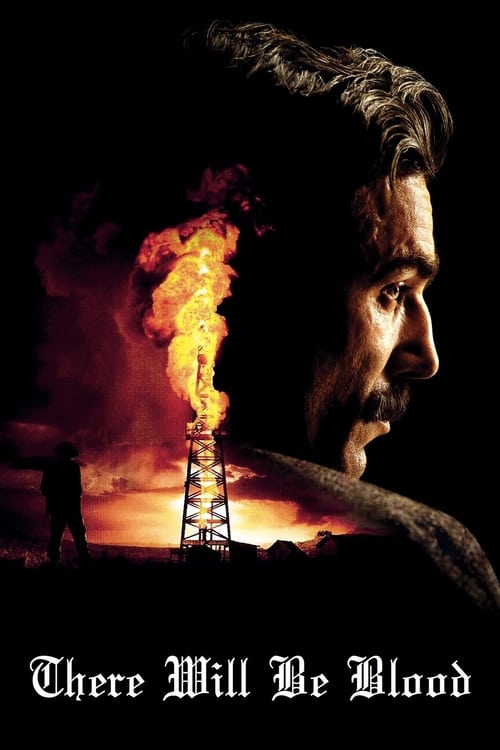
There Will Be Blood
2007 · Paul Thomas Anderson
The critics' consensus "greatest living American director" finally made a commercial-scale film with One Battle After Another, instantly triggering debates about its politics, its reported $130M+ budget, and whether the best-reviewed film of 2025 could actually win Best Picture. PTA fandom is a Letterboxd personality type.
When you want a monumental, serious film to chew on for days — a challenge, not a comfort. Save it for a night when you have full attention to give and want to be pinned to your seat.
What it's about
Around the turn of the twentieth century, a silver miner reinvents himself as an oil man and moves on oil-rich California, using his young son as a prop to charm landowners out of their property. A local preacher sees through him, and the two begin a feud — oil money against religion, each man convinced the other is a fraud. It's the story of American ambition boiled down to one terrifying man.
The experience
Slow-burning, hypnotic, and genuinely menacing — long stretches of near-silence broken by eruptions you feel in your chest. It's less watched than endured, in the best sense: by the end you feel like you've been in a room with something dangerous.
Performances
Daniel Day-Lewis's Daniel Plainview is one of the towering screen performances — a voice, a walk, a hatred so fully built it stops feeling like acting. Paul Dano holds his own opposite him as the preacher, which is its own kind of feat. Day-Lewis won the Oscar for it.
The craft
Paul Thomas Anderson stages the birth of an industry with an almost wordless opening stretch and images of fire and derricks that beg for the biggest screen you can find; the cinematography won an Academy Award. Jonny Greenwood's score is a character in itself — dissonant strings that make an empty desert feel like a horror film.
Why it matters
Almost immediately canonized, it now sits near the top of most lists of the century's great American films and reset expectations for what a prestige drama could sound and feel like. It confirmed Anderson's leap from ensemble stories to mythic, single-figure portraiture.
Snapshot
Paul Thomas Anderson's fifth feature is a two-and-a-half-hour portrait of Daniel Plainview, a silver prospector turned oil wildcatter who methodically strips the Californian desert of its wealth while stripping himself of every human attachment. Set between the 1890s and 1927, the film adapts the early chapters of Upton Sinclair's 1927 novel Oil! with severe freedom — jettisoning Sinclair's socialist argumentation in favor of a psychological study of American acquisitiveness in its pure, mythic form. Its antagonist-protagonist is among the most fully realized figures in American cinema of the decade. The film won Academy Awards for Best Actor and Best Cinematography and is now routinely placed among the canonical American films of the twenty-first century.
Industry & production
Anderson developed the screenplay over several years, drawing primarily from the first hundred-odd pages of Sinclair's novel rather than its full arc. The early relationship between oilman and son, and the collision between secular capital and evangelical religion, were the nuclei he retained; Sinclair's explicit political didacticism was discarded entirely. Financing was split between Paramount Vantage and Miramax Films, an unusual arrangement reflecting the film's prestige-but-uncommercial profile.
Principal photography took place in West Texas — notably in and around Marfa and in the Permian Basin — as well as in the California desert and the actual oil-field landscape of Stockton, California, whose wooden derrick infrastructure has largely survived from the early twentieth century. Shooting in locations with genuine period character gave the production a texture of archaeological authenticity that no studio backlot could replicate. The burning oil-derrick sequence was achieved as a practical effect: an actual constructed derrick was set alight, giving cinematographer Robert Elswit a single-take opportunity to photograph a real conflagration at scale.
Paul Dano, originally cast as the smaller role of Paul Sunday, took on the expanded dual role of Eli Sunday when Anderson substantially reconceived the preacher character during pre-production. This late revision restructured the entire second half of the film's dramatic dynamic, making Dano's Eli a figure of equal monstrousness — if opposite register — to Plainview.
Technology
The film was shot on 35mm anamorphic, a deliberate choice that placed it in dialogue with the widescreen epic tradition of the 1950s and 1960s — the era of Giant, Shane, and the John Ford landscapes Anderson's frame frequently echoes. Elswit used the anamorphic format's characteristic horizontal compression and lens flare qualities to render the desert as both hostile and sublime. No digital intermediate was used to desaturate or otherwise process the image toward a period look; the period feel emerges from costume, location, and natural-light choices rather than post-production grading.
The sound design relies heavily on location ambience — wind across open flats, the thud and hiss of drilling machinery — in combination with Jonny Greenwood's score. The absence of a conventional score over long stretches, and the deployment of silence as a dramatic instrument, required the production-sound and sound-design teams to treat ambient noise as compositionally significant.
Technique
Cinematography
Robert Elswit, who had shot every Anderson feature to this point, works here with a restraint and a grandeur that marks a significant evolution. The film opens with approximately fifteen minutes of nearly wordless cinema: Plainview alone in a landscape, prospecting by hand, suffering a broken leg, hauling himself across rock. There is no score in the conventional sense — only Greenwood's dissonant string episodes — and the camera observes from middle distance. This opening functions as a silent-film passage, establishing character through physical action and environment rather than dialogue, and it invokes the grammar of Erich von Stroheim and the early Hollywood landscape tradition.
Elswit's compositions are wide and often low-angle, placing the human figure against enormous skies. Light is predominantly naturalistic — the California high desert in full midday sun, or the amber glow of oil fires at dusk. Close-ups are reserved for moments of rupture: the ambush of Day-Lewis's face in the bowling alley finale being the most extreme. The anamorphic frame creates scope paintings in which spatial relations between figures carry dramatic weight; when Plainview and Sunday stand in a church interior or a field, the frame records a territorial negotiation.
Editing
Dylan Tichenor, another long-term Anderson collaborator, constructs the film in extended sequences with sparse cutting. Scenes are allowed to breathe to the point of discomfort; Anderson and Tichenor resist the editorial interventions that would conventionally modulate tension. The film's temporal ellipses are handled with unusual abruptness — years collapse in a cut — while individual scenes dilate beyond conventional scene-length. The bowling alley finale holds on Day-Lewis's face for durations that verge on the unwatchable. This relationship between duration and horror is the edit's central argument.
Mise-en-scène / staging
Anderson's staging is notably theatrical in the nineteenth-century sense: he blocks scenes for the depth of the frame, moving figures through space rather than cutting between them. The church revival sequences, in which Eli performs faith healings, are choreographed to expose the performative infrastructure of both religion and confidence artistry simultaneously. The film repeatedly stages confrontations as physical rituals — kneeling, shouting, oil being smeared on skin — that resemble ceremonies. The mud-soaked baptism of Plainview, his body forced down by Eli, is among the decade's most grotesque staging inversions: the capitalist humiliated by the mechanism he has always recognized as fraud.
Sound
Jonny Greenwood's score was among the most discussed and controversial musical contributions in American film of the decade. Drawing on the modernist string techniques of Krzysztof Penderecki — cluster chords, col legno bowing, extreme registral writing — Greenwood produced cues that function less as emotional underscoring than as sonic disruption. His earlier concert piece Popcorn Superhet Receiver contributed material; this prior release caused the Academy's Music Branch to rule portions of the score ineligible for Oscar consideration, a decision that drew significant criticism from film music scholars and practitioners who regarded it as among the finest scores in recent American cinema. The score rejects late-Romantic Hollywood convention entirely, substituting anxiety for sentiment.
The sound design treats the industrial environment with precision: oil gushing, metal creaking, fire consuming wood. The contrast between these material sounds and Greenwood's abstract strings creates a film-wide sonic argument about the relationship between physical extraction and psychic cost.
Performance
Daniel Day-Lewis's performance is one of the most sustained and technically extreme in the sound-film tradition. He reportedly drew on John Huston — director of The Treasure of the Sierra Madre and himself an actor — for Plainview's cadences and rhetorical self-projection, though the full architecture of the performance remains his own synthesis. Day-Lewis committed to a physicality rooted in period manual labor: the early prospecting sequences make visible a body that has been shaped by the logic of extraction. The voice — a mid-Atlantic baritone with evangelical undertones — places Plainview in a tradition of nineteenth-century American self-invention, the confidence man as civic mythology.
Paul Dano matches Day-Lewis by opposite means: where Plainview suppresses and channels, Eli Sunday erupts. The performance amplifies the film's argument that both men are performing for an audience — Sunday's congregation, Plainview's workforce — and that their mutual recognition is finally what makes their relationship catastrophic.
Narrative & dramatic mode
The film is formally a character study that uses the conventions of the American epic: long duration, historical sweep, landscape as moral register. Its narrative engine is not plot but deterioration — we watch Plainview shed each human connection he permits himself until what remains is pure appetite. The relationship with his son H.W. traces the arc of instrumental parenthood: the child is initially a business prop, then becomes a genuine if inarticulate bond, and the rupture between them when H.W. chooses independence is the film's emotional turning point, rendered in a scene of extraordinary coldness.
The Plainview-Sunday dynamic is the film's dramatic spine: two frauds who recognize each other as such and are destroyed by the recognition. Their final confrontation, which collapses the film's thirty-year span into a single absurdist tableau, is simultaneously cathartic and deliberately unsatisfying. The closing image — Plainview alone, surrounded by what he has acquired — is the film's thesis in visual form.
Genre & cycle
There Will Be Blood inhabits the tradition of the American historical epic while systematically refusing its consolations. The genre template — the self-made man, the settling of the West, the founding mythology of American prosperity — is present and then inverted. Anderson had studied Robert Altman's revisionist Westerns and the 1970s Hollywood films that questioned American mythology; the film is in dialogue with that tradition as much as with the epics themselves.
It belongs to a distinct early-2000s cycle of revisionist American historical films — alongside Terrence Malick's The New World (2005) and Cormac McCarthy adaptations like No Country for Old Men (also 2007) — in which the founding myths of American expansion are examined with increasing formal austerity and moral bleakness. That two such films dominated critical conversation in the same year, No Country and There Will Be Blood, suggested a particular moment of cultural self-examination in American cinema.
Authorship & method
Anderson had established a reputation through Hard Eight (1996), Boogie Nights (1997), and Magnolia (1999) for sprawling ensemble construction and a debt to Robert Altman. Punch-Drunk Love (2002) was a tonal and structural departure — compressed, formally experimental. There Will Be Blood represents the synthesis and transcendence of both impulses: it has the scope and moral ambition of the early films and the formal austerity of Punch-Drunk Love.
Elswit and Tichenor are long-term collaborators whose creative relationships with Anderson shaped the film's visual and rhythmic identity. Greenwood's involvement represented a significant departure from conventional film-scoring practice; his background as lead guitarist of Radiohead had no precedent in prestige American drama, and the collaboration opened a question — that subsequent PTA films have continued to investigate — about what serious-music compositional practice does to cinematic emotional registers when stripped of the conventions of the Hollywood score.
Anderson wrote the screenplay himself, adapting Sinclair loosely and drawing on research into early California oil history. The film's screenplay economy — vast narrative territory managed with minimal expository dialogue — reflects a maturation in Anderson's writing toward showing over explaining.
Movement / national cinema
There Will Be Blood is American cinema in the most unambiguous sense: concerned with national mythology, set in recognizable American landscapes, engaged with the origins of the economic order. It lacks the European art-cinema affiliations that sometimes attach to Anderson's other work, though its formal patience and its willingness to leave narrative business incomplete are characteristic of international art cinema rather than classical Hollywood. Its closest American antecedents are the 1970s films of Francis Ford Coppola and Terrence Malick — filmmakers willing to use the resources of American commercial cinema for projects that refuse those resources' conventional constraints.
Era / period
The film depicts the late Gilded Age through the early 1920s, a period Anderson treats with historical specificity in costume and technology while avoiding nostalgia. It engages directly with the founding conditions of American petroleum culture — the land rush, the wildcat well, the displacement of agrarian communities — and places the rise of fundamentalist evangelicalism in the same moment as industrial capitalism's expansion. This historical layering, in which two ascendant American forces meet and mutually corrupt each other, gives the period setting its argumentative weight.
Themes
The film's central proposition is that American capitalism and American evangelical religion are structurally identical: both are organized around the extraction of value from human credulity, both require performance, and both promise transcendence they cannot deliver. Plainview and Sunday are doubles rather than opposites. Their feud is not ideological but territorial — two confidence systems competing for the same audience.
Loneliness is the film's emotional substrate. Plainview explicitly articulates his misanthropy — "I don't like people," he tells his brother-impostor — and the film dramatizes how the drive for total dominance is incompatible with any sustained relationship. The oil, in this reading, is not wealth but a metaphor for the psychic appetite that consumes everything it touches.
The film also traces the transformation of American land from commons to commodity: the landowners who sell to Plainview do not understand what they are selling, and the film frames this incomprehension as a structural feature of capitalist expansion rather than individual naivety.
Reception, canon & influence
Critical reception was among the most emphatic of the decade. The film won the Academy Award for Best Actor (Daniel Day-Lewis, his second Oscar) and Best Cinematography (Robert Elswit), and received nominations for Best Picture, Best Director, Best Adapted Screenplay, Best Film Editing, and Best Sound Editing. Critical organizations broadly named it among the best films of 2007 and subsequently of the decade. It appears consistently on polls of the finest films of the twenty-first century, including the Sight & Sound surveys.
Influences on the film are traceable primarily to John Huston's The Treasure of the Sierra Madre (1948) — the study of greed as psychological pathology, the male antagonist-bond, the desert landscape as moral crucible — which Anderson has acknowledged as a foundational reference. Erich von Stroheim's Greed (1924), itself an adaptation of an American naturalist novel, provides a structural precedent for the long-duration character study of acquisitive destruction. The silent-film grammar of the opening sequences invokes both von Stroheim and the Griffith-era landscape tradition. The influence of 1970s American art cinema — Coppola, Malick, Altman — is present in the formal freedom and the willingness to prioritize atmosphere over narrative efficiency.
Legacy and forward influence are more difficult to trace precisely, as is standard for any recent canonical work. The film confirmed Anderson's position as the preeminent American art-cinema director of his generation and established the prestige historical character study as a viable mode for ambitious American filmmaking in the following decade. Its visual language — wide anamorphic desert, naturalistic light, long takes observing extreme psychological states — has been broadly influential on the look of American prestige drama. Greenwood's score effectively established that dissonant concert-music composition was available to mainstream prestige filmmaking, and his subsequent work on Anderson's The Master (2012), Inherent Vice (2014), and Phantom Thread (2017) extended that practice into an ongoing body of work. Day-Lewis's performance became a reference point for discussions of screen acting at the edge of theatricality, cited both as exemplary and as a cautionary instance of performance overwhelming narrative function. "I drink your milkshake" entered the cultural vocabulary as an idiom for zero-sum competitive destruction — a rare instance of a film's imagery migrating into common speech.
A Deleuzian reading
A man lies at the bottom of a hole he dug himself.
The full Deleuzian reading of There Will Be Blood →
Reception
Acclaimed on arrival in 2007 but famously edged out of the Best Picture Oscar by No Country for Old Men, it has since climbed past nearly everything from its era — topping the New York Times' 2025 poll of the century's best films and routinely leading 'greatest of the 2000s' lists.
How There Will Be Blood was received, from release to now →
Influences: the films it descends from and the films it influenced
- Greed (1924) — The fifteen-minute wordless opening of TWBB — Plainview prospecting alone, suffering a broken leg, hauling himself across rock without dialogue or score — directly inherits von Stroheim's technique of sustaining silent-cinema grammar to render obsession: character established entirely through physical labor, environmental hostility, and duration rather than exposition.
- Citizen Kane (1941) — Welles and Toland's deep-focus staging system — positioning figures across the full Z-axis of the frame to visualize power differentials without cutting — is the direct formal ancestor of Anderson's depth-of-field blocking in the Plainview–Sunday confrontation scenes, where territorial dominance is encoded in spatial placement rather than dialogue.
- The Treasure of the Sierra Madre (1948) — Huston's location-shot portrait of a prospector whose physical deterioration tracks precisely with his moral collapse — Bogart's body registering greed's cost in real desert conditions — establishes the visual grammar of the acquisitive man undone by his own drive that TWBB inherits and escalates through Day-Lewis's full-body transformation.
- Shane (1953) — Stevens's systematic use of low-angle compositions to set the solitary male figure against the full expanse of Western sky — encoding heroic scale as landscape proportion — is the precise visual grammar Elswit adopts for Plainview in the California desert, where the frame consistently diminishes then re-aggrandizes the same figure against identical sky.
- The Searchers (1956) — Ford's practice of framing characters within Monument Valley's geological formations so that landscape encodes moral and psychological states without dialogue — the arch as entrapment, the mesa as isolation — is the tradition TWBB consciously inhabits in Elswit's wide compositions placing Plainview against California desert formations that operate as psychological registers.
- Giant (1956) — Stevens's use of 35mm anamorphic widescreen to render Texas oil landscapes as national myth-space — the derrick as America's totem, the lone figure dwarfed by industrial infrastructure against enormous sky — is the immediate visual template for Elswit's framing of the Permian Basin, including the specific compositional choice to photograph burning infrastructure at practical scale.
- Once Upon a Time in the West (1968) — Leone and Morricone's grammar of silence-punctuated confrontation — extended takes building unbearable duration before eruption, the score deployed as rupture rather than accompaniment — is the foundational model for the bowling alley finale's theatrical staging and for TWBB's entire strategy of treating silence not as absence but as a compositional element under positive dramatic control.
- McCabe & Mrs. Miller (1971) — Vilmos Zsigmond's pushed, flared anamorphic photography using firelight and diffuse natural sources as sole illumination for a period American setting established the template for period-authentic naturalistic cinematography that Elswit extends; Altman's treatment of ambient sound and overlapping voices as environmental texture rather than dramatic illustration is the direct precedent for TWBB's compositionally significant location ambience.
- Barry Lyndon (1975) — Kubrick and John Alcott's commitment to natural-light-only photography — using NASA-modified lenses to capture candlelit interiors — to achieve period-photographic authenticity rather than post-production period grading is the precedent Anderson and Elswit follow in refusing digital intermediate; both films treat the antihero's deterioration across time through episodic temporal ellipsis and sustained ironic distance.
- Days of Heaven (1978) — Nestor Almendros's magic-hour naturalistic cinematography for a period American landscape narrative — in which the environment carries meaning that dialogue withholds — and Malick's elliptical, fragmentary temporal structure gave TWBB its formal permission to subordinate plot to atmosphere and to treat the land itself as a psychological register of the protagonist's interior.
- Apocalypse Now (1979) — Storaro's photography uses large-scale practical fire — napalm strikes, the compound conflagration — as the visual vocabulary of psychological disintegration, establishing the precedent TWBB's burning derrick sequence follows: a practical fire of real scale that functions as a psychological event rather than a staged stunt, photographed in a single take at actual risk.
- Casino (1995) — Anderson extends Casino's classical American tragedy chronicle and controlled-interiority performance model — Day-Lewis's Plainview built on De Niro's template of the brilliant self-destroying operator — into a longer-take, more austere formal register.
- The Master (2012) — Anderson and Greenwood extend TWBB's methodology directly into 65mm: the expanded format amplifies the already-large anamorphic frame's capacity for theatrical depth staging; Greenwood's non-conventional scoring again deploys silence and orchestral dissonance rather than narrative illustration; the two-man power drama between Phoenix and Hoffman explicitly replicates the Plainview–Sunday dynamic of mirrored monstrousness confronting itself across a power differential.
- 12 Years a Slave (2013) — McQueen's use of extended unbroken takes — the whipping sequence, the hanging-tree sequence — to make duration itself a moral experience for the viewer directly extends TWBB's strategy of holding on Day-Lewis past the threshold of comfort, treating the edit's refusal to cut as the film's ethical argument rather than a lapse in conventional pacing.
- Sicario (2015) — Jonny Greenwood's subsonic orchestral score — low-frequency pressure deployed as existential dread rather than melodic support, bypassing the ear for the body — established the template that Jóhann Jóhannsson extended with Sicario's brass-driven sound design, including the use of acoustic silence as a pressure valve between assaults.
- Killers of the Flower Moon (2023) — Establishes the structural model of extraction capitalism as protagonist biography — a single man's moral rot filmed in wide static frames that implicate landscape in the crime — which Killers inherits and racializes by making the extraction victim an Indigenous nation.
- Parasite (2019) — Jonny Greenwood's score — Brahms-adjacent string writing undercut by atonal clusters and percussion — established orchestral dissonance as a tonal-modulation device in prestige cinema; Jung Jae-il's Parasite score adopts the identical strategy of deploying classically-coded 'wrong' music to accelerate the audience's generic disorientation during tonal pivots.
- The Power of the Dog (2021) — Jonny Greenwood's score integrates a gramophone playing Brahms into the diegesis before expanding into composed dissonance — establishing the diegetic-score-integration technique he reprises directly for Campion — while Daniel Day-Lewis's embodied performance of Plainview's concealed interior life through physical behavior is the immediate precursor to Cumberbatch's method for Phil Burbank.
- Inherent Vice (2014) — Where the Elswit-photography/Greenwood-score method crystallizes—Greenwood's dissonant strings governing emotional weather over long takes—the working process Inherent Vice inherits and softens.
- Nightcrawler (2014) — The Elswit/Anderson school of composed, patient widescreen framing around a portrait of ironic capitalist ambition, the visual sophistication Elswit transplants directly into Nightcrawler's images.
- The Brutalist (2024) — The film's explicit structural model: an American epic of capital staged as the long, corrosive war between a driven outsider and his wealthy patron, scored with abrasive dissonant strings that function as argument rather than accompaniment.
- A Most Violent Year (2014) — The portrait of American enterprise as moral combat, where a striver's controlled exterior masks ruthless ambition — the capitalism-as-character study that underwrites Abel's quiet menace.
- King Richard (2021) — Robert Elswit's available-light, warm-amber naturalism and willingness to underexpose interiors is the DP method he transposes onto Compton's kitchens and dusk-lit courts here.
- The Promised Land (2023) — The template for the obsessive-builder character study in a drained, dust-toned palette whose patient accumulation of labor and land erupts into rupture — Kahlen is written as a Danish Plainview, ambition rendered as pathology.
- The Assassination of Jesse James by the Coward Robert Ford (2007) — Deakins shoots anamorphic with lens smear and natural light to mythologize the American West as a space of inevitable melancholy; Dominik's staging of a two-man drama between a charismatic monster and his worshipping antagonist shares TWBB's revisionist historical framework, its deployment of extended silences, and its treatment of American mythology as a site of psychological pathology rather than heroic romance — both released the same year.
- No Country for Old Men (2007) — Deakins photographs the same West Texas anamorphic landscape in low-angle wide compositions with naturalistic light; the Coens construct extended sequences entirely without musical scoring, treating ambient sound and silence as primary dramatic instruments — the identical sound-design strategy TWBB employs — while both films use an implacable antagonist as a vehicle for depicting American violence as systemic rather than individual.
- American Gangster (2007) — Anderson's American capitalist myth uses enterprise itself — oil extraction — as the vehicle for an American dream critique, replacing violence with commercial logic as the protagonist's operative grammar; AG's capitalism-as-drug-trade thesis is a parallel structure, with Day-Lewis's withholding register and Washington's occupying the same formal register of suppressed monstrousness.
- Inglourious Basterds (2009) — Anderson's sustained 35mm anamorphic wide-shot compositions in the church and oil-field sequences — frames where character power dynamics are inscribed in the physical arrangement of bodies in space rather than through cutting — parallel IB's use of the wide frame as a theatrical stage for behavioral performance.
- Joker (2019) — Greenwood composed and recorded the score before principal photography and played it on set — the direct methodological precedent for Guðnadóttir's approach on Joker — and the solo string instrument (violin, cello) as index of psychological deterioration is a shared formal strategy; Day-Lewis's physical transformation and the editing governed by bodily performance rather than conventional coverage are parallel methods.
- A Complete Unknown (2024) — Robert Elswit's off-axis two-person staging in confrontational scenes and Daniel Day-Lewis's withholding performance methodology — refusing sympathetic legibility while sustaining screen charisma — are direct formal siblings to ACU's blocking and Chalamet's approach; both films refuse the redemption arc for a figure whose genius and damage are inseparable.
- One Battle After Another (2025) — Greenwood's dissonant orchestral score as primary carrier of historical dread and psychological unease — string clusters and prepared piano used not to comment on scenes but to replace conventional emotional signposting with disorientation — establishes the sound-design vocabulary OBAA inherits for Vineland's surveillance-state paranoia.
- Once Upon a Time in America (1984) — Operatic, dilated setpieces of American origin-myth driven by a foregrounded, near-prescored score (Greenwood) that governs the staging — Leone's music-led monumentality transposed to capitalist allegory.
- The Bourne Legacy (2012) — Elswit's celebrated photochemical, naturalistic-light approach here is the craft credential Legacy imports to pull a tentpole toward gravity and texture rather than digital spectacle.
- Under the Skin (2014) — Jonny Greenwood's dissonant, texture-based string score — out of the same Radiohead milieu Glazer came from — is the immediate model for Levi's atonal, glissando-driven scoring as primary meaning.
- Road to Perdition (2002) — Shares the Depression-era American tableau, glacial measured tempo, and a tragedy of paternal inheritance and damnation built from regionalist painting and suppressed performance.
- In the Name of the Father (1993) — Carries the Day-Lewis immersive-Method authorship — the actor as the film's dominant expressive force through voice and body — into another director partnership modeled on the Sheridan alliance.
Similar films
- The Assassination of Jesse James by the Coward Robert Ford (2007) — influence & lineage · same viewing thread
- No Country for Old Men (2007) — influence & lineage
- The Master (2012) — influence & lineage
- Days of Heaven (1978) — influence & lineage · same viewing thread
- The Tree of Life (2011) — same viewing thread
- The Last Picture Show (1971) — same viewing thread
- One Battle After Another (2025) — shared sensibility
- Boogie Nights (1997) — shared sensibility
All the films related to There Will Be Blood →
Watch it with: curated runs of related films
- The Frontier's Long Shadow — A run of American myths going to seed — outlaws, oilmen, and foreclosed ranchers set against big country that outlasts them all; watch them close together and the classic Western slowly dissolves into its elegiac modern kin.
Film essays and courses that include it
- Paul Thomas Anderson
- Scope and Shadow: The Anamorphic Vision
- The Silence of God: Cinema's Argument with the Divine
- The Corrupting Vein: Cinema's Century with Greed
- The Machinery of Greed: Cinema's Anatomy of Capital
- The Dream at the End of the Road: Los Angeles & California
- The Heir Who Became an Original
- The Genre That Aged With America
- The Perfect Protagonist
- The Sin It Can't Stop Admiring
- The Sound of Things About to Go Wrong