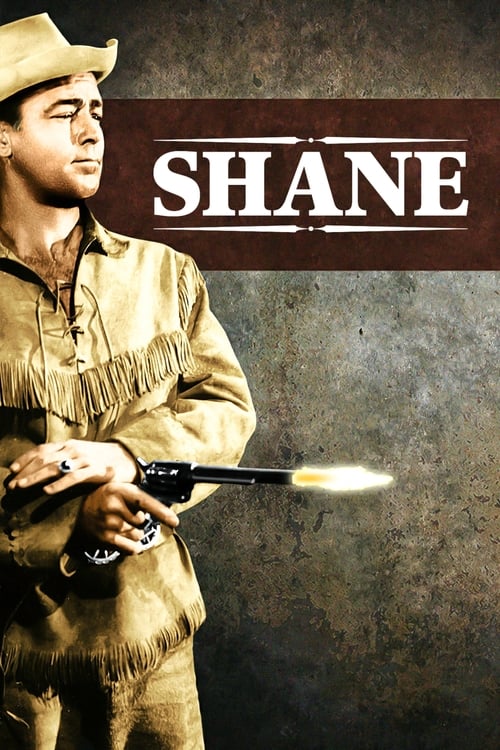
Shane
1953 · George Stevens
For a classic-movie evening when you want myth done right — big landscapes, clear stakes, and an ache underneath. Comfort viewing that earns its emotion honestly.
What it's about
A weary gunfighter rides down out of the Wyoming mountains and takes work with a homesteader family, hoping to hang up his gun for good. But the valley's cattle baron is squeezing the settlers off their land, and as the intimidation escalates, the stranger's past becomes the one thing that might save them — seen throughout through the awestruck eyes of the family's young son.
The experience
Stately, beautiful and quietly sorrowful — an adventure that plays like an elegy, where every gunshot carries weight and consequence. It's gentle for long stretches, then lands its moments of violence with real force.
Performances
Alan Ladd's soft-spoken restraint makes the gunfighter's coiled capability register all the more, Jack Palance is unforgettable menace in black leather, and young Brandon deWilde's open-faced hero worship gives the film its heart.
The craft
George Stevens shoots the Grand Tetons like a cathedral behind every scene, and the Technicolor landscapes alone justify the biggest screen you can find. The gunfights were staged for shock and impact at a time when screen violence was usually bloodless, and the difference still registers.
Why it matters
It codified the elegiac Western — the myth of the gunman who can save civilization but never join it — and its images and final moments became permanent fixtures of American movie memory.
Snapshot
Shane stands as the paramount achievement of the prestige Western in Hollywood's classical era — a film that self-consciously mythologizes the gunfighter even as it mourns him. Adapted from Jack Schaefer's 1949 novel, Stevens's film refracted the settler-versus-rancher conflict of the Wyoming Territory through the prism of a child's awe, producing a Western that operates simultaneously as adventure, elegy, and American founding myth. Its images — the lone rider against the Grand Tetons, the supine body in the mud after a gunfight that carries real cost — entered the cultural bloodstream immediately and have not left it. Shane did not merely participate in the adult Western cycle of the early 1950s; it codified that cycle's aspirations and set the template against which subsequent elegiac Westerns would measure themselves for decades.
Industry & production
Paramount Pictures released Shane in April 1953, positioning it as a prestige production at a moment when Hollywood was accelerating its counter-programming against television: longer films, richer color, more serious subject matter. George Stevens produced and directed, retaining a degree of creative control unusual even for A-list directors of the period. He had secured the rights to Schaefer's novel shortly after its publication and developed the project over several years with characteristic deliberateness.
Stevens recruited A.B. Guthrie Jr. — whose 1947 novel The Big Sky had established him as a serious literary chronicler of the frontier — to write the screenplay. The casting assembled veterans alongside emergent talent: Alan Ladd at the height of his star power; Van Heflin, whose stage-trained naturalism grounded the homesteader Starrett in credible earthiness; Jean Arthur, coaxed from semi-retirement for what would prove her final screen performance; and the then-relatively unknown Jack Palance as the hired gun Wilson. Brandon De Wilde, nine years old during filming, carries a structural weight far beyond his years, since the film's perspective is organized around Joey's gaze.
Location shooting in Jackson Hole, Wyoming placed the Grand Teton range directly in the frame as both backdrop and symbolic protagonist. The mountains' sheer verticality dwarfs every human figure in long shot, rendering the homestead struggles simultaneously intimate and cosmically insignificant. Stevens's customary working method — shooting enormous volumes of footage, sometimes circling the same moment from many angles over multiple days — was particularly suited to capturing the landscape's variability of light, which Loyal Griggs photographed through the Technicolor process.
Technology
Shane reached theaters in April 1953, just months before the CinemaScope revolution that The Robe launched in September of that year. Stevens shot in the standard Academy ratio (1.37:1), but the film's visual grammar — particularly its deployment of vast horizontal landscape — is already straining against that frame, anticipating the widescreen compositions that would soon become obligatory for the Western genre. The Technicolor photography captures Wyoming at the edge of its short alpine summer, giving the film a palette of saturated greens and deep shadow that distinguishes it from the sun-bleached yellows of Monument Valley Westerns.
Stevens also made a deliberate decision regarding sound design: the gunshots in Shane are louder, more percussive, and more physically present than convention demanded. The report of Palance's revolver when he kills Torrey (Elisha Cook Jr.) is startling even today. This amplification served a moral argument — death by gun should feel consequential, not casual — and anticipated the sonic realism that later filmmakers would pursue more systematically.
Technique
Cinematography
Loyal Griggs won the Academy Award for Best Cinematography (Color) for Shane, and the film merits close attention as a lesson in how landscape can be recruited as meaning. The Tetons function as a visual constant that the settlers' fences and plowed fields can never adequately respond to; the civilization they are attempting to build looks provisional against those peaks. Griggs and Stevens frequently position Shane himself against open sky, constructing him from below — particularly when filtered through Joey's literal vantage point — so that the character achieves a monumental quality that the screenplay is careful never to overclaim in dialogue.
The color work is equally purposeful. The homestead interior scenes are warm, domestically golden; the Ryker ranch and the saloon interiors are harder, cooler. Shane's buckskin costume places him between these two registers — neither fully of the wilderness nor of civilization — a chromatic ambiguity that reinforces his narrative function.
Editing
William Hornbeck edited the film, collaborating with Stevens in what was by this point an established creative partnership. Shane's pacing is among its most distinctive qualities: Stevens refuses the quick-cut rhythm of B-Western action and holds shots past the conventional release point, demanding that the viewer register duration. The celebrated saloon fight between Shane, Joe, and the Ryker hands is staged and cut to maximize the sense of effort and punishment rather than balletic choreography. The blows land heavily; men tire. It is a precursor, in spirit if not in method, to the de-glamorized violence that Sam Peckinpah would pursue a generation later.
The final act — from the moment Shane straps on his gun belt to his departure — is edited with a near-ceremonial deliberateness, each beat weighted as though aware it is passing into myth.
Mise-en-scène / staging
Stevens's staging is saturated with spatial meaning. The homestead is frequently framed with the Teton range visible through doorways and windows — civilization's domesticity literally framed by the wild. When the Ryker faction enters the homesteader's sphere, Stevens disrupts the calm horizontal compositions with crowding and physical threat. The famous shot of Shane's gun clearing leather in the final confrontation is preceded by extended restraint; Stevens made audiences wait for the violence so that when it arrives it feels both inevitable and regrettable.
The domestic triangle between Shane, Marian, and Joe is staged with rigorous economy. Stevens rarely needs dialogue to make legible Marian's complicated response to Shane — composition and eyeline achieve it. Shane and Marian's farewell before he rides to Grafton's is one of the more emotionally concentrated sequences in classical Hollywood, accomplished almost entirely through blocking and the actors' physical comportment.
Sound
Victor Young's score is lyrical rather than heroic — a distinction worth noting. The main theme carries a bittersweet, almost valedictory quality, as though the music itself understands Shane cannot stay. Young was one of Hollywood's most prolific composers and could write in any register; his work here is restrained relative to his more florid assignments, serving the film's elegiac undertow rather than announcing it.
The amplified gunshots, discussed above under Technology, constitute Shane's most consequential sound decision. The silences between those shots — the pause before Wilson draws, the held breath of the valley after the final confrontation — are exploited with equal care.
Performance
Alan Ladd's Shane is a character of deliberate suppression. Ladd communicates what cannot be said — the violence held in abeyance, the longing for domestic peace he knows he cannot have — through physical stillness that reads, in context, as immense internal pressure. The performance has sometimes been undervalued precisely because its means are so quiet.
Van Heflin's Joe Starrett is indispensable to the film's balance. Without a credible, dignified homesteader, Shane's sacrifice collapses into mere wish-fulfillment on behalf of inadequate people; Heflin gives Joe enough substance that the audience understands what Shane is protecting as genuinely worth protection.
Jack Palance's Jack Wilson arrives as pure menace, his stillness matching Shane's but radiating a different and colder energy. The scene in which Wilson goads Torrey into drawing, practically daring the smaller man to attempt suicide by gun, is a masterclass in economy of threat. Brandon De Wilde navigates the risk of cloying child performance with a directness that makes Joey's adoration of Shane feel specific rather than generic. Jean Arthur brings to Marian an undercurrent of thwarted feeling that gives the romantic geometry its necessary tension.
Narrative & dramatic mode
Shane is structured as myth refracted through a child's remembering consciousness. Joey is the organizing intelligence; we see Shane through his eyes, and the film honors that perspective by granting it a selective, amplifying power — Shane is always, from Joey's angle, slightly larger than life. The narrative withholds Shane's history almost completely, offering only laconic signals (the ease with which he handles firearms, the recognition in Palance's eyes when the two men regard one another). This opacity is the correct mythic choice: Shane's potency depends on his not being fully explained.
The settler-versus-rancher conflict provides the political substrate — the question of who gets to determine land use in a transitional territory — but Stevens and Guthrie subordinate historical specificity to parable. The homesteaders collectively represent settled democratic community; Ryker's operation represents entrenched power unwilling to share the range; Shane represents a force that can contest entrenched power but cannot itself be domesticated into the community it defends. This triangulation is the film's deepest structural idea, and it accounts for the ending's genuinely unresolved quality. Whether Shane is wounded unto death as he rides away is left pointedly open; the myth requires the departure, not necessarily the death, but admits both readings.
Genre & cycle
Shane arrived a year after Fred Zinnemann's High Noon (1952) and belongs, with that film and Henry King's The Gunfighter (1950), to the early-1950s formation of the "adult Western" — a conscious elevation of the genre to address psychological, social, and moral complexity beyond the B-Western formula. Where High Noon is structured around political allegory (widely interpreted as a response to McCarthyism) and operates with clock-driven tension, Shane chooses a slower, more mythopoeic mode.
Stevens was resistant to reductive allegorical readings of his film, though the Cold War atmosphere — the question of what legitimate violence can achieve and at what cost to the one who exercises it — is embedded in the narrative's marrow whether or not it was consciously schematized. The adult Western cycle of the early 1950s established conventions — the weary gunfighter, the cost-of-violence theme, the ambivalent ending — that would govern the genre's prestige aspirations for the next two decades.
Authorship & method
George Stevens's career trajectory is among the more striking in classical Hollywood. He began directing two-reel comedies at Hal Roach, graduated to features including the Astaire-Rogers comedy Swing Time (1936), and then spent World War II as a Signal Corps filmmaker. His unit documented the D-Day landings and, subsequently, the liberation of the Dachau concentration camp. The footage he shot at Dachau was introduced as evidence at the Nuremberg trials. Stevens returned from the war a changed filmmaker: his subsequent pictures — A Place in the Sun (1951), Shane, Giant (1956) — are saturated with moral gravity and a refusal of easy resolution that his pre-war comedies had not prepared observers to expect.
This biographical arc is directly relevant to Shane's treatment of violence. Stevens had seen what industrial killing looked like, and his amplified gunshots and reluctance to aestheticize combat reflect a man who understood that cinema's habitual prettification of death was a kind of lie.
A.B. Guthrie Jr.'s screenplay honors Schaefer's novel while also condensing and clarifying its dramatic structure. Guthrie's literary instincts — he was a Pulitzer Prize winner (The Travels of Jaimie McPheeters, 1949) and a serious student of frontier history — helped prevent the adaptation from drifting toward sentimentality. Loyal Griggs's contribution to the film's visual argument has been sufficiently recognized by the Academy Award but deserves ongoing critical attention as a central, not merely technical, element of the film's meaning-making.
Movement / national cinema
Shane is emphatically a product of classical Hollywood studio cinema at the moment of its late flowering. The Western as a genre was in 1953 the most distinctively American form in world cinema — a mode with no exact European equivalent, grounded in a specifically American mythology of frontier expansion that other national cinemas could adapt but not originate. Stevens's film is aware of this; its grand landscape photography reads as a claim on the American sublime, an assertion that the Western genre is adequate to the traditions of landscape painting and frontier literature.
The film also reflects Hollywood's early-1950s anxiety about television, which is to say its aspiration toward spectacle, duration, and thematic seriousness that the small screen could not then replicate. Shane is an A-picture making the argument for cinema as a venue for serious cultural work — an argument the Western genre, in the right hands, could make credibly.
Era / period
1953 sits at a hinge point in Hollywood history: the studio system's classical contracts and vertical integration were unraveling under antitrust pressure; widescreen and stereophonic sound were about to reorganize the industry's technical grammar; television was rapidly absorbing the audience for casual theatrical attendance. The prestige Western — long-form, color, location-shot, adapted from respectable literary sources — was one of Hollywood's considered responses to these pressures.
Shane also belongs to a broader early-1950s reckoning with American identity under Cold War conditions. The decade's Westerns repeatedly staged anxieties about community, legitimate authority, and the uses of violence that the political culture was processing through very different channels. Stevens's film participates in this discourse without being reducible to it.
Themes
At its core, Shane meditates on the irreducibility of the violent man to domesticated community life. Shane can protect the valley's settlers; he cannot join them, and the film is honest about why. His skills are the skills of death, however much he would prefer to use them for carpentry and fence repair. The homestead stands for what America imagines it is becoming; Shane stands for what America knows it has had to be. The film does not resolve this tension — it presents it as constitutive of American identity.
The child's perspective doubles this theme. Joey's idealization of Shane is the film's sympathetic position but not its only position; Marian's more complicated response, and Joe's dignity in accepting both Shane's help and Shane's departure, constitute the adult counterweight. The coming-of-age dimension — Joey learning that admiration does not guarantee possession, that heroes depart — gives the film its emotional depth beyond the genre pleasures of the action climax.
Reception, canon & influence
Shane received six Academy Award nominations, including Best Picture and Best Director, winning Best Cinematography (Color) for Loyal Griggs. Brandon De Wilde and Jack Palance were both nominated for Best Supporting Actor, an unusual double nomination that testifies to the film's generative effect on its supporting cast. Contemporary critical reception was broadly enthusiastic, recognizing the film as a landmark of the genre. Dissenting voices — including Pauline Kael, who found Stevens's deliberateness portentous — argued that the film's self-consciousness about its own mythic ambitions produced a certain stiffness. This remains a defensible minority position.
The film's retrospective canonical standing is secure. It appears on the American Film Institute's lists of the greatest American films and is included in the Library of Congress National Film Registry. Its influence radiates in two directions.
Looking backward: Shane draws on the literary tradition that includes Owen Wister's The Virginian (1902), the founding text of the cowboy-hero archetype; on John Ford's spatial grammar for Western landscape (while substituting the Tetons for Monument Valley, and a warmer palette for Ford's often austere light); and on the more immediate precedents of The Gunfighter and High Noon.
Looking forward: the film's legacy is immense and largely uncontested. Sergio Leone's Dollars trilogy — and by extension the Clint Eastwood persona — is inconceivable without Shane's template of the taciturn stranger whose violence is simultaneously the community's salvation and its problem. Eastwood's Pale Rider (1985) is an explicit structural homage, transposing Shane's plot nearly intact into a mining-camp context. Unforgiven (1992) is, among other things, a systematic interrogation of every promise Shane made about heroic violence. James Mangold's Logan (2017) — which has characters within the film explicitly watch Shane and discuss its themes — represents the most self-aware of these inheritances, using the 1953 film as a mirror in which an aging superhero recognizes his own archetype and its costs.
The line "Shane, come back!" — De Wilde's call across the empty valley — entered American culture immediately as an emblem of irreversible loss. It is, in the compressed grammar of the famous closing line, the whole film's argument: what the community needed, it could not keep; what it cannot keep, it can only call after.
A Deleuzian reading
Start where the film starts you: low, looking up.
The full Deleuzian reading of Shane →
Reception
A massive hit in 1953 — Best Picture nominee, one of the year's top earners — Shane never needed rescuing; the shift is that modern cinephiles now argue over whether it's the sublime, mythic peak of the Western or the 'respectable' one that Sergio Leone and Clint Eastwood spent decades roughing up.
How Shane was received, from release to now →
Influences: the films it descends from and the films it influenced
- Stagecoach (1939) — Ford's deployment of Monument Valley buttes as visual counterpoint to human smallness established the compositional grammar — figures in long shot dwarfed by geological scale — that Stevens inherited and repurposed, replacing Ford's mythic grandeur with the Tetons as a measure of civilization's inadequacy.
- The Ox-Bow Incident (1943) — Wellman's decision to stage Western violence as grinding physical horror rather than adventure spectacle established the adult Western's de-glamorized ethos that Stevens extended into Shane's amplified gunshot sound design and the mud-and-weight saloon fight choreography.
- My Darling Clementine (1946) — Ford's staging of Earp's post-gunfight exit — the civilizing agent who cannot remain in the civilization he creates — gave Stevens the structural and blocking template for Shane's departure: hero in medium-long shot moving away from domesticity, observed by those he protects and can never join.
- Red River (1948) — Hawks's sustained use of horizontal landscape to block male conflict — figures positioned against open range so that spatial arrangement carries narrative meaning — gave Stevens a compositional vocabulary for encoding the homesteader/rancher power struggle without expository dialogue.
- The Gunfighter (1950) — King and Gregory Peck developed the suppressed-stillness performance mode for the Western protagonist — the gunfighter's danger expressed entirely through economy of gesture and calibrated silence — which Alan Ladd inherited as Shane's defining interpretive choice.
- The Searchers (1956) — Ford adopted Stevens's doorway-threshold framing as a structural device: the cabin doorframe as mediating boundary between domesticity and wilderness governs the film's famous opening and closing shots, directly echoing Shane's homestead-window compositions that organized the civilization-versus-wilderness dialectic spatially.
- Ride the High Country (1962) — Peckinpah built his first elegiac Western on Shane's specific template of veteran gunfighters whose skills are historically obsolescent, carrying over the withheld-backstory technique — character revealed through behavioral detail rather than expository dialogue — intact.
- Hud (1963) — Ritt transplanted Shane's child-POV-consciousness structure into a contemporary Western, with Lon's focalization organizing our understanding of Hud's moral complexity exactly as Joey's gaze shapes Shane; James Wong Howe's landscape photography uses the Texas plains as a measure of diminishment parallel to Stevens's Tetons.
- Once Upon a Time in the West (1968) — Leone systematized Stevens's amplified-gunshot sound design into a compositional principle — extended pre-gunfight silence followed by the explosive report of the shot — while extending Shane's low-angle hero framing into extreme wide/close alternation that monumentalizes the gunfighter through Morricone's sonic punctuation.
- The Wild Bunch (1969) — Peckinpah extended Shane's de-glamorized fight staging into a formal system: slow-motion capture that stretches the duration of violence, making death as physically detailed and costly as Stevens demanded, while amplifying the sonic realism of gunfire into near-overwhelming sensory texture.
- McCabe & Mrs. Miller (1971) — Altman extended Shane's sound/strategic-silence principle by inversion: the climactic gunfight in falling snow muffles violence into near-inaudibility, making death heavy through the presence of stillness rather than amplification — equivalent moral purpose achieved by opposite acoustic means.
- Days of Heaven (1978) — Malick carried Stevens's landscape-as-meaning principle into an extreme formal statement: Nestor Almendros's golden-hour Texas Panhandle photography uses changing light conditions as moral and temporal register, directly extending Stevens's systematic use of Wyoming light to encode the provisionality of human settlement.
- Unforgiven (1992) — Eastwood systematically deconstructs Shane's formal grammar — the retired gunfighter reluctantly returning to violence, the amplified cost-of-violence sound design, the suppressed-stillness performance register — while explicitly refusing Shane's mythologizing resolution, substituting degradation where Stevens offered elegy.
- A Fistful of Dollars (1964) — Stevens codified the laconic stranger archetype—a figure who communicates through physical stillness and deliberate withholding of personal history, whose costume and guncraft signal competence before any dialogue does—which Leone inherited and stripped of its redemptive moral coding.
- The Good, the Bad and the Ugly (1966) — Stevens' staging of the Western gunfight as ceremonial, liturgical performance—opponents entering a defined proscenium space, each movement deliberate and watched by the town—established the operatic staging convention Leone inflated into the triello's three-way geometric standoff ritual.
- Butch Cassidy and the Sundance Kid (1969) — Stevens and cinematographer Loyal Griggs established the golden-hour, amber-ochre Western landscape palette — warm, soft-lit, nostalgic — that Conrad Hall inherits and extends through optical diffusion filtration in Butch Cassidy's color scheme.
- There Will Be Blood (2007) — Stevens's systematic use of low-angle compositions to set the solitary male figure against the full expanse of Western sky — encoding heroic scale as landscape proportion — is the precise visual grammar Elswit adopts for Plainview in the California desert, where the frame consistently diminishes then re-aggrandizes the same figure against identical sky.
- High Noon (1952) — Both films use pacing as moral argument within the same adult-Western cycle: Zinnemann's real-time clock structure and Stevens's extended shot duration both force the viewer to inhabit the weight of heroic obligation rather than observe it as adventure spectacle.
- Johnny Guitar (1954) — Ray used Trucolor palette as psychological register — coding ideological tension through chromatic contrast between interior and exterior spaces — running parallel to Stevens's Technicolor warm/cool coding that positioned Shane between domestic warmth and frontier cool.
- From Here to Eternity (1953) — Stevens and Loyal Griggs shot in Academy ratio the same year, making the identical deliberate choice against the widescreen revolution for the identical reason: the tight 1.37 frame holds a tragic hero's face in close psychological work, using formal constraint as a statement about the hero's contained fate within institutional and social forces.
- A Place in the Sun (1951) — Stevens and Mellor transferred the telephoto compression grammar from face-to-face psychological close-up to landscape, compressing Wyoming mountain ranges against human figures to render scale as social force — extending the same optical logic across a different register with the same director-cinematographer team.
- The Man Who Shot Liberty Valance (1962) — Dramatized founding violence as the prerequisite the homesteaders must disavow, the gunman departing so settled civilization can pretend it was never needed.
Similar films
- Ride the High Country (1962) — influence & lineage · same viewing thread · often watched together
- High Noon (1952) — influence & lineage · same viewing thread
- My Darling Clementine (1946) — influence & lineage · same viewing thread
- The Wild Bunch (1969) — influence & lineage · same viewing thread
- Stagecoach (1939) — influence & lineage
- The Searchers (1956) — influence & lineage
- Red River (1948) — influence & lineage
- Once Upon a Time in the West (1968) — influence & lineage
All the films related to Shane →
Watch it with: curated runs of related films
- Print the Legend — A run of frontier myths and their unmaking — town-taming marshals, aging gunfighters, and the stories the newspapers chose to print instead of the truth.