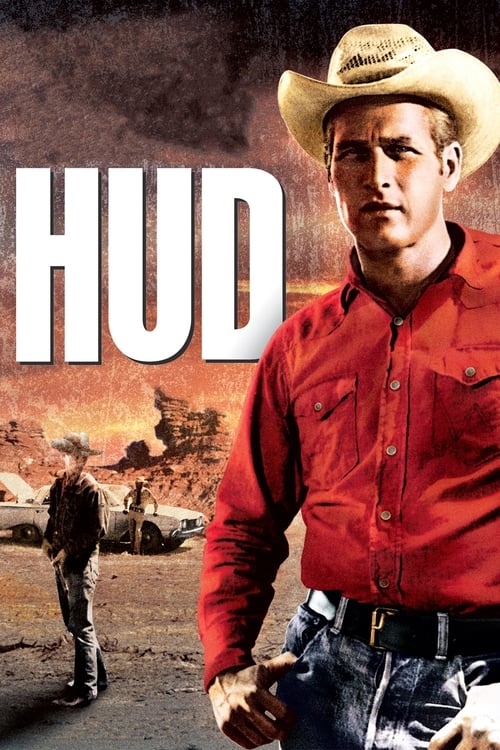
Hud
1963 · Martin Ritt
For when you want a serious, grown-up drama with a magnetic bad man at the center — something closer to a character autopsy than a comfort watch. Reach for it when you're up for being challenged, not consoled.
What it's about
On a windswept Texas cattle ranch, three generations of Bannon men grind against each other: Homer, the aging patriarch who still believes a man's word and his land mean something; Hud, his magnetic, self-serving son who drinks, cheats, and takes what he wants; and Lon, the teenage nephew caught between worshipping his uncle's swagger and sensing the rot underneath. Alma, the housekeeper who keeps their world running, watches it all with wary, hard-won humor. When trouble hits the herd, the family's slow-burning war over what a man owes anyone but himself comes to a head.
The experience
It plays lean and unsparing — long silences, dusty roadhouses, arguments that cut deeper than any gunfight. You keep waiting for the charming antihero to redeem himself, and the film's cold nerve is in how it handles that expectation. It leaves a bruise.
Performances
Paul Newman weaponizes his own charm as Hud, letting you enjoy the man while showing you exactly what he costs everyone around him. Patricia Neal gives Alma a dry, wounded intelligence that won her the Oscar, and Melvyn Douglas makes the old rancher's stubborn decency feel earned rather than preachy — he took home an Oscar too.
The craft
James Wong Howe's Oscar-winning black-and-white widescreen photography turns the flat Texas horizon into a moral landscape — enormous skies, small people, nowhere to hide. Martin Ritt directs with restraint, trusting faces and pauses over speeches, and the spare sound of wind and screen doors does as much work as the dialogue. It rewards a big, sharp screen.
Why it matters
A landmark of the early-sixties turn against the heroic Western, it proved audiences would embrace a leading man played as genuinely corrosive — and it helped launch Larry McMurtry's Texas onto the screen. Its seven Oscar nominations made the anti-Western respectable.
Snapshot
Hud is a black-and-white widescreen drama of generational rupture set on a contemporary Texas cattle ranch, adapted from Larry McMurtry's debut novel Horseman, Pass By (1961). On its surface a domestic conflict among three men and the woman who keeps their house, it is at heart a moral autopsy of the American West at the moment the cattle economy and its codes were dying. Paul Newman plays the title role, a charismatic, predatory son who treats land, livestock, and people as things to be used; Melvyn Douglas is his upright cattleman father Homer; Brandon de Wilde is the watchful teenage nephew Lon who must choose between them; Patricia Neal is Alma, the ranch housekeeper. Released by Paramount and produced by Newman and director Martin Ritt's own company, the film became a critical landmark — nominated for seven Academy Awards and winning three (Neal, Douglas, and cinematographer James Wong Howe) — and a cultural flashpoint, because audiences fell for the heel the filmmakers meant to indict.
Industry & production
Hud was an independent production assembled within the studio system's distribution apparatus, a configuration increasingly common in early-1960s Hollywood. It was made by Salem Productions, the company of Ritt and Newman, in collaboration with the writing-producing partnership of Irving Ravetch and Harriet Frank Jr. (working under their Dover Productions banner), with Paramount distributing. This producer-driven, talent-owned model gave the filmmakers latitude to make a downbeat, star-led drama with no conventional romance, no triumphant arc, and an unsympathetic protagonist — material a risk-averse studio committee might have softened.
The Ritt–Ravetch–Frank combination was already established: the trio had previously collaborated on adaptations of Faulkner (The Long, Hot Summer, 1958) and were drawn to American regional material and class friction. McMurtry's slim first novel offered a contemporary Western setting stripped of romance. Principal photography took place on location in the Texas Panhandle around the town of Claude, near Amarillo — flat, treeless, sun-bleached country that the production used as a character rather than a backdrop. The decision to shoot on location, in black-and-white, in anamorphic widescreen, was central to the film's austere effect.
The film's commercial performance is best described as a respectable success buoyed by strong reviews and Newman's star power; precise grosses I won't assert here, but its awards profile and lasting reputation indicate it landed as a prestige hit rather than a blockbuster.
Technology
Hud was photographed in 35mm black-and-white using anamorphic widescreen lenses (Panavision), yielding a roughly 2.35:1 frame. This pairing — monochrome and a very wide aspect ratio — was a deliberate aesthetic choice at a time when color and widescreen were marketed together as the industry's answer to television. By 1963 black-and-white was increasingly reserved for either low-budget work or self-conscious artistic seriousness; here it signals the latter. The wide anamorphic frame, usually deployed for spectacle, is instead used to register emptiness: the horizontal expanse of the panhandle, the smallness of figures within it, the distance between people sharing a porch. James Wong Howe and the production exploited available conditions — hard sunlight, dust, night exteriors — rather than smoothing them with heavy fill. The technological "statement" of Hud is essentially subtractive: it withholds the period's default amenities of color and gloss to force attention onto land, faces, and texture.
Technique
Cinematography
James Wong Howe's work on Hud won the Academy Award for Best Cinematography (Black-and-White) and remains the film's most celebrated technical achievement. Howe, a veteran whose career stretched back to the silent era, built an image system of high contrast, deep focus, and stark composition. The Texas sky becomes an oppressive blankness — overexposed, near-white, pressing down on low horizon lines. Interiors are lit with a documentary plainness. Howe favored compositions that isolate characters within the wide frame or wedge them apart, using doorframes, fences, and the geometry of the ranch house to articulate the family's divisions visually. The famous slaughter sequence, in which Homer's diseased cattle are driven into a pit and shot, is staged and photographed with a flat, almost newsreel objectivity that makes the killing of the herd genuinely harrowing. Howe's monochrome here is not nostalgic prettiness but a moral instrument: it strips glamour from a milieu that the Western had spent decades romanticizing.
Editing
The film, cut by editor Frank Bracht, is paced with deliberate restraint. Scenes are allowed to play in sustained takes that let performance and tension accumulate rather than being driven by montage. The editing favors observation: holding on reactions, on the boy Lon watching the adults, on silences across a kitchen table. The major set piece of the cattle destruction is the principal exception, where cutting tightens to convey the brutal mechanics of the slaughter. Otherwise the rhythm is novelistic and patient, matching the material's interest in moral erosion as a gradual process rather than a single event.
Mise-en-scène / staging
Hud's staging is organized around thresholds and barriers — porches, screen doors, fence lines, the truck cab — that physicalize the characters' inability to reach one another. The Bannon ranch is rendered as a working place of dust, troughs, and worn furniture, not a picturesque homestead. Ritt repeatedly positions Hud in motion or in aggressive postures against the stillness of his father, and stages Alma in the domestic interior she manages but does not own. The town, with its neon and diners, is set against the ranch to mark the encroachment of a transactional modernity. The overall design is anti-pastoral: this is the West as economic dead end, not myth.
Sound
Elmer Bernstein composed the score, and it is notable for its sparseness. Rather than scoring emotion continuously, the music is used selectively, often giving way to ambient sound — wind, insects, the lowing of cattle, the rattle of a truck — that reinforces the environment's harshness and emptiness. Source music (jukebox and radio country tunes) situates the modern Texas world. Bernstein, best known for muscular scores like The Magnificent Seven, here works against Western convention, declining the sweeping orchestral heroics the genre had trained audiences to expect.
Performance
Performance is the film's engine, and all four principals are extraordinary. Newman plays Hud as magnetic and physically loose, weaponizing charm; the performance is precisely the source of the film's central irony, since his appeal overwhelms the script's condemnation. Melvyn Douglas, as Homer, gives a weathered, interior performance of moral exhaustion and dignity that won him the Oscar for Best Supporting Actor. Patricia Neal, in a relatively limited amount of screen time, won Best Actress for Alma — a worn, wry, self-protective woman whose scenes with Newman carry a charged adult realism, and whose near-assault by a drunken Hud is a pivotal turn. Brandon de Wilde, the boy of Shane now grown, plays Lon as the film's moral barometer, his disillusionment registering the story's verdict. The acting style throughout is naturalistic, rooted in the era's Method-inflected American realism.
Narrative & dramatic mode
The film operates in a realist, character-driven dramatic mode organized as a domestic tragedy rather than a plot-driven Western. Its inciting crisis is biological and economic: Homer's cattle are found to carry foot-and-mouth disease, and the federal government orders the entire herd destroyed. This catastrophe externalizes the film's argument — the old way of life is condemned, literally driven into a pit and shot — while forcing the human conflict to a head. Hud's response is to scheme to seize the ranch by having his father declared incompetent, exposing the predatory logic beneath his charm. The drama is filtered substantially through Lon's coming-of-age perspective: he begins idolizing his uncle and ends repudiating him, and his departure at the close leaves Hud alone, victorious and empty, in a final image of self-satisfied isolation. The mode is unsentimental and open-ended, refusing both redemption and punishment.
Genre & cycle
Hud belongs to the contemporary or "anti-Western" — a Western emptied of frontier myth and relocated to the present day, where the cowboy's code is a dead letter and the cattle ranch is a failing business. It sits alongside other early-1960s revisionist treatments of the cowboy in decline, such as Lonely Are the Brave (1962, also Kirk Douglas/Universal) and The Misfits (1961), films that mourn or interrogate the vanishing West. Within the broader cycle, Hud is distinctive for centering not the elegiac old cowboy but the corrosive modern son who has discarded the code entirely. It is also part of a wider early-'60s American current of psychologically dark, adult dramas that anticipate the moral ambiguity of New Hollywood. McMurtry's source material connects it to a strand of contemporary Texas literature that would recur across his career (later The Last Picture Show, also Ritt-adjacent territory adapted by others).
Authorship & method
Martin Ritt directed with the social seriousness that defined his career. Blacklisted during the McCarthy era, Ritt brought to his films a consistent concern with class, dignity, and institutional power, and a preference for actors' performances over directorial flourish. His method on Hud was to serve the script and the ensemble, building the film around sustained scenes and committed acting rather than visual bravura — though he and Howe achieved a powerful austerity together.
The screenplay by Irving Ravetch and Harriet Frank Jr. substantially reshaped McMurtry's novel. Most significantly, the novel's housekeeper Halmea, a Black woman, became the white character Alma — a change generally understood as a concession to the period's reluctance to dramatize interracial sexual menace, and one that altered the racial dimension of McMurtry's original. The writers also sharpened Hud into the film's center of gravity. James Wong Howe (cinematographer) supplied the visual conception described above. Elmer Bernstein (composer) provided the restrained score. Frank Bracht edited. The title derives, by way of the novel, from W. B. Yeats's self-composed epitaph — "Cast a cold eye / On life, on death. / Horseman, pass by." — a literary frame that gestures at the film's cold-eyed moral detachment.
Movement / national cinema
Hud is a work of American cinema positioned between the classical Hollywood system and its imminent disruption. It reflects the early-1960s vogue for serious, monochrome, location-shot adult dramas influenced at a distance by European art cinema's realism and moral ambiguity, while remaining grounded in a distinctly American regionalism. It is not part of a formal movement, but it is a clear waypoint on the road from the studio era toward the director- and actor-driven New Hollywood of the late 1960s, sharing that later cinema's appetite for unresolved endings and unsympathetic protagonists.
Era / period
The film is a precise artifact of 1963 America: a country whose mythologies of the West and of upright manhood were under strain, on the eve of the cultural ruptures of the mid-decade. Its preoccupation with a charming, amoral young man "out for kicks with no regard for the consequences" taps directly into period anxieties about a new generation untethered from inherited values. The contemporary setting — diesel trucks, government inspectors, neon-lit town — insists that this is not the frontier past but the modernizing present, where the rancher's independence is being absorbed by federal authority, agribusiness economics, and oil.
Themes
The dossier's central themes are tightly interwoven. Generational conflict is foundational: Homer's principled stoicism against Hud's transactional cynicism, with Lon as the contested inheritance. The death of the West is literalized in the slaughter of the herd — the destruction of a way of life by forces (disease, regulation, money) indifferent to the old code. Amorality and the takers-versus-taken worldview define Hud, whose creed — that the law "was meant to be interpreted in a lenient manner" — makes him a clear-eyed embodiment of self-interest unmoored from community. The seductiveness of charisma is the film's most resonant and partly accidental theme: its anxiety that audiences, like Lon, will be drawn to exactly the qualities that make Hud destructive. Running beneath all of it is a meditation on inheritance and worth — what is passed down, what is squandered, and whether character can be transmitted across generations.
Reception, canon & influence
Hud was met with strong critical admiration and quickly entered the conversation about American film's growing maturity. It received seven Academy Award nominations — including Best Director (Ritt), Best Actor (Newman), and Best Adapted Screenplay — and won three: Best Actress (Patricia Neal), Best Supporting Actor (Melvyn Douglas), and Best Cinematography, Black-and-White (James Wong Howe). A notable thread in its reception was the recognition that the film's moral design had partly backfired: the filmmakers conceived Hud as a cautionary figure, yet Newman's charisma made him an object of admiration, and the marketing leaned into his appeal. This gap between intention and effect became a touchstone in discussions of stardom and the limits of authorial control over audience identification.
Looking backward, the film draws on McMurtry's novel and the Yeatsian epitaph behind its title; on the Ritt–Ravetch–Frank lineage of literary American adaptations; on the contemporary-Western cycle of mourning the frontier; and on the era's realist, Method-influenced acting culture. James Wong Howe brought decades of accumulated craft to its monochrome image-making.
Looking forward, Hud helped legitimize the morally ambiguous American protagonist and the downbeat, open-ended prestige drama that New Hollywood would soon make standard, with Newman himself extending this line of cool, compromised antiheroes across the decade. It stands as a key text in McMurtry's screen legacy and in the revisionist Western's long reckoning with frontier myth. The film is widely regarded as one of the finest American films of its decade and a high-water mark for black-and-white widescreen cinematography; its reputation has held firm, and it is frequently cited in accounts of the period's transition toward a darker, more skeptical national cinema. Where claims about precise contemporary box-office figures are concerned the record I can vouch for is thin, and I leave them unstated rather than invent them.
A Deleuzian reading
Start with the sky.
The full Deleuzian reading of Hud →
Reception
A hit in 1963 with three Oscars to show for it, Hud is now read as a proto-New Hollywood film — the moment the western's charming cowboy curdled into an antihero, years before Easy Rider made that fashionable.
How Hud was received, from release to now →
Influences: the films it descends from and the films it influenced
- Red River (1948) — Establishes the cattle-ranch patriarch-versus-rebellious-heir dialectic that Hud restages, the herd itself (slaughtered for foot-and-mouth) standing in for the contested inheritance of a dying cattle empire.
- The Searchers (1956) — Lets the frontier hero curdle into something the audience admires but cannot endorse, modeling the morally compromised Westerner that Hud pushes toward outright anti-heroism.
- On the Waterfront (1954) — Fuses Actors Studio Method naturalism with blacklist-era social-realist seriousness — the inarticulate, physically charged performance idiom Newman inherits and Ritt builds the film around.
- East of Eden (1955) — Stretches a father-son rupture across anamorphic widescreen with a Method-trained young star (Dean) as the charismatic prodigal — the formal and performative template for Newman's Hud.
- Sweet Smell of Success (1957) — James Wong Howe's hard-edged, deep-focus, high-contrast monochrome here is the exact visual grammar he carries into Hud's austere black-and-white widescreen.
- Picnic (1955) — Howe again, staging small-town sexual charisma disrupting a community in widescreen — a dry run for photographing Newman's seductive menace against open Western space.
- The Long, Hot Summer (1958) — The first assembly of the Ritt/Newman/Ravetch-and-Frank unit adapting a literary source (Faulkner) around a charismatic Southern heel — the working method Hud refines.
- Giant (1956) — Pioneers the contemporary-Texas epic of ranch wealth and generational decline, the modern-West-in-mourning register Hud compresses into intimate domestic tragedy.
- The Misfits (1961) — Contemporaneous black-and-white elegy for the obsolete cowboy in the motorized modern West, sharing Hud's 'death of the West' lament filtered through everyday realism.
- Cat on a Hot Tin Roof (1958) — Newman reprises the Brick archetype—patriarch's disaffected son in alcoholic self-exile, emotionally armored against intimacy—while James Wong Howe's black-and-white anamorphic photography translates the scope-frame power geometry into a ranching landscape, positioning Newman and Melvyn Douglas at opposing emotional poles across the wide frame.
- High Noon (1952) — James Wong Howe's starkly unglamorous CinemaScope black-and-white photography — a deliberate choice against the color dominating the Western by 1963 — directly inherits Floyd Crosby's anti-romantic aesthetic from High Noon, deploying the same semi-documentary harshness to strip the Western landscape of mythic grandeur.
- Shane (1953) — Ritt transplanted Shane's child-POV-consciousness structure into a contemporary Western, with Lon's focalization organizing our understanding of Hud's moral complexity exactly as Joey's gaze shapes Shane; James Wong Howe's landscape photography uses the Texas plains as a measure of diminishment parallel to Stevens's Tetons.
- Hombre (1967) — Reassembles the identical Ritt/Newman/Ravetch-and-Frank/Howe team to extend the cold, compromised protagonist and the revisionist Western's deflation of heroism.
- Cool Hand Luke (1967) — Newman extends the Hud persona — the cool, grinning, institutionally defiant antihero whose charisma outruns the film's cautionary intent — into the prison genre.
- Bonnie and Clyde (1967) — Cashes out the morally ambiguous, glamorous-yet-doomed American protagonist and the abrupt downbeat ending that Hud helped make prestige-respectable for New Hollywood.
- The Last Picture Show (1971) — Returns to a McMurtry Texas source in black-and-white widescreen, deepening Hud's elegy for a dying small-town West into a full community portrait.
- Five Easy Pieces (1970) — Makes the drifting, charismatic-but-destructive American male and the deliberately unresolved open ending into New Hollywood orthodoxy, a line Hud opened.
- Junior Bonner (1972) — Carries the contemporary-Western elegy into the rodeo circuit, again pitting an unreconstructed cowboy against a commercializing modern West that has no place for him.
- Seconds (1966) — James Wong Howe's wide-angle, deep-focus, distorting black-and-white camerawork carries the same DP's austere monochrome experimentation forward in the same period.
- Brokeback Mountain (2005) — Adapted from Larry McMurtry's 'Horseman, Pass By,' it pioneered the anti-mythic revisionist Western of arid, repressed masculinity that McMurtry himself carried into Brokeback's screenplay.
- Lonely Are the Brave (1962) — Near-simultaneous anti-western of the anachronistic cowboy crushed by highways and helicopters — the same elegiac reckoning with frontier myth in a present-day setting.
- To Kill a Mockingbird (1962) — James Wong Howe's low-key widescreen monochrome—an equally deliberate against-the-grain choice in 1963—uses the same FSA-inflected documentary realism as Harlan; Brandon de Wilde's adolescent narrator witnessing a morally compromised patriarch directly mirrors Mockingbird's dual-track structure of child's-eye innocence versus adult corruption.
- The Hustler (1961) — Newman again plays a magnetic heel cast against his own charm, photographed in wide-screen black-and-white deep focus (Wong Howe) — the against-type antihero of The Hustler pushed further toward the amoral.
Similar films
- Cool Hand Luke (1967) — influence & lineage
- Red River (1948) — influence & lineage
- Bonnie and Clyde (1967) — influence & lineage
- The Searchers (1956) — influence & lineage
- On the Waterfront (1954) — influence & lineage
- The Misfits (1961) — influence & lineage · same viewing thread
- The Outlaw Josey Wales (1976) — same viewing thread
- High Noon (1952) — same viewing thread
All the films related to Hud →
Watch it with: curated runs of related films
- Print the Legend — A run of frontier myths and their unmaking — town-taming marshals, aging gunfighters, and the stories the newspapers chose to print instead of the truth.