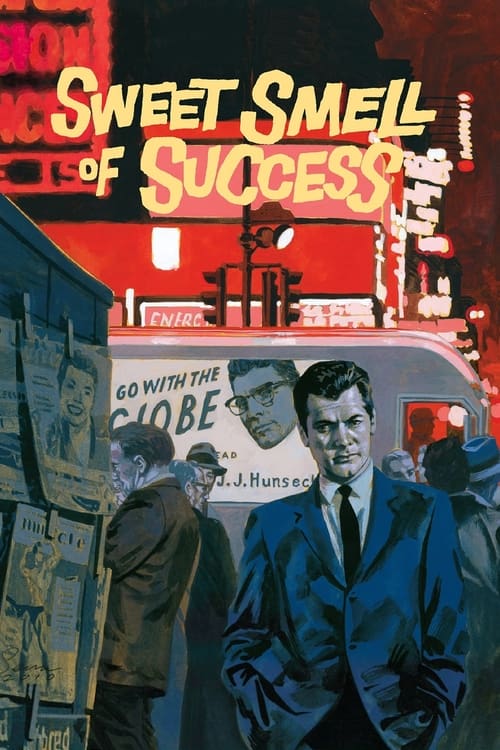
Sweet Smell of Success
1957 · Alexander Mackendrick
For when you're in a sharp, cynical mood and want the best dialogue ever put in an American movie — power, ambition, and moral rot served ice cold. Not a comfort watch; a bracing one.
What it's about
A feared Broadway gossip columnist can make or break anyone in New York — except his younger sister, who has fallen for a jazz guitarist he despises. To destroy the romance he turns to Sidney Falco, a hungry, ethically bankrupt press agent who will do almost anything to stay in the great man's favor. One long nocturnal crawl through Times Square follows.
The experience
Venomous, fast, and dazzlingly talky — every line is a switchblade, and the film moves with the propulsion of the jazz clubs it prowls. You come out exhilarated and slightly grimy, like you've been up all night in bad company.
Performances
Burt Lancaster, cast against type, plays the columnist as glacial menace behind horn-rimmed glasses — power that never needs to raise its voice — while Tony Curtis burns through the film as Falco, all jittery hustle and self-loathing charm, in the performance that proved he was a serious actor.
The craft
The Clifford Odets–Ernest Lehman script is a legend in itself, baroque insults and all, and James Wong Howe shoots nighttime Manhattan on location in glittering, hard-edged black and white. The brassy jazz score keeps the whole thing at a low boil — it looks and sounds sensational on a good setup.
Why it matters
A flop on release that became one of the most quoted films in American cinema — the benchmark for every drama about media power, publicity, and the price of access since.
Snapshot
Sweet Smell of Success is a corrosive nocturnal drama set in the Broadway demimonde of press agents and gossip columnists, a study of power, sycophancy, and moral rot rendered in some of the most baroque dialogue in American studio cinema. Burt Lancaster plays J.J. Hunsecker, a feared newspaper columnist whose syndicated Broadway column can make or break careers and reputations; Tony Curtis plays Sidney Falco, a frantic, ethically bankrupt publicist who lives by planting items in Hunsecker's column and will do anything to stay in his favor. The plot turns on Hunsecker's pathological possessiveness toward his younger sister Susan and his recruitment of Falco to destroy her romance with a jazz guitarist, Steve Dallas, by any means — smear, frame-up, betrayal. Directed by the Ealing veteran Alexander Mackendrick in his first American film, photographed by James Wong Howe on the wet midnight streets of Manhattan, and scripted by Clifford Odets and Ernest Lehman, the film was a commercial failure on release that has since been canonized as one of the great American films about media, ambition, and corruption — celebrated for its venom, its visual brilliance, and the daring of two matinee idols cast against type as monsters.
Industry & production
The film was produced by Hecht-Hill-Lancaster, the independent company formed by Burt Lancaster with the producer-agent Harold Hecht and later James Hill — one of the most powerful star-driven independents of the 1950s, releasing through United Artists. HHL had recently enjoyed prestige and commercial success (notably Marty, 1955, an Oscar winner), and Sweet Smell of Success exemplifies the latitude such star-owned outfits enjoyed in the studio system's decline: a major star using his own company to mount a dark, uncommercial property and to cast himself as a villain.
The project originated with Ernest Lehman, who had drawn on his own experience working in Broadway press agentry — proximity to figures in the orbit of the columnist Walter Winchell and the press agent Irving Hoffman — to write a novelette published in Cosmopolitan. Lehman was initially attached to direct his own adaptation but withdrew, by most accounts owing to illness and to the strain of the production environment. Mackendrick, fresh from Ealing comedies in Britain, was brought in for what became his American debut. The collaboration was famously turbulent. Clifford Odets, the celebrated Group Theatre playwright, was engaged to rewrite the screenplay and reworked the dialogue extensively, often producing pages during shooting; the much-repeated account is of Odets restructuring and rewriting scenes on or near the set, which contributed to the film's intensely stylized, almost theatrical speech but also to scheduling pressure. The casting of Tony Curtis, then a popular romantic lead, as the weaselly Falco was a notable gamble, and the film is often cited as the performance that proved his range.
Shot substantially on location in New York — Times Square, Broadway, the "21" Club milieu, the all-night world of clubs and automats — the production was logistically demanding and is part of why the film looks and feels so specific. On release in 1957 it underperformed; audiences and some reviewers recoiled from seeing two well-liked stars embody such repellent characters and from the film's unrelieved cynicism. Precise box-office figures should be checked against a reliable source, but its status as a commercial disappointment that damaged HHL's fortunes and was only later rehabilitated is well established.
Technology
The film was made with conventional late-1950s 35mm black-and-white technology, but its distinction lies in how aggressively it exploited location night shooting. James Wong Howe's photography depends on capturing the actual neon, marquee, and street light of Manhattan after dark, supplemented by carefully controlled artificial sources, to achieve deep-focus compositions in difficult low-light conditions. Achieving sharp, deep-focus images on real streets at night — with reflective wet pavement and the glare of signage — required fast lenses, sensitive stock, and meticulous lighting craft, and it is a large part of why the film remains a reference point for location-based black-and-white cinematography. The technological signature here is less novel apparatus than the disciplined marshaling of available urban light into expressionist effect.
Technique
Cinematography
James Wong Howe's cinematography is among the most admired in American cinema and is central to the film's reputation. He renders New York as a glittering, predatory nightscape — high-contrast black and white, glistening streets, the hard sparkle of neon — and uses deep focus and wide-angle compositions to pack foreground and background with information and menace. Hunsecker is often photographed from below or framed behind his heavy glasses, fixed and monumental, while Falco is kept restless, hurried, hemmed in by the crowded frame. The camera moves with Falco through the choked sidewalks and nightclubs, and the city's electric glow becomes a moral atmosphere as much as a setting: seductive, artificial, and cold. The interplay of glamour and squalor in the imagery enacts the film's argument that this world's brilliance is inseparable from its rot.
Editing
Cut by Alan Crosland Jr., the film moves with a propulsive, talk-driven momentum, its rhythm keyed to the verbal sparring rather than to action. The editing sustains long, dialogue-heavy confrontations — the extended scenes in Hunsecker's nightclub booth, the apartment encounters — while keeping the street material kinetic, matching the film's tempo to Falco's desperate forward motion. The pace tightens as the scheme escalates toward its nocturnal climax, and the cutting's restraint in the dialogue scenes lets the performances and the writing carry the tension.
Mise-en-scène / staging
The staging exploits the geometry of power. Hunsecker is repeatedly enthroned — in his club booth, behind his desk, atop the city — with supplicants arranged below or before him; Falco is staged as a man perpetually leaning in, currying, maneuvering for position. The "21"-style nightclub, the cramped press agent's office, the apartment overlooking the city, and the all-night streets supply a milieu of artificial light and closed, smoky interiors. Mackendrick blocks the dialogue scenes with a theatrical precision that suits Odets's heightened speech, using physical proximity and the encroachment of bodies in the frame to dramatize coercion and servility.
Sound
The film's soundtrack is celebrated. Elmer Bernstein composed a driving, jazz-inflected score, and the picture integrates live jazz through the figure of Steve Dallas, the guitarist whose band is portrayed by the Chico Hamilton Quintet — cool-jazz textures that root the film in the contemporary New York nightclub scene and counterpoint the moral coldness with genuine artistry. The aural world of clattering clubs, ringing telephones, and the percussive crackle of Odets's dialogue gives the film a distinctive sonic density; the music's nervous energy is inseparable from the picture's tempo and atmosphere.
Performance
The performances are extraordinary and were the film's biggest commercial risk. Burt Lancaster plays Hunsecker with a chilling, controlled stillness — soft-spoken, bespectacled, monstrous — a deliberate inversion of his athletic star persona, his power expressed through restraint rather than force. Tony Curtis, cast against his romantic-lead image, gives a career-redefining performance as Falco: ingratiating, panicked, self-loathing, and morally weightless, a man who has bargained away every principle for proximity to power. The two performances are calibrated as opposites — Hunsecker's glacial command against Falco's frantic hustle — and their scenes together are the film's electric core. The supporting playing, including Susan Harrison as the fragile sister and Martin Milner as Dallas, frames the central pathology.
Narrative & dramatic mode
The film operates in a mode of escalating moral entrapment — a tragedy of corruption rather than a conventional crime story. The dramatic engine is Hunsecker's incestuous-tinged possessiveness toward his sister and the dirty scheme he sets in motion to break her romance, with Falco as the instrument who fouls himself ever more deeply in the doing. The dialogue is the film's defining formal feature: Odets's stylized, aphoristic, almost operatic speech ("a cookie full of arsenic," "the cat's in the bag and the bag's in the river," "match me, Sidney") gives the characters a heightened, knife-edged eloquence that is both unrealistic and devastatingly expressive. The structure compresses into a single roughly continuous span of nights, intensifying the sense of a closed, airless world. There is no redemptive arc; the film's interest is in anatomizing how power corrupts and how the corrupt collude in their own degradation.
Genre & cycle
Sweet Smell of Success sits at the intersection of the social-problem drama and film noir's late, urban phase. It is not a crime thriller in the classic sense — there is no detective, no murder mystery — but it shares noir's nocturnal city, moral fatalism, expressionist black-and-white photography, and vision of a corrupt metropolis. It belongs equally to a tradition of journalism-and-publicity pictures, descending from the cynical newspaper comedies of the 1930s but stripped of their comic buoyancy and pushed toward bleak exposé. Within the 1950s cycle of adult, socially critical dramas made possible by independent production and a loosening studio grip, it is among the most unsparing — a portrait of American success-worship and the machinery of celebrity as a system of predation.
Authorship & method
The film is a rare case of multiple strong authorial signatures fusing under friction. Alexander Mackendrick, the director, had made his name on sharp Ealing comedies (The Man in the White Suit, The Ladykillers) with a streak of underlying cruelty and moral irony; Sweet Smell channels that cold-eyed misanthropy into drama, and Mackendrick's rigorous control of staging and his outsider's clarity about American ambition are everywhere in the film. He later became an influential film educator, and his thinking about dramatic construction is part of his legacy. Ernest Lehman, who wrote the source novelette and the initial screenplay, supplied the authentic, insider knowledge of the press-agent world and its predatory codes. Clifford Odets, brought in to rewrite, gave the film its astonishing, theatrically heightened dialogue — the rat-a-tat, metaphor-laden speech that is the picture's most imitated quality — reportedly rewriting heavily during production. James Wong Howe, the cinematographer, translated the material into indelible images of nocturnal New York. Elmer Bernstein composed the propulsive jazz score, and the Chico Hamilton Quintet supplied the on-screen music. Alan Crosland Jr. edited. The result is a film whose greatness emerges from the collision of an acerbic Scottish-trained director, a hard-boiled screenwriter, a literary playwright's verbal pyrotechnics, and a master cameraman — an authorship of productive tension rather than a single guiding hand.
Movement / national cinema
This is an American film, but a revealing one to read through its director's transatlantic vantage. Mackendrick — American-born, British-raised, formed at Ealing Studios — brought an outsider's analytic distance to the American success ethos, and critics have often noted the irony that one of the most penetrating films about American media corruption came from a director steeped in British comedy. The film is part of the broader mid-century current of independent, location-shot American filmmaking that pushed against studio gloss toward grittier urban realism, even as its dialogue remains highly stylized. It also draws, through Odets, on the leftist, socially conscious theatrical tradition of the 1930s Group Theatre, refracted into a jaundiced view of postwar celebrity capitalism.
Era / period
The film is bound to its late-1950s moment: the peak and incipient decline of the syndicated gossip columnist as a cultural power, with Hunsecker widely understood as modeled on Walter Winchell, then among the most influential and feared media figures in America. It captures a specific media ecology — the symbiosis of columnists and press agents, the manufacture of celebrity and the destruction of reputations by innuendo — at the threshold of its disruption by television. The film's anxieties about smear, blacklisting, and the abuse of media power also resonate with the recently waning McCarthy era, when a planted accusation could ruin a life; the subplot turning on a false charge against Dallas echoes that climate of insinuation. Its bleakness ran against the grain of much 1950s entertainment, which partly explains its initial failure and its later reappraisal.
Themes
The governing theme is power and the corruption of those who serve it. Hunsecker embodies media power as a form of tyranny — the ability to destroy with a printed line — and the film dissects the servility, betrayal, and self-abasement that such power breeds in its dependents. Falco is the study in moral abdication: a man who has traded conscience for access and who debases himself and others to survive in the columnist's shadow. Ambition and the American success myth are interrogated as engines of predation rather than self-realization. Beneath the public drama runs a current of disturbed intimacy — Hunsecker's possessive, incestuously charged control of his sister — that pathologizes his hunger for domination. The film is also about language as a weapon: its dazzling dialogue is itself an instrument of manipulation, flattery, and threat, so that the verbal brilliance enacts the very corruption it describes. Loyalty, betrayal, and the squalor underlying glamour complete its preoccupations.
Reception, canon & influence
On release in 1957 the film was a commercial failure and met a divided critical response; its unrelenting darkness and the casting of beloved stars as villains alienated contemporary audiences, and it dented the fortunes of Hecht-Hill-Lancaster. Over the following decades its reputation rose steadily until it became firmly canonical — admired for Wong Howe's cinematography, the Odets-Lehman dialogue, and the central performances, and regularly cited among the finest American films of its decade. It was selected for preservation in the United States National Film Registry by the Library of Congress in 1993, a marker of its established cultural and historical importance, and it is a touchstone in critical writing on noir, on films about journalism, and on Mackendrick's career.
Looking backward, the film draws on the cynical newspaper-picture tradition of the 1930s and on film noir's expressionist urban vision, while its verbal style descends from the socially engaged American theater of Odets and the Group Theatre; Lehman's firsthand experience of Broadway press agentry grounds its world. Looking forward, its influence has been substantial and durable. It established a template for films about the predatory machinery of media and celebrity and for the late-night, neon-lit Manhattan of subsequent urban cinema; its acidic, quotable dialogue and its portrait of a sycophantic operator in thrall to a monstrous power have echoed through later work about ambition and corruption. It is frequently invoked in discussions of films and television that anatomize media power and toxic power dynamics, and it remains a model for actors and directors of how casting against type and stylized writing can produce a portrait of evil more lasting than any conventional villainy. Tony Curtis's Falco and Burt Lancaster's Hunsecker endure as definitive screen studies of the courtier and the tyrant.
A Deleuzian reading
Start with the lighter.
The full Deleuzian reading of Sweet Smell of Success →
Reception
A box-office flop in 1957 — audiences reportedly recoiled at heartthrob Tony Curtis playing a slimy press agent — it's since been fully canonized as one of the great New York films and a high-water mark of screen dialogue.
How Sweet Smell of Success was received, from release to now →
Influences: the films it descends from and the films it influenced
- His Girl Friday (1940) — The overlapping, rat-a-tat cynical newspaper-picture dialogue whose rhythm and venality Odets and Lehman sharpen into Falco and Hunsecker's verbal jousting.
- Citizen Kane (1941) — Deep-focus, ceiling-low expressionist compositions and the anatomy of a media magnate's corrupting power that Wong Howe and Mackendrick translate to Hunsecker's empire.
- Body and Soul (1947) — James Wong Howe's mobile, high-contrast handheld-feel photography of a corrupt milieu — the direct technical precursor to his nocturnal Sweet Smell camerawork.
- Force of Evil (1948) — Heightened, near-blank-verse noir dialogue dramatizing capitalist predation — the stylized-speech-as-moral-indictment mode Odets's rewrite extends.
- The Naked City (1948) — On-location night shooting of real Manhattan streets, the documentary-realist urban template Sweet Smell pushes toward neon stylization.
- Golden Boy (1939) — Clifford Odets's own Group Theatre material, the source font of the metaphor-laden, theatrically heightened American speech he brought to the screenplay.
- On the Waterfront (1954) — Location-NYC realism fused with Method performance of corruption and a jazz-inflected Bernstein score — the scoring and casting-of-conscience model Sweet Smell answers.
- The Ladykillers (1955) — Mackendrick carries the same corrosive view of predation and the analytical, architecturally tight construction directly into his American masterpiece.
- Night and the City (1950) — Extends the predatory-city-at-night vision — a glittering, hostile metropolis shot on real streets in deep low-key — around another hollow operator scrambling for status he cannot sustain.
- Hangmen Also Die! (1943) — Howe carries the chiaroscuro-surveillance visual language forward into a nocturnal city of watchers and informers, the mature flowering of his Hangmen photographic method.
- The Apartment (1960) — The careerist toady's moral entrapment inside a corrupt urban hierarchy, where advancement is purchased by procuring for a powerful man.
- Taxi Driver (1976) — Neon-soaked, steam-and-rain nocturnal Manhattan scored by a jazz-sax theme (Herrmann), descending directly from the film's nightclub-jazz nightscape.
- Network (1976) — Aphoristic, theatrically heightened monologue weaponized to anatomize media-power corruption — the quotable-dialogue-as-exposé inheritance.
- The King of Comedy (1982) — The obsequious operator in thrall to a celebrity tyrant — the courtier/idol predation dynamic of Falco and Hunsecker transposed to TV fame.
- Wall Street (1987) — The mentor-acolyte corruption pact and quotable predatory aphorism (Gekko/Bud mirroring Hunsecker/Falco) as engine of moral collapse.
- Nightcrawler (2014) — The media-hustler-as-predator prowling a neon nightscape, extending Lehman's press-agent-as-amoral-operator template to nocturnal LA news.
- Birdman (2014) — The destructive critic as power-broker who can destroy a career with a word, scored by a percussive jazz-drum track echoing the Chico Hamilton textures.
- Miller's Crossing (1990) — James Wong Howe's deep-shadow anamorphic widescreen, lit exclusively by street lamps and practical interior sources in a power-broker milieu, is the direct photographic antecedent for Sonnenfeld's lighting design; both films also stage their central conflict as a triangulated confrontation between a boss, his subordinate, and an outsider threatening the arrangement.
- Klute (1971) — James Wong Howe's Manhattan location cinematography — supplementing practical lamps and windows rather than flooding with studio light, leaving deep shadow pools — established the available-light grammar Willis cited as direct precedent and systematized for Klute.
- All the President's Men (1976) — James Wong Howe shot on New York locations using available and practical light sources to render journalism-and-power corridors as genuinely inhabited spaces—the template Willis refined into the fluorescent newsroom; the milieu of institutional corruption as a physical environment rather than a backdrop.
- Raging Bull (1980) — James Wong Howe's glittering high-contrast black-and-white nightworld of New York establishes the durable monochrome expressionism Scorsese reaches for against the color norm.
- Good Night, and Good Luck. (2005) — James Wong Howe's extreme-ratio black-and-white lighting of smoke-filled media workspaces, combined with the Chico Hamilton Quintet's cool jazz score as ironic moral commentary on power, is the direct visual and sonic template Elswit and Clooney adapted for the CBS newsroom.
- The Man in the White Suit (1951) — Mackendrick's own cold moral irony and rigorous geometric staging of power, carried from Ealing satire into the film's choreography of dominance.
- Touch of Evil (1958) — Contemporaneous late-noir expressionism — deep-focus, wide-angle nocturnal location photography of a morally rotten border world.
- Absence of Malice (1981) — The original counter-text on press power as moral menace, staged through restaurant-and-table dialectical sparring, whose cynical anatomy of how a columnist manufactures truth Pollack's film updates for the post-Watergate era.
- Ace in the Hole (1951) — Extends the predatory-press-figure portrait (J.J. Hunsecker) with the same mordant, hyper-quotable dialogue and James Wong Howe's high-contrast chiaroscuro as moral lighting.
- Glengarry Glen Ross (1992) — Supplies the direct visual-aural ancestry: rain-slick nocturnal Manhattan, predatory men trading stylized venomous dialogue (Odets/Lehman) as verbal blood-sport, all scored to smoky jazz — the exact register Anchía and James Newton Howard reprise.
- The Man with the Golden Arm (1955) — Elmer Bernstein again scores an expressionist nighttime city with hard-bop jazz, extending the same noir-jazz idiom into a sibling portrait of urban predation.
- A Face in the Crowd (1957) — The paired 1957 statement on the corruption of American publicity — a media kingmaker wielding column/broadcast power, matching Face's expressionist night-world and its indictment of press-made reputation.
- The Hustler (1961) — James Wong Howe's glinting deep-focus chiaroscuro renders a nocturnal American world of talent for sale — the same predatory monochrome milieu, shot a few years apart.
- The Big Combo (1955) — James Wong Howe lights power as an eroticized proprietary bond between men — nightclub practicals, deep-focus banquettes, faces raked from below — the same charge Lewis puts between Brown and his gunmen.
Similar films
- Network (1976) — influence & lineage
- His Girl Friday (1940) — influence & lineage
- Citizen Kane (1941) — influence & lineage
- Taxi Driver (1976) — influence & lineage
- The King of Comedy (1982) — influence & lineage
- Tootsie (1982) — shared sensibility
- Where the Sidewalk Ends (1950) — shared sensibility
- The Maltese Falcon (1941) — shared sensibility
All the films related to Sweet Smell of Success →
Film essays and courses that include it
- The Fix Is In: Cinema's Anatomy of Corruption, 1939–2007
- The Machinery of Greed: Cinema's Anatomy of Capital
- The City as Pressure: New York Cinema, 1948–2008
- The Wages of Wanting: Noir's Cinema of Appetite and the Fall
- Until Morning: The Dusk-to-Dawn Film
- Name Your Price: Cinema's Anatomy of the Dark Deal
- The Organism Made of Strangers