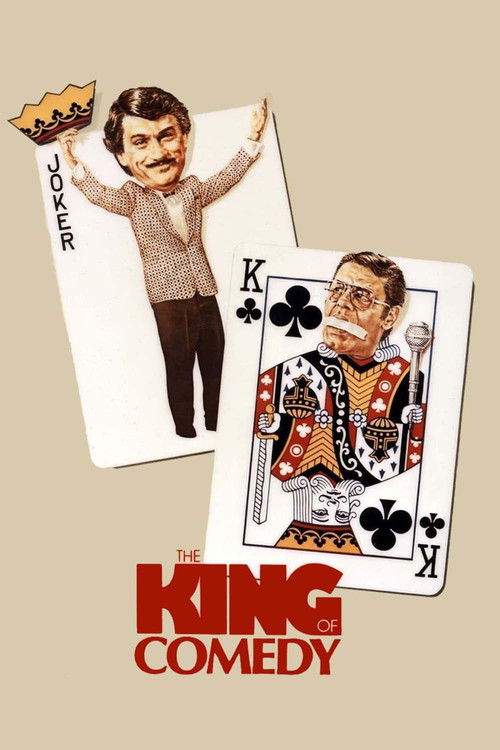
The King of Comedy
1982 · Martin Scorsese
For when you want discomfort with your comedy — something sharp and squirmy to chew on, not a feel-good night. Best when you're up for being challenged.
What it's about
Rupert Pupkin is a thirty-something aspiring stand-up who has never performed, lives in his mother's basement, and rehearses imaginary talk-show triumphs on a homemade set. Convinced he's one break from greatness, he fixates on late-night host Jerry Langford — waiting outside studios, forcing encounters, refusing every polite no — and keeps escalating to get his shot on the air.
The experience
A comedy that's genuinely painful to watch: flat, airless, and cringe-inducing decades before that was a genre, with laughs that catch in your throat. It leaves you unsettled about fame, delusion, and how thin the line between them is.
Performances
Robert De Niro makes Rupert's delusion so complete and so needy it's hard to look at, and Jerry Lewis, cast against his comic persona as the besieged host, is all weary, guarded gravity — two great performances working in opposite registers. Sandra Bernhard is unnervingly funny as a fellow obsessive.
The craft
Scorsese strips out his usual kinetic style for something deliberately static and cold, blurring Rupert's fantasies and reality until you're not always sure which you're in. The restraint is the point — no music cue or camera move rescues you from the awkwardness.
Why it matters
A flop on release that grew into one of the most prophetic films about celebrity culture ever made — its anatomy of the obsessive fan and the fame machine only looks more accurate every year, and its influence on later portraits of lonely, aspiring men is unmistakable.
Snapshot
The King of Comedy is Martin Scorsese's cold, discomfiting comedy about celebrity worship, following Rupert Pupkin (Robert De Niro), a thirty-something Manhattan delusionary who lives with his mother and rehearses talk-show triumphs in a basement mock-up of a television set. Convinced of his own genius as a stand-up comic despite never having performed, Rupert fixates on late-night host Jerry Langford (Jerry Lewis) and, with fellow obsessive Masha (Sandra Bernhard), eventually kidnaps Langford to extort a monologue slot on the air. The film sits at an odd angle to the rest of Scorsese's early-1980s work: where Raging Bull was operatic and kinetic, this is flat, static, and deliberately airless, a study of aspiration curdled into pathology. Its final movement — Rupert delivering his set, going to prison, and emerging a bestselling celebrity — is staged so ambiguously that critics still debate whether the success is real or another of his fantasies. Commercially it was among Scorsese's most conspicuous failures on release; critically it has been steadily reclaimed as one of his sharpest and most prophetic films.
Industry & production
The project's origins predate its production by roughly a decade. The screenplay was written by Paul D. Zimmerman, a film critic for Newsweek, in the early-to-mid 1970s, reportedly sparked by his observation of the culture around Johnny Carson's Tonight Show and by press coverage of autograph hounds and talk-show fixation. The script circulated for years — Michael Cimino and others were at various points attached in the trade record — before Robert De Niro, who had read it and championed it, brought it to Scorsese. Scorsese has been candid in interviews that he was not initially enthusiastic about the material and came to it partly at De Niro's urging and during a difficult personal period following Raging Bull.
The film was produced by Arnon Milchan, an early and important credit in the career of the future mogul, and released through 20th Century Fox. It was shot largely on location in New York City. On release the film was a commercial disappointment: it drew respectful but divided reviews and failed to find an audience, grossing only a small fraction of its budget and standing for years as a byword for a Scorsese picture that "didn't work" at the box office. Precise figures vary across sources and I won't assert exact numbers, but the qualitative record is unambiguous — it underperformed badly. It fared better on the festival and awards circuit abroad; Zimmerman's screenplay was recognized at the BAFTAs (winning Best Original Screenplay per most accounts), and the film had a prominent European festival profile, including a Cannes selection in 1983. Zimmerman, notably, never had another produced feature credit of comparable stature, and this remained his signature contribution to cinema.
Technology
The King of Comedy is not a technically innovative film in the sense of new tools or formats; it was shot on 35mm color film with conventional early-1980s equipment. Its "technology" is better understood as its diegetic subject: broadcast television itself. The film is deeply concerned with the apparatus of network late-night TV — the studio, the desk-and-couch grammar, the applause sign, the green room, the machinery that manufactures the intimacy viewers feel with a host they have never met. Scorsese reconstructs this apparatus meticulously, and the film's most unsettling effect comes from how convincingly it mimics the look and rhythm of real television, so that Rupert's fantasy broadcasts and the "actual" ones are rendered in the same visual register. The gap between the private person and the mediated image — a media-technology theme — is arguably the film's true engine.
Technique
Cinematography
The cinematographer was Fred Schuler, standing in for Scorsese's more frequent early collaborator Michael Chapman. The visual approach is a deliberate suppression of the mobile, subjective camera that defined Mean Streets, Taxi Driver, and Raging Bull. Here the camera is frequently locked down, frontal, and observational, holding on characters in flat, evenly lit spaces. Long lenses and static compositions create a sense of surveillance and entrapment, and the framing often isolates Rupert within rigid, symmetrical geometry. This restraint is a strategy: by refusing expressive camerawork, Scorsese denies the audience the usual cues that would let them share or excuse Rupert's inner life, leaving us stranded outside his delusion even as the film stays glued to him.
Editing
Editing was by Thelma Schoonmaker, in the partnership with Scorsese that had been consolidated on Raging Bull and would continue for the rest of his career. The cutting here is far less flamboyant than on the boxing film; it favors patience, awkward duration, and held reaction shots that let scenes curdle into embarrassment. The film's editorial signature is its refusal to signal the boundary between reality and fantasy — Rupert's imagined conversations with Langford, his fantasy of being feted, and the "real" scenes are cut together without the conventional dissolves or musical cues that would flag a daydream, so the transitions repeatedly wrong-foot the viewer.
Mise-en-scène / staging
The staging is built around cramped, over-familiar interiors: Rupert's basement shrine with its cardboard cutout of Liza Minnelli and its life-size Langford, the Langford production offices, the sterile network corridors, the suburban home where Rupert brings a date under false pretenses. These spaces are dressed to feel simultaneously banal and delusional. Scorsese repeatedly blocks Rupert crossing thresholds where he is unwelcome — reception desks, doorways, security checkpoints — physicalizing his violation of the boundary between fan and star. The famous "you're not welcome here" confrontations gain their force from staging that keeps Rupert's cheerful advance and the staff's mounting alarm in the same frame.
Sound
Robbie Robertson served as music producer/supervisor, a role continuing his association with Scorsese from The Last Waltz and Raging Bull. Rather than a driving original score, the film uses a soundtrack of source and pop recordings — the opening credits are set to Ray Charles's "Come Rain or Come Shine," and Van Morrison's "Wonderful Remark" is among the featured songs — deployed with a certain ironic sweetness against the film's cringe. Sonically, the film leans on the artificial warmth of broadcast sound: applause, canned laughter, the amplified bonhomie of the studio. That manufactured ambience is set against the dead-air quiet of Rupert's real encounters, and the contrast underlines the film's theme of mediated versus lived experience.
Performance
Performance is the film's central technical achievement. De Niro plays Rupert without the safety valve of sympathy or obvious menace — he is relentlessly polite, upbeat, and oblivious, a portrait of delusion that never lets the audience relax into either pity or fear. Jerry Lewis, cast against his own comic persona, gives a controlled, mostly straight performance as Langford, playing weariness and private contempt beneath professional charm; the casting of a genuine comedy legend as the guarded celebrity is itself a piece of meta-commentary. Sandra Bernhard, in a breakout role as Masha, delivers a raw, partly improvised performance whose extended seduction-captivity scene with Lewis is one of the most uncomfortable in Scorsese's work. There is a well-documented anecdote that De Niro deliberately provoked Lewis off-camera to sharpen the antagonism between them; it is widely repeated in the literature, and I flag it as reported rather than independently confirmable. Members of The Clash, including Joe Strummer, appear as street toughs, and Scorsese's own mother, Catherine, appears — her presence a recurring feature of his films.
Narrative & dramatic mode
The film's dramatic mode is deadpan discomfort — a comedy in structure whose laughs are strangled by dread. It withholds the interiority that character studies usually grant, presenting Rupert almost entirely from the outside so that his fantasies erupt as ruptures in the surface rather than as sympathetic access to his mind. The narrative is a straight line of escalating transgression (fixation → intrusion → kidnapping → performance → punishment → apotheosis), but its most radical feature is the epistemological instability of the ending. Rupert's on-air monologue, his fifteen minutes, his imprisonment, and his emergence as a celebrity memoirist are narrated in a rush of television-style voiceover and images that may be literal or may be the ultimate wish-fulfillment. Scorsese refuses to adjudicate, and that refusal is the point: in a culture that rewards notoriety, the distinction between earning fame and hallucinating it collapses.
Genre & cycle
Nominally a comedy-drama, the film belongs less to any comic tradition than to a small, dark cycle of American films about celebrity, fandom, and the poisoned dream of recognition. It is a companion piece to Taxi Driver — both center a lonely New York obsessive whose thwarted need for attention resolves in a violent gesture that the culture perversely rewards — but where Travis Bickle's story is drenched in expressionist subjectivity, Rupert's is drained of it. It also participates in the tradition of Hollywood-on-showbiz self-critique (the sour lineage of A Face in the Crowd, Sunset Boulevard, Network), turning its lens specifically on the television age's manufacture of intimacy.
Authorship & method
The King of Comedy is a Scorsese film that partly resists the Scorsese signature, and that tension is where its authorship lives. Working from Paul Zimmerman's long-gestating screenplay, Scorsese deliberately stripped away his characteristic camera pyrotechnics, later describing the film as a departure made in a fatigued, uncertain phase of his life. The collaboration with De Niro — their fifth feature together — is central; De Niro was the film's earliest advocate and its animating force, and Rupert extends the pair's ongoing study of male loneliness and self-mythology. The key craft collaborators reflect Scorsese's stabilizing early-'80s team: editor Thelma Schoonmaker, music supervisor Robbie Robertson, with cinematographer Fred Schuler substituting into the DP chair. The result is authored as much through subtraction — of movement, of music cues, of sympathy — as through the maximalism for which Scorsese is better known.
Movement / national cinema
The film is a product of American cinema's "New Hollywood" generation in its later, more embattled phase. Scorsese emerged from the film-school-trained, auteur-driven movement of the late 1960s and 1970s; by 1982–83 that movement's commercial latitude was contracting as the blockbuster economy consolidated, and The King of Comedy's failure is often cited as emblematic of how difficult it had become to release a mordant, uncommercial adult drama within the studio system. It is a distinctly New York film — shot in the city, steeped in its media industry, extending the metropolitan alienation that runs through Scorsese's work.
Era / period
Made and set at the turn from the 1970s to the 1980s, the film captures a specific media moment: the peak cultural centrality of network late-night television, before cable fragmentation and long before the internet, when a single host could command a mass nightly audience and embody the era's idea of celebrity. Its portrait of autograph hounds, stage-door vigils, and parasocial delusion is rooted in that broadcast ecology, which is precisely what makes the film feel prophetic — the pathology it diagnoses only intensified as media multiplied.
Themes
The film's governing theme is the parasocial delusion of the media age: the conviction, fostered by broadcast intimacy, that the fan and the star share a relationship. Around it cluster Scorsese's recurring preoccupations — loneliness, the hunger for recognition, the thin membrane between fantasy and reality, and the moral vacancy of a culture that confuses fame with worth. Rupert is a study in aspiration without craft; he wants the reward of achievement while skipping achievement itself, and the film's most chilling suggestion is that the culture may ultimately grant it. It is also, quietly, about privacy as a vanishing commodity, dramatized in Langford's wish simply to be left alone. The comedy of embarrassment throughout is a moral instrument: it implicates the viewer's own appetite for spectacle.
Reception, canon & influence
On release the film met a divided, often cool reception and a badly disappointing commercial performance; for a period it was regarded, even by admirers of Scorsese, as a misfire or a curio. Its reputation has undergone one of the more complete reversals in the director's filmography. It drew, backward, on Scorsese's own Taxi Driver (the obsessive-loner template), on the showbiz-satire tradition of films like A Face in the Crowd and Network, and on the real-world texture of talk-show culture and the era's anxieties about fans, stalkers, and celebrity intrusion.
Forward, its influence is now substantial and widely acknowledged. It stands as a foundational text for later films about toxic fandom, aspirational delusion, and the manufacture of celebrity, and its DNA is explicit in Todd Phillips's Joker (2019), which casts De Niro as a late-night host in a role that deliberately inverts and echoes the Pupkin–Langford relationship. Sandra Bernhard's performance launched her career, and the film's uncomfortable, deadpan mode prefigured a strain of cringe comedy that became central to later television and film. Today it is routinely included in reassessments of Scorsese's finest work and read as one of his most prescient films — a 1982 diagnosis of a fame culture that the subsequent decades made only more literal.
A Deleuzian reading
Rupert Pupkin hosts a talk show in his mother's basement.
The full Deleuzian reading of The King of Comedy →
Reception
A famous flop in 1983 — Scorsese himself called it 'the flop of the year' after it bombed at the box office and bewildered audiences expecting another Raging Bull. Decades on it's been fully reappraised as eerily prescient about fame, parasocial obsession, and celebrity worship — many now rank it among Scorsese's very best.
How The King of Comedy was received, from release to now →
How to watch The King of Comedy: what to notice on a first viewing
- Look at the cardboard Jerry and Liza in the basement. Rupert has built a talk-show set in his mother's house: a desk, a life-size Langford cutout, a Liza cutout, canned applause on tape. He performs a full show down there to nobody. The basement is not a fantasy about a studio. It is a working copy of one, and Rupert uses it as the real thing.
- Notice how often the camera sits still and shoots people head on. Fred Schuler shoots long lens, locked down, flat and evenly lit. Scorsese strips out the prowling subjective camera of Taxi Driver and Raging Bull. You watch Rupert from a fixed distance for two hours. The camera never climbs inside him. You stay outside the delusion, which is why the comedy stings instead of soothing.
- Watch Rupert walk past reception desks where staff tell him no. Doorways, desks, security checkpoints. Scorsese keeps Rupert's cheerful forward lean and the staff's rising alarm inside the same frame instead of cutting between them. De Niro never drops the politeness. One posture carries the whole one-way relationship: the fan arriving to collect something he believes he is owed.
- Watch for scenes where Langford suddenly treats Rupert as a friend. Thelma Schoonmaker cuts into Rupert's daydreams the way you would cut to the next room. No dissolve, no music sliding under, no soft focus. The imagined scene is lit and paced exactly like the real one. Films had flagged daydreams for sixty years. This one removes the flag and never tells you it has.
- Listen for applause and laughter against rooms with dead air. Broadcast sound here is warm and crowded: studio applause, canned laughter, amplified good cheer. Rupert's actual encounters play in a flat hum with nothing underneath. Robbie Robertson lays pop records over the cringe with the same sweetness. Manufactured warmth is the only warmth in the picture, and you can hear exactly where it stops.
The whole guide to watching The King of Comedy, with the keys for a rewatch →
Influences: the films it descends from and the films it influenced
- Taxi Driver (1976) — Establishes the Scorsese/De Niro loner who narrates his own self-mythology; its subjective distortions are the seedbed for Pupkin's fantasies, which King of Comedy pushes further by cutting to them unmarked, staged flatly as fact.
- A Face in the Crowd (1957) — The template for showbiz satire built on the manufacture of a broadcast personality — the drifter engineered into a beloved media figure whose fame is a fabricated machine product.
- Network (1976) — Treats television as a system that rewards and amplifies derangement; its on-air/backstage broadcast ambience and satire of the medium as manufacturer of instant fame prefigure Langford's studio world.
- Sunset Boulevard (1950) — The delusional performer whose private fantasy of stardom is staged without ironic distancing, and whose relationship to reality collapses into an ambiguous performed-triumph ending — the Pupkin arc's blueprint.
- Ace in the Hole (1951) — Pioneers the deadpan, unsympathetic media protagonist the audience cannot root for, wielding cynicism about a spectacle manufactured for public consumption.
- Rear Window (1954) — Source for the long-lens, locked-down surveillance gaze — observation as voyeuristic entrapment — that Scorsese repurposes for Pupkin's and Masha's watching of Langford.
- The Nutty Professor (1963) — Supplies the very persona Scorsese casts against: Langford is built by stripping the warmth and manic generosity of Lewis's own star image, weaponizing Lewis-against-type.
- The Day of the Locust (1975) — Charts the pathology of celebrity-fringe hangers-on whose aspirational delusion curdles toward violence, the fan-as-predator texture King of Comedy sharpens.
- Sweet Smell of Success (1957) — The obsequious operator in thrall to a celebrity tyrant — the courtier/idol predation dynamic of Falco and Hunsecker transposed to TV fame.
- The Circus (1928) — Sustains a whole feature on Chaplin's device of comedy performed without laughter: Pupkin's routines are shot in flat static frames and denied any supporting reaction track, so the collapse of timing becomes the film's actual subject rather than an interlude.
- To Die For (1995) — Extends the delusional-aspirant-to-media-fame study through a sociopath who confuses celebrity with self-worth, narrated in mockumentary broadcast-confessional texture.
- The Fan (1996) — Directly inverts the casting logic by putting De Niro on the obsessive-fan side, dramatizing parasocial devotion that curdles into intrusion and abduction.
- The Cable Guy (1996) — Carries forward the TV-raised parasocial obsessive who invades a stranger's life expecting friendship, sustained through excruciating cringe-comedy discomfort.
- One Hour Photo (2002) — Inherits the locked-down, observational camera and the quiet menace of the lonely parasocial fixator who believes he belongs inside another's life.
- Nightcrawler (2014) — Advances the uningratiating protagonist who pursues media success at any cost with zero audience sympathy, set against broadcast-news source ambience.
- Ingrid Goes West (2017) — Updates parasocial-delusion craft to social-media celebrity-stalking, maintaining the deadpan-discomfort register as fandom slides into identity theft.
- Joker (2019) — Explicitly echoes and inverts the Pupkin–Langford relationship by casting De Niro as the late-night host, restaging the talk-show as the site of the delusional aspirant's eruption.
- Punch-Drunk Love (2002) — Scorsese's against-type casting of Jerry Lewis uses audience familiarity with Lewis's comedic persona of desperate need for approval to generate menace and pathos simultaneously — the precise technique Anderson applies to Sandler's accumulated multiplex reputation.
- Uncut Gems (2019) — Casts a beloved comic (De Niro/Lewis) against type into excruciating dramatic discomfort, the precedent for weaponizing Adam Sandler's manic comedic persona as a dramatic engine.
- Citizen Vigilante (2026) — Models the nobody who commits a transgressive act specifically to seize an audience, fusing violence with a craving for fame that anticipates Boll's spectacle-seeking killer.
- Late Night with the Devil (2024) — Anatomizes the late-night talk-show as a machine of desperate ambition and performed intimacy, the host/guest pathology the film's talk-show reconstruction inhabits.
- Jigarthanda (2014) — Supplies the deluded-aspirant protagonist who invades a powerful man's world to manufacture his own fame, sustaining discomfort-comedy where the audience can't tell ambition from delusion.
- Zelig (1983) — Same-moment satire of the void behind manufactured celebrity, told through faux-broadcast documentary texture and a cipher-protagonist who exists only to be famous.
- Being There (1979) — Deadpan-discomfort comedy in which an empty cipher is elevated by television into a national figure, the flat affect and unresolved close paralleling King of Comedy's mode.
- Real Life (1979) — Parallel experiment in deadpan media-intrusion satire, using broadcast ambience and a protagonist whose need to be on-camera overrides all human reality.
- Lost in America (1985) — Contemporaneous proof that a comedy can be shot in the flat, unsignaled register of drama around a protagonist the audience is asked to watch rather than like, with social transgression held in real time until laughter curdles.
- Modern Romance (1981) — Another persona-comedian vehicle that systematically withholds the release laugh, observes compulsive behavior at an uncomfortable fixed remove, and closes on a protagonist whose self-regard has not moved a millimeter.
Similar films
- Taxi Driver (1976) — influence & lineage · same viewing thread
- Joker (2019) — influence & lineage
- Zelig (1983) — influence & lineage
- The Wolf of Wall Street (2013) — same viewing thread
- Fight Club (1999) — same viewing thread
- My Dinner with Andre (1981) — often watched together
- The Big Lebowski (1998) — often watched together
- After Hours (1985) — shared sensibility
All the films related to The King of Comedy →
Watch it with: curated runs of related films
- The American Male Comes Apart — A run of self-made men — brokers, founders, dealers, drifters — hollowed out by the very thing they chase, each film pressing the same nerve where ambition curdles into alienation and violence.