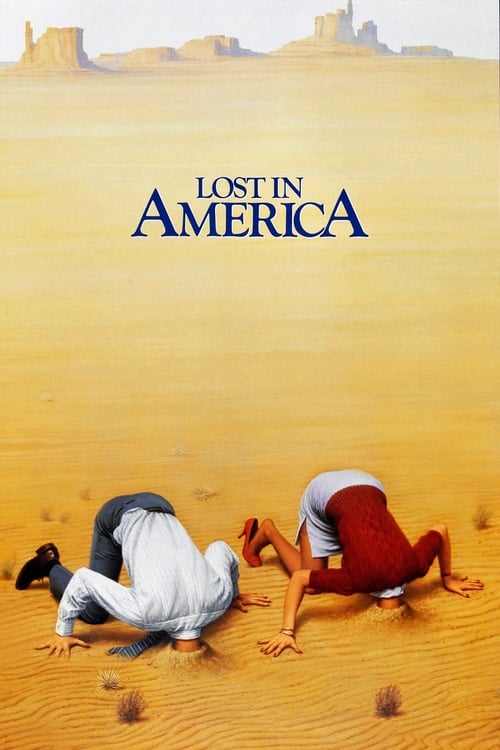
Lost in America
1985 · Albert Brooks
For when you want smart, talky laughs with teeth — perfect if you're in the mood to watch confident people faceplant, or if you've ever fantasized about quitting everything. Comfort viewing for anyone with a healthy sense of irony about their own life plans.
What it's about
David and Linda Howard are prosperous Los Angeles yuppies — he's in advertising, she's in personnel — until a career disappointment sends David over the edge. He convinces Linda to quit, liquidate everything, buy a Winnebago, and drop out of society to find themselves on the open road, in conscious imitation of Easy Rider. They are catastrophically unequipped for life outside the comfortable economy that made them, and the dream starts collapsing almost immediately.
The experience
Dry, squirmy, and very funny — comedy built from long, escalating conversations where a reasonable man talks himself into disaster and then tries to talk his way back out. You laugh and wince in equal measure, because the delusions on display are uncomfortably recognizable.
Performances
Albert Brooks is peerless as a man whose self-awareness never quite catches up to his self-sabotage, and Julie Hagerty matches him with a daffy, quietly desperate energy that gives the film its wild card.
The craft
Brooks directs with patient, unshowy precision, letting scenes run long so the comedy comes from watching a negotiation curdle in real time rather than from punchlines. The writing is the star: every rationalization is airtight until the moment it isn't.
Why it matters
A landmark of American comedy that skewered the 1980s yuppie dream from inside it, and the film that fixed Albert Brooks's reputation as the great comic anatomist of middle-class self-delusion — an ancestor of a whole strain of cringe comedy.
Snapshot
Lost in America is a ninety-odd-minute comedy about two Los Angeles professionals who quit their jobs, liquidate their assets, buy a Winnebago, and attempt to drop out of American life in conscious imitation of Easy Rider — and who discover, within about seventy-two hours, that they have no idea how to live outside the economy that made them. Albert Brooks plays David Howard, an advertising executive whose expected promotion turns out to be a lateral transfer to New York; Julie Hagerty plays Linda, his wife, a department-store personnel manager whose compliance with David's rebellion masks a discontent far less articulate and far more dangerous than his.
The film is the third feature Brooks directed, after Real Life (1979) and Modern Romance (1981), and it is the one in which his method — patient, unshowy shooting; scenes built as sustained negotiations rather than joke deliveries; a protagonist whose fluency is precisely his disease — locks into a subject large enough to carry it. Released in early 1985, it arrived within weeks of the moment "yuppie" completed its passage from sociological coinage to national epithet, and it remains the sharpest American film about the specific terror of that class: not poverty, but the loss of the credentials that make one legible.
Its commercial life was modest and its critical life long. Where the record is thin — budget, week-by-week grosses, on-set process — this dossier says so rather than guessing.
Industry & production
The film was produced by The Geffen Company and released by Warner Bros. Geffen's late-Reagan-era operation functioned as a boutique supplier of writer- and director-driven pictures to a major — the same arrangement that produced Risky Business (1983), After Hours (1985), and Little Shop of Horrors (1986). That structure matters to what Lost in America is. It is a studio-distributed picture with an essentially independent sensibility: no stars above Brooks and Hagerty, no set pieces, no high-concept logline that survives a one-sentence pitch, and a downbeat capitulation for an ending. Marty Katz produced. Brooks co-wrote with Monica Johnson, his regular collaborator from Real Life through Looking for Comedy in the Muslim World (2005).
The mid-1980s studio comedy was moving decisively toward the high-concept model — premise-forward, marketable in a poster, calibrated to a broad demographic. Lost in America runs against that grain in every respect, and its reception economics reflect it: respectable reviews, a modest theatrical performance, and a long afterlife on cable and home video, where Brooks's films consistently found the audience that first release did not. Precise budget and gross figures for the film are not well documented in reliable secondary sources, and this account will not supply invented ones.
The production is a road picture in the literal sense, shot across Southern California, Las Vegas, Hoover Dam, and Arizona, with the Winnebago serving simultaneously as prop, set, and thematic argument.
Technology
There is no technological novelty here, and that is itself the point: Brooks's cinema is deliberately unaugmented. The film was shot on 35mm in the standard spherical widescreen format of the period, with naturalistic exposure and no optical or effects apparatus of consequence. What the production did require was mobility — location shooting in desert light, cramped interiors inside a recreational vehicle, and coverage of a moving vehicle on open highway — and the crew's competence in those conditions is the film's real technical achievement.
The more interesting technological content is diegetic. The Winnebago is a machine, and Brooks treats it as one: a self-contained consumer environment with a microwave, a bed, a shower, and a television, sold as the instrument of freedom and functioning in practice as a portable version of the house the Howards just sold. The film's joke about American mobility is a joke about hardware. So is its treatment of the Las Vegas casino, a technology for extracting capital that David — a professional persuader — believes he can talk his way out of. And so is advertising itself, David's trade: the industrialized production of desire, which he has spent his adult life servicing and which has, without his noticing, written the script of his rebellion for him.
Ancillary technology shaped the film's reputation. Videocassette and pay cable carried it to a much larger audience than theatrical release did, and its eventual restoration and issue by the Criterion Collection in 2017 marked its formal admission to the canon of American comedy.
Technique
Cinematography
Eric Saarinen shot the film, as he had Real Life. Saarinen came out of documentary and commercial work, and the eye he brings is observational rather than expressive: available-feeling light, unfussy framing, a camera that holds position and lets the actors do the work. There is very little in the way of emphatic angle,移 camera flourish, or shot-level editorializing. The compositions are frequently two-shots that keep husband and wife in the same frame, which is where the film's real drama lives — not in what either says, but in the visible non-alignment of two people who believe they are doing the same thing.
The exteriors exploit a genuine contrast: the American Southwest photographed with the wide, indifferent clarity of the landscape films the Howards think they are entering, and the interiors — the Winnebago, the casino, the motel, the tiny Arizona employment office — photographed as boxes. The film's visual argument is that the couple never actually gets outdoors. The magnificent country is always out the window, seen through glass, framed like a commercial.
Editing
David Finfer cut the film. The editorial signature is restraint: scenes are allowed to run past the point where a conventional comedy would cut on a laugh, and they routinely end a beat or two after the joke has landed, on silence or on a reaction that curdles. Brooks's comedy depends on duration. The Mercedes negotiation early in the film, the confrontation with the boss, and above all the pitch to the casino manager are all built as escalating single scenes in which the humor comes from David's refusal to stop talking — a rhythm that only survives if the cutting refuses to rescue him.
The road structure is handled episodically, with transitions that are often plain and unornamented. There is no montage of liberation, no cutting-to-music sequence in which the couple experiences freedom. The film systematically denies itself the syntax of the road movie it is quoting.
Mise-en-scène / staging
Staging is the film's most underrated element. Brooks blocks scenes as negotiations with an implicit power differential, and the comedy is generated by his character's attempts to relocate himself in the room. The pitch to the Desert Inn's casino manager — Garry Marshall, cast with perfect instinct as an executive of complete, weary reality — is a masterclass: David proposes that the casino return the money Linda lost as a promotional gesture, "the Desert Inn has heart," and the staging keeps him standing, pitching, gesturing, while Marshall sits and does not move. The gap between an advertising man's belief in narrative and a casino's understanding of arithmetic is expressed entirely in posture.
The production design is period-exact without being nostalgic: the tasteful Brentwood-bound interiors, the beige corporate office, the wedding chapel, the Winnebago's plush cabin, the fast-food uniform Linda ends up in. Everything the Howards own is calibrated to signal a class position, which is why losing it is not an inconvenience but an ontological event.
Sound
The sound design is naturalistic and unshowy; Arthur B. Rubinstein composed the score, and it is used sparingly, functioning as connective tissue rather than emotional instruction. The film almost never tells the audience how to feel via music, and it conspicuously declines the ironic-needle-drop strategy that later filmmakers would use for exactly this kind of material.
What carries the soundtrack is Brooks's voice — the specific music of a man reasoning aloud, self-interrupting, doubling back to rephrase, converting panic into syntax. Brooks's dialogue is written with the density of stand-up but performed as though it were being generated in real time. Against it, Hagerty's flatter, softer line readings register as a different register of consciousness entirely, and the film's best sound effect is the silence into which David's arguments repeatedly fall.
Performance
Brooks's David is one of the great American comic performances precisely because it withholds likability. He is condescending, self-dramatizing, and convinced of his own sensitivity, and the performance never asks for a pass. Brooks plays the character's articulacy as a symptom: every crisis is met with a speech, and the speeches are always about how someone else has failed to understand.
Julie Hagerty's Linda is the film's other half and its secret subject. Cast against the ethereal ingénue register that Airplane! (1980) had made her known for, Hagerty plays a woman whose passivity is a long accommodation and whose eruption — the roulette table, the night, the nest egg gone — is the only genuinely unplanned act in the picture. She plays the aftermath without self-defense, and the choice is devastating: she cannot explain herself, and the film does not make her.
Garry Marshall's casino manager is the definitive example of Brooks's supporting-role strategy — non-actors and industry figures cast for authentic authority rather than comic technique. The employment counselor in Arizona and the highway patrolman who declines to be charmed operate the same way: reality, playing itself, unimpressed.
Narrative & dramatic mode
The structure is picaresque and circular. Act one is a career catastrophe and a manic conversion; act two is the road, which lasts approximately one night before the nest egg is destroyed; act three is the slow, humiliating discovery that the American economy does not offer a middle setting between executive and crossing guard. The film ends with the Winnebago pointed at New York and David accepting, at a steep reduction, the job he threw a tantrum to avoid.
The dramatic mode is deflation. There is no antagonist, no villain, no institution to defeat; the obstacle is the protagonist's own formation. Brooks builds the picture out of scenes in which David attempts to apply professional persuasion to non-professional situations and is met with the flat surface of the world. The comedy is closer to a demonstration than a plot — each sequence a fresh proof of the same theorem — and the film's honesty lies in refusing the redemptive third-act reversal that the genre almost obligates. The Howards learn nothing they can use. They simply run out of money.
The "nest egg" functions as the film's controlling figure, a piece of financial euphemism that David has invested with the force of scripture, and the moment Linda destroys it is the moment the film reveals that the marriage was organized around an asset.
Genre & cycle
Lost in America sits at the intersection of three lineages. It is a road movie that refuses the road movie's transcendence; it is a screwball marriage comedy in which the couple's bickering is about liquidity rather than desire; and it is a satire of a class that had only just been named.
Most usefully, it belongs to the mid-1980s cluster that critics have labeled the yuppie-nightmare cycle — films in which affluent urban professionals are ejected from their protective infrastructure and forced into contact with an America they had abstracted into demographics. After Hours (1985), Something Wild (1986), Down and Out in Beverly Hills (1986), and later Planes, Trains and Automobiles (1987) share the structure. Lost in America is the cycle's most rigorous entry because the ejection is voluntary. Nobody does this to the Howards. They do it to themselves, with a plan, in a vehicle they financed.
Authorship & method
Brooks is an authentically unusual figure in American film: a filmmaker who arrived through stand-up and television — the Tonight Show circuit, two comedy albums in the early 1970s, and the six short films he made for the first season of Saturday Night Live — and who then built a feature career on small, dialogue-driven pictures about middle-class self-deception. His father was the radio comedian Harry Einstein; his brother was Bob Einstein. The idiom is inherited, but the sensibility is his own: where Woody Allen's protagonists are aspirants to culture, Brooks's are functionaries of commerce, and that displacement is what makes his films durable as social observation.
Monica Johnson's contribution as co-writer is central and habitually underweighted. She wrote with Brooks across most of his directorial career, and the recurring precision of the female characters in his films — Linda in particular, who is neither foil nor prize — is reasonably attributed in part to that partnership. The public record on their specific working division is thin, and it should not be over-narrated.
Brooks's method has often been described as improvisational-seeming but tightly scripted, with performances built through rehearsal rather than invented on camera. His key collaborators here — Saarinen behind the camera, Finfer cutting, Rubinstein scoring — all work in a deliberately self-effacing register. Brooks's authorship is not visible in style; it is visible in tolerance for discomfort.
Movement / national cinema
The film belongs to no movement, which is part of its historical interest. In 1985, American cinema's energy was distributing itself between blockbuster spectacle and the emerging independent scene that Stranger Than Paradise (1984) and Blood Simple (1984) had just announced. Brooks fits neither. He made studio-financed films with independent-scale ambitions, in a comic tradition running from Preston Sturges through Nichols and May — American, verbal, socially specific, and fundamentally skeptical of the national self-image.
If there is a national-cinema argument to make, it is that Lost in America is a film about American mythology conducted entirely in the language of American commerce. Its subject is the country as a set of advertisements, examined by a man who writes them.
Era / period
The film is dated with unusual precision by its own content. "Yuppie" entered wide circulation in 1984; Reagan was re-elected that November on a campaign whose central advertisement announced morning in America. Lost in America opens on an advertising executive who cannot sleep. The satire's target is not merely a demographic but the period's characteristic conflation of self-worth with market position — the assumption that a promotion is a form of moral confirmation.
The 1960s counterculture is present in the film as a consumer product. David does not want the freedom Easy Rider depicted; he wants the movie, retrofitted with plumbing. That the film's chosen touchstone is a picture that ends in slaughter, and that David appears not to have registered this, is the joke on which the entire enterprise rests.
Themes
The film's principal subject is the impossibility of exit. David believes he is renouncing a system; he is in fact executing a purchase. Freedom, in his hands, becomes an itinerary, a vehicle, and a budget — and when the budget fails, the freedom is revealed to have been the budget all along.
Beneath that sits a study of class terror. The Howards are not threatened with hardship in any historical sense; they are threatened with ordinariness, and the film is merciless about how much more frightening they find it. The Arizona sequences — the employment counselor patiently explaining that David's skills do not exist in this labor market, Linda taking work at a fast-food counter under a teenage manager, David directing traffic as a school crossing guard — constitute one of the more unsentimental depictions of downward mobility in American comedy, precisely because the film grants no dignity to the fall and no nobility to the work.
The marriage is the third theme. David's rebellion is scripted and Linda's is not, and the film quietly proposes that hers is the real one. Her destruction of the nest egg is legible as an act of unconscious sabotage against a life she never chose — and David's inability to see it as anything but a betrayal of the plan is the film's most precise indictment of him.
Finally, the film is about language: about a man who has professionalized persuasion and who therefore cannot distinguish between having a case and being right.
Reception, canon & influence
The film was well received on release by the major American critics, appeared on year-end lists, and won its screenplay award from the National Society of Film Critics for Brooks and Johnson — recognition that placed it among the most respected American comedies of the decade even as its commercial performance stayed modest. Its reputation then followed the trajectory typical of Brooks: growth by repeat viewing, on television and video, among an audience that kept discovering it.
Backward. Easy Rider (1969) is the acknowledged text, invoked by name inside the film and systematically betrayed by it. The deeper ancestor is Preston Sturges's Sullivan's Travels (1941), in which a successful Hollywood man's expedition into authentic American suffering collapses under the weight of his own privilege; Brooks's version replaces Sturges's final humanism with a shrug and a salary cut. The counterculture road cycle — Five Easy Pieces (1970), Two-Lane Blacktop (1971) — supplies the imagery the Howards are shopping for. The comic register descends from Nichols and May's improvisational studies of social embarrassment, and from Brooks's own earlier work: Real Life's satire of documentary authenticity and Modern Romance's portrait of a man whose obsessiveness is indistinguishable from love.
Forward. Brooks's influence on the subsequent thirty years of American screen comedy is broad and frequently acknowledged by the people who inherited it. The comedy of the articulate, self-justifying, socially transgressive protagonist runs directly from Brooks into Larry David's work on Seinfeld and then Curb Your Enthusiasm, where the escalating-negotiation scene structure is essentially Brooks's, extended. The American independent comedy of middle-class disappointment — Alexander Payne's About Schmidt (2002), Sideways (2004), and Nebraska (2013); Noah Baumbach's Greenberg (2010) and While We're Young (2014); the work of Nicole Holofcener and the Duplass brothers — proceeds from the premise Brooks established here: that a comedy can be built around a character the audience is not asked to like, in a register that never signals its own jokes. Judd Apatow has repeatedly named Brooks as a formative figure, and the tonal move that defines the Apatow generation — comedy that stops being funny for a full minute and does not apologize — is recognizably Brooks's.
Lost in America also proved unusually durable as social diagnosis. Every subsequent recession has produced a fresh round of citation, because the film identified something that has not gone away: an educated professional class whose sense of self is entirely constituted by its market position, and whose fantasies of escape are underwritten by the very assets that make escape unnecessary. The Winnebago has changed shape since 1985 — it is a sabbatical, a van build, a startup — but the nest egg is still the nest egg.
A Deleuzian reading
A man is standing in a casino manager's office in Las Vegas and he will not sit down.
The full Deleuzian reading of Lost in America →
Reception
Critics adored it in 1985 — it was a modest earner but an instant critical favorite — and time has only promoted it: now routinely called the definitive yuppie satire and peak Albert Brooks, with a Criterion edition (2017) sealing the deal.
How Lost in America was received, from release to now →
How to watch Lost in America: what to notice on a first viewing
- Watch how often both spouses stay in the same shot together. Saarinen frames David and Linda in two-shots rather than cutting between separate close-ups, so their disagreements play out with both faces visible in one frame at once. You watch two people fail to agree in real time, without an edit telling you whose side to take.
- Notice that the desert is almost always seen through a window. The Southwest is shot with wide, clear light, but the couple views it from inside the Winnebago or through glass, never actually standing out in it. The freedom they're chasing stays outside the frame, framed like a picture rather than a place they enter.
- Notice there is no music montage of the couple hitting the road. Brooks refuses the genre's usual cutting-to-music sequence of open highway and freedom, and generally lets scenes continue a beat past where a normal comedy would cut on the laugh. This is what the reading calls dead time: a stretch that keeps running after the point has been made.
- Listen to how David keeps rephrasing himself mid-sentence. Brooks writes David's dialogue dense and self-interrupting, doubling back to rephrase, so panic keeps turning into more talk instead of into action. His fluency is the joke: a man who can argue about anything except what he actually wants.
- Watch how plainly the film cuts from one stop to the next. The road trip is broken into unadorned stretches with no ornamental transitions, so each stop reads as another flat demonstration rather than a rising adventure. Each stop repeats the same lesson instead of building toward a bigger one.
The whole guide to watching Lost in America, with the keys for a rewatch →
Influences: the films it descends from and the films it influenced
- Easy Rider (1969) — Brooks names it inside the film and then systematically reverses its grammar — László Kovács's sun-flared handheld road montages cut to needle-drops become Eric Saarinen's locked-off compositions of the same Southwest seen through Winnebago glass, with no score and no montage of release.
- Sullivan's Travels (1941) — Supplies the picaresque-circular architecture — the industry man who funds an expedition into 'real America' and returns to his desk — plus Sturges's method of building comedy from rapid, overlapping negotiation between an executive and the functionaries paid to absorb him.
- Five Easy Pieces (1970) — The chicken-salad diner scene is the template for Brooks's escalating-negotiation set piece: an articulate man weaponizing logic against a service employee, held in a sustained two-shot until the audience's sympathy inverts — Brooks rebuilds it beat for beat in the casino manager's office.
- Two-Lane Blacktop (1971) — Establishes the road film as flat duration rather than arc — non-professional presences cast for opacity, destinations that resolve nothing — the counterculture imagery the Howards are literally shopping for when they buy the RV.
- Il Sorpasso (1962) — The prototype of the road comedy whose vehicle is a class-display object rather than a freedom machine, and whose journey deflates instead of liberating; Risi also pioneered comedy staged around a protagonist the audience is never asked to endorse.
- Bob & Carol & Ted & Alice (1969) — Mazursky's affluent Californians purchase countercultural authenticity as a consumer good, staged in long two-shots that let the embarrassment run past the joke — the exact blocking logic Brooks uses for the Howards' 'dropping out' conversations.
- The Heartbreak Kid (1972) — May's directorial method — hold an excruciating social exchange in one unbroken take, deny the cutaway and the musical cue, let the protagonist talk himself into a worse position — is the improvisational register Brooks inherits from the Nichols-and-May school.
- Real Life (1979) — Brooks's own first feature with Monica Johnson and cinematographer Eric Saarinen, whose documentary-flat lighting and refusal of comedic framing establish the house style; the Brooks persona narrating a project of authenticity while destroying it carries directly into David Howard.
- Modern Romance (1981) — Perfects the sustained real-time two-shot in which obsessive self-justification plays without cuts or scoring, and — through Johnson's co-writing — the female lead written as an intelligence with her own position rather than foil or prize, which Linda inherits.
- Defending Your Life (1991) — Extends the nest-egg premise into literal accounting: a life audited as a ledger of career decisions, with Brooks again playing the deposition-style escalating negotiation — this time against a tribunal — in patient sustained two-shots.
- About Schmidt (2002) — Takes the Winnebago itself as the vessel of a man's self-deception, framing him small in wide static compositions and withholding the liberation montage; the letters function as David Howard's self-justifying monologues externalized.
- Sideways (2004) — Two articulate men run an elective escape into landscape shot through car glass, with humiliations played in unscored wide two-shots and a protagonist whose fluency is his defense mechanism — Brooks's premise that likability is not a precondition for a lead.
- Greenberg (2010) — Builds a comedy entirely from a socially transgressive protagonist's self-justifying speech, shot in long takes that never cue the joke and never grant the character an arc that redeems the behavior.
- Funny People (2009) — Apatow's acknowledged debt made structural: scenes that stop being funny for a full minute and refuse to apologize or cut away — and Brooks himself cast as the money-anxious mentor tallying his own nest egg.
- Nomadland (2020) — Inverts the seed's economics while keeping its craft — real RV interiors as practical locations, non-professional casting for texture, landscape composed through the vehicle's glass — turning the elective escape into a compelled one.
- The King of Comedy (1982) — Contemporaneous proof that a comedy can be shot in the flat, unsignaled register of drama around a protagonist the audience is asked to watch rather than like, with social transgression held in real time until laughter curdles.
- After Hours (1985) — The other 1985 yuppie-nightmare film built on circular picaresque structure — an office worker's night of escalating negotiations that deposits him back at his desk with nothing learned, the same refused redemptive reversal Brooks ends on.
- Old Joy (2006) — The anti-road movie stripped to its formal core — a trip taken to recover something, filmed in long takes of windshield-framed landscape, that ends with nothing recovered and no montage marking the failure.
Similar films
- Modern Romance (1981) — influence & lineage
- Easy Rider (1969) — influence & lineage
- Defending Your Life (1991) — influence & lineage
- Sideways (2004) — influence & lineage
- Sullivan's Travels (1941) — influence & lineage
- Five Easy Pieces (1970) — influence & lineage
- After Hours (1985) — influence & lineage
- The Big Lebowski (1998) — shared sensibility