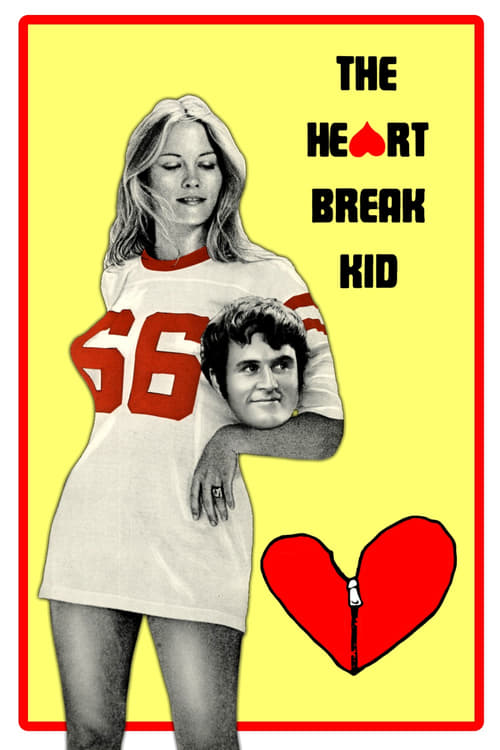
The Heartbreak Kid
1972 · Elaine May
For when you want your comedy sharp and uncomfortable rather than cozy — a film to watch when you're up for cringing, laughing, and arguing about a character's soul afterward. Not date-night material, unless your date has a dark sense of humor.
What it's about
Lenny, a fast-talking New York sporting-goods salesman, marries the eager, unpolished Lila after a short courtship — and three days into their Miami honeymoon, he's already sure he's made a terrible mistake. Then he meets Kelly, a cool blonde college student who seems to embody everything he thinks he deserves, and he starts scheming his way out of one life and into another while his new bride waits upstairs with a sunburn.
The experience
Comedy played so close to real cruelty that you laugh with your hands over your face — long, squirming scenes of lies, dinner-table confrontations, and social embarrassment that Elaine May lets run past the point of comfort. It's hilarious and it stings.
Performances
Charles Grodin's deadpan self-justifying salesman is a masterclass in playing a hollow man straight, and Jeannie Berlin (May's own daughter) and Eddie Albert both earned Oscar nominations — her as the guileless, heartbreaking Lila, him as the flint-eyed father who sees right through Lenny.
The craft
Elaine May directs Neil Simon's script against the grain, stretching scenes until the jokes curdle into something sadder and truer; the humor lives in behavior and awkward duration rather than punchlines. The Miami honeymoon sequences are small marvels of escalating, meticulously observed discomfort.
Why it matters
A high-water mark of 1970s American comedy and of Elaine May's brief, brilliant directing career — the model for generations of cringe comedy about self-deceiving men.
Snapshot
The Heartbreak Kid is Elaine May's second feature and one of the sharpest, most discomfiting American comedies of the 1970s: a romantic comedy engineered to curdle. Working from a Neil Simon screenplay adapted from Bruce Jay Friedman's short story "A Change of Plan," May turns the courtship plot inside out. Lenny Cantrow, a Jewish sporting-goods salesman from New York, marries the eager, unglamorous Lila, then abandons her mid-honeymoon in Miami for Kelly, a cool blonde Minnesota college student who embodies everything he imagines he lacks. What could have been a farce of appetite becomes, in May's hands, a study of self-deception and the emptiness at the end of aspiration. The film is celebrated for its excruciating social embarrassment, its two Oscar-nominated supporting performances, and a final image of achieved desire that lands as quiet devastation. It stands with A New Leaf and Mikey and Nicky as evidence of one of the most distinctive—and most obstructed—directorial voices of the New Hollywood era.
Industry & production
The Heartbreak Kid was produced by Palomar Pictures International, the company associated with television and film producer Edgar J. Scherick, and released through 20th Century Fox in December 1972. It arrived at a moment when major studios were funding director-driven projects on relatively modest budgets, trusting a generation of filmmakers—many from theater, television, and improvisational comedy—to bring adult, ironic sensibilities to genre material. May belonged squarely to that cohort by reputation, having risen to fame in the 1950s as half of the comedy duo Nichols and May, and having directed her debut feature, A New Leaf, in 1971.
The production is inseparable from the collaboration—and friction—between May and the studio system. May's reputation for perfectionism, extended shooting, and voluminous footage was already established on A New Leaf, where she clashed with Paramount over the final cut. On The Heartbreak Kid, the presence of Neil Simon, then Broadway's most bankable comic playwright, gave the project commercial ballast and a tighter structural spine than May's own scripts tended to have. The film was shot on location, moving from a wintry New York and a garish Miami Beach to the collegiate cold of Minnesota, a geographic progression that mirrors Lenny's fantasy of upward, outward escape. Precise budget and box-office figures are not something I can reliably cite here; the film's cultural standing rests less on its grosses than on its critical reputation and awards recognition.
Technology
The film was made with the standard professional apparatus of early-1970s American cinema: 35mm color photography and largely location-based production. This was the era in which lighter, more mobile camera and lighting packages made extensive location shooting practical, and The Heartbreak Kid uses that mobility to root its comedy in unglamorous real places—hotel dining rooms, motel corridors, snowbound campus interiors. There is nothing technologically showy about the picture; its innovations are behavioral and tonal rather than mechanical. The color palette leans naturalistic, avoiding the heightened storybook lighting that a more conventional romantic comedy of the period might have chosen, and the film trusts available-feeling light and long-held two-shots over optical trickery. In that restraint it is very much a product of the post–French Connection moment, when documentary-inflected realism became a prestige mode within mainstream narrative filmmaking.
Technique
Cinematography
The cinematography is credited to Owen Roizman, one of the defining American cameramen of the decade, whose work on films of this era favored a grounded, observational naturalism. In The Heartbreak Kid the visual approach is deliberately unromantic. Rather than flatter its characters, the camera exposes them: Miami's light is flat and unforgiving, the honeymoon suite banal, Lila's sunburn and messy eating rendered in unsparing detail. Roizman's compositions frequently hold two people in the same frame so that we watch reactions curdle in real time, and the film resists the reaction-shot rhythms that would let an audience off the hook. This visual honesty is central to the movie's discomfort: the comedy depends on our being made to look directly at what Lenny wants to look away from.
Editing
The cutting is patient and often withholding, letting scenes run past the point of comfort so that silences and social miscalculations accumulate. Where a conventional comedy accelerates toward its punchlines, The Heartbreak Kid lingers, trusting duration to generate unease. The famous restaurant scene in which Lenny begins to dismantle his marriage over dinner is built on this principle—the editing refuses to rescue either character, holding on Lila's dawning bewilderment. I don't want to overstate specifics of the editorial credit that I can't verify precisely, but the governing rhythm is unmistakable: a comedy of endurance rather than release.
Mise-en-scène / staging
May stages the film as a series of social traps. Environments are chosen for their capacity to humiliate—the tackiness of the Miami honeymoon strip, the affluent chill of the Corcoran household in Minnesota, the emptiness of the final wedding reception. Props and food carry enormous weight: eating, in particular, becomes a recurring index of Lenny's disgust and desire, from Lila's uninhibited consumption to the performative refinement Lenny adopts around Kelly. The blocking repeatedly isolates Lenny within groups, so that even in company he is scheming privately, and the geography of the film—New York to Miami to Minnesota—functions as a mise-en-scène of aspiration, each new setting whiter, colder, and more unreachable than the last.
Sound
The film's use of music is pointed and ironic. A recurring pop-romantic motif—associated with the Bacharach–David standard "(They Long to Be) Close to You," the era's ubiquitous emblem of soft romantic yearning—plays against images of a marriage collapsing and a fantasy being pursued, so that the sweetness of the song comments acidly on the sourness of the action. Garry Sherman is credited with the film's music. Beyond the score, the sound design favors the awkward acoustics of real rooms: overlapping talk, uncomfortable pauses, the ambient banality of hotels and dinner tables. The dialogue itself, sharpened by Simon and shaped by May's ear for how people evade and perform, is the film's primary sonic instrument.
Performance
Performance is where The Heartbreak Kid achieves greatness. Charles Grodin, in a career-defining role as Lenny, perfects a mode of oily, plausible sincerity—a man forever mid-pitch, lying most fluently when he half-believes himself. Grodin gives Lenny just enough charm to keep us implicated in his awfulness. Jeannie Berlin, May's own daughter, plays Lila with a raw, unguarded vulnerability that makes the character's abandonment genuinely painful rather than merely comic; her performance earned an Academy Award nomination for Best Supporting Actress. Cybill Shepherd's Kelly is a study in blank, teasing unattainability, a fantasy screen onto which Lenny projects. Eddie Albert, as Kelly's suspicious, contemptuous father, supplies the film's flinty resistance and received a Best Supporting Actor nomination. The ensemble's discipline—its willingness to be unlikable, foolish, and exposed—is inseparable from May's method as a director of actors.
Narrative & dramatic mode
Structurally the film is a comedy of pursuit that behaves like a tragedy of getting what you want. It compresses the marriage almost cruelly—wedding, road trip, honeymoon, disillusionment—so that the "meet cute" with Kelly arrives while Lenny is still legally, and grotesquely, a newlywed. The dramatic mode is ironic and observational rather than romantic; May withholds the reassurance that comedy conventionally provides, refusing to punish or redeem Lenny cleanly. The narrative's genius is its cold symmetry: it grants Lenny his fantasy in full and then holds the camera on him long enough for the audience to feel the fantasy's hollowness. The final movement—Lenny's achieved second wedding—functions less as resolution than as anti-climax, the dramatic equivalent of a door closing on an empty room.
Genre & cycle
The Heartbreak Kid belongs to, and subverts, the romantic comedy. It sits within a distinctly 1970s cycle of corrosive, anti-romantic comedies that questioned the genre's promises about love, marriage, and self-fulfillment. It is also part of a specific vein of Jewish-American comedy of manners preoccupied with assimilation and the seductions of WASP America—a preoccupation it shares, from a different angle, with the work of contemporaries like Woody Allen and with the fiction of its source author, Bruce Jay Friedman. Where Simon's Broadway comedies typically end in warmth and reconciliation, this film routes his craftsmanship toward something colder, positioning itself against the very genre whose machinery it deploys.
Authorship & method
The film is a meeting of two strong sensibilities. Elaine May, as director, brought her improvisational instincts, her attention to the small cruelties of social behavior, and her willingness to let scenes become uncomfortable; her authorship is legible in the film's refusal of easy sympathy and its trust in actors to reveal character through hesitation and self-justification. Neil Simon supplied a structured, verbally precise screenplay adapted from Friedman's short story "A Change of Plan," and the productive tension between Simon's tidy comic architecture and May's appetite for messiness gives the film its particular charge.
Among key collaborators, cinematographer Owen Roizman established the unflattering naturalism that grounds the comedy; Garry Sherman is credited with the music that ironizes it. May's casting of her daughter Jeannie Berlin as Lila is itself an authorial gesture, placing a performance of genuine tenderness at the film's moral center. May's broader method—slow, exacting, resistant to studio expectations—would become legendary and, ultimately, career-limiting; the same qualities that make The Heartbreak Kid so precise contributed to the reputation that constrained her subsequent opportunities.
Movement / national cinema
The film is a product of New Hollywood, the roughly 1967–1980 renaissance in which American studios backed personal, often subversive filmmaking. It exemplifies that movement's importation of talent from theater, cabaret, and television—May came out of the Nichols and May comedy tradition—and its embrace of location realism, morally ambiguous protagonists, and downbeat or ironic endings. Within American national cinema it also occupies a notable place as a major studio comedy directed by a woman in an era when that was exceedingly rare, making May, alongside a very small number of peers, a landmark figure in the history of women directing within the Hollywood system.
Era / period
Released in December 1972, the film captures a specific cultural moment: the fraying of postwar optimism, the questioning of marriage and conventional aspiration, and a national mood increasingly skeptical of the American Dream's promises. Its comedy of striving—Lenny's belief that a better wife, a better family, a whiter and wealthier world will complete him—speaks directly to early-1970s anxieties about upward mobility and authenticity. The period texture is exact, from the Miami honeymoon kitsch to the affluent Midwestern interiors, and the film reads now as both a comedy and a document of its historical instant.
Themes
At its core the film is about self-deception and the tyranny of aspiration. Lenny's pursuit of Kelly is less about love than about class, assimilation, and the fantasy of remaking himself into someone unmarked by his origins—a theme with pointed resonance in the Jewish-American context the film inherits from Friedman. It examines the American Dream as a receding object that loses its meaning the moment it is grasped. It interrogates the cruelty embedded in romantic idealization, showing how the elevation of one person (Kelly) requires the degradation of another (Lila). And it dwells on the emptiness of achievement—the way desire, once satisfied, exposes the void it was concealing. The final scene distills all of this: a man who has gotten everything he chased, sitting amid strangers, with nothing left to want and no self to enjoy it.
Reception, canon & influence
Critically, The Heartbreak Kid was widely admired on release for its nerve and its refusal of sentimentality, and it earned two Academy Award nominations, for Jeannie Berlin (Best Supporting Actress) and Eddie Albert (Best Supporting Actor)—recognition that helped cement its standing. Over time it has been canonized as a landmark of 1970s American comedy and as one of the clearest demonstrations of Elaine May's directorial gifts, a reputation that has grown as May's small, embattled filmography has been reassessed and celebrated.
Looking backward, the film draws on Bruce Jay Friedman's acidic short fiction, on the Jewish-American comic tradition of assimilation anxiety, on the well-made structure of Neil Simon's theatrical comedy, and on the observational realism that the New Hollywood absorbed from documentary and European art cinema. Looking forward, its influence runs through the lineage of cringe comedy and the "unlikable protagonist" romantic comedy—works that mine humor from social embarrassment and moral discomfort rather than charm. Its most direct legacy is the Farrelly brothers' 2007 remake starring Ben Stiller, which retained the premise while coarsening its irony, an adaptation whose comparative bluntness only sharpened appreciation for May's original restraint. More broadly, The Heartbreak Kid helped establish a template in which the romantic comedy could be turned against itself, and it remains a touchstone for filmmakers and critics interested in comedy that refuses to comfort its audience.
A Deleuzian reading
Three days into the honeymoon, Lila eats.
The full Deleuzian reading of The Heartbreak Kid →
Reception
A critical and commercial hit in 1972 that earned two acting Oscar nominations, it later slid into rights-limbo obscurity — notoriously hard to see for years — even as Elaine May's stock soared, making it the crown jewel of the 'why can't I stream this?' canon.
How The Heartbreak Kid was received, from release to now →
How to watch The Heartbreak Kid: what to notice on a first viewing
- Watch how differently Lila and Lenny eat in front of people. Lila eats messily, with her whole face, unembarrassed. Lenny performs refinement the moment Kelly's family is at the table. Grodin plays him as a man forever mid-pitch, closing on everyone in the room. Appetite tells the truth here. What a character does with food is what May will not let him say out loud.
- Notice when two people share one shot with no cut away. Owen Roizman often holds Lenny and Lila, or Lenny and Kelly, together in frame instead of cutting to a reaction shot. The camera stays on both faces while one decides something terrible. You watch a choice get made in real time instead of being told how to feel about it after.
- Notice scenes keep running well past their punchline. May lets silences and social miscalculations stretch on instead of cutting to relief, so a joke turns into something happening to a person rather than a line landing. The gag never gets a release, so what should be funny sits in your stomach instead of passing.
- Listen for the sweet pop song under a marriage falling apart. A Bacharach and David style romantic standard recurs against scenes of the honeymoon curdling, its soft yearning playing straight through the sourness of what is happening onscreen. The song never changes tone to match the action, so its sweetness ends up commenting on the action instead.
The whole guide to watching The Heartbreak Kid, with the keys for a rewatch →
Influences: the films it descends from and the films it influenced
- The Graduate (1967) — Directed by May's own improv-comedy partner, it hands New Hollywood the deadpan observational timing of the Nichols-and-May duo and the ambivalent final close-up of a man who gets what he chased and doubts it — the exact device May freezes onto Lenny's face at the wedding.
- A New Leaf (1971) — May's directorial debut establishes her method: long takes that let a misanthrope's social self-justification curdle in real time, with actors permitted to hesitate and stumble rather than land clean punchlines.
- The Apartment (1960) — The template for a comedy that withholds warmth and locates its humor in moral discomfort, resolving on a deflated, ambivalent grace note instead of a romantic payoff.
- The Odd Couple (1968) — Neil Simon's tight, well-made architecture of two mismatched people locked in an escalating social trap — the verbally precise comic engineering Simon carried into the Heartbreak Kid screenplay.
- Marty (1955) — Chayefsky's unglamorous, location-grounded naturalism of working-class ethnic courtship supplies the observational, anti-cosmetic realism the New Hollywood — and Owen Roizman's unflattering lensing here — absorbed.
- The Rules of the Game (1939) — The comedy of manners as social trap, staged in deep-focus two-shots that catch characters mid-hypocrisy — the ensemble-cruelty grammar May applies to the Miami country-club and dinner-table scenes.
- The Lady Eve (1941) — Inherits Sturges's cringe-comedy of a naïve man undone by a wised-up woman and the precise comic timing of social humiliation, extending screwball's verbal cruelty into the New Hollywood.
- Annie Hall (1977) — Turns the Jewish-American romance against itself with the same assimilation-anxiety and shiksa-idealization that drives Lenny toward Cybill Shepherd, and closes on a wistful non-resolution rather than a union.
- The Heartbreak Kid (2007) — The direct remake, retaining the honeymoon-abandonment premise while coarsening May's withheld, ambiguous irony into explicit gross-out — a bluntness that retroactively clarified her restraint.
- Meet the Parents (2000) — Rebuilds the film's social-trap mechanism as sustained escalation, with Ben Stiller again the engine of self-inflicted humiliation, forcing the audience to squirm inside inescapable etiquette.
- Election (1999) — Extends the unlikable-striver comedy: ironic voiceover and a coolly observational satiric eye trained on American aspiration and self-deception, refusing to let the protagonist off the hook.
- Sideways (2004) — A self-deceiving, morally shabby protagonist whose comedy of embarrassment is anchored — exactly as Berlin's Lila anchors May's — by one performance of genuine tenderness (Virginia Madsen) placed at the emotional center.
- The Squid and the Whale (2005) — Naturalist comedy of intellectual self-delusion built on withheld, uncomfortable duration, letting a character's pretensions and small betrayals accrue without editorial rescue.
- Greenberg (2010) — The purest heir to the unlikable-protagonist romantic comedy — an abrasive man whose charmlessness the film refuses to soften, mining humor and pathos from the audience's discomfort.
- Young Adult (2011) — Diablo Cody's script pushes the aspirational-self-deception protagonist to its limit — a woman chasing a fantasy of belonging who is denied any redemptive arc, comedy that pointedly refuses to comfort.
- Crossing Delancey (1988) — May's demonstration that Jewish-American comic performance can be played at full theatrical broadness while the camera stays flat, patient and unhelpful — refusing to cut away or score the joke, so the discomfort lands as observation.
- Lost in America (1985) — May's directorial method — hold an excruciating social exchange in one unbroken take, deny the cutaway and the musical cue, let the protagonist talk himself into a worse position — is the improvisational register Brooks inherits from the Nichols-and-May school.
- Modern Romance (1981) — The technique of holding a scene well past the point where its joke has paid out — Lenny's dinner-table confession — until embarrassment rather than gag structure becomes the content, capped by an ending that gives the protagonist his win and withholds relief.
- Carnal Knowledge (1971) — Contemporary Nichols film mining male self-delusion through static, watchful two-shots and Jules Feiffer's acid dialogue — the same coolly observed comedy of a man narrating himself into cruelty.
- Diary of a Mad Housewife (1970) — A parallel early-'70s naturalist dissection of a marriage's small daily cruelties, letting scenes run uncomfortably long to expose a spouse's casual contempt.
- Play It Again, Sam (1972) — The same-season stage-derived romantic-humiliation comedy that also holds the shot on the performer through sustained social cringe rather than cutting away on the joke, proving the editing approach was a 1972 mode, not a Ross idiosyncrasy.
Similar films
- A New Leaf (1971) — influence & lineage
- Annie Hall (1977) — influence & lineage
- The Graduate (1967) — influence & lineage
- The Apartment (1960) — influence & lineage
- The Squid and the Whale (2005) — influence & lineage
- Manhattan (1979) — often watched together
- Jay Kelly (2025) — shared sensibility
- Breakfast at Tiffany's (1961) — shared sensibility