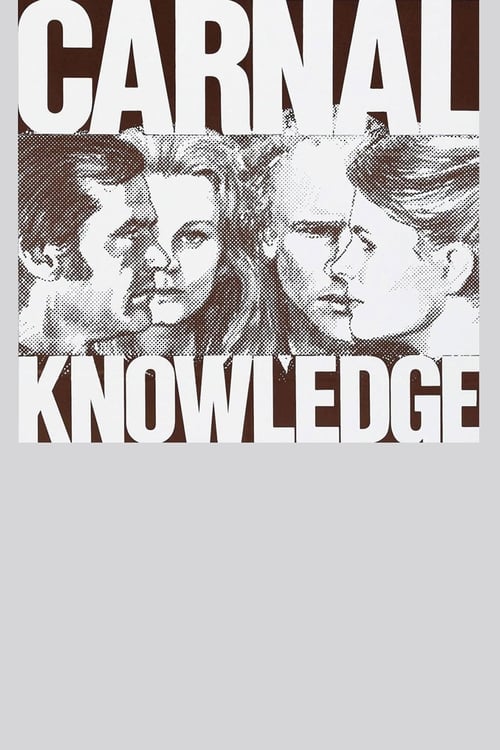
Carnal Knowledge
1971 · Mike Nichols
For when you want a film to argue about — a caustic, adult dissection of men and sex that trades warmth for honesty. Definitely a challenge pick, best with someone to talk it over with afterward.
What it's about
Two college roommates in late-1940s Amherst — one predatory and self-assured, the other passive and yearning — pursue the same young woman, and the film then follows their friendship across the decades as they chase, marry, discard, and resent the women in their lives. It's the story of two men's entire romantic education, told as a series of sharp, escalating episodes.
The experience
Cold, funny, and merciless — a comedy that keeps making you laugh at things that then sit uncomfortably in your stomach. It moves in clipped, decades-jumping vignettes and gets bleaker and more piercing as the men age without growing.
Performances
Jack Nicholson is ferocious as Jonathan, letting you see the fear under the swagger, and Art Garfunkel is quietly perfect as his wistful, self-deluding foil. Ann-Margret is the revelation — raw and heartbreaking in a role that shattered her sex-kitten image, with Candice Bergen sharp and touching early on.
The craft
Jules Feiffer's script is scalpel-precise, built almost entirely on conversations about sex that reveal everything else, and Mike Nichols directs with icy control — long takes, stark compositions, faces held on screen until they confess. The time jumps are handled with brutal economy: a cut, and years of damage have passed.
Why it matters
A landmark of New Hollywood frankness — it used the era's new freedoms not to titillate but to diagnose, sparked obscenity battles, and remains a touchstone for films about masculinity examined without flattery.
Snapshot
Carnal Knowledge is Mike Nichols's mordant, decades-spanning anatomy of male sexual appetite and its discontents, following two friends — the predatory, self-deceiving Jonathan (Jack Nicholson) and the passive, perpetually dissatisfied Sandy (Art Garfunkel) — from their Amherst College dormitory in the late 1940s through middle age. Written by the cartoonist and playwright Jules Feiffer, the film is structured as a series of clipped vignettes that track the two men's pursuit, possession, and abandonment of women, chiefly Susan (Candice Bergen) and Bobbie (Ann-Margret). It is less a story than a diagnosis: a cold, often very funny clinical study of misogyny, performance anxiety, and the failure of intimacy. Arriving at the high-water mark of the New Hollywood and the sexual revolution, it used newly available frankness not to celebrate liberation but to expose the bitterness underneath it. The film became a landmark for its candor — including a notable American obscenity prosecution that reached the Supreme Court — and remains one of the most unsparing portraits of heterosexual masculinity in American cinema.
Industry & production
The film was produced by Joseph E. Levine and released through his Avco Embassy Pictures, the company that had earlier backed Nichols's The Graduate (1967). It came at a pivotal moment in Nichols's career: after the prestige of Who's Afraid of Virginia Woolf? (1966) and the generational phenomenon of The Graduate, his ambitious adaptation of Catch-22 (1970) had been a costly, exhausting production with a muted reception. Carnal Knowledge, by contrast, was a deliberately lean, contained project — chamber drama rather than epic — built around a single sharp script and a small ensemble.
The screenplay originated with Jules Feiffer, who had conceived the material as a play; Nichols, recognizing its cinematic possibilities, brought it to the screen instead. The two shared sensibilities rooted in postwar urban Jewish satire and the comedy of social discomfort, and the collaboration gave the film its distinctive blend of stage-like dialogue economy and filmic compression.
Casting was central to the production's identity. Jack Nicholson, fresh off Easy Rider (1969) and Five Easy Pieces (1970), was ascending rapidly; Carnal Knowledge gave him one of his first fully dramatic leads. The casting of Art Garfunkel — then far better known as half of Simon and Garfunkel than as an actor, though he had appeared in Catch-22 — was a striking choice that traded on his soft, almost beatific screen presence. Candice Bergen and Ann-Margret rounded out the principal quartet, with Rita Moreno appearing in the film's final scene. The production is documented as having filmed in Vancouver, British Columbia, with the city and surrounding interiors standing in for the various American settings across the decades.
Technology
Carnal Knowledge was shot on 35mm film in anamorphic widescreen (Panavision), a format choice that is unusual and pointed for what is essentially an intimate, dialogue-driven drama. The wide frame is more often associated with spectacle; here it is harnessed for the opposite purpose — to isolate figures, to stretch couples apart across an expanse of negative space, and to frame faces in tight, exposing close-up against largely empty backgrounds. The film carries no synthesized or composed orchestral score, relying instead on period source music, which keeps the technological apparatus subordinate to the spoken word and the human face. In production terms it is a conventional studio-era package deployed with deliberate restraint; the innovation is rhetorical rather than mechanical.
Technique
Cinematography
The cinematography is by Giuseppe Rotunno, the Italian master associated with Visconti and Fellini, whose involvement lends the film an unexpected European pedigree. Rotunno and Nichols favor a controlled, often static visual scheme dominated by close-ups and two-shots. The film is famous for its monologue passages staged as direct, near-frontal address — characters speaking almost to camera against neutral or darkened backgrounds, the surrounding world stripped away so that nothing distracts from the words and the eyes. The anamorphic format is used to emphasize separation: lovers occupy opposite ends of the frame, and the wide aspect ratio becomes a visual measure of emotional distance. Lighting tends toward the clean and unsentimental, refusing the romantic glow that the subject matter might conventionally invite. The overall effect is a deliberate coldness — beautiful compositions in the service of discomfort.
Editing
The editing is by Sam O'Steen, Nichols's regular collaborator (Virginia Woolf, The Graduate, Catch-22). O'Steen's cutting governs the film's most distinctive structural device: its elliptical, vignette-based construction, in which large spans of time vanish between scenes and the narrative advances through abrupt jumps across years and relationships. Transitions frequently use hard cuts and fade-to-black, so that the film reads as a sequence of discrete episodes — almost theatrical scenes — rather than a continuous flow. The editing also enables the film's blackout-comedy rhythm, allowing scenes to end on a cruel or deflating line. This compression is essential to the film's tone: by withholding connective tissue, the cutting forces the audience to register only the recurring pattern of seduction and disappointment, decade after decade.
Mise-en-scène / staging
Production design is by Richard Sylbert, another key Nichols collaborator and one of the era's most intelligent designers. The film's staging is conspicuously spare. Interiors are pared down, props minimized, and backgrounds often reduced to flat planes of color or shadow, throwing all attention onto the actors. This austerity reflects the material's theatrical roots and Nichols's background in the stage and in improvisational comedy: scenes are blocked for maximum exposure of behavior, with bodies arranged to reveal who holds power and who is pleading for it. Costume and period detail are used economically to mark the passage from the buttoned-up late 1940s through the loosening decades, but Nichols resists nostalgia; the periods register as variations on the same enclosed drama rather than as evocative recreations.
Sound
The sound design is built around dialogue and a soundtrack of period popular songs rather than original scoring. The decision to forgo an orchestral score is one of the film's most consequential aesthetic choices: with no music to cue emotion or smooth over silences, the film lays its conversations bare, and the long monologues land without cushioning. Silence and the unscored beat after a wounding line become expressive instruments in their own right. Period songs locate the eras and occasionally comment ironically on the action, but the dominant sonic texture is the human voice — Feiffer's dialogue delivered, attacked, and parried.
Performance
Performance is the film's true medium. Nicholson's Jonathan is a study in charismatic rot — seductive, witty, and progressively poisoned by his own contempt for the women he pursues, culminating in an impotence he can only escape through a degrading scripted ritual. It is among the performances that established Nicholson's gift for making cruelty magnetic. Garfunkel plays Sandy as a soft, evasive foil, forever convinced that fulfillment lies in the next woman; his mildness makes him complicit rather than innocent. Candice Bergen's Susan, courted by both men, registers the cost of being an object of competition. The film's most celebrated performance is Ann-Margret's Bobbie, a former model whose neediness and depression Jonathan exploits and despises; widely regarded as the strongest work of her career to that point, it earned her an Academy Award nomination for Best Supporting Actress and decisively reframed her as a serious dramatic actress. Rita Moreno's brief closing appearance as the prostitute Louise delivers the film's bleak final note.
Narrative & dramatic mode
The film operates in an episodic, almost essayistic mode, advancing through discrete time-jumps rather than continuous plot. Its dramatic logic is comparative and accumulative: by returning to the same two men across decades, it builds an argument rather than a conventional arc. The mode is satirical and clinical — Feiffer's background as a social cartoonist is visible in the way scenes function as panels, each isolating a behavior and exposing it. Comedy and bleakness are inseparable; lines that draw laughter also indict the speaker. There is no redemption structure and no resolution in the ordinary sense. The film ends not with growth but with stasis confirmed: Jonathan's sexuality has contracted into a single, joyless transaction, and the pattern that opened the film is revealed as a life sentence. This refusal of catharsis is the film's central formal stance.
Genre & cycle
Carnal Knowledge sits at the intersection of drama, dark comedy, and the adult-themed relationship film that flourished in the early 1970s once the Production Code had been replaced by the ratings system. It belongs to the New Hollywood cycle of frank, character-driven films made for adult audiences, and specifically to a subset preoccupied with the disillusionments of the sexual revolution. Where many contemporaneous films treated newfound permissiveness as liberation, Carnal Knowledge belongs to a more skeptical strain that examined its emotional wreckage. It can be read alongside Nichols's own The Graduate as a darker companion piece — the seduction comedy soured into a study of arrested development — and within a broader cultural moment of films and plays dissecting American masculinity and the war between the sexes.
Authorship & method
The film is the product of a tight authorial partnership between Nichols and Feiffer, supported by a remarkably accomplished craft team. Nichols brought his theatrical and improvisational training to bear on the actors' work, drawing performances of unusual psychological precision and trusting dialogue and face over visual flourish. Feiffer supplied a script of acid economy, its rhythms shaped by his career in satirical cartooning and stage writing. Around them, Nichols assembled collaborators with whom he had repeatedly worked or who carried significant artistic authority: cinematographer Giuseppe Rotunno, editor Sam O'Steen, and production designer Richard Sylbert. The method throughout is subtractive — removing score, removing décor, removing narrative connective tissue — so that the human behavior under examination stands fully exposed. Authorship here is best understood as a fusion of director and writer, with Nichols functioning as the orchestrator of a deliberately austere realization of Feiffer's vision.
Movement / national cinema
The film is a product of American New Hollywood, the late-1960s-to-1970s period in which a generation of directors gained creative latitude and treated adult themes with new candor. Yet its sensibility is hybrid. Nichols and Feiffer draw on a distinctly American, urban, satirical tradition rooted in postwar comedy and cartooning, while the participation of Giuseppe Rotunno connects the film visually to the European art cinema of the 1960s. The result is an American film with an art-house gravity — closer in spirit to a continental chamber drama than to a Hollywood entertainment, even as its subject is unmistakably the American romantic and sexual imagination.
Era / period
Made in 1971, the film is fully of its moment: produced after the collapse of the Production Code, amid the sexual revolution, second-wave feminism, and the broader cultural reckoning of the era. Its frankness about sexuality, impotence, and male contempt for women was possible only in this brief window of permissiveness, and the film both exploits that freedom and interrogates the culture that produced it. The Vietnam-era disillusionment that colored so much New Hollywood work surfaces here as a domestic, intimate disenchantment rather than a political one. The film's reach back across decades — from the conformist late 1940s forward — also makes it a retrospective account of how postwar American men were shaped, lending it a historical sweep unusual for so small a drama.
Themes
The film's governing theme is the corrosion of intimacy by male sexual ego. It anatomizes misogyny not as cartoon villainy but as an ordinary, socially sanctioned structure of feeling — the reduction of women to objects of conquest, comparison, and complaint. Impotence, both literal and emotional, runs throughout: Jonathan's eventual physical impotence is the externalization of a lifelong incapacity for connection. Related themes include the failure of friendship to mature, the gap between fantasy and reality in desire, and the way men narrate their own dissatisfaction as women's fault. The notorious late sequence in which Jonathan presents a slide show of the women in his life, captioned with grievances, crystallizes the film's argument: that he has experienced people as a catalog rather than as persons. Throughout, the film insists that the sexual revolution did not dissolve these patterns but merely gave them new permission.
Reception, canon & influence
Critically, Carnal Knowledge was a significant and controversial event on release, recognized for its bracing candor and the strength of its performances, particularly Ann-Margret's, whose work earned an Academy Award nomination for Best Supporting Actress. Some reviewers admired its unflinching honesty while others found its bleakness and its concentration of cruelty difficult; the very coldness that is its method divided opinion then as it can now. The film's most consequential legacy in the public record is legal: it became the subject of an obscenity prosecution in Albany, Georgia, and the resulting case, Jenkins v. Georgia, reached the United States Supreme Court, which in 1974 overturned the conviction, holding that the film was not obscene under the standard the Court had recently articulated. The decision is a landmark in American film and First Amendment history, frequently cited in discussions of obscenity law and the limits of community standards.
Influences on the film flow from Nichols's and Feiffer's shared roots in postwar satirical comedy, from the theatrical tradition of the dialogue-driven relationship play, and visually from the European art cinema embodied by Rotunno. Looking forward, the film helped consolidate Jack Nicholson's stardom and established a template for the unsparing, unsentimental examination of male sexuality and self-deception that later filmmakers — in American independent and relationship cinema especially — would return to. Its bleak, episodic anatomy of masculinity anticipates a lineage of films willing to treat their male protagonists as case studies rather than heroes. Within Nichols's own body of work it stands as the dark culmination of the seduction-and-disillusion theme he first explored in The Graduate. The detailed reception record beyond the legal case and the acting recognition is, in places, thin and contested, and where specific contemporary critical verdicts are uncertain they should be treated with caution; what is not in doubt is the film's enduring standing as one of American cinema's most rigorous and discomfiting studies of the war between desire and intimacy.
A Deleuzian reading
A man stands in a dim room while a woman reads him his lines.
The full Deleuzian reading of Carnal Knowledge →
Reception
Scandalous in 1971 — it was literally banned in Georgia as obscene until the Supreme Court stepped in — and now reads as a brutal, decades-ahead-of-its-time autopsy of toxic masculinity that critics keep rediscovering.
How Carnal Knowledge was received, from release to now →
Influences: the films it descends from and the films it influenced
- Who's Afraid of Virginia Woolf? (1966) — Nichols's debut established the method Carnal Knowledge perfects: a dialogue-as-blood-sport relationship play staged in claustrophobic theatrical spaces and cut by editor Sam O'Steen, treating marital cruelty as clinical exposure rather than melodrama.
- The Graduate (1967) — Nichols and O'Steen's elliptical hard-cut grammar and the seduction-into-disillusion arc are the direct precursor; Carnal Knowledge is the same anatomy of male sexual passivity turned colder and stripped of the comic warmth.
- Persona (1966) — The frontal-address-to-camera confessional, the scoreless expressive silence, and the face held in tight isolation as the primary dramatic surface are devices Carnal Knowledge borrows from Bergman/Nykvist's interrogation of intimacy.
- Fellini Satyricon (1969) — Cinematographer Giuseppe Rotunno carries his European-art-cinema palette and sculpted anamorphic compositions directly into Carnal Knowledge, lending its American material a Continental, friezelike formality.
- The Leopard (1963) — Rotunno's Visconti work schooled him in the wide-format tableau where figures are arranged with painterly stillness against spare décor — the exact restraint Nichols asked of him here.
- L'Avventura (1960) — The episodic, essayistic anatomy of erotic boredom and emotional sterility — refusing plot resolution in favor of a clinical study of desire's failure — is the European model behind Carnal Knowledge's refusal of catharsis.
- The Last Detail (1973) — Extends Nicholson's profane, bullying-yet-hollow masculinity and the New Hollywood willingness to let an unsympathetic male anti-hero remain unredeemed.
- Shampoo (1975) — Robert Towne and designer Richard Sylbert (Carnal Knowledge's own production designer) build a parallel anatomy of compulsive male sexuality as emotional bankruptcy, episodic and refusing moral payoff.
- Annie Hall (1977) — Adopts the direct-to-camera monologue address and the elliptical-vignette structure of a relationship dissected in non-linear fragments rather than told as continuous story.
- Husbands and Wives (1992) — The mock-documentary talking-head confessions and the unsparing, scoreless dissection of marital cruelty are a direct continuation of Carnal Knowledge's frontal-monologue interrogation of intimacy.
- sex, lies, and videotape (1989) — Built the American indie relationship film on candid, confessional talk about sex and impotence in spare rooms, inheriting Carnal Knowledge's faith in dialogue and face over incident.
- In the Company of Men (1997) — LaBute's clinical, theatrically spare staging of men weaponizing seduction — male sexual ego presented as cold case study with no catharsis — is the most literal extension of Carnal Knowledge's method.
- Magnolia (1999) — Tom Cruise's seduction-guru Frank Mackey is an explicit descendant of Nicholson's Jonathan — the predatory male-ego performer dissected on stage and then broken down under the camera's frontal gaze.
- Closer (2004) — Nichols's own late return to the form — Patrick Marber's stage-derived, explicit verbal cruelty between two couples — replays Carnal Knowledge's scoreless, theatrical, four-hander anatomy of sexual betrayal.
- Silkwood (1983) — Nichols's actor's-director technique of staging unguarded private behavior in long character scenes and letting theme emerge from conduct rather than polemic, the structural DNA of Silkwood.
- Happiness (1998) — Stages sexual failure in static, frontal, clinically composed two-shots that hold characters at conversational deadpan, the blocking grammar Happiness adopts for its scenes of thwarted intimacy.
- Modern Romance (1981) — Nichols and Feiffer's flat frontal staging of men whose talk about women convicts them, with no third-act correction — the structural precedent for a film that declines to redeem or explain its protagonist.
- Little Murders (1971) — Jules Feiffer's other 1971 screenplay shares his acid-cartoonist economy and satirical-revue rhythms, the same writerly DNA of clipped, hostile dialogue treating American dysfunction as deadpan diagnosis.
- Husbands (1970) — A contemporaneous case-study of male self-deception that, like Carnal Knowledge, abandons heroic arc to observe men's evasions of intimacy as raw behavioral specimen rather than narrative.
- Five Easy Pieces (1970) — Nicholson's charismatic-rot persona — magnetic surface over self-loathing flight from women — is the same instrument deployed across both New Hollywood films a year apart.
- Catch-22 (1970) — Nichols extends the score-less austerity and long-held wide two-shots, staging performances with deadpan theatrical precision and withholding musical comfort.
- The Heartbreak Kid (1972) — Contemporary Nichols film mining male self-delusion through static, watchful two-shots and Jules Feiffer's acid dialogue — the same coolly observed comedy of a man narrating himself into cruelty.
Similar films
- The Graduate (1967) — influence & lineage
- Closer (2004) — influence & lineage
- Who's Afraid of Virginia Woolf? (1966) — influence & lineage
- Husbands (1970) — influence & lineage
- sex, lies, and videotape (1989) — influence & lineage
- Five Easy Pieces (1970) — influence & lineage
- Once Upon a Time in America (1984) — shared sensibility
- Faces (1968) — shared sensibility