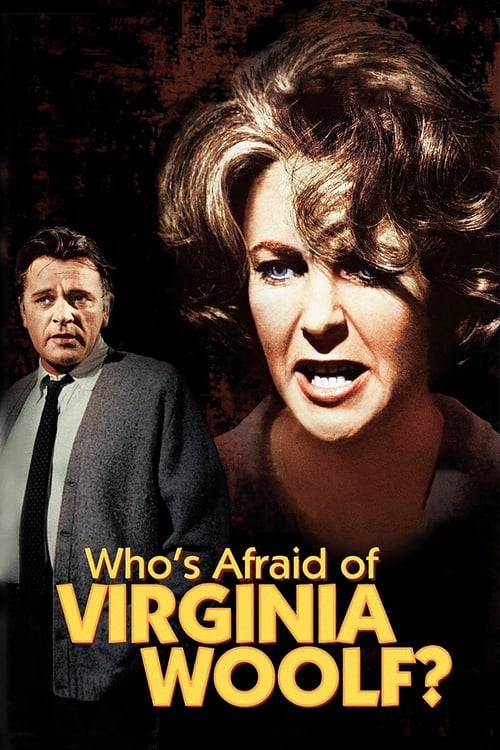
Who's Afraid of Virginia Woolf?
1966 · Mike Nichols
For when you want to be pinned to the couch by great acting and razor-wire dialogue — a night for intensity, not comfort, ideally with someone to argue about it with after.
What it's about
After a faculty party, a middle-aged history professor and his ferociously sharp wife invite a young new couple back for a nightcap. As the drinks keep coming, the hosts turn their marriage's private games and grievances into a blood sport, pulling their bewildered guests into an all-night war of secrets, humiliations, and dares.
The experience
Electric and exhausting in the best way — two hours of verbal combat that's savagely funny one minute and genuinely painful the next. You watch it wound up tight, half laughing, half wincing, and the final stretch lands like a punch you feel afterward.
Performances
Elizabeth Taylor and Richard Burton, married in real life and famous beyond measure, tear into each other with a ferocity that still startles — Taylor deglamorized and volcanic, Burton quietly lethal. George Segal and Sandy Dennis hold their own as the guests slowly stripped of their defenses.
The craft
Mike Nichols's first film turns a single night and a handful of rooms into something relentlessly cinematic, shot in stark black and white that makes every close-up feel like an interrogation. The dialogue, kept shockingly intact from Edward Albee's play, is some of the sharpest ever put on screen.
Why it matters
Its profanity and frankness helped break the old Hollywood censorship code and usher in the modern ratings era, while launching Nichols as a major director and giving Taylor a career-defining role.
Snapshot
Who's Afraid of Virginia Woolf? is the adaptation of Edward Albee's 1962 stage play, transposed to the screen as the directorial debut of Mike Nichols. Over a single alcohol-soaked night, a middle-aged academic couple — George, an associate professor of history, and Martha, the college president's daughter — entertain a younger couple, Nick and Honey, and proceed to flay one another with escalating cruelty until a long-guarded illusion is destroyed. The film is remembered as a watershed on two fronts at once: as a piece of sustained, theatrically derived acting cinema anchored by Elizabeth Taylor and Richard Burton at the height of their joint celebrity, and as a frontal challenge to the Production Code whose handling helped accelerate the Code's collapse and the arrival of the MPAA ratings system. It earned thirteen Academy Award nominations — nominated in every category for which it was eligible — and won five, including Best Actress for Taylor and the last black-and-white cinematography Oscar before that category was retired.
Industry & production
Warner Bros. acquired the screen rights to a property widely regarded as unfilmable under the censorship regime of the day: Albee's play traded in profanity, sexual frankness, and a corrosive view of marriage and procreation. Studio head Jack Warner backed the project as a prestige gamble, and the production was shepherded by screenwriter-producer Ernest Lehman, an established Hollywood craftsman (North by Northwest, The Sound of Music) who both adapted the play and produced the picture — an unusual concentration of authority that gave the adaptation a strong continuity of purpose.
The casting was the production's defining commercial wager. Elizabeth Taylor and Richard Burton were, in the mid-1960s, arguably the most scrutinized couple in the world following Cleopatra and their attendant scandal; their pairing as George and Martha fused the film's marital warfare with the public's appetite for their offscreen drama. Taylor, then in her early thirties, took on a role written for a woman appreciably older and heavier, and famously altered her appearance — adding weight and aging herself — to play the blowsy, embittered Martha. Burton, the more obviously classical stage actor, took the comparatively recessive role of George.
Hiring Mike Nichols to direct was itself a notable industry decision. Nichols had no feature credits; his reputation rested on his celebrated comedy partnership with Elaine May and a run of Broadway hits. Entrusting a first-time film director with a major star vehicle and a censorship minefield reflected both the prestige of the source material and a broader late-Code willingness to import talent from the theater. The shoot was reportedly demanding and protracted, and the budget rose well above the play's modest single-set scale — though specific figures should be treated cautiously, the production was understood at the time to have grown costly relative to its chamber-drama origins.
Technology
The film was shot on 35mm black-and-white stock at a moment when prestige features had largely migrated to color, making the choice a deliberate aesthetic and technological statement rather than a default. Black-and-white afforded the high-contrast, grainy, near-documentary texture that cinematographer Haskell Wexler pursued, and it suited the nocturnal, claustrophobic interior world of the story. Production largely combined studio interiors with location work; the campus exteriors were shot at a New England college, lending the artificial drama a real institutional backdrop. No single technological novelty defines the picture — its innovations are matters of style and content rather than apparatus — but the commitment to monochrome in 1966 is the salient technical fact, and it placed the film at the tail end of an era: the Academy merged its separate black-and-white and color craft categories shortly afterward, so the film's wins stand as among the last honors specifically for monochrome work.
Technique
Cinematography
Haskell Wexler's Oscar-winning photography is the film's most celebrated technical achievement. Working in stark black and white, Wexler favored hard, naturalistic light, deep shadow, and a roving, often handheld-feeling camera that pushed in on faces and tracked the combatants through the cramped house. The visual idiom owed something to contemporary documentary and to the European art cinema then reshaping American taste — an unglamorous, pore-level scrutiny of stars usually photographed with cosmetic care. That Wexler photographed Elizabeth Taylor, one of cinema's iconic beauties, in deglamorizing close-up was part of the film's shock. The cinematography opens the play out without ever dispelling its claustrophobia, using the house's confined spaces and a late roadhouse detour to vary rhythm while keeping the four characters trapped together.
Editing
Sam O'Steen's editing — the beginning of a long and important collaboration with Nichols — shapes the film's escalating tempo. The cutting modulates between long, dialogue-driven takes that preserve the actors' theatrical builds and sharper, more aggressive montage in the cruelest exchanges, mirroring the characters' drunken oscillation between lull and assault. O'Steen's work demonstrates how a "filmed play" need not be inert: the editing finds cinematic pulse in eyelines, reactions, and the timing of verbal blows.
Mise-en-scène / staging
Richard Sylbert's Oscar-winning art direction renders George and Martha's home as a lived-in academic clutter — book-strewn, worn, suffused with the residue of a long marriage — a setting that functions almost as a fifth character. Nichols, drawing on his theatrical instincts, choreographs the four bodies through the house with precision, using doorways, staircases, and the division between rooms to stage shifting alliances and retreats. The compositions repeatedly isolate and pair the characters to chart the night's emotional realignments. Irene Sharaff's costume design (also Oscar-winning) reinforces character through dress, from Martha's deliberately unflattering ensembles to the younger couple's tidier conformity.
Sound
The film is fundamentally a sound film in the most literal sense — a torrent of language. Its sound design foregrounds overlapping, rapid-fire dialogue, the clink of glasses, and the ambient hush of late night, all serving Albee's verbal architecture. Alex North's score is used sparingly and elegiacally, providing a melancholic counterweight to the savagery rather than underlining it; the music tends to frame and punctuate rather than accompany the verbal violence, leaving the dialogue to carry the dramatic weight.
Performance
Acting is the film's center of gravity. Taylor's Martha — raucous, wounded, predatory, and finally devastated — is the performance that recalibrated her reputation as a serious actress and won her a second Best Actress Oscar. Burton's George is its calibrated opposite: outwardly passive, intellectually superior, building toward a quiet ferocity in the final "exorcism." The younger couple are essential foils: George Segal's Nick as ambitious, exposed careerist and Sandy Dennis's Honey as the brittle, retreating innocent who absorbs the night's collateral damage; Dennis won Best Supporting Actress. The film's reputation rests on this four-handed ensemble sustaining feature-length intensity.
Narrative & dramatic mode
The narrative observes a near-classical unity of time, place, and action: a single night, essentially one house, one continuous escalation. Albee's three-act structure — "Fun and Games," "Walpurgisnacht," and "The Exorcism" — survives in the film's movement from social sparring through outright psychological warfare to ritual destruction. The dramatic mode is that of the chamber play, dialogue-driven and revelatory: information is withheld and weaponized, and the plot advances through verbal "games" the couples play. The film's engine is a slow stripping of illusions, culminating in the revelation around the couple's "son" — a shared fiction whose destruction is the night's exorcism. The mode is realist in surface texture but builds toward something nearly mythic and ceremonial.
Genre & cycle
The film belongs to the prestige literary adaptation — the mid-century Hollywood tradition of importing acclaimed Broadway drama to the screen, a lineage that runs through Williams and Miller adaptations of the 1950s and early '60s. Within that, it is a marital melodrama or "domestic battlefield" drama, sharing tonal DNA with the era's serious chamber dramas of dysfunction. It also stands at the threshold of the late-1960s "New Hollywood," its frankness and aesthetic seriousness pointing toward the more permissive, director-driven cinema that Bonnie and Clyde and The Graduate would announce within a year or two — the latter Nichols's own immediate follow-up.
Authorship & method
The dossier's authorial center is Mike Nichols, here translating stage expertise into film for the first time. His method emphasized fidelity to the text and to performance: rather than "opening up" Albee aggressively, he trusted the play's language and concentrated on extracting calibrated, unsparing work from his actors, while using the camera and cutting to keep the chamber piece kinetic. The debut announced the actors'-director sensibility that would define his career.
His key collaborators form an unusually strong unit. Ernest Lehman (writer-producer) adapted the play with restraint, preserving Albee's structure and much of its language while making the strategic dialogue concessions that censorship negotiations required. Haskell Wexler (cinematographer) supplied the deglamorizing black-and-white look central to the film's identity. Sam O'Steen (editor) and Richard Sylbert (production designer) both began enduring associations with Nichols here, becoming part of his recurring creative ensemble across later films. Alex North provided the elegiac score. Hovering behind all of them is Edward Albee, whose play is the true generative source; the film is best understood as a faithful, intelligently cinematic transmission of his work rather than a radical reinterpretation of it.
Movement / national cinema
The film is a product of American studio cinema in its terminal Production Code phase, but it is legible only against the pressure of contemporaneous European art cinema, whose seriousness, sexual candor, and stylistic freedom were reshaping the expectations of sophisticated American audiences and filmmakers. It is not part of a formal movement, yet it functions as a hinge between the Broadway-adaptation tradition of postwar Hollywood and the emergent American auteur cinema of the late 1960s. Its monochrome austerity and adult subject matter align it with an international current of "serious" black-and-white filmmaking even as it remains a thoroughly Hollywood product.
Era / period
Released in 1966, the film sits precisely at the breaking point of the old censorship order. The Production Code, administered for decades, was by the mid-1960s an exhausted instrument, and Virginia Woolf became one of the decisive test cases in its dismantling. Its profanity and sexual frankness could not be reconciled with the Code as written; the resolution — a negotiated approval paired with an advisory that the film was not suitable for younger audiences — functioned as a de facto adult classification. This anticipated, and helped precipitate, the MPAA's adoption of the age-based ratings system in 1968 under Jack Valenti. The film thus belongs to a brief, charged transitional moment when American movies were renegotiating what they could show and say.
Themes
The film's central themes are the corrosion of intimacy and the human need for sustaining illusion. George and Martha's marriage is a closed system of mutual cruelty that is also, paradoxically, a form of dependency and love — their "games" are the medium through which they remain bound. The invented child stands as the film's master metaphor: a shared fiction propping up a barren union, and its ritual "killing" is both annihilation and a possible, ambiguous path toward truth. Surrounding these are themes of academic and social pretension, the disillusionments of ambition (embodied in Nick), reproduction and sterility, alcohol as solvent and weapon, and the gulf between public performance and private reality. The title's nursery-rhyme pun — substituting Virginia Woolf for the "big bad wolf" — encodes the film's recurring question of who can face life without the protective fictions everyone fears to live without.
Reception, canon & influence
Critically, the film was received as a major and serious event, lauded for its performances and for the audacity of bringing Albee to the screen with much of his bite intact; its thirteen Academy Award nominations — covering every eligible category — and five wins (Taylor, Dennis, Wexler's cinematography, Sylbert's art direction, Sharaff's costumes) confirmed its prestige standing. It remains canonical both as a landmark of screen acting and as a pivotal artifact in the history of American film censorship.
Its backward influences are clear and specific: above all Albee's play and the broader postwar tradition of psychologically intense American stage drama (Williams, Miller) that Hollywood had been adapting for over a decade, together with the deglamorizing visual seriousness absorbed from contemporary documentary and European art cinema.
Its forward legacy operates on two tracks. Institutionally, the film's collision with the Production Code is repeatedly cited as a catalyst in the Code's collapse and the birth of the ratings system — reshaping what mainstream American movies could thereafter depict. Artistically, it launched Mike Nichols, who immediately directed The Graduate, and it cemented a creative ensemble (O'Steen, Sylbert) that recurred in his later work. As a model of the "filmed play" done with cinematic intelligence and a benchmark for ferocious two-couple chamber drama, it became a reference point for subsequent screen depictions of marital combat. Where the historical record is thinnest — precise budget and grosses, and the granular detail of Code negotiations — this account leaves the specifics open rather than asserting figures that cannot be reliably grounded.
A Deleuzian reading
Two a.m.
The full Deleuzian reading of Who's Afraid of Virginia Woolf? →
Reception
A scandal in 1966 — its profanity helped shatter the Production Code and forced a 'mature audiences' warning — yet it was also a smash that scored 13 Oscar nominations. Sixty years on the shock has faded and it's settled in as the gold standard for marital-warfare cinema, the film every 'toxic couple' drama gets measured against.
How Who's Afraid of Virginia Woolf? was received, from release to now →
Influences: the films it descends from and the films it influenced
- A Streetcar Named Desire (1951) — Established the Hollywood template Nichols inherited: a near-verbatim transfer of an intense American stage play, carried by Method-driven ensemble acting in claustrophobic single-set staging with star deglamorization (Brando, Leigh).
- Long Day's Journey Into Night (1962) — Direct ancestor in chamber dynamics — a unity-of-time-place domestic-combat play filmed with restrained 'opening up,' close camera attention on faces, and escalating four-hander acting duels rather than cinematic spectacle.
- Cat on a Hot Tin Roof (1958) — Model for the censored-but-faithful stage adaptation: preserves Williams' confrontational marital-melodrama language while making the strategic dialogue concessions Production Code negotiation demanded, exactly Lehman's strategy here.
- Look Back in Anger (1959) — Burton carries his Jimmy Porter operatic-presence method directly into George — the same combination of verbal brilliance, performative self-destruction, and domestic fury staged within a single interior — while Nichols preserves Albee's theatrical monologue-accumulation structure intact; the film is the American reception and extension of the mode Richardson established, with Burton himself as the biographical transmission vector.
- The Night of the Iguana (1964) — Extends the filmed-play-in-black-and-white chamber drama, again handing Richard Burton a bravura role of articulate ruin sustained across long, talk-driven scenes of confession and endurance.
- The Heiress (1949) — The fullest inheritance of the deglamorized-star single-set play: Wexler lights Elizabeth Taylor into coarse plainness the way Tover flattens de Havilland, and the long takes let a theatrical text's cruelty run at its written duration instead of being cut into beats.
- Carnal Knowledge (1971) — Descendant from the same author: another Nichols chamber study of sexual combat and illusion, extending his clinical, deglamorizing examination of coupledom with sparse scoring and concentrated two-handed acting.
- Scenes from a Marriage (1973) — Descendant in marital-combat chamber drama: extended unsparing closeups of a couple flaying each other in confined domestic space, the European art-cinema seriousness Woolf had absorbed now turned on the same subject.
- After the Hunt (2025) — Establishes the academic-interior chamber play in which a single faculty house becomes an arena for corrosive, subtext-loaded dialogue concealing a withheld secret — the staging template Guadagnino inherits.
- Blue Moon (2025) — A boozy single-house chamber piece driven by virtuoso verbal performance under high-contrast practical interior lighting (Haskell Wexler), the model for sustained spoken duels lit like a real room.
- From the Life of the Marionettes (1980) — Theatrical marital combat preserved in near-real-time with long uncut takes and stage-derived blocking; the model for containing Strindbergian verbal warfare within a cinematic frame without dissolving it into montage.
- The Banshees of Inisherin (2022) — Nichols adapting Albee established the playwright-to-screen transposition method *Banshees* inherits: preserving theatrical act rhythm marked by tonal ruptures, using the single night as container for irreversible relational destruction, and treating dialogue itself as the weapon rather than a vehicle for exposition.
- Sleuth (1972) — Turns a single-location two-hander (-plus) into rule-governed verbal blood sport, where 'games' with stated names structure the night — the articulate-combat-as-game design Sleuth formalizes.
- Charlie Wilson's War (2007) — Nichols's debut established his core method—stage verbal combat in tight, theatrically blocked spaces and let elite actors carry meaning through overlapping talk—the same actor-trust classicism he applies to the three-hander here.
- A Separation (2011) — Carries the Ibsen–Miller theatrical naturalism of the buried family secret detonated through escalating dialogue — the playwriting architecture Farhadi brings from his stage training.
- Silkwood (1983) — Established the Nichols–Sam O'Steen partnership and its behavioral cutting rhythm — editing to the truth of a performer's gesture and pause rather than to plot beats — the exact method O'Steen brings to Silkwood.
- The Breakfast Club (1985) — The chamber confessional in which confined antagonists strip away social masks through escalating, theatrically-derived talk—the well-made-stage-play dramaturgy Hughes inherits for the truth-telling circle.
- Educating Rita (1983) — The benchmark for opening a claustrophobic stage two-hander cinematically while preserving its verbal density — the adaptation problem Russell and Gilbert solve by giving the play 'air.'
- 12 Angry Men (1957) — Ancestor in single-set kinetics: keeping a one-room ensemble piece visually alive through tightening lenses, varied angles, and editing tempo that escalates as the drama heats — the very problem Nichols and O'Steen solved for Albee.
- Faces (1968) — Sibling in deglamorizing black-and-white handheld intimacy and overlapping, abrasive marital dialogue, pushing the unsparing-closeup aesthetic of domestic disintegration even further toward documentary rawness.
- The Graduate (1967) — Direct descendant — Nichols' immediate follow-up, carrying forward the same actors'-director sensibility and the O'Steen/Sylbert creative ensemble first assembled here, now applied to expressive cutting and framing.
- In the Heat of the Night (1967) — Sibling via Haskell Wexler, who carried his deglamorizing, naturalistic location lighting and tense close-quarters cinematography directly from this film into another New Hollywood-threshold prestige picture.
- Bonnie and Clyde (1967) — Sibling at the Production Code collapse: shares the deglamorizing seriousness and frank adult content that, alongside Woolf's censorship collision, catalyzed the move from the Code to the ratings system.
- Persona (1966) — Sibling in deglamorizing black-and-white psychological closeup — the European art-cinema model of the merciless, illusion-stripping face study that informs Wexler's visual approach to Taylor and Burton.
- Husbands and Wives (1992) — Descendant fusing Woolf's two-couple marital warfare with handheld, deglamorizing camera and overlapping naturalistic dialogue, explicitly modeling its caustic ensemble combat on the chamber-drama template.
- Closer (2004) — Late Nichols descendant returning to the stage-adaptation roots: a verbally brutal four-hander on sexual betrayal and illusion, the same actors'-director fidelity-to-text method that defined his debut.
- Who's Afraid of Virginia Woolf? lineage anchor — Revolutionary Road (2008) — Descendant in the ferocious single-couple marital-melodrama mode: a theatrically constructed domestic disintegration built on escalating two-hander confrontations and star deglamorization in a confined suburban set.
- Marriage Story (2019) — Descendant extending the two-hander marital-combat scene as set piece — long, escalating-tempo verbal duels staged in confined domestic interiors with deglamorized star performances foregrounded over visual spectacle.
- Death of a Salesman (1951) — Ancestor in the postwar Miller/Williams tradition of transferring psychologically intense American stage drama to film with expressionistic black-and-white and a star carrying a single anguished domestic role.
- Knife in the Water (1962) — Confines a tiny group across one night to a single setting where cruelty is conducted through escalating games and humiliations — the dominance-and-desire chamber dynamic in another key.
Similar films
- Cat on a Hot Tin Roof (1958) — influence & lineage
- Carnal Knowledge (1971) — influence & lineage
- Long Day's Journey Into Night (1962) — influence & lineage
- Faces (1968) — influence & lineage
- A Streetcar Named Desire (1951) — influence & lineage
- After the Hunt (2025) — influence & lineage
- Closer (2004) — influence & lineage
- The Graduate (1967) — influence & lineage
All the films related to Who's Afraid of Virginia Woolf? →