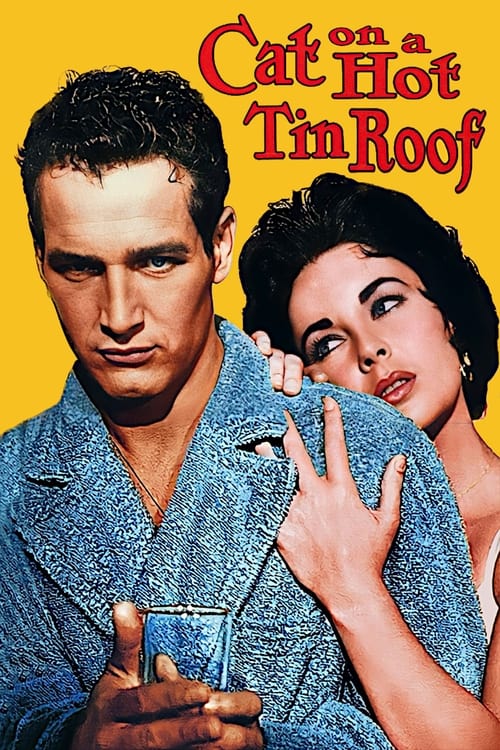
Cat on a Hot Tin Roof
1958 · Richard Brooks
For a night when you want grown-up drama with teeth — people saying devastating things in beautiful rooms. It asks a little of you but pays off like great theater; comfort food for anyone who loves a family blowup done right.
What it's about
On a sweltering Mississippi plantation, a Southern family gathers for the patriarch's birthday just as he receives a terminal diagnosis. His son Brick, a former football star, has retreated into whiskey and silence, haunted by the death of his closest friend, while his wife Maggie fights tooth and claw to win back a husband who won't touch her. As the night wears on, inheritance schemes, old wounds, and long-buried truths start forcing their way to the surface.
The experience
It plays like a pressure cooker with the lid rattling — nearly all talk, all heat, every conversation a negotiation or a wound. The tension is emotional rather than physical, and it builds until the shouting matches feel like release.
Performances
Elizabeth Taylor is ferocious and wounded as Maggie, Paul Newman makes sullen withdrawal magnetic, and Burl Ives dominates as Big Daddy, a mountain of a man staring down his own mortality.
The craft
Adapted from Tennessee Williams's Pulitzer-winning play, it keeps the crackle of stage dialogue while the widescreen framing turns the mansion into a battlefield of doorways and closed rooms. What the era's censors wouldn't let it say outright becomes its own kind of charge — you feel the unspoken pressing against every scene.
Why it matters
A huge hit that cemented Taylor and Newman as the faces of late-'50s Hollywood, and a landmark case of adult American theater colliding with studio-era censorship.
Snapshot
A prestige MGM melodrama adapted from Tennessee Williams's Pulitzer Prize-winning 1955 play, Cat on a Hot Tin Roof pits a family of Southern landowners against one another in the hours surrounding the patriarch's birthday—and his terminal diagnosis. Alcoholic ex-football star Brick Pollitt (Paul Newman) drinks himself numb while his wife Maggie (Elizabeth Taylor) wages a campaign of desire against his indifference, and patriarch Big Daddy (Burl Ives) confronts mortality and his son's dissolution simultaneously. The film is most notable as a collision between the frankness of postwar American drama and the censorship regime of late-Code Hollywood, producing a text in which suppression itself becomes legible—every omission generating pressure that the performances and CinemaScope staging transmit even when the screenplay cannot name its subject directly.
Industry & production
Tennessee Williams's original Broadway production opened in March 1955, directed by Elia Kazan, with Ben Gazzara as Brick, Barbara Bel Geddes as Maggie, and Burl Ives as Big Daddy. The play ran for 694 performances and won the Pulitzer Prize for Drama. MGM acquired the film rights and assigned the project to producer Lawrence Weingarten, a studio veteran whose slate at the time leaned toward sophisticated literary adaptations. Richard Brooks was brought on as both director and co-screenwriter (sharing the screenplay credit with James Poe), following the pattern of assigning writer-directors to Williams material as a means of consolidating creative control and limiting the diffusion of authorial responsibility.
The casting of Paul Newman and Elizabeth Taylor was industrially decisive. Newman had emerged from the East Coast Method world and was consolidating his stardom after Somebody Up There Likes Me (1956) and The Long, Hot Summer (1958, also Williams-adjacent in its Faulknerian Southern texture). Taylor was in the midst of a transition from MGM ingénue to legitimate dramatic actress; her performance here, though she did not win the Academy Award for which she was nominated, is widely credited as a turning point in how she was received by critics. Burl Ives reprised his Broadway role—the only principal cast member to do so—lending the production an authenticity of theatrical lineage that was commercially and critically useful.
The Production Code Administration (PCA), still operative in 1958 though increasingly pressured, required the film to suppress or recode the homosexual content that Williams had embedded in Brick's guilt over his relationship with his dead friend Skipper. The PCA's mandate meant that Brick's paralysis—rooted in the play in ambivalent desire and shame—had to be translated into something more acceptable: grief, masculine codes of loyalty, a generalized emotional blockage. Brooks and Poe complied, and the adaptation replaced specificity with suggestive vagueness, which had the unintended effect of making the subtext more rather than less apparent to attentive viewers. The film also altered the play's ending, moving toward a qualified domestic reconciliation that Williams himself found a betrayal of the material's tragic logic.
Technology
The film was photographed in CinemaScope and Metrocolor, both technologies that carried specific aesthetic implications for intimate psychological drama. CinemaScope's extreme horizontal field (approximately 2.35:1) was developed primarily for spectacle—epics, musicals, outdoor adventure—and presented a formal challenge for chamber drama set almost entirely within a single plantation bedroom and its adjoining spaces. Cinematographer William H. Daniels used the wide frame to choreograph power relations within the room: characters occupy opposite poles of the scope frame, and the space between them measures emotional distance as precisely as any dialogue.
Daniels was one of Hollywood's most experienced cinematographers, having shot Greta Garbo's MGM films in the 1920s and 1930s and won the Academy Award for The Naked City (1948). His assignment here represents MGM's commitment to bringing craft rigor to prestige literary adaptation. Metrocolor's palette in the film tends toward warm, oppressive tones—the plantation interiors are rendered in saturated golds and amber shadows that inflect the domestic space with a slow-burning intensity appropriate to the material.
Technique
Cinematography
Daniels works against CinemaScope's centrifugal tendencies by anchoring the frame around bodies in sustained close and medium-close work, but the format's width is never decorative. The scope frame allows Brooks to keep multiple figures in the same shot without cutting, producing compositions in which Taylor, Newman, and Ives occupy the same visual field while existing in psychologically sealed compartments. This staging choice—derived partly from theatrical practice and partly from the formal demands of sustaining long-take confrontations—intensifies the sense of characters trapped in proximate isolation. The camera moves relatively conservatively; there is no anxiety of expressionist movement here. The tension is produced through sustained framing, not through editing rhythm.
Editing
Ferris Webster edited the film, and the cutting pattern reflects an adaptation strategy: the play's rhetorical power resided in extended speeches and the accumulating pressure of language, and Webster's editing generally protects the integrity of the longer acting moments rather than fragmenting them into reaction-shot coverage. This produces sequences—particularly in the exchanges between Newman and Ives—that have the durational quality of theatrical watching, in which the viewer's relationship to performance shifts from passive spectatorship toward something closer to witness.
Mise-en-scène / staging
The decision to confine almost all the action to the single plantation-house set—faithful to the play's own claustrophobic unity of place—means that staging becomes the film's primary visual argument. Brooks and Daniels choreograph bodies across the scope frame with deliberate architectonic logic: Brick's retreat to the liquor cabinet and the gallery doors defines one axis; Maggie's pursuit of him defines another; Big Daddy's arrival reorganizes the spatial grammar of the room entirely. The set itself—plantation opulence rendered slightly airless, with ceiling fans that never quite cool the atmosphere—functions as a psychological environment. The bed, never occupied in the ways Maggie desires, becomes the film's central prop: present, visible, and inactive, it is the material correlative of everything the script cannot say about Brick.
Sound
The film's sound design is largely conventional for its period and genre, prioritizing dialogue clarity and Charles Wolcott's score. Wolcott's music is functional rather than distinctive—it underscores emotional transitions without the kind of motific development that would make it independently notable. The more interesting acoustic register is in the performances themselves: Newman's slurred, elliptical line-readings produce a kind of negative sound, the sound of words withheld.
Performance
The performances are the film's primary critical and historical site. Paul Newman's Brick is a study in evasion performed as stillness—he conveys psychological liquidity not through emotional display but through a quality of refusal, a body that does not quite occupy the space it moves through. Newman had been trained in the Actors Studio tradition, and his Brick applies Method interiority to a character whose defining trait is the suppression of interiority; the result is technically sophisticated and periodically oblique in ways that frustrated some 1958 reviewers and compel later analysis.
Elizabeth Taylor's Maggie moves in the opposite direction: all surface urgency, frank physicality, and calculated exposure. Where Newman retreats from the camera, Taylor inhabits it. Her Maggie is not a victim of Brick's indifference but an agent working against it, and Taylor's intelligence is in never playing the desperation sentimentally. Burl Ives's Big Daddy—earned through the Broadway run and the physical authority of the actor's presence—is the performance that most clearly bridges theatrical and cinematic registers. The confrontation scene between Big Daddy and Brick is the film's dramatic center, and Ives's ability to hold the wide frame with concentrated stillness while Newman moves within and around him constitutes the film's most purely cinematic extended passage.
Narrative & dramatic mode
The film is a compressed domestic tragedy structured around revelation and confrontation. Its temporal unity—the events of a single evening, under the pressure of Big Daddy's birthday celebration and the suppressed knowledge of his diagnosis—creates the conditions for a Greek-influenced dramatic architecture in which old truths surface under new pressure. The play's central Aristotelian concept, articulated most forcefully by Big Daddy, is "mendacity"—the social fabric of lies that sustains Southern landed families in denial of mortality, sexuality, financial reality, and emotional truth. The film's dramatic mode is one of incremental unmasking, in which each scene strips away one layer of the sustaining lie.
The Production Code's interference with the sexuality theme does not dissolve the dramatic logic so much as displace it: the film's mendacity operates as much between itself and the viewer as between its characters, producing a second-order irony that is partly aesthetic accident and partly—in the hands of a careful viewer—a form of heightened meaning. The adaptation's tamed ending, in which Maggie and Brick's future is left on a note of domestic possibility rather than the play's darker ambiguity, was the most substantial distortion of Williams's original vision and the change most directly attributable to studio and Code pressure.
Genre & cycle
Cat on a Hot Tin Roof belongs to at least three overlapping genre formations of the 1950s. First, it is a prestige literary adaptation, the Hollywood mode of acquiring cultural legitimacy through association with celebrated theatrical or literary properties—a mode that, in the 1950s, was particularly active in relation to American drama and to British novels. Second, it is a domestic melodrama in the tradition that Thomas Elsaesser and later scholars have theorized as a form that critiques the American family from within, using the genre's conventions of emotional excess and repression-under-pressure to expose what normative ideology prefers to conceal. Third, it participates in a distinct Southern Gothic cycle of Hollywood films that drew on Williams, Faulkner, and their congeners: A Streetcar Named Desire (Kazan, 1951), Baby Doll (Kazan, 1956), Suddenly, Last Summer (Mankiewicz, 1959), The Fugitive Kind (Lumet, 1960), and Brooks's own Sweet Bird of Youth (1962) constitute a sustained engagement with the Southern Gothic mode that spans approximately a decade of American cinema.
Authorship & method
Richard Brooks (1912–1992) was a literary filmmaker in the classical Hollywood sense: a writer-director who took adaptation seriously as an intellectual project and who sought to translate the internal logic of prose or theatrical works rather than merely transcribe their surfaces. His career encompasses adaptations of Sinclair Lewis (Elmer Gantry, 1960), Dostoevsky (The Brothers Karamazov, 1958—released in the same year as Cat), and Truman Capote (In Cold Blood, 1967). His approach to Williams was methodologically consistent: fidelity to the core dramatic argument, aggressive cuts to theatrical elaboration, and a recognition that cinema's spatial and temporal resources require reformatting what works on stage.
Brooks's co-writer James Poe brought significant screen adaptation experience to the project; the division of labor between them is not fully documented in available production records, and it would be inaccurate to assign specific passages to either writer without archival evidence. William H. Daniels's cinematographic contribution was discussed above. Ferris Webster, as editor, had accumulated substantial MGM experience across multiple decades and genres; his editing choices here reflect a practical theater-to-film sensitivity that prioritizes performance duration. Charles Wolcott's score does not reach the level of Elmer Bernstein's or Bernard Herrmann's contemporaneous work in terms of thematic integration, and represents the one significant craft element where the film's achievement is narrowly functional.
Movement / national cinema
Cat on a Hot Tin Roof is emphatically a product of classical Hollywood's late period—the years in which the studio system was contracting under television competition, the Paramount decrees, and demographic shifts, but had not yet disintegrated into the New Hollywood configurations that would emerge in the following decade. As a studio-system film at the end of the studio-system era, it exemplifies both the system's most sophisticated mode—the prestige adaptation, resourced and crafted—and its most constrictive—the Production Code's censorship of content that the theatrical source had treated with relative openness. It is not a film of any identifiable aesthetic movement beyond classical Hollywood melodrama and the specifically American tradition of theatrical realism adapted for the screen.
Era / period
The late 1950s were a moment of formal conservatism in Hollywood combined with unprecedented subject-matter pressure. The Production Code was visibly weakening—Kazan's Baby Doll had provoked the Legion of Decency's condemnation in 1956; Otto Preminger had tested Code enforcement with The Moon Is Blue (1953) and The Man with the Golden Arm (1955)—but it had not yet collapsed. The result was a cycle of films that addressed sexuality, race, addiction, and institutional violence through a combination of surface compliance and subextual legibility. Cat on a Hot Tin Roof is among the most formally revealing documents of this transitional cultural moment: the gap between what the Code permitted and what Williams had written is not concealed but visible, and that visibility becomes an unintended formal signature.
The period also marks the consolidation of Method-trained actors as major Hollywood stars—Brando, Dean, Newman, Clift—and the tension between their performance styles and the emotional conventions of studio-era acting is productively present in the film.
Themes
The film's central thematic preoccupation is mendacity—the network of consensual fictions by which families and social formations sustain themselves against disintegrating truths. Big Daddy's dying, Brick's sexuality, Gooper and Mae's mercenary calculations regarding the plantation inheritance, Maggie's pregnancy (announced as fact before it is fact): all are instances of a culture organized around strategic untruth. Williams's play argued that mendacity is not aberration but structure, the constitutive form of bourgeois Southern life.
Repressed sexuality—displaced but not dissolved in the adaptation—is the film's second major register. Brick's alcoholism is rendered as a symptom of unacknowledged interior life, and Newman's performance tracks a man who drinks not to forget but to remain below the threshold at which honest self-knowledge would become unavoidable. The film is also engaged with the dynamics of female desire and female agency under patriarchy: Maggie's campaign is as much a refusal of powerlessness as it is an expression of love, and Taylor's performance insists on the political dimension of a woman whose access to the future depends entirely on whether she can make her husband want her.
Mortality and inheritance—both material and psychological—organize the plot's structural logic. Big Daddy's cancer is the engine of the plot's forward movement, and the plantation represents the Southern myth of landed continuity that all the characters are, in different ways, trying to claim or perpetuate or escape.
Reception, canon & influence
Cat on a Hot Tin Roof was a significant commercial success for MGM on its release in September 1958, and it received six Academy Award nominations—Best Picture, Best Director, Best Actor (Newman), Best Actress (Taylor), Best Adapted Screenplay, and Best Cinematography (Color)—without winning in any category. The 1958–59 awards season was dominated by Gigi (Minnelli), and the shutout was not read by contemporary observers as a critical repudiation so much as the predictable consequence of a lighter film sweeping a season in which several strong nominees competed.
Contemporary critical reception was respectful but divided on the question of the adaptation's fidelity and Brooks's handling of the Code constraints. Pauline Kael and other serious critics of the period noted the gap between the play's ambitions and the film's permissible content, often framing this as a structural failure of Hollywood censorship rather than a failure of directorial craft.
Looking backward, the film's primary influences are the theatrical tradition of postwar American realism—Williams, Arthur Miller, William Inge—as refracted through the stage-to-screen adaptation practices established by Kazan's Williams films. Kazan's A Streetcar Named Desire (1951) is the direct precursor: it demonstrated that Williams's work could be adapted for Hollywood with a degree of seriousness and formal ambition, established Marlon Brando as a Method star, and set the template for prestige Williams adaptation that Brooks was working within and against. The film also draws on the theatrical staging conventions of 1950s Broadway naturalism—the use of continuous space, ensemble pressure, and extended confrontation scenes—in ways that distinguish it from classical Hollywood's more fragmented cutting rhythms.
Looking forward, the film's legacy operates on several axes. It is part of the textual history of Hollywood's negotiation with homosexuality before the collapse of the Production Code, and in that context it has been extensively analyzed by queer film historians—particularly in relation to the visible pressure of the Code's prohibitions and what that visibility does to the film's meaning. The Taylor-Newman pairing entered the cultural vocabulary as an image of charged erotic stalemate; it is invoked, consciously or not, in subsequent films about couples whose desire is asymmetrical or blocked.
More broadly, the Southern Gothic adaptation cycle to which the film belongs created a body of Hollywood work—from Streetcar through Suddenly, Last Summer to The Chase (Penn, 1966)—that constitutes an extended meditation on American mythology, sexuality, and violence conducted under conditions of censorship that paradoxically sharpened the work's critical edge. Cat on a Hot Tin Roof is among the most formally lucid documents of that negotiation, and its canonical interest lies precisely in the legibility of the forces pressing against it.
A Deleuzian reading
Look at the bed.
The full Deleuzian reading of Cat on a Hot Tin Roof →
Reception
A smash in 1958 — MGM's biggest hit of the year, six Oscar nominations — but Tennessee Williams famously hated it for censoring the play's gay subtext; today it's seen as both a compromised adaptation and an irresistible star vehicle, with the Newman–Taylor pairing doing what the script can't say.
How Cat on a Hot Tin Roof was received, from release to now →
Influences: the films it descends from and the films it influenced
- The Little Foxes (1941) — Toland's deep-focus compositions stage the Hubbard family power struggle with multiple figures simultaneously visible at opposing depth planes without cutting—establishing the power-geometry logic of keeping antagonists in the same frame that Brooks and Daniels translate into CinemaScope's horizontal axis.
- All About Eve (1950) — Mankiewicz's editorial restraint preserves Bette Davis's extended theatrical speeches in sustained multi-figure compositions rather than fragmenting them into reaction-shot coverage—the performance-duration editing philosophy Ferris Webster applies to the Newman-Ives confrontations.
- A Streetcar Named Desire (1951) — Establishes the Williams stage-to-screen protocol: Method performers confined to a single-location interior, with Harry Stradling's sustained close framings translating theatrical language density into cinematic pressure—the formal template Brooks inherits for making a stage-bound play cinematically urgent without opening it up.
- The Rose Tattoo (1955) — Mann's Williams adaptation preserves Anna Magnani's stage-trained performance style through minimal cutting and sustained close framings in confined Southern domestic space, demonstrating the approach of subordinating cinematic grammar to theatrical performance momentum that Brooks follows with Ives and Newman.
- Baby Doll (1956) — Kazan stages Williams's most Production Code-controversial material in Southern domestic confinement—Kaufman's claustrophobic black-and-white photography making suppressed desire spatially legible through architectural enclosure—directly establishing the strategy of allowing PCA prohibition to generate rather than dissipate erotic tension.
- Tea and Sympathy (1956) — MGM's own prior CinemaScope adaptation of a stage play encoding homosexual subtext under Production Code constraint, using sustained compositional pressure and performance ambiguity rather than explicit statement—the studio template for productive suppression that Brooks follows two years later with Brick's grief-coded paralysis.
- Written on the Wind (1956) — Sirk and Russell Metty develop the saturated amber-gold Metrocolor palette in CinemaScope domestic melodrama—deploying color as psychological externalization rather than neutral record—establishing the chromatic approach Daniels applies to the Pollitt plantation interiors as expressive pressure.
- Suddenly, Last Summer (1959) — The immediate successor in the Williams-Code negotiation series: Mankiewicz confines the action to a single garden-asylum set and uses sustained widescreen compositions to encode homosexuality the Production Code still prohibits, extending Brooks's methodology of making omission itself generate narrative pressure.
- Long Day's Journey Into Night (1962) — Lumet confines O'Neill's family demolition to a single domestic interior with black-and-white sustained close framings and editing that preserves the durational integrity of extended confrontational speeches without cutting to coverage—directly extending the performance-duration preservation strategy Webster used on the Newman-Ives sequences.
- Sweet Bird of Youth (1962) — Brooks returns to Williams material with the identical formal toolkit—CinemaScope power geometry, warm Metrocolor palette, performance-duration editing protecting Paul Newman's extended speeches—making this an auteur's self-quotation of the methodology developed in Cat, with Newman again playing a man paralyzed by guilt and self-mythology.
- Hud (1963) — Newman reprises the Brick archetype—patriarch's disaffected son in alcoholic self-exile, emotionally armored against intimacy—while James Wong Howe's black-and-white anamorphic photography translates the scope-frame power geometry into a ranching landscape, positioning Newman and Melvyn Douglas at opposing emotional poles across the wide frame.
- Who's Afraid of Virginia Woolf? (1966) — Haskell Wexler's black-and-white anamorphic compositions stage Albee's domestic warfare through the same power-geometry logic—figures at opposing poles of the wide frame—while the editing preserves the durational integrity of extended theatrical speeches, extending Brooks's single-location scope methodology into the post-Code era where what Cat could only encode can finally be named.
- The Night of the Iguana (1964) — Extends the Williams adaptation cycle's reliance on long, room-bound scenes of mendacity and confession built around a single symbolic prop, a structure Iguana echoes with the iguana tethered beneath the veranda.
- The Fugitive Kind (1960) — Lumet's Williams adaptation uses Kaufman's black-and-white photography in confined Southern interiors to encode racially and sexually transgressive desire under Code constraint, extending the productive suppression methodology to Williams material even more severely censored than Cat's homosexual subtext.
- Summer and Smoke (1961) — Charles Lang's CinemaScope photography stages Miss Alma's repressed desire in sustained single-location Southern compositions, applying Brooks's protocol of making PCA-constrained sexuality legible through performance pressure and the spatial geometry of the wide frame rather than through dialogue.
- Splendor in the Grass (1961) — Kazan—who directed the original Broadway Cat—translates his Williams-inflected methodology into CinemaScope domestic repression: Kaufman's compositions stage adolescent desire as spatial containment, making PCA prohibitions structurally visible in the architecture of sustained framings that force repression to register as physical pressure.
Similar films
- Suddenly, Last Summer (1959) — influence & lineage · same viewing thread
- A Streetcar Named Desire (1951) — influence & lineage · same viewing thread
- Who's Afraid of Virginia Woolf? (1966) — influence & lineage
- Long Day's Journey Into Night (1962) — influence & lineage
- Tea and Sympathy (1956) — influence & lineage
- Hud (1963) — influence & lineage
- The Little Foxes (1941) — influence & lineage
- Gone with the Wind (1939) — same viewing thread
All the films related to Cat on a Hot Tin Roof →
Watch it with: curated runs of related films
- Heat and Reckoning in the American South — A run of Southern dramas where family, race, and old money simmer under the same unbearable heat — watch them together to trace the region from the plantation myth through the civil-rights march.