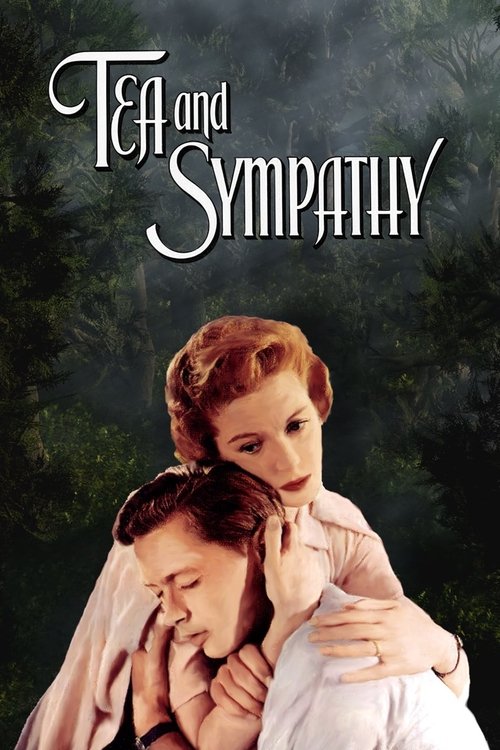
Tea and Sympathy
1956 · Vincente Minnelli
When you want an old-Hollywood melodrama that actually hurts — a film for a reflective evening, more challenge than comfort, especially if you've ever felt like the odd one out.
What it's about
At a 1950s boys' prep school, a sensitive teenager who prefers folk songs and sewing to touch football is branded 'sister boy' and hounded by his classmates — and by a housemaster obsessed with manliness. The only person who shows him real kindness is the housemaster's lonely wife, and their tentative bond becomes the film's fragile center. It's a story about cruelty dressed up as character-building, and the cost of not fitting the mold.
The experience
Quiet, aching, and slow-burning — the tension comes not from events but from watching decency and conformity grind against each other. It leaves you tender and a little bruised, with much of its meaning carried in glances and pauses rather than speeches.
Performances
Deborah Kerr, reprising her Broadway role, gives one of her most delicately modulated performances — tenderness, loneliness, and fear shifting almost invisibly across her face — with John Kerr matching her as the persecuted boy.
The craft
Vincente Minnelli, Hollywood's great director of repressed longing, had to work under a censorship code that forbade naming what the story is about — so he smuggled the meaning through hothouse CinemaScope color, gardens, and interiors, letting decor and light say what dialogue couldn't. The result rewards patient, attentive viewing; the surfaces are doing the talking.
Why it matters
A landmark of coded queer storytelling in studio-era Hollywood, it shows how a great filmmaker could say the unsayable under censorship, and it remains a touchstone for how repression shaped 1950s American cinema.
Vincente Minnelli's adaptation of Robert Anderson's Broadway play arrived with its original stage leads intact — Deborah Kerr, John Kerr, Leif Erickson — and with the Production Code standing guard over everything the material was actually about. A sensitive prep-school boy, branded 'sister boy' for preferring folk songs and sewing to touch football, is hounded by classmates and by a housemaster obsessed with manliness; only the housemaster's lonely wife extends him kindness. The Code forbade any naming of homosexuality and imposed a moralizing frame, so Minnelli — Hollywood's great director of repressed longing, whose own queerness has been long discussed — smuggled the meaning through craft: hothouse CinemaScope color, the language of gardens and interiors, Kerr's extraordinary modulations of tenderness and fear. The result is a fascinating double exposure, a film about conformity's cruelty made under conformity's rules. Deborah Kerr's most famous line, delivered near the end, entered the culture whole. What censorship muffled in the script, the décor and the faces say fluently.
Reception
In 1956 it landed as a watered-down version of Robert Anderson's hit Broadway play, its central subject blurred to appease the Production Code; today that very censorship is the fascination, and it's studied as a key text of coded queer Hollywood — Vito Russo gave it a whole discussion in The Celluloid Closet.
How Tea and Sympathy was received, from release to now →
Influences: the films it descends from and the films it influenced
- Madame Bovary (1949) — Minnelli's earlier template of a moralizing frame narrative (the courtroom trial) bracketing a story of repressed provincial longing, later reused as Laura Reynolds' returning-to-campus letter that frames Tea and Sympathy.
- The Bad and the Beautiful (1952) — Establishes Minnelli's gliding crane-and-track camera prowling emotionally charged interiors so that décor and blocking carry the subtext the dialogue cannot state.
- A Streetcar Named Desire (1951) — Set the postwar model of transferring a Broadway hit to screen intact with its original stage leads and Method intensity while smuggling coded homosexuality past the Production Code.
- The Children's Hour (These Three) (1936) — Pioneered the craft of dramatizing a whispered accusation of homosexuality whose very word is unspeakable, forcing the theme into gesture, rumor and reaction shots — the same 'coded by omission' strategy Tea and Sympathy inherits.
- Cat on a Hot Tin Roof (1958) — Continues the star-studded stage-play adaptation that must launder its hero's homosexuality into vague 'disgust' and immaturity to satisfy the Production Code, exactly as Tea and Sympathy's play was softened.
- Some Came Running (1958) — Extends Minnelli's expressionist color melodrama, orchestrating CinemaScope crowds and symbolic reds to dramatize a sensitive man crushed by small-town conformity.
- Home from the Hill (1960) — Minnelli's fullest CinemaScope study of masculinity and the anxious father-son inheritance of manhood, the theme Tea and Sympathy's Bill Reynolds embodies.
- The Children's Hour (1961) — Loosens the code just enough to voice the homosexual accusation that Tea and Sympathy kept implicit, showing the same mechanism of communal cruelty destroying a suspected deviant.
- Splendor in the Grass (1961) — Carries forward the William Inge/Robert Anderson strain of color melodrama about sexual repression enforced by community propriety and the psychic damage it inflicts on the young.
- Far from Heaven (2002) — A scholarly reconstruction of the Sirk-Minnelli 1950s melodrama — CinemaScope color-as-subtext, manicured gardens and repression — that makes explicit the coded homosexuality those films could only imply.
- Brokeback Mountain (2005) — Inherits the melodrama of repressed same-sex longing crushed by codes of masculinity, using landscape and withheld gesture (rather than dialogue) to carry the forbidden feeling.
- Carol (2015) — Perfects the tradition of period color melodrama where framing through glass, interiors and restrained performance encode a love the era forbids speaking aloud.
- Dead Poets Society (1989) — The New England prep-school drama of a sensitive nonconformist boy persecuted by a masculine-conformist institution — DPS's closest setting-and-theme ancestor in the conformity-vs-individuality strand.
- All That Heaven Allows (1955) — Contemporary use of saturated Technicolor and hostile small-town interiors as ironic subtext, indicting conformity's cruelty toward a nonconforming outsider.
- Rebel Without a Cause (1955) — Deploys CinemaScope width and expressive color to stage a crisis of 1950s masculinity, complete with a coded-queer sensitive youth (Plato) punished for not fitting the male ideal.
- Picnic (1955) — CinemaScope stage adaptation that choreographs repressed desire across gardens, porches and open-air interiors, letting landscape staging externalize longing.
- The Cobweb (1955) — Minnelli's own widescreen chamber melodrama set in an institution, using color-coordinated furnishings (the drapes) as the literal battleground of repression and control.
- East of Eden (1955) — CinemaScope Method melodrama centered on a sensitive son failing his father's masculine expectations, the same wound Tea and Sympathy locates in John Kerr's 'sister-boy.'
- Written on the Wind (1956) — Simultaneous flowering of the color-as-subtext studio melodrama, where hue, mirrors and phallic objects encode sexual anxiety the code forbids naming.
Similar films
- The Children's Hour (1961) — influence & lineage
- Rebel Without a Cause (1955) — influence & lineage
- All That Heaven Allows (1955) — influence & lineage
- Cat on a Hot Tin Roof (1958) — influence & lineage
- A Streetcar Named Desire (1951) — influence & lineage
- Far from Heaven (2002) — influence & lineage
- Carol (2015) — influence & lineage
- Written on the Wind (1956) — influence & lineage