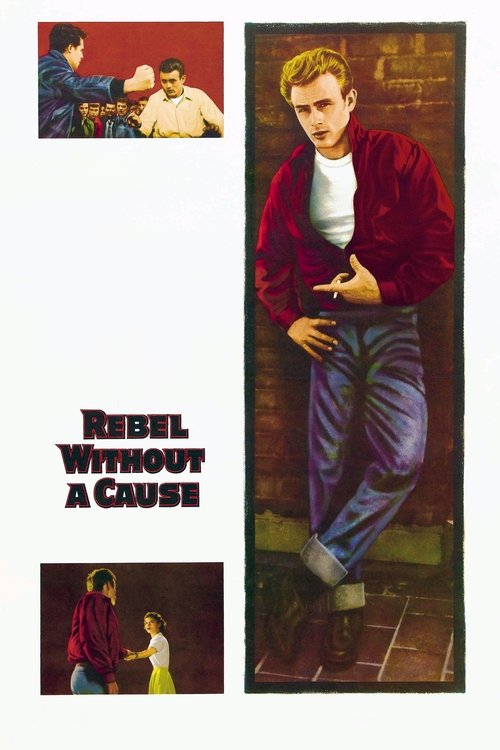
Rebel Without a Cause
1955 · Nicholas Ray
For when you want to feel seventeen again — misunderstood, restless, and desperate for someone to actually listen. It's an emotional watch more than a comfortable one; come to it when you want a film that wears its heart completely on its sleeve.
What it's about
Jim Stark is a teenager who's just moved to a Los Angeles suburb, hoping a new town means a clean slate — but trouble finds the new kid fast. Over roughly twenty-four hours he collides with a local tough named Buzz, falls for Buzz's girlfriend Judy, and bonds with Plato, a lonely, fragile classmate. A knife fight and a deadly dare on a cliff-edge drag race push the three of them together into a makeshift family, because the real families back home have failed them all.
The experience
Feverish and raw — teenage emotion played at full operatic volume, with moments of surprising tenderness in between the confrontations. It moves fast, aches openly, and its anguish still lands even when the 1950s trappings feel dated.
Performances
James Dean, in the role that made him an icon, turns adolescent inarticulacy into something magnetic — every slouch and outburst feels torn out of him. Natalie Wood and Sal Mineo match him as the other two corners of the film's fragile surrogate family, and Mineo's wounded devotion is quietly devastating.
The craft
Nicholas Ray shoots teenage turmoil in blazing WarnerColor and widescreen CinemaScope, using color — most famously Dean's red jacket — and tilted, unsettled framing to make suburban living rooms feel as dangerous as the cliff edge. The Griffith Observatory sequences give it a scale few teen stories have ever had. It genuinely rewards the biggest screen you can find.
Why it matters
This is the film that made the American teenager a serious cinematic subject, fixed James Dean as a permanent icon of youth rebellion, and shaped decades of coming-of-age movies about kids failed by their parents. Dean's death just before its release sealed its legend.
Snapshot
Rebel Without a Cause is the film that fixed the postwar American teenager as a subject of serious cinema — anguished, articulate in his inarticulacy, and starved for a authority worth respecting. Made by Warner Bros. in 1955 and directed by Nicholas Ray, it compresses roughly twenty-four hours in the life of Jim Stark (James Dean), a middle-class boy newly arrived in a Los Angeles suburb, as a single night of a knife fight, a fatal "chickie run," and a desperate flight to an abandoned mansion exposes the failures of the families that produced him. Its three young leads — Dean, Natalie Wood as Judy, and Sal Mineo as Plato — form a fragile surrogate family in the absence of functioning real ones, and the film's emotional logic is built almost entirely on that substitution. Shot in CinemaScope and WarnerColor, scored by Leonard Rosenman, and released only weeks after Dean's death in a car crash, the picture arrived already mythologized. It remains the canonical text of 1950s adolescent alienation and one of the foundational documents of the modern teen film.
Industry & production
The project originated at Warner Bros., which had under contract both Ray and, after East of Eden (1955), the rising James Dean. The title was purchased from an unrelated source: Dr. Robert M. Lindner's 1944 psychoanalytic case study Rebel Without a Cause: The Hypnoanalysis of a Criminal Psychopath. Warner owned the title from the prior decade and effectively grafted it onto a new story; the finished film bears no narrative relationship to Lindner's book. The screen story is credited to Ray, with adaptation by Irving Shulman and the final screenplay by Stewart Stern. The development passed through several hands, which is well documented, though the precise apportionment of credit among the writers has long been a subject of discussion.
A consequential mid-production decision was the shift from black-and-white to color. The film began shooting in black-and-white and was converted early to CinemaScope and WarnerColor, a change that required reshooting completed material — an unusual studio commitment that signals Warner's growing confidence in Dean's commercial value following East of Eden. Ray, who had come up through lower-budgeted RKO pictures, here worked with a major studio's widescreen resources.
The release context is inseparable from tragedy: Dean died on September 30, 1955, when his Porsche collided with another car near Cholame, California. Rebel opened in late October 1955, so the young star's death immediately preceded and shadowed its reception, and the film became bound up with the posthumous Dean cult. A grim coda often noted in the literature is that all three principal young actors met early or violent ends — Dean in 1955, Mineo murdered in 1976, and Wood drowned in 1981 — which has fed the film's aura of doom, though this is biography rather than anything in the work itself.
Technology
Rebel Without a Cause was photographed in CinemaScope, the anamorphic widescreen process Twentieth Century-Fox had introduced in 1953 and licensed widely across the industry, and in WarnerColor. The mid-shoot conversion to these formats is the decisive technological fact of the production. The roughly 2.55:1 (early CinemaScope) frame is not incidental decoration here; Ray and his cinematographer organized the compositions around the extreme horizontal field, using its width to isolate figures at opposite edges and to register the architecture — the planetarium, the staircase, the mansion — as a pressurizing environment. The film stands as an early and influential demonstration that the wide frame, often dismissed in its first years as suited only to spectacle and landscape, could serve intimate psychological drama.
Technique
Cinematography
The director of photography was Ernest Haller, a veteran whose credits stretched back to the silent era and included Gone with the Wind (1939). Working in CinemaScope and color, Haller and Ray produced one of the more compositionally self-conscious studio films of the period. The palette is keyed to Jim's red windbreaker — a costume choice that functions almost as a graphic motif, a slash of warning color tracked across the frame and against the cooler blues and neutrals around it. The film's use of diagonals is striking: the canted angle late in the picture, and the recurring exploitation of staircases and the planetarium dome as places where bodies can be arranged on multiple planes. Ray's much-discussed sensitivity to the expressive possibilities of architecture and to the placement of figures within the wide frame is on full display.
Editing
The film was edited by William H. Ziegler. The cutting is largely classical and continuity-based, subordinated to performance and to Ray's staging; the picture does not call attention to montage as an effect. Its most demanding sequence to assemble is the "chickie run," the cliff-edge drag race, which intercuts the two speeding cars, the watching crowd, and the mechanics of the door handle on which Buzz's life hinges — a passage that builds tension through accumulation and timing rather than rapid fragmentation. Throughout, the editing serves the film's compressed near-real-time structure.
Mise-en-scène / staging
Mise-en-scène is where Ray's authorship is most legible. He stages emotional relationships spatially — characters are constantly arranged on different levels (the celebrated overhead and stairway compositions in the Stark home), pushed to the edges of the wide frame, or pulled into clustered intimacy. Three settings carry thematic weight: the Griffith Observatory / planetarium, where the cosmic lecture on humanity's insignificance frames the teenagers' private apocalypse; the Stark household, with its visual coding of inverted or collapsed parental authority (Jim's apron-wearing father is staged as emasculated); and the abandoned mansion, where Jim, Judy, and Plato play at being a family. Ray's training as an architecture student under, by his own account, the influence of Frank Lloyd Wright is frequently invoked to explain this spatial intelligence.
Sound
Leonard Rosenman, who had also scored East of Eden, composed the music. His score leans toward a modern, dissonant, symphonic idiom rather than the romantic lushness or pop scoring that would soon dominate teen pictures — a serious "art music" treatment that elevates the melodrama and matches the film's claim to psychological gravity. Dialogue and the sounds of the milieu (revving engines, the planetarium narration) are integrated into the drama; the film is not a musical or a jukebox vehicle, and its sonic seriousness distinguishes it from the rock-and-roll teen cycle that ran parallel to it.
Performance
The acting is the film's enduring core. James Dean, formed in part by the Method milieu of the Actors Studio, gives a performance of celebrated emotional volatility — the slurred, mumbling vulnerability, the sudden physical outbursts (the opening drunk scene, the anguished "You're tearing me apart!"), the tenderness toward Plato. It became the template for a generation of "sensitive" male screen acting and is routinely paired with Brando's contemporaneous work as the public face of Method performance. Natalie Wood, transitioning from child star to adult roles, plays Judy's hunger for paternal affection with a directness that grounds the film's thesis about fathers. Sal Mineo's Plato — lonely, hero-worshipping, widely read as one of the era's most legible coded-gay adolescents — supplies the film's most fragile and ultimately tragic note. The three earned a place in screen-acting history; Mineo and Wood received Academy Award nominations in supporting categories for the film, and Stern's story was also nominated.
Narrative & dramatic mode
The film operates in the register of domestic melodrama crossed with social-problem realism, raised to near-tragic pitch. Its structure is unusually classical: the action observes a tight unity of time, unfolding across roughly a single day and night, bracketed by the police station at the start and the planetarium at the end. This compression lends the everyday events — a new school, a knife fight, a dare — the inexorability of fate. The dramatic mode is psychological and expressionist rather than naturalistic: dialogue is heightened, emotions are externalized through color and architecture, and the parents are drawn in broad, almost diagrammatic strokes to serve the film's argument about generational failure. The surrogate-family idyll in the mansion is the film's utopian center, and its violent collapse — Plato's death — supplies the catharsis.
Genre & cycle
Rebel is the keystone of the mid-1950s juvenile-delinquency cycle that also includes The Wild One (1953) and Blackboard Jungle (1955). But where those films locate menace in working-class or marginal youth, Rebel relocates delinquency to the affluent suburb and roots it not in poverty but in emotional and parental dysfunction — a significant reframing. In doing so it effectively founds the teen film as a genre that takes adolescent interiority seriously, distinct from the exploitation quickies and rock-and-roll vehicles proliferating at the same moment. Its DNA runs forward through the coming-of-age and high-school films of subsequent decades.
Authorship & method
Nicholas Ray is the film's decisive authorial presence, and Rebel is the work most central to his elevation by Cahiers du cinéma critics into the auteur pantheon. Ray's signature concerns — outsiders and misfits, the instability of the family, violence as an eruption from emotional repression, and an architect's command of space and color — find their fullest popular expression here. He took the story credit and was, by many accounts, closely involved with his young cast, cultivating an intense on-set rapport with Dean in particular. His key collaborators reinforced the film's seriousness: cinematographer Ernest Haller (the wide-frame compositions), composer Leonard Rosenman (the modernist score), editor William H. Ziegler, and screenwriter Stewart Stern, who shaped the final, psychologically inflected dialogue from the story Ray had developed with Irving Shulman's intermediate adaptation. The method was that of a major studio's resources placed at the service of an unusually personal directorial vision.
Movement / national cinema
The film belongs to classical Hollywood at the threshold of its mid-century transformation, but its retrospective reputation was substantially made in France. Ray was a hero to the critics of Cahiers du cinéma — the future New Wave directors — who saw in him a model of the personal artist working within the studio system; Godard's much-quoted enthusiasm for Ray belongs to this current. Rebel thus sits at an important node in the transatlantic traffic of the politique des auteurs: an American commercial product reinterpreted as art cinema by European critics, whose reading then fed back into the film's standing at home.
Era / period
The picture is a quintessential document of Eisenhower-era America — the affluent, conformist, suburban 1950s — and reads, in hindsight, as that culture's anxious self-critique. It registers Cold War undercurrents (the planetarium's vision of cosmic annihilation maps onto atomic-age dread), the period's preoccupation with juvenile delinquency as a national worry, and a crisis of masculinity centered on the figure of the ineffectual or "feminized" father unable to model adulthood for his son. Made just as television was eroding the studio audience and widescreen color was being deployed to lure viewers back, it is also a technological artifact of Hollywood's defensive 1950s.
Themes
The governing theme is the failure of parents and the resulting orphaning of the young, even within intact, comfortable homes. Each of the three leads is defined by a wound inflicted by a parent: Jim by a weak father and domineering mother, Judy by a father who has withdrawn his affection as she matures, Plato by absent parents and the substitute of a housekeeper. From this springs the film's central gesture — the construction of a chosen, surrogate family as a hedge against the real one's collapse. Secondary themes braid through: the search for authentic courage and honor in a world that offers only empty dares (the chickie run as a perverse test of manhood); the longing for an authority worth obeying; the coding of non-normative desire in Plato's attachment to Jim; and an existential dread of insignificance voiced literally by the planetarium lecture. The title itself names the film's diagnosis: rebellion without object or program, a refusal that cannot articulate what it wants because what it wants — love, structure, a father — has no name in the available vocabulary.
Reception, canon & influence
Backward — influences on the film. Rebel draws on the social-problem film tradition and the immediately preceding delinquency cycle (The Wild One, Blackboard Jungle), on the heightened emotional register of 1950s domestic melodrama, and on the Method acting culture of the Actors Studio that shaped Dean. Ray's own RKO films, particularly his interest in fugitives and outsiders (They Live by Night, In a Lonely Place), prepared the thematic ground. The popular-psychological discourse of the period — anxieties about delinquency, the family, and conformity — supplies its intellectual frame, even if its purchased title's psychoanalytic source contributed nothing to the plot.
Contemporary reception. The film was a commercial and cultural success and was inseparable from the wave of mourning and fascination that followed Dean's death weeks before release. It earned three Academy Award nominations — for Mineo and Wood in the supporting categories and for Ray's motion-picture story. (Specific box-office figures and the full texture of period reviews are reported variously in the literature, so I note only the secure facts here.)
Forward — legacy and what it shaped. Rebel Without a Cause became the defining iconography of teenage rebellion: the red jacket and white T-shirt, the comb, the slouch, the cars, the inarticulate cry of feeling. It crystallized James Dean into a permanent cultural icon — alongside Brando and Presley, one of the era's templates of cool, troubled young manhood — and made the teenager a legitimate and bankable subject for serious filmmaking. Its influence threads through subsequent youth and coming-of-age cinema and through pop iconography far beyond film. For the French critics who canonized Ray, it was a primary exhibit in the auteur argument. The film has since been preserved in the National Film Registry by the Library of Congress as a work of enduring cultural significance, and it is routinely taught and cited as the foundational text of the American teen film. Its central image — adolescence as a state of unbearable, unnamable longing surrounded by adults who have forgotten how to help — has proven one of the most durable in postwar cinema.
A Deleuzian reading
Open on a boy in the gutter.
The full Deleuzian reading of Rebel Without a Cause →
Reception
A hit on release — opening just a month after James Dean's fatal car crash, which supercharged it into instant myth — and it's never really left the canon; today it's less 'shocking exposé of juvenile delinquency' and more the founding document of the teen movie.
How Rebel Without a Cause was received, from release to now →
Influences: the films it descends from and the films it influenced
- They Live by Night (1948) — Ray's debut establishes his doomed-young-outsiders template and lyrical sympathy for fugitive lovers, which Rebel transposes from the criminal margins into the suburban living room.
- In a Lonely Place (1950) — Ray's command of interiors as emotional pressure-chambers and his theme of violence erupting from male repression are the formal/thematic grammar he scales up to CinemaScope here.
- The Wild One (1953) — Established the inarticulate-rebel iconography — slouch, jacket, the 'what are you rebelling against?' shrug — that Dean's posture and costuming directly inherit and refine.
- Blackboard Jungle (1955) — Codified the juvenile-delinquency social-problem cycle's machinery — switchblade menace, school-as-battleground, pop-music youth marketing — that Rebel adopts and sentimentalizes.
- A Streetcar Named Desire (1951) — Brought Actors Studio Method's mumbled, gestural, emotionally raw register into studio filmmaking — the precise performance idiom Dean deploys against Ray's stylized frames.
- East of Eden (1955) — Dean's same-year debut as a son starving for a withholding parent, shot in CinemaScope and WarnerColor — the immediate Method-melodrama prototype Ray reworks weeks later.
- On the Waterfront (1954) — Brando's 'I coulda been a contender' fragility models the sympathetic-inarticulate young man whose wounded interiority Dean's Jim Stark extends to adolescence.
- Johnny Guitar (1954) — Ray extends his symbolic-architecture and color-coded staging (the planetarium, the mansion) and repressed-hysteria performance into adolescent melodrama, now in CinemaScope.
- The 400 Blows (1959) — A Cahiers critic who canonized Ray channels his empathy for the misunderstood adolescent and theme of parental failure into the New Wave coming-of-age film.
- West Side Story (1961) — Extends the delinquency-cycle gang rumble into choreographed crosscut confrontation, formalizing the kinetic teen-violence staging Rebel pioneered in the chickie run.
- Splendor in the Grass (1961) — Carries forward the adolescent-emotional-repression-and-parental-failure melodrama in color, with Method performance pushed to near-hysteria as Rebel had with its cast.
- Badlands (1973) — Kit Carruthers is explicitly built on Dean's Rebel persona — the comb, the jacket, the affectless cool — inheriting the iconography as a deliberate critical citation.
- The Outsiders (1983) — Directly revives Rebel's surrogate-family of disaffected boys and Dean-derived romantic youth iconography, even casting and lighting its cast as 1950s-rebel archetypes.
- Rumble Fish (1983) — Extends Ray's expressionist stylization — canted angles, architectural shadow, alienated-youth abstraction — into monochrome art-cinema homage to the teen-rebel film.
- My Own Private Idaho (1991) — Develops Rebel's coded-gay adolescent (Plato) and improvised surrogate-family of lost boys into explicit queer cinema, making subtext the text.
- Ashes and Diamonds (1958) — Cybulski's performance code—sunglasses as existential mask, bravado thinning into fatalist despair, death embraced as romantic gesture—is explicitly constructed against the James Dean template; Wajda staged Cybulski as Poland's answer to Ray's doomed-youth iconography.
- Days of Being Wild (1990) — Dean's Jim Stark — the parentally abandoned, emotionally volatile male youth whose surface aggression conceals a hunger for authentic belonging — defines the A Fei archetype that Leslie Cheung's Yuddy inhabits as its Hong Kong cultural heir.
- American Graffiti (1973) — Codified the automobile as dramatic stage and the drag-race set-piece (the 'chickie run') as the arena where teen mortality and bravado are staged, the cars-as-stage grammar Graffiti inherits.
- The Breakfast Club (1985) — Establishes the suburban-teen archetype set—jock, princess, outcast—and the compressed single-day reckoning driven by failing, absent adults, the generational-cruelty frame Hughes adopts wholesale.
- Good Will Hunting (1997) — The gifted-misfit youth steered by a surrogate-parent mentor figure, the foundational mentor-and-troubled-kid dynamic.
- All That Heaven Allows (1955) — A parallel 1955 color domestic melodrama weaponizing decor and saturated palette to indict suburban conformity and family suffocation — the same Eisenhower critique through mise-en-scène.
- Bigger Than Life (1956) — Ray's immediate follow-up extends his architectural CinemaScope-and-color staging to a suburban father's breakdown, deepening the same eruption-of-the-repressed-family motif.
- Picnic (1955) — A widescreen small-town melodrama of repressed desire and male anxiety, sharing Rebel's compressed near-unity-of-time structure and CinemaScope handling of social heat.
- A Place in the Sun (1951) — Ray and DP Ernest Haller use Method close-up — James Dean carrying the Clift grammar directly into CinemaScope — alongside class-geometry blocking that positions the protagonist as spatially isolated from both his social superiors and the suburban milieu, operating in the same American Dream critique Stevens anchors.
- Tea and Sympathy (1956) — Deploys CinemaScope width and expressive color to stage a crisis of 1950s masculinity, complete with a coded-queer sensitive youth (Plato) punished for not fitting the male ideal.
Similar films
- East of Eden (1955) — influence & lineage
- The Outsiders (1983) — influence & lineage
- West Side Story (1961) — influence & lineage
- A Streetcar Named Desire (1951) — influence & lineage
- The Graduate (1967) — same viewing thread
- American Graffiti (1973) — same viewing thread
- Dazed and Confused (1993) — same viewing thread
- Fast Times at Ridgemont High (1982) — same viewing thread
All the films related to Rebel Without a Cause →
Watch it with: curated runs of related films
- Restless Youth, Rigid Walls — Watch these as one long walk through the school years — the teachers who crack you open, the friends who pull you off the sidelines, the first loves and the institutions you push against — where a beloved tearjerker and a surreal boarding-school revolt turn out to be cousins.