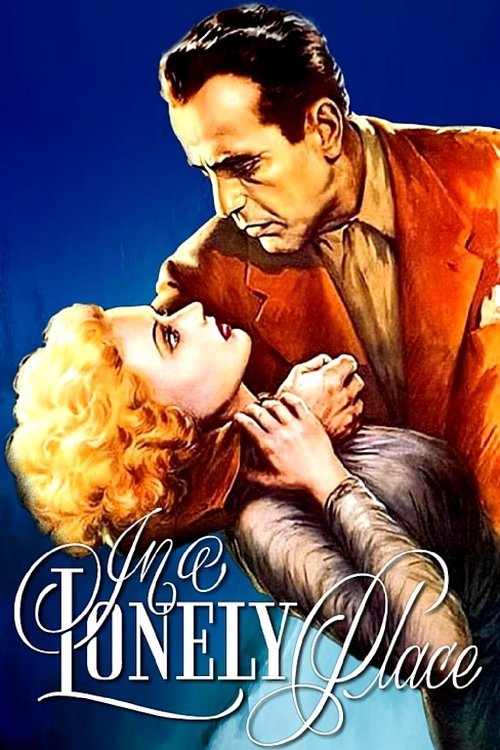
In a Lonely Place
1950 · Nicholas Ray
For when you want a grown-up heartbreaker with a dark edge — a film to chew on for days, best watched when you're ready to feel something complicated rather than comforted.
What it's about
Dixon Steele is a Hollywood screenwriter with a brilliant past, a stalled career, and a violent temper that goes off like a tripwire. When a young woman he barely knew turns up murdered, his neighbor Laurel Gray gives him an alibi — and then falls in love with him. The mystery of who killed the girl matters far less than the question that grows between them: what is Laurel actually living with?
The experience
It starts as a murder mystery and turns into something much sadder and more frightening — a love story poisoned in slow motion by doubt. Intimate, adult, and quietly devastating; it gets under your skin and stays there.
Performances
Humphrey Bogart gives maybe his rawest performance — charming, wounded, and genuinely scary, often within a single scene — and Gloria Grahame matches him as a woman watching her love curdle into fear.
The craft
Nicholas Ray directs it as a noir turned inward: the shadows fall on a relationship instead of a crime, and Hollywood itself — the industry Bogart and Ray worked in — is the corrosive backdrop. The framing of Bogart's face in his darkest moments is some of the most unnerving imagery in 1950s American film.
Why it matters
Undervalued on release, it's now ranked among the greatest of all film noirs — the one that turned the genre's suspicion onto love itself, and a touchstone for every film about a romance shadowed by what one partner might be capable of.
Snapshot
In a Lonely Place is the film in which the noir cycle turns its suspicion inward, onto its own maker. Humphrey Bogart plays Dixon Steele, a Hollywood screenwriter with a distinguished past, a stalled career, and a temper that detonates without warning; Gloria Grahame plays Laurel Gray, the neighbor who alibis him out of a murder charge and then, slowly, comes to fear the man she loves. Directed by Nicholas Ray for Bogart's own Santana Productions and released through Columbia, the film wears the costume of a murder mystery but abandons the whodunit almost immediately. Its true subject is whether two damaged people can sustain love under the corrosive pressure of doubt — and its devastating answer is that the suspicion itself does the killing, regardless of guilt. Long undervalued on release, it is now widely regarded as one of the supreme American films of its decade, the keystone of Ray's reputation, and arguably the finest, most self-lacerating performance Bogart ever gave.
Industry & production
The film was a product of the postwar independent-production moment, when major stars set up their own companies to gain creative control and tax advantages. Bogart had co-founded Santana Productions (named for his yacht) with producer Robert Lord in 1948, releasing through Columbia under Harry Cohn. In a Lonely Place was a Santana picture, which is central to understanding it: Bogart was both star and proprietor, and the role of a brilliant, self-destructive Hollywood professional carried an unmistakable autobiographical charge for an actor known for his own combativeness and drinking.
The source was Dorothy B. Hughes's 1947 novel, a first-person study of a serial strangler. The adaptation by Edmund H. North and the screenplay by Andrew Solt transformed the material radically, discarding Hughes's premise that Dix is the killer. Nicholas Ray was hired to direct; he had recently emerged with They Live by Night. The casting of Grahame is bound up with one of the most-discussed production circumstances in noir history: Grahame and Ray were married during filming, and their marriage was disintegrating on set. Accounts long in circulation describe the couple as estranged, even living apart in the studio, with a contractual arrangement reportedly ceding Ray professional control over her — details often repeated but which should be treated with some caution as to exact terms. What is not in dispute is that the off-screen wreckage of the marriage shadows the on-screen romance, lending Laurel's dawning fear a documentary intensity. Columbia had initially wanted Ginger Rogers or Lauren Bacall (Bogart's wife) for Laurel; the part went to Grahame instead.
The film performed modestly in 1950 and was not a notable commercial success, consistent with its bleak refusal of resolution.
Technology
In a Lonely Place was made with the standard apparatus of a 1950 studio production: black-and-white 35mm photography, Academy ratio, optical soundtrack, predominantly soundstage-bound shooting with controlled studio lighting. There is no technological novelty to claim here, and to assert otherwise would be false — the film's distinction lies wholly in how conventional tools are deployed. Its most significant "technological" choice is one of restraint: the apartment-courtyard set that anchors the film was built to allow continuous, observational staging across facing windows and a shared patio, so that the spatial architecture itself dramatizes proximity and surveillance. The film exploits the deep tonal range and high-contrast modeling that fast panchromatic stock and studio arc lighting made available, but as expressive instrument rather than demonstration.
Technique
Cinematography
Burnett Guffey — later an Oscar winner for From Here to Eternity and Bonnie and Clyde — shot the film, and his work is a model of disciplined noir chiaroscuro that never tips into mannerism. Faces are sculpted so that Bogart's can shift, within a single setup, from charm to menace as the light catches the hardness around his eyes. Guffey favors stable, classically composed framings rather than the canted angles of more baroque noir, which makes the eruptions of violence more shocking against the calm. A recurring strategy is the use of the courtyard geometry to place characters in separate planes — Laurel watched from across the patio, doorways and windows framing figures as if under observation. Crucial dramatic beats are staged in tight two-shots that trap the lovers in the same frame even as the emotional distance between them widens.
Editing
Viola Lawrence, a veteran Columbia editor, cut the film, and the editing is notable for its patience. The picture lets scenes run on performance and reaction rather than chopping for tension, trusting Bogart's face to carry shifts of mood. The most consequential editorial fact concerns the ending. As scripted (and shot), the film concluded with Dix strangling Laurel — confirming, in effect, the novel's logic. Ray, by his own later account, found this false and reshot the finale so that Dix is interrupted before he can kill: the phone rings with news clearing him of the original murder, but the relationship is already destroyed, and Laurel watches him walk away. The released cut thus ends not with a corpse but with something worse — a love killed by what it revealed about both people. This decision, made late and against the written blueprint, is the single most important interpretive act in the film's construction.
Mise-en-scène / staging
Ray was among the most spatially intelligent of American directors, and the staging here is exemplary. The shared courtyard becomes a moral arena where private life is perpetually semi-public. Domestic interiors — Dix's cluttered, masculine apartment; Laurel's brighter rooms — are choreographed so that bodies move through them in ways that telegraph dominance, retreat, and entrapment. A celebrated set piece has Dix re-enacting a hypothetical strangling for his detective friend and the friend's wife at a dinner table, his hands miming the murder with a frightening relish that freezes the room: the staging makes the audience feel, as the onlookers do, that the line between imagination and capacity has gone thin. Throughout, Ray blocks the lovers to begin in intimate closeness and gradually open physical gaps between them, the geometry tracking the erosion of trust.
Sound
George Antheil — the avant-garde composer once notorious as the "Bad Boy of Music" — wrote the score. His music here is comparatively restrained and romantic on the surface, supporting the love story while threading in unease; it underscores tenderness in ways that the narrative will betray, so that the lush passages acquire irony in retrospect. Dialogue carries enormous weight: the screenplay is unusually literate, full of insider Hollywood talk, and the soundtrack lets verbal sparring breathe. The film's most quoted lines are the ones Dix composes for his own screenplay — "I was born when she kissed me. I died when she left me. I lived a few weeks while she loved me" — spoken first as romance and reprised at the close as elegy, a structural use of language as motif.
Performance
The film rests on two extraordinary performances. Bogart strips away the protective irony of his star persona to expose something raw: Dix is witty, loyal, and capable of real tenderness, yet his violence is not a plot mechanism but a settled feature of his character, and Bogart refuses to soften it or excuse it. It is among the bravest things he did on screen — a portrait of charisma curdled by rage that risks the audience's affection. Grahame's Laurel is its equal and counterweight: watchful, sensual, increasingly haunted, registering fear in micro-shifts of expression rather than melodrama. The supporting playing — Frank Lovejoy as the sympathetic detective, Carl Benton Reid, Art Smith as Dix's loyal agent Mel — grounds the central relationship in a credible professional world. The Bogart–Grahame chemistry is genuine and unsettling precisely because it carries warmth and dread at once.
Narrative & dramatic mode
The film executes a deliberate genre bait-and-switch. It opens as a murder mystery — a young hat-check girl is killed after leaving Dix's apartment, and he is the prime suspect — but it resolves the literal crime almost casually and redirects all dramatic energy toward the romance. The governing mode is therefore not detection but moral and psychological suspense: the question is never really "did Dix do it?" but "what is Dix capable of, and can Laurel live with not knowing?" This is a tragedy of character built on dramatic irony — the audience, like Laurel, accumulates evidence of Dix's temper while wanting to believe in him — and it withholds the consolation of certainty. The structure is closer to chamber drama than to thriller: a few interiors, a small cast, a relationship examined under intensifying pressure until it breaks.
Genre & cycle
In a Lonely Place belongs to the classic American film noir cycle of roughly 1944–1955, but it occupies an unusual position within it. It lacks the femme fatale, the heist, the doomed criminal scheme; its threat comes not from a corrupt outside world but from inside the protagonist and inside the relationship. In this it anticipates the cycle's late, introspective phase and overlaps with the postwar problem picture about damaged men — Dix's barely governed violence has been read by later critics as inflected by the era's awareness of returning veterans and unspecified trauma, though the film leaves his history pointedly vague. It is also a Hollywood-on-Hollywood film, joining a small, potent group (alongside Sunset Boulevard, released the same year, and later The Big Knife) that turns the industry's gaze on its own pathologies. Its hybridity — noir, romance, melodrama, show-business satire — is part of why it eluded easy placement in 1950 and why it has proven so durable since.
Authorship & method
The film is central to the auteurist case for Nicholas Ray as a great American director. Ray's recurring concerns — outsiders, the impossibility of home, tenderness wrecked by violence, the loneliness encoded in the title — are all present, and his method of building emotion through space and gesture rather than plot is fully realized. His decisive late reinvention of the ending is the clearest evidence of authorship overriding the script. He worked here with first-rate collaborators: cinematographer Burnett Guffey, whose restrained chiaroscuro serves the drama rather than displaying itself; editor Viola Lawrence, whose patient cutting lets performance govern rhythm; composer George Antheil, whose ironically romantic score shadows the love story; and writers Andrew Solt and Edmund H. North, adapting Dorothy B. Hughes. Looming over the production is the entanglement of Ray and Grahame's failing marriage, which by most accounts charged the film's depiction of intimacy under suspicion with real-life desolation — a rare case where biography and subject seem to bleed directly into one another.
Movement / national cinema
This is mainstream Hollywood studio filmmaking — a Columbia release via an independent star company — rather than the product of any formal movement. Its retrospective importance to movements is largely a matter of reception: it became a touchstone for the French critics of Cahiers du cinéma, who elevated Ray to the front rank of American auteurs, and through them for the directors of the nascent New Waves. Within American cinema it sits in the noir tradition while pointing toward the more psychologically exposed, character-driven films of the later 1950s.
Era / period
In a Lonely Place is a quintessential artifact of 1950 Hollywood and of the broader postwar American mood: disillusionment beneath prosperity, a culture uneasy about masculine violence, an industry both glamorous and predatory. The film's portrait of a once-successful man whose talent and temper have outrun his standing speaks to anxieties about reputation and the precariousness of professional life. It belongs to the same crowded year as Sunset Boulevard and All About Eve, films that share its skepticism about the worlds that made them, marking 1950 as a moment when American cinema grew unusually willing to look critically at itself.
Themes
At its center is the proposition that suspicion can destroy love as surely as guilt would. The film anatomizes male violence with rare honesty, refusing to romanticize Dix's rage even as it makes him magnetic. Loneliness — announced in the title — is its emotional ground note: Dix is isolated by temperament and by the gap between his gifts and his circumstances, and the brief possibility of connection only sharpens the desolation when it fails. Other threads run through it: the corrosions of the Hollywood machine and the disposability of those who serve it; the difficulty of truly knowing another person; the way past success becomes a burden. The film's tragic insight is that Dix need not be the killer for the relationship to be doomed — what Laurel learns about his capacity for violence is enough, and that knowledge cannot be unlearned.
Reception, canon & influence
On release in 1950 the film drew respectful but unspectacular notice and performed modestly; it was not, at the time, regarded as a landmark. Its reputation grew enormously over subsequent decades, driven first by the French auteurist critics' veneration of Ray — Jean-Luc Godard's famous declaration that "the cinema is Nicholas Ray" (written in a review of the later Bitter Victory) captures the esteem in which that generation held him — and then by the broader critical rehabilitation of film noir and of Bogart's range. It is now routinely cited among the greatest films noir and among Bogart's finest work, and has been recognized in canon-forming surveys and preservation efforts as a major American film.
Looking backward, the film draws on Dorothy B. Hughes's novel (while inverting its central premise), on the established noir vocabulary of light and dread, and on the Hollywood self-portrait tradition. Looking forward, its influence runs through later films about violent or self-destructive men and about love undone by mistrust, and through the self-reflexive Hollywood film as a form. Filmmakers and critics have repeatedly named it an inspiration — Curtis Hanson among those who have publicly championed it — and Ray's wider devotees, notably Wim Wenders (who chronicled Ray's final days in Lightning Over Water), helped sustain the director's stature. Its most lasting legacy may be tonal: it demonstrated that a noir could dispense with the mechanics of crime and locate its terror entirely in character and intimacy, a move that expanded what the genre, and the American film more generally, could be about.
A Deleuzian reading
Watch his hands.
The full Deleuzian reading of In a Lonely Place →
Reception
A modest performer met with polite reviews in 1950, it's since climbed into the noir pantheon — now routinely called Nicholas Ray's masterpiece and one of Bogart's two or three greatest performances, a rise cemented by decades of critical championing and a Criterion release.
How In a Lonely Place was received, from release to now →
Influences: the films it descends from and the films it influenced
- They Live by Night (1948) — Ray's debut established the method realized here — building emotion through spatial blocking, courtyard geography, and gesture rather than plot mechanics, with doomed outsiders as the recurring subject.
- High Sierra (1941) — Gave Bogart the sympathetic-killer template of tenderness shadowed by lethal violence, the exact persona Ray fractures by casting him as a man we come to fear.
- The Maltese Falcon (1941) — Codified the hard, controlled Bogart screen persona whose stability the film weaponizes as a bait-and-switch, letting that trusted mask crack into menace.
- A Star Is Born (1937) — The Hollywood self-portrait built on a marriage corroded by the man's self-destruction — a structure Ray inverts into noir, replacing alcoholic decline with violent paranoia.
- Laura (1944) — A chamber noir of romantic obsession carried by a lushly romantic recurring theme played against the dread — the precedent for Antheil's ironically tender scoring of a love story curdling.
- Double Indemnity (1944) — Fixed the noir grammar of restrained chiaroscuro and venetian-blind shadow that Burnett Guffey deploys in service of character rather than display.
- Gilda (1946) — Migrated noir's menace away from crime mechanics and into a mutually destructive couple, anticipating the film's relocation of terror entirely to intimacy.
- The Big Heat (1953) — Reuses Grahame's flickering microexpression and the theme of male violence physically and emotionally scarring the woman closest to it.
- Rebel Without a Cause (1955) — Continues Ray's architecture of feeling expressed through blocking and the impossibility of home, scaling the courtyard staging up into widescreen emotional geography.
- Bigger Than Life (1956) — A domestic chamber drama in which a sympathetic man's escalating menace erodes a household's trust through staging and gesture — the In a Lonely Place engine moved indoors.
- Vertigo (1958) — Builds suspense from love undone by a man's controlling obsession and suspicion, locating dread in intimacy and shooting the romance itself as the source of menace.
- Raging Bull (1980) — Casts a star against type as a self-destructive violent man whose jealous suspicion annihilates love — terror located wholly in character, not in the genre's external action.
- Lightning Over Water (1980) — Wenders, the Ray devotee who literally documented the dying director, carries forward Ray's biography-bleeding-into-subject and his portrait of the artist as doomed outsider.
- L.A. Confidential (1997) — Hanson publicly championed the film and revives its classical noir framing and the figure of the brutal man whose violence threatens the woman who loves him.
- Mulholland Drive (2001) — Extends the self-reflexive Hollywood film by placing its horror in interior character and intimacy rather than industry plotting, the genre bait-and-switch pushed to dream logic.
- Gone Girl (2014) — Runs the same genre bait-and-switch — a thriller that withholds conventional crime mechanics to study how suspicion and performance dismantle a marriage from inside.
- The American Friend (1977) — Ray's tender, doomed reading of a compromised, isolated man establishes the melancholy-masculine register Wenders adopts and pays back through Ray's on-screen presence as a 'dead' artist who survives.
- The Harder They Fall (1956) — Burnett Guffey's low-key noir chiaroscuro built around a weathered Bogart face is the direct visual precedent Guffey extends in his Oscar-nominated photography here.
- Choose Me (1984) — The noir template Rudolph strips for parts: a crime plot demoted to pretext so that a chamber romance between two people concealing their real selves becomes the actual subject, staged across a handful of recurring interiors rather than an investigation.
- Sunset Boulevard (1950) — Released the same year as the definitive self-reflexive Hollywood film, locating horror inside an industry insider's psyche rather than in external crime.
- The Bad and the Beautiful (1952) — Extends the industry-as-subject Hollywood portrait and redeploys Gloria Grahame, whose microexpressive vulnerability the film mines the same way Ray does.
- The Big Sleep (1946) — Bogart's sardonic Hollywood screenwriter inherits the equanimity-under-pressure performance template established by Marlowe, while Ray uses Hawksian spatial intimacy — actors placed in proximity the dialogue barely justifies — to generate erotic charge under identical Production Code constraints.
- The Postman Always Rings Twice (1946) — Extends the Garfield-style naturalistic male lead drawn from theatrical Method acting, building noir tension out of intimate two-character performance rather than plot mechanics.
Similar films
- Laura (1944) — influence & lineage · same viewing thread · often watched together
- The Big Heat (1953) — influence & lineage · same viewing thread
- The Maltese Falcon (1941) — influence & lineage
- Sunset Boulevard (1950) — influence & lineage
- Double Indemnity (1944) — influence & lineage
- L.A. Confidential (1997) — influence & lineage
- Gilda (1946) — influence & lineage
- Kiss Me Deadly (1955) — same viewing thread
All the films related to In a Lonely Place →
Watch it with: curated runs of related films
- The Long Shadow of M — A run from Lang's Weimar crime films through their noir and neo-noir children — killers, con men, masterminds, and manhunts — where you can watch expressionist menace mutate step by step into the modern thriller.