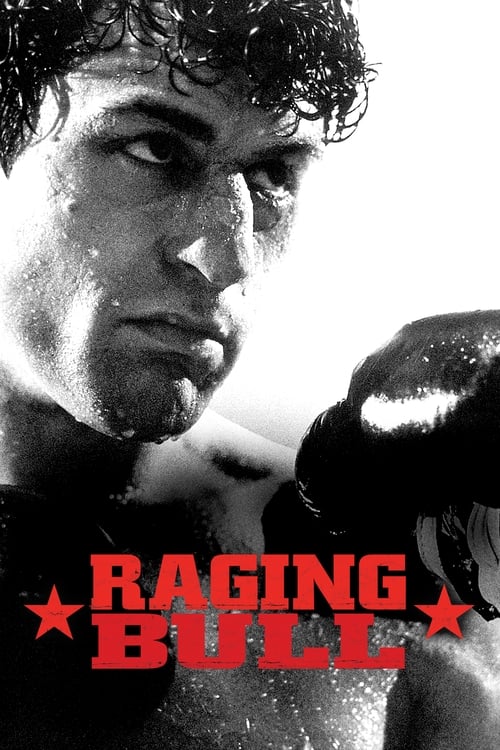
Raging Bull
1980 · Martin Scorsese
His "Marvel isn't cinema" comments spawned a years-long culture war about what cinema even is; Killers of the Flower Moon added runtime discourse and questions about centering white perspectives in Osage history. Also beloved as a TikTok dad and Letterboxd's patron saint.
For when you want to be leveled by a film — a heavyweight character study for a night you're ready to sit with something dark and come out the other side. Challenge, not comfort.
What it's about
Jake LaMotta fights his way up through the middleweight ranks of 1940s New York, managed by his loyal brother and shadowed by the mob that controls the sport. The same fury that makes him nearly unbeatable in the ring turns on everyone he loves — his wife most of all — as jealousy and paranoia eat him from the inside. It's a boxing biography where the real fights happen at the kitchen table.
The experience
Brutal and hypnotic — the ring sequences hit like nightmares, and the domestic scenes are somehow harder to watch. It's punishing, magnificent filmmaking that leaves you wrung out rather than pumped up.
Performances
Robert De Niro's LaMotta is a landmark of screen acting — he trained to fight convincingly, then famously transformed his body for the character's later years, and the rage and self-loathing underneath never break. Joe Pesci and Cathy Moriarty, both then unknowns, go toe to toe with him.
The craft
Scorsese shot it in stark black and white against every commercial instinct, and the fight scenes — each choreographed with its own visual logic, with flashbulbs, animal cries, and silence woven into the sound — changed how screen violence is edited forever. Thelma Schoonmaker's cutting won an Oscar and earns it in every round. Demands a big screen and good speakers.
Why it matters
Regularly named the best American film of the 1980s, it won De Niro the Academy Award and cemented the Scorsese–De Niro partnership as the defining actor-director collaboration of its era. Every serious boxing film since lives in its shadow.
Snapshot
Martin Scorsese's portrait of middleweight boxer Jake LaMotta stands as one of the defining works of American cinema—a film about self-annihilation rendered in monochrome with the formal precision of a requiem. Shot almost entirely in black and white at a moment when color was the unchallenged commercial norm, Raging Bull turns the prize ring into an arena of Catholic suffering and masculine paranoia, tracing LaMotta's rise to the world middleweight title and his subsequent dissolution through jealousy, domestic violence, and mob entanglement. It is simultaneously a sports film, a character study, a stylistic tour de force, and Scorsese's most confessional work—made while the director was in personal crisis and understood, by his own account, as an act of artistic and spiritual survival.
Industry & production
Robert De Niro had been pursuing the LaMotta project for years before he brought it to Scorsese in the mid-1970s, pressing a copy of LaMotta's 1970 autobiography Raging Bull: My Story (co-written with Joseph Carter and Peter Savage) on the director during the New York, New York shoot. Scorsese was initially resistant—he did not regard himself as a boxing enthusiast—but De Niro's conviction, combined with the material's undertow of guilt and violence, eventually proved persuasive. The screenplay passed through two primary hands: Mardik Martin drafted an early version, and Paul Schrader—whose work on Taxi Driver had established the template for this strain of self-lacerating male psychology—wrote the version that most shaped the final film, though the credits list both writers. Schrader has said he found the interior life of LaMotta near-impenetrable and structured the screenplay around external incident rather than psychological exposition, a choice that proved formally productive.
The film was produced by Robert Chartoff and Irwin Winkler under their United Artists deal—the same producers who had delivered Rocky four years earlier, an irony that sharpens the contrast between the two films' visions of the boxer. Production took place in 1979, primarily on Los Angeles soundstages, with location work in New York. The budget was in the range of eighteen million dollars, modest by late-New Hollywood standards. De Niro's decision to gain approximately sixty pounds for the sequences depicting LaMotta's later years required a production hiatus; the actor trained extensively with LaMotta himself, reportedly sparring enough rounds to have competed as a professional.
Technology
The decision to shoot in black and white was deliberate and multiple in its reasoning. Scorsese has cited concerns about the longevity of color film stocks from the late 1970s (several of his earlier color films had already suffered fading) and a desire for the film to look durable across decades rather than fixed to its production moment. He has also pointed to the visual grammar of boxing photography from the 1940s—the ringside stills of photographers like Stanley Kubrick's early photojournalism—as a template for the film's aesthetic world. An additional motivation was the desire to distinguish Raging Bull from Rocky: the celebratory, warmly lit color palette of John G. Avildsen's film occupied one end of the boxing-film spectrum, and Scorsese wanted the opposite pole. The home-movie sequences—LaMotta's domestic life in the 1950s—were shot on 8mm color stock, then blown up, creating a deliberate degradation that marks those passages as memory rather than record.
The ring itself was built as a set on a soundstage, and its dimensions were adjusted for different fights, a detail Scorsese has discussed as a means of controlling spatial dynamics. Cinematographer Michael Chapman and the camera crew worked at extremely close distances to the fighters, sometimes operating handheld at floor level or positioning cameras at ringside with wide-angle lenses. The Steadicam—recently introduced and used to celebrated effect in Rocky—was employed selectively rather than as a default tool; Chapman's approach was more varied and aggressive than the smooth glide associated with that technology.
Technique
Cinematography
Michael Chapman, who had shot Taxi Driver with Scorsese and Vilmos Zsigmond on The Last Waltz, brought to Raging Bull a photographic sensibility calibrated to extremity. The ring sequences are the technical set pieces: Chapman used wide-angle lenses to distort the geometry of boxing, compressing or expanding distances in ways that disorient the viewer's spatial sense. Slow motion—at various frame rates—is deployed not for elegance but for violence, stretching the moment of impact until it acquires the suspended quality of trauma. The ring is lit in high contrast, sweat and blood catching the light against a middle-distance darkness. Outside the ring, the domestic scenes are shot with a more naturalistic flatness, the visual grammar shifting registers to track LaMotta's psychological state. Chapman was nominated for the Academy Award for Cinematography.
Editing
Thelma Schoonmaker won her first Academy Award for her work here—the beginning of one of the most significant long-term director-editor partnerships in American cinema. Schoonmaker had worked with Scorsese as far back as Who's That Knocking at My Door (1967) and Woodstock (1970), and from Raging Bull onward she has edited virtually every Scorsese feature. Her approach to the ring sequences is the film's formal signature: she builds through rapid, disorienting cuts that refuse conventional match-cutting logic, then releases into slow motion, creating a rhythm that feels less like sports broadcasting than like the interior experience of violence. Transitions between time periods are made abruptly, without dissolves or title cards in many cases, demanding active assembly on the viewer's part. The domestic scenes are cut with a different tempo—longer takes, more observational—but punctuated by sudden eruptions that echo the ring.
Mise-en-scène / staging
Scorsese's staging is organized around the principle that the ring and the domestic space are continuous environments—that LaMotta carries the ring inside him wherever he goes. The cramped apartments and nightclub interiors are staged to reproduce the claustrophobia of a boxing gym or dressing room; exits are blocked, eyelines are confrontational, furniture becomes obstacle. The film deploys a recurring motif of LaMotta framed against walls or in doorways—contained, surveilled, the possessive rage that makes him formidable in the ring reading as pathology in a living room. The camera frequently moves with an agitation that mirrors his psychology, then freezes into stillness at moments of rupture. The fights themselves are staged as distinct set pieces, each with its own choreography and lighting scheme, so that the sequence of bouts reads as a kind of episodic cycle rather than a continuous narrative of athletic career.
Sound
The sound design of Raging Bull was among the most discussed of its era. Sound editor Frank Warner constructed the audio for the ring sequences from sources that had no literal connection to boxing—animal sounds, camera shutters, and other non-athletic material were reportedly layered to create the film's characteristic impact sounds. The effect is not realism but expressionism: punches arrive with a weight and texture that registers as primal rather than athletic. The contrast between this heavily designed ring sound and the ambient quietness of the domestic scenes amplifies the film's central argument about where LaMotta's violence lives. Pietro Mascagni's Intermezzo from Cavalleria Rusticana—an opera concerning jealousy, betrayal, and murder in a Sicilian village—recurs on the soundtrack, its lyrical melancholy placing LaMotta's story within a longer tradition of Southern Italian masculine tragedy.
Performance
De Niro's performance is the film's lodestone. His preparation was physical—the weight gain, the boxing training—but his screen work is more than athletic mimicry. He renders LaMotta's paranoia as a kind of total sensory alertness, every glance across a room calibrated for threat, every compliment registered as potential insult. The performance is largely interior and depends on withholding: LaMotta does not explain himself, does not ask for sympathy, and De Niro refuses to supply explanatory affect. The older LaMotta, overweight and reciting Paddy Chayefsky dialogue in a Miami nightclub, is one of the period's most desolating screen images. Joe Pesci, in his first substantial film role, plays Joey LaMotta with a quick-tempered volatility that would become his signature register; the relationship between the brothers—affectionate, exploitative, ultimately ruptured—carries the film's emotional core. Cathy Moriarty, in her screen debut and her late teens during production, brings an uncanny stillness to Vickie LaMotta; her flat affect in the face of Jake's interrogations reads as the survival strategy it is.
Narrative & dramatic mode
Raging Bull does not follow the arc of a conventional biopic or sports film. It does not build toward triumphant validation of its subject, nor does it supply a clear moment of redemptive self-knowledge. The structure is episodic—a series of increasingly compressed vignettes spanning 1941 to 1964—and the framing device (LaMotta rehearsing his nightclub act) establishes from the opening that we are watching a man performing himself, narrating backward through a life he cannot fully understand. The film's final image—LaMotta alone before a mirror, shadowboxing, reciting Brando's "I coulda been a contender" speech from On the Waterfront—positions him as both self-appointed tragic hero and absurdist figure, quoting another man's lines to explain his own failure. Before the credits, a verse from John 9:25 appears on screen ("I once was blind and now I can see"), which Scorsese has said reflects his own experience of making the film as an act of recovered sight. The film thus operates simultaneously as LaMotta's portrait and Scorsese's confession, the subject and the director occupying the same moral and psychological space.
Genre & cycle
Raging Bull belongs to the boxing film, a genre with roots in pre-code Hollywood and a persistent association with working-class masculinity, ethnic identity, and the ambivalent promise of physical self-determination. It enters into dialogue with a long lineage: Body and Soul (1947), Champion (1949), The Set-Up (1949), and Somebody Up There Likes Me (1956) all share its preoccupation with the ring as social escalator and moral crucible. But Scorsese and Schrader strip the genre of its residual optimism—there is no trainer-as-father-figure structure, no redemptive championship, no community restored. Raging Bull is closer to the genre's darkest iteration: a film that uses the prize ring as a laboratory for studying what violence does to a man who is constitutively incapable of leaving it at the ropes. It also belongs to the male-crisis film that dominated American prestige cinema of the late 1970s and early 1980s, a cycle that includes Apocalypse Now, The Deer Hunter, and Ordinary People—films preoccupied with masculinity's capacity for self-consumption.
Authorship & method
Scorsese's authorship here is indivisible from his biography. He has spoken at length about making the film while emerging from a period of severe drug dependency and physical collapse following New York, New York and the The Last Waltz, and about understanding the project as a confrontation with his own capacity for self-destruction. The film's Catholicism—guilt as atmosphere rather than doctrine, the body as the site of both sin and suffering—reflects his formation in the Italian-American Catholic community of Little Italy, the same milieu that generated Mean Streets and Who's That Knocking at My Door. His collaboration with De Niro, begun with Mean Streets (1973), reaches its most intensive point here; accounts of the production describe an unusually close identification between director and subject, with Scorsese and De Niro working through the material together in a manner closer to the Cassavetes tradition than to conventional studio practice. Schoonmaker's contribution as editor cannot be overstated: the film's rhythm is as much her creation as Scorsese's, and their partnership would define his output for the next four decades. Chapman's photography and Warner's sound design complete a collaborators' quartet whose individual contributions are deeply integrated—it is one of American cinema's great ensemble achievements behind the camera.
Movement / national cinema
Raging Bull occupies a transitional moment in American cinema. It is a late New Hollywood film—made under the conditions of relative directorial autonomy that the auteur revolution of the late 1960s had secured, but already operating in a landscape where the commercial blockbuster model established by Jaws and Star Wars was restructuring studio priorities. Scorsese belongs to the generation of film-school directors (alongside Coppola, De Palma, Spielberg, Lucas) who reshaped American cinema by synthesizing European art cinema influences with Hollywood genre forms; Raging Bull is perhaps the most extreme product of that synthesis—a genre picture whose formal ambitions are closer to Visconti or Cassavetes than to anything the studio system had conventionally produced. Its Italian-American specificity—the Bronx milieu, the Mascagni, the Sicilian codes of honor and jealousy—places it within a distinct strand of ethnic American cinema that had no real precedent in mainstream Hollywood before Coppola and Scorsese made it visible.
Era / period
The film was released in November 1980, the year of Ronald Reagan's election, and its bleak vision of masculine failure and institutional corruption (LaMotta's mob entanglement, the boxing commission's complicity) can be read against the optimism of the moment's political turn—though such readings risk over-determination. More precisely, it belongs to the cultural reckoning of the late 1970s, when the counterculture's promises had curdled and American cinema was working through the consequences. Raging Bull shares with Apocalypse Now and The Deer Hunter a preoccupation with the price of a certain American masculine ideal, and its formal darkness stands as a period document regardless of its ostensible setting in the 1940s and 1950s.
Themes
The film's central preoccupation is the relationship between violence and possession—LaMotta's need to own and control everything around him, including his own body, and the paradox that the qualities that make him a formidable fighter make him incapable of ordinary human relationship. Jealousy is its motor: LaMotta's obsessive surveillance of Vickie, his paranoid interrogations of Joey, his incapacity to believe that any woman near him is not being possessed by another man. The film traces this not as psychological pathology to be diagnosed but as a mode of being that has its own tragic logic. Catholicism runs beneath the surface—guilt, suffering, and the body as instrument of both transgression and penance. The question of intelligence is also present: LaMotta is not stupid, but his intelligence is entirely corporeal, and the film mourns the gap between physical genius and the capacity for self-knowledge. The closing nightclub scenes, in which LaMotta has become a minor celebrity performing his own degradation, propose an uncomfortable answer to the question of whether self-destruction can become its own kind of performance.
Reception, canon & influence
Critical reception. The film opened to admiring but not universally rapturous reviews. Pauline Kael, the most influential American critic of the period, found it technically impressive but morally exhausting—she questioned whether the film's refusal of sympathy was a virtue or an evasion. Vincent Canby's review in the New York Times was more measured than enthusiastic. Roger Ebert awarded it four stars and wrote with conviction about its formal achievement. The film received eight Academy Award nominations and won two: De Niro for Best Actor and Schoonmaker for Best Editing. It lost Best Picture and Best Director to Robert Redford's Ordinary People—a result that has since become one of the canonical examples of Oscar misvaluation. The film performed modestly at the box office on initial release; it was not a commercial failure, but it did not match the returns that would have been expected from a De Niro vehicle at this moment.
Influences on the film (backward). Scorsese's cinephilia is documented extensively, and Raging Bull's debt to specific antecedents is traceable. John Cassavetes' improvisatory domestic dramas (Faces, Husbands) shaped the register of the non-ring scenes—the way the camera observes without editorialising, the performances' roughness. Italian neorealism, particularly Visconti—whose Rocco and His Brothers (1960) had already mapped Italian-American working-class masculinity onto operatic tragedy—is a clear structural influence. The boxing films of the 1940s, especially Robert Rossen's Body and Soul and Robert Wise's The Set-Up, provide genre templates that Scorsese systematically inverts. The Powell and Pressburger tradition—the idea that a physical art form (dance, in The Red Shoes) can be rendered in film as both documentation and transfiguration—informs the ring sequences' relationship to the sport. Scorsese's own Mean Streets is the direct predecessor: the same milieu, the same Catholic guilt, the same explosive violence contained within domestic space.
Legacy and influence (forward). Raging Bull's canonization was gradual and then decisive. By the late 1980s it had displaced Citizen Kane in several critics' polls as the greatest American film of the sound era, a position it held in the American Film Institute's 2007 survey (ranked fourth on their revised list). Its influence on subsequent filmmaking is pervasive and often unacknowledged. The aestheticization of violence in the ring—slow motion, extreme close-up, stylized sound—became a default visual language for boxing and combat films in the decades following. Darren Aronofsky's The Wrestler (2008) is its most direct descendant in its treatment of the athletic body as site of self-punishment. Paul Thomas Anderson has cited Scorsese's work of this period as foundational to his own approach to masculine interiority. The biopic's transformation—from hagiography toward the more abrasive, anti-redemptive form—owes a significant debt to Raging Bull's refusal of conventional narrative satisfaction. Schoonmaker's editing approach, developed here, changed how film editors thought about the relationship between rhythm and violence. And the film cemented De Niro's physical transformation methodology as a paradigm—for better and worse—for what serious screen acting required.
A Deleuzian reading
The old fighter stands in front of a dressing-room mirror, sixty pounds heavier than the man who won the title, working a speech that isn't his.
The full Deleuzian reading of Raging Bull →
Reception
Divided critics and underwhelmed at the box office in 1980 — many found it brutal and cold — but within a decade critics' polls were crowning it the best American film of the 80s, and it's now bedrock canon.
How Raging Bull was received, from release to now →
Influences: the films it descends from and the films it influenced
- On the Waterfront (1954) — Brando's Method inhabitation of a washed-up fighter and the 'I coulda been a contender' confessional is literally re-performed by De Niro as LaMotta's dressing-room mirror monologue, the template for the role's interiorized self-pity.
- Body and Soul (1947) — James Wong Howe shot the climactic bout on roller skates with a handheld camera inside the ropes, inventing the subjective in-the-ring vantage that Michael Chapman pushes to wide-angle extremity.
- The Set-Up (1949) — Renders a single fight as a real-time expressionist ordeal of sweat-streaked ringside close-ups and crowd grotesques, the noir boxing grammar Scorsese inherits for his high-contrast ring lighting.
- Citizen Kane (1941) — Toland's wide-angle deep-focus warping of spatial geometry is the optical precedent for Chapman distorting the ring's distances with wide lenses to disorient the viewer's sense of space.
- The Wild Bunch (1969) — Lou Lombardo's multi-speed slow-motion montage of bodily impact established violence-as-ballet at variable frame rates, the editing logic Schoonmaker adapts to stretch the moment of the punch into suspended trauma.
- Battleship Potemkin (1925) — The Odessa Steps' associative montage—cutting for rhythmic shock rather than spatial continuity—is the model Scorsese cites for building ring sequences out of disorienting, anti-matched fragments.
- Rocco and His Brothers (1960) — Fuses a boxer's rise with operatic family melodrama and Catholic suffering scored to swelling strings, the Italian-American craft lineage behind Raging Bull's Mascagni intermezzo and brother dynamic.
- Taxi Driver (1976) — Schrader and Scorsese's method of externalizing an opaque, self-destructive male psyche through incident rather than exposition—shot by Chapman—is the immediate formal rehearsal for LaMotta's withheld interiority.
- Sweet Smell of Success (1957) — James Wong Howe's glittering high-contrast black-and-white nightworld of New York establishes the durable monochrome expressionism Scorsese reaches for against the color norm.
- Mean Streets (1973) — De Niro's total-immersion body performance — gaining 60 pounds, training professionally — amplifies the physical character truth he established as Johnny Boy; the slow-motion aestheticization of the boxing ring also extends Mean Streets' Peckinpah-derived temporal expansion of violence.
- The Godfather Part II (1974) — De Niro's transformative methodology for LaMotta — obsessive weight gain, posture and dialect research as character construction — descends directly from the Vito preparation he undertook for Coppola; Chapman's high-contrast monochrome chiaroscuro also extends Willis's principle of motivation-based extreme darkness into black-and-white.
- Touch of Evil (1958) — Michael Chapman's wide-angle boxing-ring photography at floor level uses lens distortion to transform LaMotta into a physical grotesque — the same Welles/Metty technique of using extreme-angle wide lenses to exaggerate a performer's physical mass as a projection of moral condition, applied here to self-destruction rather than institutional corruption.
- Schindler's List (1993) — Spielberg and Kamiński shot in black-and-white within a color era explicitly invoking Raging Bull's rationale that monochrome reads as durable, timeless record rather than period artifact.
- There Will Be Blood (2007) — Builds an episodic portrait of masculine self-annihilation around a protagonist whose interiority is deliberately withheld, extending Schrader's incident-over-psychology structure for an anti-redemptive arc.
- The Wrestler (2008) — Carries forward the anti-redemptive sports-body biopic, with handheld immersion in a ruined physique and a continuity between the arena and domestic wreckage that mirrors Raging Bull's ring-to-home staging.
- Black Swan (2010) — Pushes De Niro's total bodily-psychological transformation into performance-as-self-destruction, treating the disciplined body as an arena of suffering rendered in claustrophobic, tactile framing.
- The Fighter (2010) — Reworks the LaMotta template of a working-class fighter destabilized by a parasitic brother and family, staging boxing as an extension of domestic combat.
- Whiplash (2014) — Synchronizes Schoonmaker-style percussive, blood-and-sweat cutting to bodily punishment, turning physical ordeal into an editing rhythm of impact and recovery.
- Creed (2015) — Stages a one-take ringside camera moving inside the ropes that directly inherits Chapman's subjective in-the-ring geography over the broadcast-style coverage of conventional boxing films.
- Million Dollar Baby (2004) — Lights its boxing tragedy in near-monochrome pools of shadow toward an anti-redemptive ending, sharing Raging Bull's rejection of the Rocky uplift in favour of suffering as the genre's true subject.
- The Smashing Machine (2025) — Founding text of the serious fight film: subjective in-ring sound design (amplified blows, animal roars, sudden silence) and the athlete's bodily self-destruction as moral spectacle hang over all the film's combat staging.
- Marty Supreme (2025) — The template for the obsessive-athlete tragedy built around self-destruction, with sound design that makes the arena subjective and the body's punishment visceral.
- Snatch (2000) — The boxing cinematography — undercranked acceleration, slow-motion impact shots, Dutch-angle disorientation, and percussive rapid cutting — descends directly from Michael Chapman and Scorsese's fight choreography, transposed from tragic realism into comic spectacle without surrendering the physical shock.
- Gladiator (2000) — Michael Chapman and Thelma Schoonmaker's use of distorted, suddenly attenuating crowd sound to register LaMotta's psychological dissociation mid-bout is the precise subjective-crowd-roar technique Gladiator's sound design applies to Maximus's dissociative arena states.
- Rumble Fish (1983) — Michael Chapman's high-contrast black-and-white with selective color punctuation (blood on the canvas), combined with fight choreography rendered through wide-angle lens distortion as expressionist spectacle — a near-exact formal parallel reached from different generic material.
- Born on the Fourth of July (1989) — Provides the immersive subjective treatment of a degraded male body and masculine self-destruction through kinetic editing rhythms, a template for Stone's coupling of bodily ruin with emotional overstatement.
- The Hurricane (1999) — Set the template of method physical transformation for a boxing role and expressionistic in-ring photography that Denzel's training regimen and Deakins's stylized fight staging answer.
- The Last Temptation of Christ (1988) — Same Schrader-scripted theology of redemption through bodily suffering, plus Thelma Schoonmaker's subjective editing that makes flesh and punishment the vehicle for grace.
- The Irishman (2019) — Template for Schoonmaker editing married to De Niro's bodily transformation across decades and a protagonist crushed by Catholic guilt — Irishman swaps prosthetics and weight for digital de-aging.
- The Cranes Are Flying (1957) — Scorsese's avowed debt to Kalatozov–Urusevsky surfaces in the subjective, gliding and lunging camera that makes the lens an extension of the protagonist's perception.
- The First Slam Dunk (2022) — Subjective ring sound that drops crowd noise to near-silence and isolates breath, flashbulbs and impact is the template for Slam Dunk's crowd-drop-out and silence set-pieces at the decisive plays.
- Tatami (2024) — Michael Chapman's expressionist high-contrast black-and-white turns the sporting body into a punished canvas — the same monochrome grammar of muscle, effort and pain Tatami adopts for judo.
- The Wrong Man (1956) — Realizes Scorsese's admiration for the film's gray austerity — black-and-white location realism and a suffering Catholic protagonist whose guilt is transferred and expiated through the body rather than plot mechanics.
Similar films
- On the Waterfront (1954) — influence & lineage · often watched together
- Taxi Driver (1976) — influence & lineage · often watched together
- Body and Soul (1947) — influence & lineage
- Rocco and His Brothers (1960) — influence & lineage
- The Wrestler (2008) — influence & lineage
- Million Dollar Baby (2004) — influence & lineage
- The Fighter (2010) — influence & lineage
- The Set-Up (1949) — influence & lineage
All the films related to Raging Bull →
Watch it with: curated runs of related films
- American Crime, Long Memory — A run of mob epics, noir, and neighborhood tragedies that all circle the same wound — loyalty, masculine violence, and the past that never lets go — so watch them close together and let the decades and cities blur into one long American story.
Film essays and courses that include it
- How Cuts Think: From Soviet Montage to New Hollywood Rhythm
- Martin Scorsese
- American Cinema Breaks Open: New Hollywood 1967–1980
- The Grammar of Shadow: Black & White Cinema from Caligari to Raging Bull
- Into the Skin: Cinema's Greatest Performances of Total Commitment
- The Camera That Loves the Sin
- The Shot That Pulls the Ground Away
- The Ghost That Walks
- The Frame That Refuses to End
- The Beautiful Death
- The Hands That Cut the Rhythm