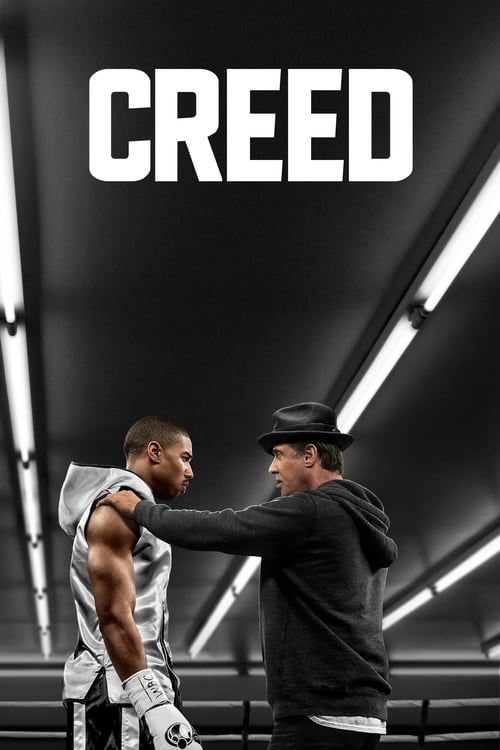
Creed
2015 · Ryan Coogler
Sinners transformed him from Marvel's best franchise steward into the era's proof that original films can still be blockbusters; his ownership-reversion deal with Warner Bros. sparked an industry argument about whether directors owning their films sets a "dangerous precedent." A rare director whose business terms became discourse.
When you need to feel fired up — a bad week, a stalled goal, that itch to get off the couch. Pure comfort with real emotional weight underneath; the movie you put on when you want to believe effort counts.
What it's about
Adonis Johnson grew up in and out of juvenile facilities before learning he's the son of heavyweight legend Apollo Creed, a father he never met. He walks away from a Los Angeles desk job to fight for real in Philadelphia, and talks his father's old rival and friend — an aging, reluctant Rocky Balboa — into training him. It's a boxing story, but really it's about a young man deciding whether to carry a famous name or earn his own.
The experience
Rousing in the old-school way — training montages that genuinely lift you, fights that leave your shoulders tense — but grounded in tender, unhurried scenes between a young fighter and an old man running out of road. You'll get chills and you might cry, in that order.
Performances
Michael B. Jordan carries the film with coiled hunger and vulnerability, and Sylvester Stallone gives one of his finest performances — a Rocky worn soft and sad, whose reluctant return to the corner earned him major awards attention.
The craft
Ryan Coogler directs with confidence beyond his years: an early bout unfolds in a single unbroken take that puts you inside the ropes, and the Philadelphia streets feel lived-in rather than mythic. Ludwig Göransson's score threads the famous old themes into something new, and the fight sound hits hard on good speakers.
Why it matters
It revived a forty-year-old franchise by handing it to a new generation and a new protagonist, launched the Creed series, and confirmed Coogler and Jordan as one of the defining director-actor partnerships of their era.
Snapshot
Creed is the seventh entry in the Rocky franchise and the first to displace its founding star from the title and the center of the frame. Directed by Ryan Coogler from a screenplay he wrote with Aaron Covington, the film follows Adonis Johnson (Michael B. Jordan), the son Apollo Creed never knew, as he leaves a Los Angeles office job and a juvenile-detention past behind to pursue boxing in Philadelphia under the reluctant mentorship of his father's old rival and friend, Rocky Balboa (Sylvester Stallone). The film performs a delicate generic operation: it is at once a faithful continuation of a forty-year-old property and a generational hand-off that re-centers the saga on a young Black protagonist. Coogler treats the franchise's mythology as inheritance rather than nostalgia, and the result revived both a dormant series and Stallone's standing as an actor, earning him an Academy Award nomination for Best Supporting Actor. Creed is significant less for formal novelty than for the precision with which it reconciles studio-franchise obligation with the intimate, character-first sensibility Coogler had established in his debut.
Industry & production
Creed emerged from an unusual authorship dynamic for a legacy franchise: the impetus came from a young director rather than the rights-holders. Coogler, whose father was a devoted Rocky fan, developed the concept of an Apollo Creed–descended protagonist before making his first feature, and pitched it to Stallone, who initially declined to revisit the character he had created and controlled across the series. Stallone eventually agreed, ceding directorial and creative authority to Coogler — a notable transfer of stewardship for a property Stallone had written and, in several entries, directed himself. The film was produced and distributed under the Metro-Goldwyn-Mayer and Warner Bros. arrangement that governed the franchise, with New Line Cinema also attached, and shot largely on location in Philadelphia, the saga's spiritual home.
Coogler came to the project off Fruitvale Station (2013), an acclaimed micro-budget independent film, making Creed his first studio production at meaningful scale. He carried Michael B. Jordan with him from that film, extending a director-actor partnership that would continue through Black Panther and beyond. Reported budgets cluster around the mid-thirty-million-dollar range, modest for a major studio release; the film was a clear commercial success on release in late November 2015, comfortably out-earning its costs, though precise figures are best confirmed against the box-office record rather than asserted here. Its profitability and warm reception immediately established Creed as a viable ongoing sub-franchise, spawning Creed II (2018) and Creed III (2023).
Technology
Creed is a conventional digital-era studio production rather than a showcase for new tools, and its technological interest lies chiefly in how camera mobility and Steadicam/handheld rigs were deployed for the boxing sequences. The film's signature technical achievement — the unbroken single-take first fight — depended on practiced camera operation and choreography rather than on any conspicuous post-production innovation. Coverage in boxing scenes favored compact, maneuverable camera bodies able to move inside the ropes with the fighters. The sound design and score relied on standard contemporary recording and mixing practice; the more notable choices there are aesthetic rather than technical, and are addressed below. There is no significant visual-effects signature to the film, which keeps its world grounded and physical — a deliberate contrast to the increasingly synthetic spectacle of much mid-2010s studio output.
Technique
Cinematography
Maryse Alberti shot the film, and her background is the most legible influence on its look. Alberti built her reputation in documentary (her credits include nonfiction work that trained her in responsive, available-light shooting) and brought that intimacy to narrative boxing with Darren Aronofsky's The Wrestler (2008). Creed extends that lineage: the camera lives close to bodies, favoring handheld immediacy over the proscenium framing of classic fight pictures. The most discussed sequence is Adonis's first professional bout against Leo Sporino, staged and shot as a single continuous take that circles the ring with the fighters, refusing the cut-driven montage grammar the genre had relied on since the original Rocky. The choice collapses the distance between viewer and combatant, making the round feel lived-through in real time rather than assembled. Elsewhere Alberti gives Philadelphia a textured, naturalistic palette — the worn warmth of Rocky's restaurant, the gray municipal light of training spaces — that grounds the franchise's myth in a recognizable city.
Editing
Cut by Claudia Castello and Michael P. Shawver, the film alternates registers deliberately: the long-take immersion of the early fight throws into relief the more orthodox montage of the training sequences and the climactic championship bout, which returns to a faster, more conventionally constructed rhythm to convey scale and stakes. The editing's central task is structural — braiding two arcs (Adonis's ascent and Rocky's confrontation with mortality) so that the younger man's fight in the ring and the older man's fight against illness rise toward the same emotional crest. The film's pacing honors the franchise's patience with character before spectacle, withholding the first major bout and letting the mentor relationship accrue weight before any title is at stake.
Mise-en-scène / staging
Coogler stages the film as a dialogue with franchise memory. Familiar iconography — Rocky's row-house Philadelphia, the gym, the restaurant named for Adrian, the museum steps — is present but reframed through Adonis's outsider perspective. A celebrated staging choice is the training run in which Adonis is escorted through Philadelphia streets by a phalanx of dirt-bike and ATV riders drawn from the city's bike-life culture, an image that localizes the saga's mythic montage tradition in a specifically contemporary, Black urban Philadelphia. Rocky's spaces are dressed to register accumulated loss; the staging consistently positions him as a survivor surrounded by the dead, which gives his eventual fight for his own life its gravity.
Sound
The sound work serves immersion in the ring — the percussive register of blows, breath, and corner instruction — and emotional restraint elsewhere. The most consequential sonic decision belongs to the score (below): the strategic withholding and eventual release of Bill Conti's original Rocky theme functions as a sound-design event as much as a musical one, timed to land as catharsis rather than as continuous nostalgic underscoring.
Performance
Stallone's performance is the film's critical centerpiece and the basis of its awards recognition. Returning to a role he had played across four decades, he plays Rocky as diminished, lonely, and tender — a register far from the character's heroic mode — and the cancer subplot lets him externalize the franchise's accumulated mortality. The performance earned him the Golden Globe for Best Supporting Actor and an Academy Award nomination in the same category, his first acting nomination since the original Rocky (1976). Michael B. Jordan anchors the film with a younger man's mixture of grievance, hunger, and vulnerability, building Adonis's identity crisis — the desire to earn a name rather than inherit one — into physical performance. Tessa Thompson, as the singer-songwriter Bianca, and Phylicia Rashad, as Apollo's widow Mary Anne Creed, supply the relational texture that keeps the film from reducing to genre mechanics.
Narrative & dramatic mode
The film operates in the classical sports-melodrama mode — underdog ascent, mentor relationship, climactic bout — but its dramatic engine is genealogical. Adonis is the son born of Apollo Creed's affair, raised partly in group homes before Mary Anne takes him in; his drive to box is inseparable from a wound about paternity and legitimacy. The narrative deliberately doubles the original Rocky's structure (an obscure fighter granted an improbable shot at a champion, the moral victory of going the distance rather than winning) while reversing its valences: here the protagonist already carries a famous name and must decide whether to claim or refuse it. The mentor arc inverts the original too — Rocky, once the protégé and the fighter, is now the trainer and the patient. The film's emotional logic is reciprocal care: Adonis trains for the ring while persuading Rocky to fight his cancer, so that the two struggles resolve in tandem. The climactic bout against Conlan ends, pointedly, in a loss-by-decision that is a victory in every other sense — a faithful echo of the franchise's foundational insistence that endurance, not the verdict, is the measure of a man.
Genre & cycle
Creed sits squarely in the boxing film, one of American cinema's most durable genres, and within it the Rocky cycle specifically. It belongs simultaneously to the 2010s vogue for the "legacy sequel" — films that revive aging franchises by transferring the lead to a successor generation while retaining the original star in an elder-statesman role (a cycle that includes Star Wars: The Force Awakens, released weeks later, and Mad Max: Fury Road the same year). Within that cycle Creed is among the most critically esteemed precisely because it treats the hand-off as theme rather than as mere commercial bridge: the question of inheritance is built into the story, not just the marketing. As a boxing picture it converses with The Wrestler through Alberti's lens and with the long tradition running from Body and Soul and Raging Bull through the original Rocky.
Authorship & method
The film is the work of a young auteur operating within franchise constraints, and its authorship is collaborative in a way Coogler's career has made characteristic. Coogler co-wrote the screenplay with Aaron Covington and directed with a clear thesis — that a legacy property could carry the personal, generational, and racial concerns of his own filmmaking. His most consequential collaborators recur across his filmography. Composer Ludwig Göransson, who scored Fruitvale Station and would go on to Black Panther and Oppenheimer, built a score that fuses orchestral writing, hip-hop, and the franchise's musical DNA; his much-noted strategy is to hold Conti's "Gonna Fly Now" in reserve, quoting it only at a climactic moment so that the iconic theme detonates rather than decorates. Cinematographer Maryse Alberti supplied the documentary-rooted intimacy described above. Editors Claudia Castello and Michael P. Shawver — Shawver another recurring Coogler collaborator — shaped the dual-arc structure. And Michael B. Jordan functions almost as a co-author of Coogler's project across films, the body and face through which the director's concerns are dramatized. The throughline of Coogler's method here is the grounding of mythic or generic material in specific Black American experience and in intimate father-and-son emotion.
Movement / national cinema
Creed is mainstream American studio cinema, not a movement film, but it is meaningfully read within the emergence of a cohort of Black American filmmakers gaining studio-scale resources in the 2010s — a wave to which Coogler is central and which crested with his subsequent Black Panther. The film's particular contribution to that current is its re-authoring of an established, predominantly white-coded popular myth from a Black perspective, relocating the Rocky saga's Philadelphia into the contemporary Black city without disowning the franchise's working-class Italian-American roots. It is national cinema in the most literal sense — a film deeply about an American city, American boxing, and American myths of self-making and reinvention.
Era / period
Made and set in the mid-2010s, Creed is a contemporary film attentive to its present: smartphones, social media, and the texture of present-day Philadelphia situate it firmly in 2015 even as it converses with a 1976 ancestor. Its production coincided with, and became entangled in, a moment of public reckoning over representation in Hollywood. Although Stallone was nominated, the omission of Coogler, Jordan, and the film's other Black creative principals from the major Academy categories became a frequently cited example in the #OscarsSoWhite controversy that surrounded that awards cycle — a piece of reception history worth recording precisely, without embellishment, as it reflects the era's debates rather than any deficiency the contemporaneous critics identified in the work.
Themes
The film's governing theme is inheritance — what we receive from our fathers, what we owe a name, and whether identity is given or earned. Adonis's refusal to trade on the Creed name, followed by his eventual decision to fight under it, traces an arc from disavowal to chosen belonging. Fatherlessness and surrogate fatherhood run throughout: Apollo is dead before the story begins, and Rocky becomes the father Adonis lacks even as Adonis becomes the son Rocky lost. Mortality is the film's second great subject — Rocky's cancer makes literal the franchise's reckoning with age and death, and the parallel between fighting in the ring and fighting to stay alive is the film's central metaphor. Legitimacy, both familial and social, threads through Bianca's arc as a musician racing her own clock (progressive hearing loss), which rhymes with the film's broader preoccupation with making something lasting against time. Underlying all of it is reinvention — the durable American, and durably Rocky, faith that a person can remake himself through discipline and will.
Reception, canon & influence
Creed was received as a critical success on release, widely praised for revitalizing a franchise many had written off and for Stallone's late-career performance; the consensus held that Coogler had achieved the rare legacy sequel that justified its own existence. The clearest institutional marker of that reception is Stallone's Golden Globe win and Academy Award nomination for Best Supporting Actor, alongside the broad critical agreement around Jordan's and Coogler's contributions.
Influences on the film (backward): Creed draws directly on the Rocky films, above all the 1976 original whose underdog structure and moral-victory ethos it reproduces and reverses; it inherits Bill Conti's musical iconography, which Göransson treats as sacred text to be quoted sparingly. Through Alberti it draws on the handheld, body-close grammar of The Wrestler and the documentary tradition behind it, and it stands in the longer lineage of the American boxing film.
Legacy (forward): The film's success re-established the Rocky property as an ongoing concern, generating Creed II (2018, directed by Steven Caple Jr.) and Creed III (2023, Michael B. Jordan's directorial debut), and turning a forty-year-old franchise into a sustainable contemporary sub-series. It consolidated Coogler's standing and led more or less directly to his Black Panther, with Göransson and Jordan carried along; in that sense Creed is a hinge in the careers of one of the more influential creative partnerships in recent American studio cinema. More broadly it became a touchstone example of how to execute the legacy sequel with integrity — cited in subsequent discussion of franchise hand-offs as the case where the generational transfer was made meaningful rather than merely commercial.
A Deleuzian reading
The camera goes into the ring with him and doesn't come back out.
The full Deleuzian reading of Creed →
Reception
A rare legacy sequel that arrived to instant acclaim in 2015 — critics called it better than any Rocky film since the original — and a decade on it's only grown, now cited as the proof-of-concept that franchise revivals could be personal filmmaking.
How Creed was received, from release to now →
Influences: the films it descends from and the films it influenced
- Rocky (1976) — Supplies the three-act underdog structure and moral-victory climax — losing the bout but winning self-respect — that Creed reproduces and inverts, plus Bill Conti's 'Gonna Fly Now' as the iconographic motif Göransson treats as quotable scripture.
- Rocky Balboa (2006) — Establishes the late-career, physically diminished Rocky and the elegiac mentor-stepping-aside register that Creed deepens into Stallone's withdrawn, cancer-shadowed supporting performance.
- The Wrestler (2008) — Creed hires the same cinematographer, Maryse Alberti, and inherits her documentary handheld grammar of shadowing the athlete's body from close behind — the camera trailing Adonis exactly as it once trailed Randy 'The Ram.'
- Raging Bull (1980) — Its expressionistic in-ring sound design — isolated impacts, distorted crowd, flashbulb pops — is the template for Creed's subjective ringside immersion that collapses us into the fighter's perception during bouts.
- Body and Soul (1947) — James Wong Howe's skate-mounted, handheld in-ring camerawork pioneered the subjective fighter's-eye boxing coverage from which Alberti's body-close intimacy descends.
- Fruitvale Station (2013) — Coogler's debut codifies the Coogler–Jordan–Göransson method — naturalistic handheld intimacy grounding racial and social specificity in one young Black man's body — which Creed transplants wholesale into franchise material.
- On the Waterfront (1954) — Brando's washed-up-contender pathos ('I coulda been a contender') is the prototype for Creed's diminished-fighter melodrama and the surrogate father–son bond between trainer and protégé.
- Children of Men (2006) — Cuarón's choreographed long-take action is the lineage behind Creed's unbroken single-take first professional fight, where the camera weaves through a full ring round without a visible cut.
- Million Dollar Baby (2004) — Its trainer–protégé surrogate-family structure and underlit, restrained naturalistic palette prefigure Creed's mentor relationship and tonal control.
- The Fighter (2010) — Shoots its bouts on period broadcast video gear to mimic televised fights, a documentary commitment to in-ring realism that parallels Creed's effort to make the boxing feel literally aired.
- Warrior (2011) — Coogler inherits Warrior's model of staging fight sequences with body-proximate cameras that convert athletic competition into psychological portraiture — most explicitly in the single-take round — while extending its argument that the sports-drama genre can carry the full weight of father-son legacy narrative within a working-class visual register.
- Real Steel (2011) — Carries forward the Rocky craft via a generational hand-off structure — a mentor's legacy transmitted to a surrogate son — the same reconciliation-through-the-ring mechanism, now reflexively acknowledged.
- Creed II (2018) — Direct continuation that inherits the dual-arc braiding and withheld-theme detonation, extending the legacy-sequel doubling into the next generation by importing the Drago bloodline.
- Creed III (2023) — Jordan's directorial debut carries Coogler's handheld intimacy and register-contrast forward while severing the Rocky iconography entirely — the protégé-actor now authoring the franchise himself.
- Black Panther (2018) — The same Coogler–Jordan–Göransson partnership applies Creed's exact method — mythic/generic material grounded in specific Black American experience, with a leitmotif withheld then detonated — to the superhero film.
- Southpaw (2015) — A same-year boxing melodrama built on the identical grief-driven redemption arc and immersive ringside handheld coverage, a parallel extension of the modern naturalistic fight film.
- King Richard (2021) — Extends Creed's model of the legacy sports film centering Black familial inheritance, using intimate domestic naturalism rather than spectacle to recast the athletic-greatness narrative.
- Sinners (2025) — Göransson's score method — weaving period musical idioms (Apollo Creed's soul-funk era) into contemporary compositional forms to literalize genealogy acoustically — is the direct technical precursor to the blues synthesis of Sinners, scaling the device from a single family's musical inheritance to the acoustic archaeology of an entire culture's expropriated tradition.
- Jurassic World (2015) — Parallel 2015 legacy-sequel using a torch-passing structure — a new lead deferring to inherited iconography and theme music — to reactivate a dormant franchise without a straight remake.
- Star Wars: The Force Awakens (2015) — Same-year exemplar of the legacy-requel template — torch-passing from an aging icon to a newcomer protagonist, with the new film structurally mirroring the franchise original.
- Spider-Man: Brand New Day (2026) — Reinvents a legacy franchise by narrowing to one character's interior life and using handheld, in-the-ring intimacy — franchise renewal through compression rather than expansion.
Similar films
- Rocky (1976) — influence & lineage · same viewing thread
- Southpaw (2015) — influence & lineage · same viewing thread
- The Wrestler (2008) — influence & lineage · same viewing thread
- The Fighter (2010) — influence & lineage
- Fruitvale Station (2013) — influence & lineage
- King Richard (2021) — influence & lineage
- Raging Bull (1980) — influence & lineage
- Million Dollar Baby (2004) — influence & lineage
All the films related to Creed →
Watch it with: curated runs of related films
- The Working-Class Long Shot — A run of men whose bodies and grit are their only capital, each grinding toward a single shot at dignity — watch them together and the American bootstrap dream and its bleaker European labor-film shadow start to rhyme.