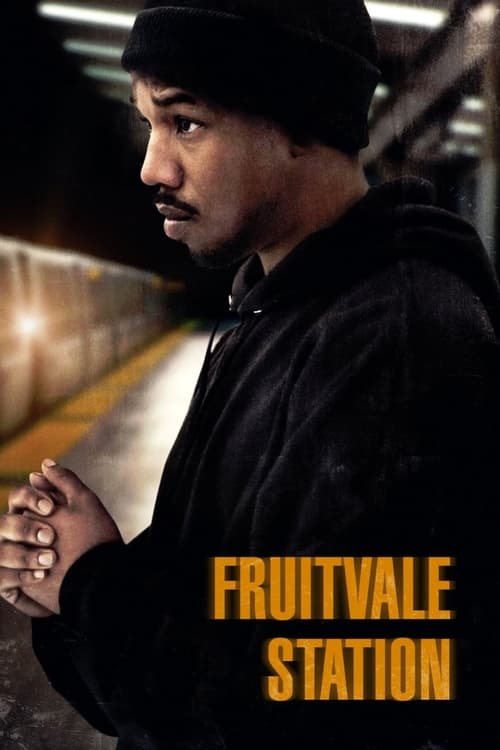
Fruitvale Station
2013 · Ryan Coogler
Sinners transformed him from Marvel's best franchise steward into the era's proof that original films can still be blockbusters; his ownership-reversion deal with Warner Bros. sparked an industry argument about whether directors owning their films sets a "dangerous precedent." A rare director whose business terms became discourse.
For when you want to feel something real and carry it out of the room with you — a film that connects straight to the world outside it. Emotionally demanding, but brief and completely gripping.
What it's about
Oakland, the last day of 2008. A young father runs errands, calls his mother on her birthday, picks up crabs for New Year's gumbo, and rides the BART train into the city with his girlfriend and friends — the final hours of Oscar Grant, the real man killed by a transit police officer at Fruitvale Station in the first minutes of 2009.
The experience
Intimate and warm, with the weight of what you know is coming pressing on every ordinary moment — a phone call, a favor, a joke. It's devastating precisely because it stays small, and at under ninety minutes it hits with no wasted motion.
Performances
Michael B. Jordan gives Grant the full, contradictory weight of an ordinary man — flawed, funny, trying — and Octavia Spencer is superb as his mother, holding the film's final stretch together.
The craft
Shot on 16mm in the actual Bay Area locations, including Fruitvale Station itself, with a deliberately modest structure: no thesis, no courtroom, just a day observed closely enough to matter. The handheld grain gives it the texture of witnessed life rather than reenactment.
Why it matters
Ryan Coogler was twenty-six when it swept the Grand Jury Prize and Audience Award at Sundance, launching his partnership with Michael B. Jordan that went on to reshape Hollywood through Creed and Black Panther — and it caught the national moment just before Black Lives Matter had a name.
Ryan Coogler was twenty-six when his debut swept both the Grand Jury Prize and the Audience Award at Sundance, announcing a filmmaker and a partnership — with Michael B. Jordan — that would go on to reshape Hollywood through Creed and Black Panther. The film reconstructs the last day of Oscar Grant, the young Oakland father killed by a BART police officer on the platform at Fruitvale Station in the first hours of 2009, an event captured on bystanders' phones and seen by millions. Coogler's structure is deliberately modest: no thesis, no courtroom, just errands, phone calls, a birthday, a grandmother's gumbo — Jordan giving Grant the full, contradictory weight of an ordinary man, with Octavia Spencer superb as his mother. Shot on 16mm in the actual Bay Area locations, including the station itself, it belongs to the moment just before Black Lives Matter had a name; it opened in theaters within days of the George Zimmerman verdict, and audiences met it less as drama than as testimony. The humanist day-in-a-life form has since become a template for a generation of American filmmakers.
A Deleuzian reading
Count the phones.
The full Deleuzian reading of Fruitvale Station →
Reception
It arrived at Sundance 2013 as the festival's knockout — winning both the Grand Jury Prize and the Audience Award — then got famously shut out of the Oscars a year later. Now it's canonized as ground zero for the Coogler–Michael B. Jordan partnership that went on to Creed, Black Panther and Sinners.
How Fruitvale Station was received, from release to now →
Influences: the films it descends from and the films it influenced
- Bicycle Thieves (1948) — The neorealist blueprint of structuring an entire feature around one ordinary working man's single day of small errands, shot in actual streets with performances that read as non-professional.
- Umberto D. (1952) — Pioneered the neorealist 'dead time' of dwelling on mundane daily routine — money worries, small domestic tasks — to accrue empathy for an ordinary life before catastrophe arrives.
- The 400 Blows (1959) — Established the observational day-in-a-life portrait that refuses moralizing thesis, letting an ordinary protagonist's unremarkable hours carry the emotional weight toward a fixed, aching ending.
- Killer of Sheep (1978) — The founding Black American independent model: grainy 16mm shot in a real working-class neighborhood, dignifying ordinary daily Black life through episodic texture rather than melodramatic plot.
- Do the Right Thing (1989) — The slow accumulation of one day's small, warm neighborhood interactions detonating into a fatal act of police violence at the climax, indicting the system through prior intimacy.
- La Haine (1995) — A day-in-the-life of marginalized youth that lets banal hours build over real time toward an inevitable fatal police confrontation the audience senses coming.
- Rosetta (1999) — The handheld, nape-of-the-neck camera glued to a single working-class protagonist through the granular texture of daily survival, forcing the viewer into bodily proximity.
- Elephant (2003) — The architecture of dread — trailing ordinary characters through banal, near-real-time hours toward a violent death the audience already knows is coming, charging every mundane beat.
- United 93 (2006) — Handheld docu-realist recreation of a known-fatal true event, weaponizing the audience's foreknowledge of the ending so that ordinary preliminary moments ache with dramatic irony.
- Boyz n the Hood (1991) — Inherits the place-rooted, near-real-time elegy for an endangered young Black man, building dread toward a foreordained death the way Singleton frames Ricky's killing.
- Precious: Based on the Novel 'Push' by Sapphire (2009) — Carries forward the Sundance-launched, intimate handheld social realism of Black American life, building a whole film around a single deglamorized lead's lived texture.
- Drylongso (1999) — An Oakland-specific docu-realist portrait that turns the film itself into an archive mourning an endangered Black man's last day — Drylongso's archive-against-disappearance made literal and biographical.
- Creed (2015) — Extends the Coogler–Michael B. Jordan partnership, importing Fruitvale's intimate handheld realism and location-rooted authenticity into the machinery of studio genre.
- Blindspotting (2018) — Oakland-set social realism shot in actual neighborhoods, confronting police violence and gentrification through the lived humanity of local characters.
- The Hate U Give (2018) — A post-Black-Lives-Matter narrative built around a police killing that grounds its politics in the ordinary humanity and daily life of its victim and community, per Fruitvale's template.
- Queen & Slim (2019) — Dramatizes a police-violence flashpoint by anchoring it to the tender, granular intimacy of two ordinary Black protagonists rather than issue-driven abstraction.
- Black Panther (2018) — Continues the Coogler–Jordan collaboration and Coogler's insistence on emotionally legible, grounded characterization, carrying his humanist independent sensibility into blockbuster scale.
- Medicine for Melancholy (2008) — Bay Area Black independent day-in-a-life naturalism on a micro-budget, using actual San Francisco/Oakland locations and unforced performance to render everyday Black interiority.
- Short Term 12 (2013) — Contemporaneous American-indie handheld humanism built on close-observed institutional daily routine and a career-launching naturalistic ensemble performance.
- Moonlight (2016) — An intimate, chaptered humanist portrait of Black American life shot on film with tactile close-ups, prioritizing quiet interior grace over plot the same way Fruitvale does.
- Selma (2014) — Intimate, humanizing portraiture of a Black man before the state violence that claims him — establishing personhood ahead of the historical event, as Selma does with its murdered marchers.
- Mudbound (2017) — Shot by Rachel Morrison in the same handheld, available-light documentary register—her intimate naturalism on Black lives is the throughline connecting it directly to Mudbound.
- A Thousand and One (2023) — Intimate handheld naturalism on grainy 16mm rooted in one specific city geography, compressing Black urban life into charged everyday texture.
- Spider-Man: Brand New Day (2026) — The Sundance humanist debut that, exactly like Short Term 12, trained a director later handed a Marvel property — the parallel indie-to-tentpole pipeline Cretton exemplifies.
- Just Mercy (2019) — Shares Michael B. Jordan as its lead and a handheld, available-light naturalism that builds procedural patience toward a foreknown fatal outcome, the same dread-structured march Just Mercy applies to death row.
Similar films
- Blindspotting (2018) — influence & lineage · same viewing thread
- Creed (2015) — influence & lineage
- Black Panther (2018) — influence & lineage
- Moonlight (2016) — influence & lineage
- Short Term 12 (2013) — influence & lineage
- Get Out (2017) — shared sensibility
- Inside Llewyn Davis (2013) — shared sensibility
- Judas and the Black Messiah (2021) — shared sensibility
All the films related to Fruitvale Station →
Watch it with: curated runs of related films
- Genre as Trojan Horse — Watch these together when you want the pleasures of a genre picture — a buddy-cop case, a heist crew, a monster in the sky — that turns out to be secretly arguing about who America polices, prices, and erases.