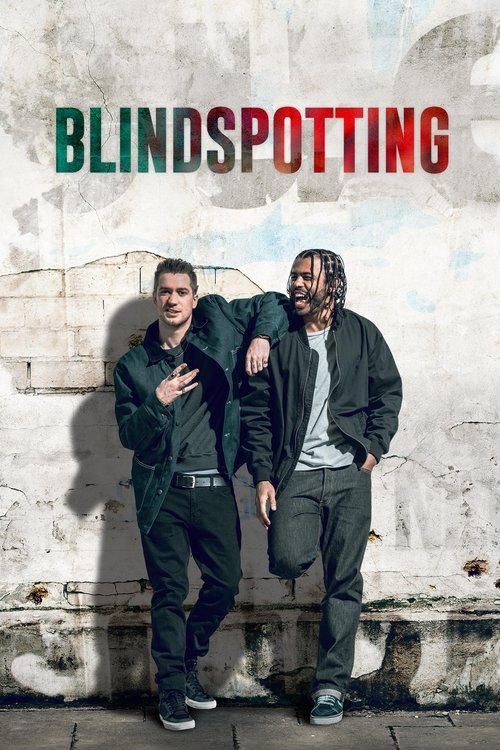
Blindspotting
2018 · Carlos López Estrada
For when you want a film with something to say that's also flat-out entertaining — you'll laugh, you'll tense up, and you'll be thinking about it on the walk the next day. It runs hot; come to it with energy rather than looking to zone out.
What it's about
Collin has three days left on his probation, and all he has to do is stay out of trouble — which is hard when your best friend is Miles, a live-wire white Oakland native with a talent for chaos, and harder still after Collin witnesses a police shooting he can't unsee. The two work as movers in a neighborhood being gentrified out from under them, and the film tracks their friendship, their city, and Collin's mounting dread through one loaded countdown.
The experience
It whiplashes — genuinely funny buddy comedy one minute, throat-tightening tension the next, and at moments of maximum pressure the characters break into rhymed spoken word that hits like a pulse spike. It's energetic, warm, and angry all at once, and it leaves you buzzing.
Performances
Daveed Diggs and Rafael Casal — lifelong friends and Bay Area natives who also wrote the script — have a lived-in chemistry no casting director could fake, and Diggs's shift from easy charm to barely contained fear is the film's engine.
The craft
The writing is the star: a script that fuses social realism, comedy, and verse, built over years by two people who know Oakland block by block. López Estrada directs with music-video verve — bold color, rhythmic cutting — so the heightened moments feel like eruptions rather than gimmicks. It sounds great loud.
Why it matters
A Sundance breakout that arrived in the thick of America's reckoning over police violence and gentrification, it announced Diggs and Casal as filmmaking voices and became a reference point for formally daring social cinema.
Snapshot
Blindspotting is a first-person Oakland fable that stretches a three-day countdown—the final seventy-two hours of Collin's probation—into a taut examination of race, class, perception, and the violence that gentrification does both slowly and suddenly. Written by and starring Daveed Diggs and Rafael Casal, two Bay Area natives and longtime collaborators, the film fuses the register of social-realist drama with buddy comedy and, at intervals, with outright verse: characters break into rhymed spoken word at moments of maximum pressure. That formal hybridity is the film's signature and its argument. The title borrows a name for the perceptual phenomenon in which a single image (the classic figure-ground illusion, a vase or two faces) can be read two ways but not both at once—a metaphor the film applies to how bodies, neighborhoods, and men are seen. Premiering at the Sundance Film Festival in January 2018 and released that summer, it arrived in the same season as Boots Riley's Sorry to Bother You, marking a conspicuous moment of Oakland-centered filmmaking.
Industry & production
Blindspotting was the feature directorial debut of Carlos López Estrada, who came to it from a career directing music videos, and it was the product of an unusually long gestation. Diggs and Casal, friends since their teens in the East Bay, developed the screenplay over roughly a decade, and the project's protracted path to production is part of its public history—by the time cameras rolled, Diggs had become a nationally visible figure through the original Broadway cast of Hamilton, where he won a Tony Award for playing Lafayette and Jefferson. That visibility helped the long-shelved script finally attract financing.
The film was shot in Oakland, and its authenticity of place—specific streets, the changing storefronts, the sound of the city—is central to its identity rather than incidental to it. It premiered in the U.S. Dramatic Competition at Sundance 2018 and was released theatrically in the United States by Lionsgate through its Summit Entertainment label in July 2018. Beyond broad strokes, the granular deal terms, budget, and box-office figures are not something I can state with confidence, and I will not invent numbers here; the film was understood as a modestly budgeted independent rather than a studio tentpole, and its commercial profile matched that scale.
Technology
Blindspotting is a conventionally-originated digital independent feature of its moment; I do not have a verified record of the specific camera system or capture format used, and I will not guess at a make and model. What is worth noting technologically is not the hardware but the film's willingness to shift representational modes—to move from documentary-adjacent handheld realism into heightened, near-theatrical passages of verse—without a change of medium. The technology serves an unbroken naturalistic surface that the performances and writing then rupture from within. The film also belongs to a period in which independent features could rely on a mature digital-intermediate color pipeline to grade Oakland's light with warmth and specificity, though the exact post workflow is not something I can document precisely.
Technique
Cinematography
The cinematography is credited to Robby Baumgartner. The visual approach binds the film to its geography: Oakland is photographed as a lived, textured place—sunlight on residential streets, the interiors of the moving-company work, the nocturnal charge of the inciting police shooting. The camera generally favors an observational proximity to Collin, keeping us inside his sightline so that the film's title-concept is enacted formally—we are made to see what he sees and to feel the cost of seeing it. When the film escalates into its stylized confrontations, the imagery tightens and intensifies rather than abandoning realism outright, so that the shift registers as pressure breaking through an otherwise grounded surface.
Editing
The editing is credited to Gabriel Fleming. Structurally the cut is organized around the ticking probation clock, which gives the film its forward propulsion and its dread; the countdown is the spine against which every detour and comic digression is measured. The most demanding editorial task is managing the tonal gearshifts—comedy to menace, naturalism to verse—so that they feel motivated rather than whiplash-inducing. The film's recurring image of the police shooting operates almost as an intrusive memory, and the editing treats it as something that keeps returning to Collin against his will, an editorial rendering of trauma.
Mise-en-scène / staging
Production design and location work make gentrification legible in the frame: new juice bars and renovated facades sit beside the older Oakland the protagonists grew up in, so that the neighborhood's transformation is staged as visual fact rather than stated as theme. Costume and prop choices sharpen character—Miles's guns, grills, and performative hardness against Collin's watchfulness—so that the two men's diverging strategies for survival are worn on the body. The climactic confrontation is staged with a theatrical directness that acknowledges the writers' spoken-word roots.
Sound
The score is credited to Michael Yezerski, and music is doubly important here because the film's leads are musicians and lyricists; the boundary between score, source music, and the characters' own rapped and spoken verse is deliberately porous. Rhythm is a structuring principle at the level of dialogue itself. The sound design's handling of the gunshots at the inciting incident—and the way that sonic memory recurs—is one of the film's more pointed uses of audio to convey Collin's interior state. I do not have documentation of specific songs licensed for the soundtrack and will not fabricate a track list.
Performance
Performance is the film's greatest strength and its clearest link to its authorship. Diggs plays Collin with a coiled, watchful restraint—a man doing everything to make himself small enough to survive three more days—while Casal plays Miles as volatile, funny, and dangerous, a white man performing a hardness that Collin can no longer afford. The friendship between them carries decades of real-life rapport, and the film's central tension turns on the different consequences their identical behavior would provoke. Janina Gavankar plays Val, Collin's ex and coworker, who articulates much of the film's critique of Miles; Jasmine Cephas Jones—like Diggs a Hamilton alumna—plays Ashley, Miles's partner. The ensemble's naturalism is what makes the eruptions into verse land as emotional truth rather than gimmick.
Narrative & dramatic mode
The film runs on a classic ticking-clock structure—three days, then freedom or ruin—overlaid on a buddy-movie frame and shot through with the conventions of social-problem drama. Its dramatic mode is fundamentally hybrid: it is genuinely funny in its two-handed banter, genuinely frightening in its encounters with authority, and finally something closer to tragedy narrowly averted. The defining formal gambit is the shift into heightened verse at the emotional apex, which converts realist crisis into a mode of address that is confessional, incantatory, and theatrical at once. That gambit descends directly from the writers' backgrounds in rap and spoken-word performance, and it asks the audience to accept that the truest expression of the film's rage and grief cannot be spoken in ordinary conversational language.
Genre & cycle
Nominally a comedy-crime-drama, Blindspotting sits inside a late-2010s cycle of American films confronting police violence and racialized surveillance in the wake of the Black Lives Matter movement—company that includes work such as The Hate U Give (also 2018) and, adjacently, Jordan Peele's Get Out (2017) in its use of genre to dramatize Black perception under threat. It also belongs, more locally, to a burst of Oakland- and Bay Area–rooted filmmaking. Released the same year as Boots Riley's Sorry to Bother You and following Ryan Coogler's Fruitvale Station (2013), it participates in what observers reasonably described as an Oakland moment in American independent cinema—films using the specificity of that city, and its gentrification in particular, as both setting and subject.
Authorship & method
The authorial center of Blindspotting is the writing-and-acting partnership of Daveed Diggs and Rafael Casal, whose decade-long development of the material makes the film as much theirs as anyone's; the movie is best understood as the cinematic distillation of a shared artistic voice forged in Bay Area performance culture. Carlos López Estrada, directing his first feature after a music-video career, brings the visual fluency and rhythmic sensibility that let the film move between documentary grounding and stylized set-pieces without fracturing. Among key collaborators, cinematographer Robby Baumgartner grounds the film in Oakland's light and texture; editor Gabriel Fleming manages its risky tonal architecture and the recurring trauma-image structure; and composer Michael Yezerski scores a film in which music, verse, and speech are continuous. The method is collaborative and voice-driven—an auteurism located in the writers-performers as much as in the director.
Movement / national cinema
The film is a work of American independent cinema, and within that, of a regionally specific tradition of Black and multiracial Bay Area storytelling that foregrounds place. It is not affiliated with a formal movement in the manifesto sense, but it is legibly part of a post-2013 wave of socially engaged, genre-flexible independent films—accelerated by Sundance as a launch platform—that treat American racial reality through hybrid tonal registers rather than solemn realism alone. Its insistence on Oakland's particularity aligns it with a lineage of American regional filmmaking in which the city is not a backdrop but a protagonist.
Era / period
Blindspotting is emphatically a film of the late 2010s: it addresses police shootings of Black men, the Black Lives Matter era's changed public consciousness, and the acute, ongoing displacement of longtime residents by tech-driven gentrification in the San Francisco Bay Area. Its concerns—who gets to belong in a neighborhood, whose behavior is read as threat, how quickly a place can be made unrecognizable—are specific to that decade's Bay Area even as they resonate more widely. The presence of two Hamilton alumni in the cast also situates it at a cultural juncture when that production had lifted spoken-verse Black performance to unprecedented mainstream visibility.
Themes
The film's governing theme is the one embedded in its title: perception as a site of injustice—the way a single person or place is seen as one thing or its opposite depending on the viewer's bias, and the impossibility of holding both readings at once. Around that core cluster gentrification and displacement (a city being made to "blindspot" its own history), the asymmetric consequences of identical actions across the color line (Miles can perform danger; Collin cannot), the burden of the witness (Collin's inability to unsee the shooting), Black masculinity and the pressure to shrink or to harden, code-switching and the labor of being read correctly, and friendship as both refuge and liability. The film's refusal to resolve into a single tonal key is itself thematic: it insists that comedy, terror, and grief are not separable in the lives it depicts.
Reception, canon & influence
Blindspotting was warmly received by critics, who singled out the Diggs–Casal writing and performances, the film's tonal ambition, and its verse climax, while some noted the risks inherent in its shifts of register. I don't have exact aggregate scores or citable review quotations to hand and will not fabricate them; the broad critical consensus was strongly favorable and framed the film as a distinctive, urgent debut. It was widely discussed as part of the Sundance class of 2018 and of that year's Oakland-cinema conversation alongside Sorry to Bother You.
Its influences run backward to the social-problem and buddy-film traditions, to Spike Lee's mode of place-rooted, tonally elastic urban drama, to the Oakland precedent of Fruitvale Station, and—crucially—to the writers' own grounding in hip-hop and spoken-word performance, which supplies the film's formal innovation. Looking forward, the most concrete piece of its legacy is the Blindspotting television series that Starz launched in 2021, developed by Casal and Diggs and centered on Ashley (Jasmine Cephas Jones) in the aftermath of the film's world—an unusual case of an independent film extending into serialized television on the strength of its universe and voice. More diffusely, the film helped consolidate Diggs's and Casal's standing as screen authors and contributed to a moment in which hybrid, verse-inflected, regionally specific storytelling about American racial life found a place in the independent mainstream. The durability of its critical reputation rests less on commercial metrics than on the audacity of its final act, which remains its most cited and most debated achievement.
Reception
It opened Sundance 2018 to a standing ovation and glowing reviews, then got somewhat lost in a crowded year — perpetually paired with fellow Oakland joint Sorry to Bother You. Since then it's settled into 'criminally underseen' status, the film people insist you watch when 2018 comes up.
How Blindspotting was received, from release to now →
Influences: the films it descends from and the films it influenced
- Do the Right Thing (1989) — Lee's model of a single Black neighborhood in a single heat-baked stretch, sustaining comic ensemble texture over a slow fuse that detonates in a police-chokehold killing, is the template for Blindspotting's place-rooted tonal elasticity and its structure of suspended dread.
- 25th Hour (2002) — Lee's final-hours countdown around a man about to lose his freedom, plus the stylized mirror-monologue that breaks realism for a torrent of direct address, prefigures both Blindspotting's probation ticking-clock and its verse-address climax.
- Chi-Raq (2015) — Lee scripts an entire film about street violence in rhyming spoken verse, establishing the direct precedent for using sustained rhyme as dramatic argument rather than ornament—the formal move Blindspotting saves for its confrontation scene.
- Fruitvale Station (2013) — Coogler's handheld observational proximity to one ordinary Oakland day ending in a fatal transit-station police shooting builds the regional-realist docudrama grounding that Blindspotting's witnessed shooting inherits.
- Slam (1998) — Levin stages live spoken-word performance as the literal climax and a character's instrument of survival, the foundational example of verse-as-weapon that Blindspotting's final act reprises.
- 8 Mile (2002) — The film's cathartic third act, in which a working-class protagonist channels rage into a rhymed verbal confrontation of his antagonist, gives Blindspotting the battle-rap logic of its climactic verse aimed at the officer.
- Boyz n the Hood (1991) — Singleton pairs one volatile and one restrained friend inside a social-problem film about surviving the neighborhood, the buddy-under-threat architecture Blindspotting rebuilds in the Collin/Miles dynamic.
- Menace II Society (1993) — The Hughes brothers cut a killing back in as an intrusive recurring flashback structuring the protagonist's guilt, the trauma-image editing grammar Blindspotting uses for the shooting Collin can't stop replaying.
- Killer of Sheep (1978) — Burnett's LA Rebellion patience—observational proximity to Black working-class labor, faces, and light—models the unhurried textural attention to Oakland that grounds Blindspotting's cinematography between its stylized set-pieces.
- Medicine for Melancholy (2008) — Jenkins makes Bay Area gentrification and racial displacement the explicit subject of a two-hander walking-and-talking indie, the direct San Francisco/Oakland predecessor to Blindspotting's gentrification anxiety.
- The Last Black Man in San Francisco (2019) — Talbot extends Bay Area gentrification cinema and climaxes on a theatrical spoken-word monologue delivered to a hostile audience, echoing Blindspotting's decision to resolve emotion through performed verse.
- Queen & Slim (2019) — Matsoukas builds an entire feature from the ticking dread of a Black couple after a routine police stop turns fatal, extending the 'one wrong encounter' escalation Blindspotting stages in miniature.
- Blindspotting (2021) — Casal and Diggs directly serialize the film's Oakland world around Ashley, carrying the verse-monologue interludes and porous music/speech scoring into episodic television.
- Sorry to Bother You (2018) — The other 2018 Oakland debut shares Blindspotting's tonal hybridity—social comedy swerving into stylized nightmare—and a code-switching-voice conceit forged in the same Bay Area performance culture.
- Dope (2015) — Famuyiwa mixes comedy, crime plotting, and life-or-death stakes around a young Black protagonist, the register-blending comedy-crime-drama mode Blindspotting operates in.
- If Beale Street Could Talk (2018) — Jenkins renders racial injustice through intimate observational proximity and a lyrical, music-continuous rhythm, a sibling in the late-2010s wave of formally ambitious Black-authored films built on perception-as-injustice.
- I Love Boosters (2026) — Same Oakland vernacular and code-switching, heightening verbal performance and rhythmic comic timing into satire of race, value, and gentrification.
- The Hate U Give (2018) — Builds to a spoken-word climax as the eruption of suppressed voice and threads code-switching between neighborhood registers — the voice-and-witness arc in a shared 2018 BLM frame.
Similar films
- Fruitvale Station (2013) — influence & lineage · same viewing thread
- Sorry to Bother You (2018) — influence & lineage · often watched together
- Do the Right Thing (1989) — influence & lineage
- 8 Mile (2002) — influence & lineage
- Zootopia (2016) — same viewing thread
- The Big Lebowski (1998) — often watched together
- Judas and the Black Messiah (2021) — often watched together
- BlacKkKlansman (2018) — shared sensibility
All the films related to Blindspotting →
Watch it with: curated runs of related films
- Genre as Trojan Horse — Watch these together when you want the pleasures of a genre picture — a buddy-cop case, a heist crew, a monster in the sky — that turns out to be secretly arguing about who America polices, prices, and erases.