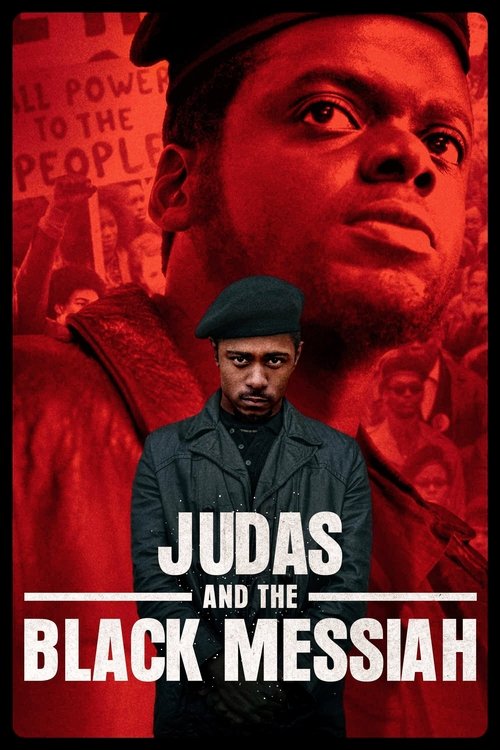
Judas and the Black Messiah
2021 · Shaka King
For when you want to be gripped and shaken, not soothed — a film that leaves you angry, awestruck, and reaching for the history books. Challenging by design, but propulsive enough that it never feels like homework.
What it's about
Chicago, late 1960s. Bill O'Neal, a small-time car thief, is flipped by the FBI and sent inside the Illinois Black Panther Party to inform on its rising chairman, Fred Hampton — a 21-year-old orator uniting street gangs, poor whites, and student radicals into a Rainbow Coalition. Drawn from true events, it's a Judas story told from the betrayer's side, as O'Neal is squeezed between his handler and the movement he's starting to believe in.
The experience
It moves with the coiled, paranoid energy of a seventies thriller — electric when Hampton speaks, suffocating when O'Neal is alone with his handler. You watch a man dissolve under surveillance from both sides, and the dread builds even in the film's warmest moments.
Performances
Daniel Kaluuya won the Oscar for his Hampton — a full-body transformation, capturing the cadence and charisma of a born movement-builder — while LaKeith Stanfield does subtler, queasier work as O'Neal, a man whose face keeps trying to hide what his eyes can't. Both were nominated for the same film.
The craft
Shaka King directs with remarkable control for a filmmaker previously known for comedy, and Sean Bobbitt's nocturnal cinematography gives Chicago a sodium-lit menace that rewards a dark room and a big screen. The speeches are staged like concert footage — the sound of a crowd catching fire is half the film's power.
Why it matters
It brought Fred Hampton's story to a mass audience during a national reckoning over race and policing, earned Kaluuya an Academy Award, and vaulted King into the front rank of American directors.
Shaka King's telling of the FBI's campaign against Illinois Black Panther chairman Fred Hampton runs on a daring structural choice: it's a Judas story, filtered through the betrayer. William O'Neal, the car thief turned informant, becomes the film's queasy moral center, and LaKeith Stanfield plays him as a man dissolving under surveillance from both sides. Opposite him, Daniel Kaluuya's Hampton is a marvel of physical transformation — the cadences of a 21-year-old orator who could fuse street gangs, poor whites, and student radicals into a Rainbow Coalition — and it won him the Oscar, in the strange circumstance of both leads being nominated in the supporting category. King, previously known for the stoner comedy Newlyweeds, directs with the coiled energy of a seventies paranoid thriller, aided by Sean Bobbitt's nocturnal, sodium-lit photography. That a major studio financed an unambiguous indictment of COINTELPRO — with Hampton's speeches delivered uncut, at length — remains one of the more remarkable facts of post-2020 Hollywood.
A Deleuzian reading
A man is talking in a room, and the camera doesn't cut away.
The full Deleuzian reading of Judas and the Black Messiah →
Reception
A Sundance-to-Oscars rocket in the strange pandemic year — six nominations including Best Picture, with Daniel Kaluuya sweeping the supporting-actor season. Five years on it's remembered as the film that actually stuck from that HBO Max-simulcast era of 2021 prestige.
How Judas and the Black Messiah was received, from release to now →
Influences: the films it descends from and the films it influenced
- On the Waterfront (1954) — Established the tormented-informer template whose testimony destroys his own community — Bill O'Neal's guilt-ridden interiority is a direct descendant of Terry Malloy's.
- The Battle of Algiers (1966) — Its newsreel quasi-documentary staging of clandestine cell organizing versus a state counterinsurgency apparatus supplies the procedural grammar for JBM's infiltration-and-surveillance scenes.
- The Conformist (1970) — Pioneered the betrayer-POV structure in which the entire narrative is filtered through the collaborator leading the state to its target's assassination.
- Klute (1971) — Gordon Willis's underexposed low-key darkness married to wiretap surveillance set the visual template for rendering paranoia as literal shadow that Bobbitt reworks.
- The Parallax View (1974) — Core text of seventies paranoid cinema — an omnipotent covert apparatus liquidating radicals — whose dread of unseen institutional power drives JBM's tone.
- The Conversation (1974) — Fuses surveillance craft with informant guilt: the operative consumed by complicity in the harm his listening enables, the emotional engine of O'Neal's arc.
- All the President's Men (1976) — Willis's sodium-lit nocturnal palette and the paranoid procedural of institutional surveillance are quoted directly in Bobbitt's amber night exteriors.
- Malcolm X (1992) — Built the Black biographical drama around uncut, charismatic oratory delivered as extended performance set-pieces — the model for Hampton's rally speeches.
- Hunger (2008) — Sean Bobbitt's unbroken single-take oratory (the seventeen-minute priest dialogue) and available-light naturalism is the exact uncut-speech method he reuses for Hampton.
- 12 Years a Slave (2013) — Bobbitt's unflinching held long takes and cool historical-indictment framing carry over as JBM's formal approach to staging state violence against Black bodies.
- Selma (2014) — Dramatizes COINTELPRO's wiretap surveillance of a Black leader via on-screen FBI log intertitles while staging movement oratory as performance — JBM's twin concerns.
- BlacKkKlansman (2018) — An infiltration/informant plot capped by an archival-footage historical-indictment coda that collapses past into present — the device JBM echoes with its closing real footage and title cards.
- Donnie Brasco (1997) — Undercover-informant drama tracking the psychic dissolution of an agent whose assumed loyalty curdles into real love and unbearable guilt.
- The Departed (2006) — Dual-protagonist mole architecture in which the informant's terror of exposure structures the whole film — the cross-cut betrayer/target design JBM adapts.
- One Night in Miami (2020) — Contemporaneous release built on theatrically staged long-form debate among Black icons over coalition, respectability, and revolution — the same oratory-as-cinema wager.
- The Trial of the Chicago 7 (2020) — A parallel-era historical-indictment courtroom drama of the same Panther-era state repression (Bobby Seale bound and gagged), extending the seventies-conspiracy mode into prestige biopic.
- Straight Outta Compton (2015) — Shares the meticulous period reconstruction of late-20th-century black radicalism confronting the police/state, re-narrated for a Black Lives Matter audience as living political text rather than historical artifact.
- Marighella (2021) — Contemporary sibling on the same formal problem: a Black revolutionary killed through infiltration, with the informant's coercion cross-cut against the leader's public speech, and low-key lighting engineered to hold detail in dark skin across night interiors — the exact craft Marighella asks of Teijido.
Similar films
- The Trial of the Chicago 7 (2020) — influence & lineage
- BlacKkKlansman (2018) — influence & lineage
- 12 Years a Slave (2013) — influence & lineage
- Malcolm X (1992) — influence & lineage
- One Night in Miami... (2020) — influence & lineage
- Selma (2014) — influence & lineage
- Michael (2026) — same viewing thread
- Soundtrack to a Coup d'Etat (2024) — shared sensibility
All the films related to Judas and the Black Messiah →
Watch it with: curated runs of related films
- The Making of a Legend — A run of biopics that watch private people get forged into public icons — the ambition, the pressure, and the loneliness of becoming somebody the world can't stop looking at.