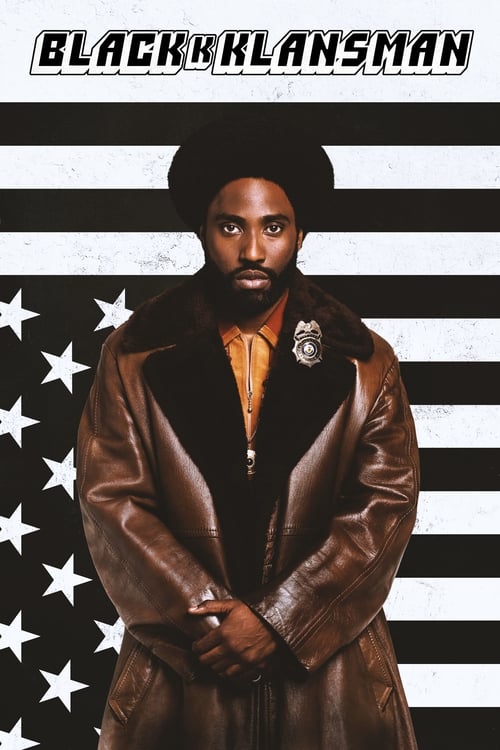
BlacKkKlansman
2018 · Spike Lee
For when you want to be entertained and confronted at once — a film that goes down like a buddy-cop comedy and stays with you like a documentary. Choose it when you're up for something with teeth, not pure escapism.
What it's about
Colorado Springs, early 1970s. Ron Stallworth, the city's first Black police detective, cold-calls the local Ku Klux Klan chapter and talks his way in — over the phone. For face-to-face meetings he sends his Jewish colleague Flip Zimmerman to play 'Ron Stallworth' in person, and together they run an undercover operation into the heart of American white supremacy. Based on the real Stallworth's memoir.
The experience
A strange, potent cocktail: genuinely funny — the phone-call cons are pure caper pleasure — but the laughter keeps catching in your throat as the menace underneath shows itself. It builds to a finish that yanks the story into the present and leaves you shaken rather than comforted.
Performances
John David Washington carries the film with cool, wry charisma, and Adam Driver does subtle, layered work as a man forced to think about an identity he'd never had to examine. Topher Grace is unnervingly banal as Klan leader David Duke.
The craft
Spike Lee swings between period caper, romance, horror, and raw documentary footage with total confidence, using the collisions between tones as the point rather than a problem. Terence Blanchard's score gives it sweep, and the seventies textures — hair, needle-drops, film grain — are a pleasure in themselves. The screenplay won the Oscar.
Why it matters
It marked a major late-career resurgence for Spike Lee — his first competitive Oscar — and became one of the defining films of America's post-Charlottesville reckoning, proof that a period piece could speak directly to the headlines.
Snapshot
Spike Lee's thirty-fifth feature is a true-story political crime comedy set in Colorado Springs circa 1972–73, in which Black police detective Ron Stallworth opens an undercover file on the local Ku Klux Klan chapter — and, because the Klan conducts much of its business by telephone, manages to do so himself, while his Jewish partner Flip Zimmerman handles the in-person infiltration as "Ron Stallworth." The film adapts Stallworth's 2014 memoir Black Klansman (co-authored with David Thomas Roberts) and concludes with real footage from the August 2017 Charlottesville rally and its aftermath, explicitly yoking a period genre piece to the immediate American present. That strategic pivot — from retro comedy to raw documentary horror — defines the film's moral architecture and its reception. Produced with Jordan Peele's imprint, it arrived the year after Peele's Get Out and consolidated a visible cycle of politically explicit Black American genre cinema.
Industry & production
The project originated when producer Jason Blum and Jordan Peele's QC Entertainment acquired the rights to Stallworth's memoir. Kevin Willmott, Lee's long-term collaborator at Kansas, drafted an early screenplay; Charlie Wachtel and David Rabinowitz delivered a subsequent draft before Lee came aboard and rewrote substantially, incorporating the Charlottesville prologue and epilogue and enlarging the Black Student Union subplot. Jordan Peele served as producer and his commercial cachet after Get Out (2017) helped secure Focus Features distribution and a $15 million production budget — modest by studio standards for a film of this scope.
Lee shot largely on location in New York, standing in for Colorado, with brief Colorado interiors. The production maintained a period discipline in design without the prohibitive cost of full location shooting in the actual Colorado Springs settings. Focus Features gave the film a substantial wide release platform, unusual for Lee since his early 2000s commercial high-water mark. It premiered in Competition at the 2018 Cannes Film Festival, where jury president Cate Blanchett's panel awarded it the Grand Prix — Lee's first major festival prize of that magnitude, a late-career validation that sharpened the film's cultural momentum before its August North American release.
Technology
Lee and cinematographer Chayse Irvin chose to shoot on 35mm Kodak film stock rather than digital, a decision rooted in period fidelity and in a broader argument about cinema's materiality. The grain structure, color temperature, and optical behavior of 35mm organically codes the film within the visual idiom of 1970s American studio and blaxploitation cinema without requiring digital simulation. Irvin had established his sensibility on Beyoncé's Lemonade (2016), where he demonstrated facility with period-evoking film stocks in high-stakes contexts. Anamorphic lenses further widen the frame, reinforcing the sense of scope and allowing Lee his preferred staging of multiple figures in a single plane.
The epilogue transitions from the period film grain to the harsh, compressed video quality of smartphone and news footage from Charlottesville — the format shift is part of the argument, the glossy period reconstruction giving way to the terrible immediacy of contemporary image-making.
Technique
Cinematography
Irvin's palette in the period sequences leans warm and amber-tinged, evoking the Eastmancolor look of 1970s genre films without pastiche. Interior scenes of the police department are rendered in institutional fluorescents that create a visual tension with the warmth of BSU meetings and Ron's apartment — the white institutional world lit harshly, the Black social world lit with depth and tactility. Lee deploys his signature "double Dutch" or "floating" tracking shot — in which the camera glides with a subject who appears to be moving without walking, as though carried on a current — during Ron's first encounter with Patrice at the BSU meeting, marking the moment as emotionally heightened, romantically charged, untethered from the mundane procedural world around it. This shot has been a Lee signature since Do the Right Thing (1989) and functions here as both stylistic signature and an implicit claim: certain experiences, Lee suggests, carry people beyond the ordinary physics of narrative.
Editing
Barry Alexander Brown, who has edited most of Lee's major features since Do the Right Thing, cuts with a rhythm that respects the comedy of the undercover premise while maintaining political charge. The film's most formally assertive passage is a cross-cut sequence in which David Duke and the Klan celebrate The Birth of a Nation (Griffith, 1915) while Jerome Turner (Harry Belafonte) recounts to BSU members the 1916 lynching of Jesse Washington — a long, agonizing historical testimony set against the Klan's filmic revelry. Brown holds both sequences long enough for the counterpoint to accumulate moral weight, refusing the shortcut of fast cutting. The cross-cut formally echoes Griffith's own intercutting — the technique whose cinematic genealogy Lee is explicitly interrogating — while putting it in the service of an opposite moral claim.
Mise-en-scène / staging
Lee opens with what initially appears to be a pastoral Gone with the Wind-style landscape accompanied by Confederate rhetoric, then reveals the frame as a staged propaganda shoot presided over by Alec Baldwin as the fictional white supremacist Dr. Kennebrew Beauregard — a declaration of intent: the film will be about the production and consumption of racist imagery, not merely racist ideology. The KKK interior scenes are staged in the visual grammar of American domestic normalcy — suburban living rooms, potluck tables — precisely to refuse any comforting visual othering of the Klan as alien or exotic. Meanwhile, the BSU sequences are staged with warmth, community, and the visual vocabulary of affirmation: Kwame Ture's (Corey Hawkins) opening speech is filmed with the reverential lighting and close framing of a political document, the audience's faces given as much screen time and presence as the speaker.
Sound
Terence Blanchard's score, built on jazz-inflected orchestration with funk rhythm elements, has been the sonic signature of Lee's work since Mo' Better Blues (1990) and is deployed here with characteristic intelligence. Blanchard underscores the comedy of the undercover operation with ironically bright brass and percussion while reserving the full orchestral weight for the political sequences — the Klan cross-burning, the Charlottesville footage. The score drops away almost entirely in the epilogue, leaving the real footage to stand in the ambient sound of documentary chaos. The period soundtrack licensed for the BSU scenes draws on funk and soul of the early 1970s, locating Ron's Black social world in a specific cultural moment of Black political vitality.
Performance
John David Washington carries the film with a cool that conceals considerable technical difficulty: Stallworth must be simultaneously sincere about his police vocation, politically awakening through his contact with the BSU, and capable of performing white-coded telephone personae on demand. Washington plays these registers without visible seams. Adam Driver's Flip Zimmerman is the film's moral surprise — a Jewish man who has assimilated so thoroughly that he has stopped identifying with his own vulnerability to racism, and who is forced, through the in-person Klan infiltration, to experience antisemitism as lived threat rather than historical abstraction. Driver plays this awakening with characteristic internalized intensity. Topher Grace's David Duke is one of the film's sharpest performances: soft-spoken, rational-sounding, banal — Lee and Grace refuse to make Duke a cartoon, which makes him more disturbing.
Narrative & dramatic mode
BlacKkKlansman operates in an unusual hybrid mode: procedural thriller, political satire, and historical elegy simultaneously. The undercover narrative provides genre propulsion — the procedural pleasures of deception, double identity, and escalating risk — while the film's satirical comedy, generated by the sheer absurdity of Stallworth's situation, keeps the political argument from becoming lecture. The mode is essentially Brechtian in its structure: the audience is never allowed to settle into genre comfort because the formal and rhetorical interventions (direct address, documentary interpolation, explicit political speeches) keep breaking the fourth wall of genre convention. The film does not resolve the contradiction between Ron's institutional allegiance — he is a cop — and the political education the BSU subplot provides; the ending refuses catharsis precisely because the resolution the period narrative appears to offer is immediately negated by the Charlottesville footage.
Genre & cycle
The film participates in multiple genre lineages. It is, most visibly, a period police procedural and a comedy of deception — a structure with roots in farce. It explicitly situates itself in relation to blaxploitation cinema of the early 1970s: the opening credit sequence evokes the typography, music, and visual grammar of films like Super Fly (1972) and Shaft (1971), and Lee has spoken of wanting to reclaim the blaxploitation aesthetic for purposes more politically coherent than the genre sometimes permitted. The film also belongs to the cycle of racially explicit genre films that emerged in the mid-to-late 2010s, alongside Get Out (2017), Sorry to Bother You (2018), and Judas and the Black Messiah (2021) — films that use genre mechanics as an entry point for structural critiques of American racism. BlacKkKlansman is the most formally and historically self-conscious of these, and the one most interested in cinema itself as a site where racism is produced and contested.
Authorship & method
Spike Lee has described his films since the beginning of his career as "joints" — a term that both signals informality and claims ownership. His authorship is defined by several consistent practices: direct address to the camera (characters who look into the lens and speak to the audience as audience), the floating tracking shot described above, a commitment to jazz and Black popular music in his scores through Terence Blanchard, and an explicit engagement with African American political and cultural history. Lee trained at NYU's Tisch School and emerged from the independent Black American filmmaking ferment of the 1980s with She's Gotta Have It (1986) before Do the Right Thing (1989) established him as the defining voice of politically radical Black American cinema for a generation.
His partnership with Terence Blanchard — who has scored his work from Mo' Better Blues forward — represents one of the most sustained director-composer collaborations in contemporary American cinema. Barry Alexander Brown's editing sensibility, attuned to Lee's rhythmic preferences and willingness to hold uncomfortable sequences at length, is equally constitutive of the Lee "joint" sound. Willmott's contribution to the screenplay brings the academic rigor of a film scholar (Willmott teaches at Kansas) to the political argument, particularly in the elaboration of the Birth of a Nation counterpoint sequence. Chayse Irvin, the youngest of the major collaborators here, brought a fresh visual sensibility while respecting the formal grammar Lee had established over three decades.
Movement / national cinema
Lee is the central figure of the New York-based Black independent cinema that emerged in the 1980s alongside (though somewhat apart from) the UCLA-educated "LA Rebellion" filmmakers (Charles Burnett, Julie Dash, Haile Gerima). His work is firmly within American studio-independent production — he has worked within and against Hollywood throughout his career — but is marked by the political urgency, formal experimentation, and explicit engagement with Black American cultural history that distinguishes African American auteur cinema as a tradition. BlacKkKlansman is his most commercially successful film in over a decade and represents a late-career reunion between Lee's political voice and mainstream distribution scale.
Era / period
The film arrives in the specific cultural moment of 2017–18 American political life: the first year of the Trump administration, the Charlottesville rally (August 2017), and a wider public reckoning with the persistence and mobilization of white supremacist movements. Lee made the decision to frame the 1970s story explicitly within this contemporary context after Charlottesville; without that frame, the film would be a period genre piece about a remarkable true story. With it, the film becomes an argument about historical continuity — that the Klan of the 1970s and the white supremacist marchers of 2017 are not separated by fifty years of moral progress but are expressions of a continuous American tendency. The era also encompasses a Black cultural and commercial renaissance in prestige film and television, making BlacKkKlansman both a product and a marker of that moment.
Themes
The film's central thematic concern is performance and its costs: Ron Stallworth performs whiteness on the telephone, Flip Zimmerman performs a specific white-ethnic Americanness in person, and both must manage the gap between the performances they sustain and the identities they actually hold. For Ron, the performance is always doubled: he performs white on the phone and, the film suggests, a version of assimilated respectability in his daily police work. The Patrice subplot makes this explicit — she challenges him about the fundamental incompatibility of Black political solidarity and institutional police loyalty, a contradiction the film refuses to resolve.
The film also meditates on cinema as an instrument of racist ideology: The Birth of a Nation is not a background reference but a present argument, its screening by the Klan in the cross-cut sequence establishing that Griffith's film is still, in the 1970s, functioning as a recruitment and radicalization text. Against this, Lee positions a counter-cinema — one that looks directly at racist violence, represents it without aestheticizing it, and refuses the comforting narrative of American racial progress.
Jewish identity and its relationship to whiteness is a theme given more sustained attention here than in most Hollywood films: Flip's arc traces the process by which assimilation produces a certain amnesia, and the antisemitism he encounters from the Klan forces a re-identification with a vulnerability he had managed to forget.
Reception, canon & influence
BlacKkKlansman was received as a major critical event, and the Cannes Grand Prix — awarded during a festival known for rewarding formally adventurous European and world cinema — was widely read as an international validation of Lee's political filmmaking in a moment of American political crisis. It won the Academy Award for Best Adapted Screenplay (Wachtel, Rabinowitz, Willmott, Lee), and received additional nominations for Best Picture, Best Director, Best Supporting Actor (Driver), Best Film Editing, and Best Original Score. The screenplay Oscar was Lee's first competitive Academy Award after decades of work.
Influences on the film reach in several directions: the blaxploitation tradition Lee explicitly evokes; Sidney Lumet's police procedurals and their ambivalence about institutional loyalty; Lee's own Do the Right Thing and Malcolm X as templates for the synthesis of genre accessibility and political explicitness. The cross-cut Birth of a Nation sequence is in direct dialogue with D.W. Griffith's own intercutting technique, citing the instrument of harm in order to dismantle it.
Its legacy and forward influence include its role in consolidating the 2017–2021 cycle of Black American genre cinema as a commercially and critically viable form — films that use thriller, horror, and comedy mechanics not as escapism but as vehicles for structural political argument. The decision to end with documentary footage from Charlottesville influenced subsequent films about historical racism that chose to break the frame at their conclusions, refusing the closure that period reconstruction tempts. For Lee's own career, it represented a commercial and critical reentry into the mainstream conversation that his work had been somewhat excluded from since the mid-2000s, demonstrating that his voice remained urgently relevant — that the political crises he had spent forty years filming had not, whatever the myths of progress suggested, passed.
A Deleuzian reading
Ron Stallworth picks up a telephone in a Colorado Springs squad room and, in a voice borrowed from white America, introduces himself to the local Ku Klux Klan.
The full Deleuzian reading of BlacKkKlansman →
Reception
It landed hot — Cannes Grand Prix in 2018, released on the one-year anniversary of Charlottesville, and finally won Spike Lee his first competitive Oscar (Adapted Screenplay). Now it's remembered as much for what happened at those Oscars — Green Book taking Best Picture over it, and Lee's visible fury ('the ref made a bad call') — as for the film itself.
How BlacKkKlansman was received, from release to now →
Influences: the films it descends from and the films it influenced
- The Birth of a Nation (1915) — Griffith's race-war intercutting — simultaneous storylines spliced to generate false moral equivalence — is the precise formal technique BlacKkKlansman inverts in the sequence pairing Harry Belafonte's eyewitness testimony against a Klan rally screening of Griffith's own film, citing the instrument of harm to dismantle it.
- Sweet Sweetback's Baadasssss Song (1971) — Van Peebles' guerrilla 35mm production outside Hollywood infrastructure and his anti-institutional Black male protagonist operating against white legal authority established the blaxploitation grammar Ron Stallworth's undercover persona explicitly performs and cites.
- Shaft (1971) — Isaac Hayes' wah-wah jazz-funk score as political assertion within a Black crime procedural is the direct sonic antecedent to Blanchard's BlacKkKlansman score; Parks' Black investigator navigating white institutional authority supplies the genre template Lee reclaims.
- Serpico (1973) — Lumet's undercover procedural established dual-identity performance as a structural force that corrodes police institutional loyalty from within; the 35mm New York cinema-vérité grain aesthetic and ambivalence about whether the institution is worth serving are the procedural inheritance BlacKkKlansman draws on directly.
- She's Gotta Have It (1986) — Lee's debut established his Brechtian direct-address grammar — characters who speak to camera and acknowledge the audience — and his Black independent 35mm New York aesthetic; BlacKkKlansman inherits both as foundational formal DNA, with no intervening reinvention.
- Do the Right Thing (1989) — The floating tracking shot (camera on dolly, actors on skateboard platform), Barry Alexander Brown's rhythmic editing that holds uncomfortable sequences at length, and the strategy of embedding politically explicit argument within an accessible genre framework are all carried into BlacKkKlansman without transformation.
- Malcolm X (1992) — Lee's template for period Black political biography using genre scaffolding, with the full Lee–Blanchard–Brown ensemble working at scale; the strategy of ending with documentary footage — Mandela addressing schoolchildren — to refuse fictional closure is the direct antecedent to BlacKkKlansman's Charlottesville epilogue.
- Bamboozled (2000) — Lee's Brechtian interrogation of racist minstrel imagery using fiction as a frame that implicates its own audiences — the show-within-a-film structure that makes viewers complicit in what they're watching — is the formal prototype for BlacKkKlansman's Birth of a Nation counterpoint sequence.
- Chi-Raq (2015) — Lee's most formally radical Brechtian experiment — Aristophanes in rhyming couplets with direct-address political argument — is the immediate precursor to BlacKkKlansman's Brechtian structure, testing how far a politically explicit formal rupture could go within a genre framework before BlacKkKlansman found the more commercially navigable calibration.
- Mississippi Burning (1988) — Returns to the Klan-infiltration investigative thriller but routes it through a Black detective's agency and ironic montage, reclaiming the genre Mississippi Burning built around white investigators.
- Devil in a Blue Dress (1995) — Extends the Black-detective-under-racial-surveillance framework into period genre filmmaking — a Black investigator using disguise and code-switching to work a case inside a hostile white power structure, the same double-consciousness Easy performs.
- The Spook Who Sat by the Door (1973) — Built on the literal 'spook by the door' device — a Black man who infiltrates a white power institution and turns its own machinery against it from the inside.
- Da 5 Bloods (2020) — Lee's immediate formal extension of BlacKkKlansman's format-shift rupture: vintage 4:3 Academy ratio for archival Black soldier footage integrated with contemporary widescreen, with Blanchard's score and Brown's editing continuing the ensemble, and the documentary epilogue principle now embedded throughout the film's structure rather than reserved for its end.
- Judas and the Black Messiah (2021) — A period Black political film whose narrative engine — an undercover informant's double-identity performance within white power structures, Bill O'Neal infiltrating the Black Panther Party for the FBI — directly extends BlacKkKlansman's template of the Black man performing loyalty to white institutional authority while his political identity fractures beneath.
- One Night in Miami (2020) — A period Black political drama using theatrical staging and rhetorical direct address within a historical reconstruction framework, in lineage to Lee's Brechtian structure — characters argue political positions explicitly rather than dramatizing them implicitly, refusing the naturalism of conventional period biography.
- Get Out (2017) — A Black genre film released the year before BlacKkKlansman that uses horror mechanics to carry a structural political argument about racial performance and white liberal complicity; both films belong to the same cycle of Black American cinema where thriller/horror scaffolding bears political argument rather than providing escape from it.
- Detroit (2017) — A period institutional racism film released the same year as BlacKkKlansman using 35mm handheld grain aesthetic and documentary-inflected cross-cutting between reconstruction and historical record, working the same formal question of how period cinema can indict white institutional violence without aestheticizing it.
- The Hate U Give (2018) — Delivers studio-scaled BLM-era address that fuses period drama to a real-footage coda, sharing THUG's project of connecting a dramatized narrative to contemporary movement politics.
- American Fiction (2023) — Stages sustained telephone impersonation as split-scene comedy, holding on the performer's body while the listener believes absolutely — the same shot grammar Jefferson uses for Monk's calls to his agent and the producer, where the gap between voice and posture is the gag.
Similar films
- The Birth of a Nation (1915) — influence & lineage · same viewing thread
- Malcolm X (1992) — influence & lineage · same viewing thread
- Get Out (2017) — influence & lineage
- Judas and the Black Messiah (2021) — influence & lineage
- Bamboozled (2000) — influence & lineage
- She's Gotta Have It (1986) — influence & lineage
- Do the Right Thing (1989) — influence & lineage · same viewing thread
- The Hate U Give (2018) — same viewing thread
All the films related to BlacKkKlansman →
Watch it with: curated runs of related films
- Reckoning with the Color Line — A run through a century of American film on race — from the movie that industrialized screen racism to the ones that talk back to it — best watched in rough chronological conversation.