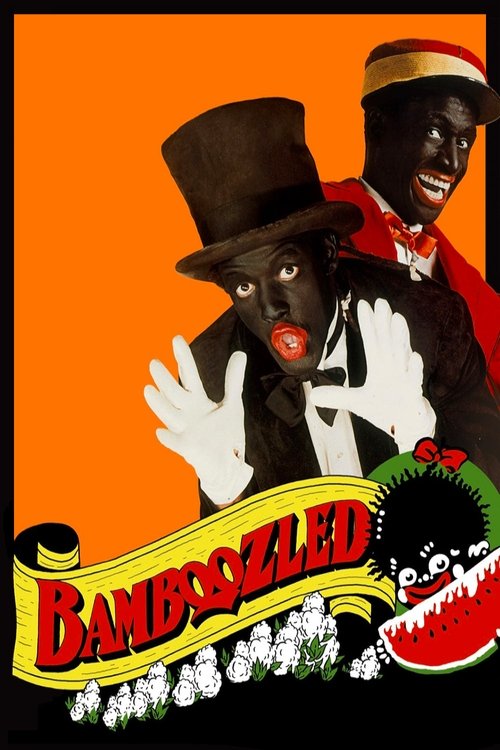
Bamboozled
2000 · Spike Lee
For when you want to be provoked and have something to argue about for days — bold, angry, challenging viewing, absolutely not a comfort watch.
What it's about
Pierre Delacroix, a frustrated Black television writer whose sitcom pitches keep getting rejected, tries to get himself fired by pitching the most offensive idea he can imagine: a modern-day minstrel show, blackface and all. The network loves it. It becomes a smash. What follows is a furious satire of American entertainment, race, and ratings — about what television is willing to sell and what audiences are willing to cheer.
The experience
Confrontational, bitterly funny, and deliberately uncomfortable — it keeps implicating you, letting a dazzling tap number seduce you even as the imagery appalls. It's a film that means to leave a mark, and does.
Performances
Savion Glover's tap dancing in the show-within-the-show is genuinely virtuosic — the film weaponizes his brilliance, making the artistry and the shame inseparable — which is exactly the trap the satire needs.
The craft
Spike Lee shoots the offices and apartments on cheap, smeary consumer digital video — the ugliness indicting the medium itself — while the minstrel show gleams on Super 16, so the most poisonous material looks the most beautiful. The blackface was applied by the authentic nineteenth-century burnt-cork method, and the racist props are real artifacts from Lee's own collection of memorabilia; the film's texture is built from the actual history it's attacking.
Why it matters
Dismissed and barely released in 2000, it has undergone one of the great critical reappraisals and now looks prophetic about media, minstrelsy's afterlife, and viral entertainment — a key work in Lee's career and in American satire.
Spike Lee's most incendiary film is a media satire in the lineage of A Face in the Crowd and Network, pushed somewhere neither dared go. A frustrated Black television writer, Pierre Delacroix, pitches a modern minstrel show — blackface, watermelon patch, the full apparatus of American shame — intending career suicide; the network smells a hit. Lee shot the offices and apartments on cheap consumer digital video, its smeary ugliness indicting the medium itself, while the show-within-the-show gleams on Super 16, seducing us with Savion Glover's genuinely virtuosic tap even as the imagery appalls. The burnt-cork makeup was applied by the authentic nineteenth-century method; the props are real artifacts from Lee's own collection of racist memorabilia. Dismissed and barely released in 2000, it has undergone one of the great critical reappraisals — a Criterion edition, and visible fingerprints on Atlanta and Sorry to Bother You. Its closing montage, assembled from a century of actual Hollywood footage, remains one of the most damning sequences an American studio ever financed.
A Deleuzian reading
Two men sit at a mirror and burn a cork.
The full Deleuzian reading of Bamboozled →
Reception
A box-office flop in 2000 that critics called messy and heavy-handed (Roger Ebert panned it), Bamboozled has been thoroughly reappraised as one of Spike Lee's most prescient films — a rehabilitation sealed by its 2020 Criterion Collection release.
How Bamboozled was received, from release to now →
Influences: the films it descends from and the films it influenced
- A Face in the Crowd (1957) — Blueprint for the media-manufactured monster arc — a folksy performer built up by a broadcast apparatus into a demagogue who is then consumed by it, the exact rise-and-ruin structure Lee gives Manray/Mantan.
- Network (1976) — Establishes the network-satire form Lee inherits: a cynical, ratings-desperate executive greenlighting incendiary on-air spectacle while the live performer is destroyed by the machine's appetite.
- The Producers (1967) — Supplies the show-within-a-show mechanics — a program engineered to be maximally offensive and to fail, which instead becomes a runaway hit, driving Bamboozled's 'Mantan: The New Millennium Minstrel Show' plot.
- Ethnic Notions (1987) — Documentary taxonomy of the coon, mammy, Sambo and pickaninny in collectibles and film clips; Bamboozled's closing found-footage montage of racist memorabilia and archival caricature descends directly from Riggs's cataloging method.
- The Jazz Singer (1927) — Jolson's burnt-cork application ritual is the primal scene Lee restages as horror — the authentic blackface makeup sequence where Manray and Womack cork up is a deliberate, mournful inversion of this.
- The Birth of a Nation (1915) — Source reservoir for the white-actors-in-blackface archival imagery Lee samples in his indictment montage, weaponizing Hollywood's own foundational footage against it.
- Stormy Weather (1943) — Bill 'Bojangles' Robinson's tap virtuosity framed within minstrel-adjacent staging models the tension Savion Glover embodies — authentic Black hoofing haunted by the caricature it was made to serve.
- Tap (1989) — Direct collaborator lineage: Savion Glover's screen tap tradition (alongside Sammy Davis Jr.) is the very performance vocabulary Lee recruits and then forces into blackface, making the choreography itself an argument.
- Putney Swope (1969) — Absurdist advertising/media satire built on Black tokenism and fake commercial interstitials — the mock-ad device (e.g. 'Da Bomb' malt liquor spots) is lifted straight from this tradition.
- The Celebration (Festen) (1998) — Dogme 95's consumer mini-DV, available-light handheld aesthetic is the technical grammar Ellen Kuras adopts, shooting the show-world on multiple small digital cameras against the Super-16 'real' scenes for dual-format contrast.
- West Indies: The Fugitive Slaves of Liberty (1979) — Deploys Brechtian minstrel spectacle and performance-within-performance to expose racial commodification, extending Hondo's use of the musical number as self-aware political indictment.
- C.S.A.: The Confederate States of America (2004) — Extends the mock-broadcast device with fake racist product commercials as satire's payload; Willmott would later become Lee's co-writer, making the debt literal.
- Atlanta (2016) — The 'B.A.N.' episode's fabricated commercials and surreal in-show television satire of Black media representation is a direct descendant of Bamboozled's fake-ad interstitial structure.
- Sorry to Bother You (2018) — Carries forward the absurdist-escalation satire of race, performance and commodification, building to a grotesque literalization of Black labor-as-spectacle in the same key as Lee's minstrel revival.
- BlacKkKlansman (2018) — Lee reprises Bamboozled's signature closing move — a montage that ruptures the fiction with real archival atrocity footage (Charlottesville) — collapsing narrative into documentary indictment exactly as the memorabilia montage did.
- Dear White People (2014) — Structures its satire around a campus blackface party and media self-image, extending Bamboozled's interrogation of racial performance staged for a spectating audience.
- I Love Boosters (2026) — Media satire that escalates into grotesque literalization, using production design (the minstrel-show set) as an explicit polemical argument.
- American Fiction (2023) — Supplies the plot engine outright: a Black creator writes a deliberately offensive caricature as career sabotage and is rewarded for it, with complicity escalating as the product succeeds; Jefferson keeps the structure and swaps Lee's video-grain fury for restrained comic cutting.
- Hollywood Shuffle (1987) — Insider sketch-satire skewering the demeaning Black screen roles the industry demands, using imagined show segments as its weapon — the same from-within-the-machine critique Lee sharpens.
- School Daze (1988) — Lee's own musical-number satire that turns critique inward on Black community and colorism, prefiguring Bamboozled's willingness to make its own audience complicit.
- Tropic Thunder (2008) — Deploys blackface as showbiz satire through a white actor's 'full commitment' method performance, targeting the industry's appetite for racial masquerade that Bamboozled anatomizes.
- Cecil B. Demented (2000) — Builds the same intercut mediation stack — a show-within-the-show shot on degraded consumer formats and folded into the feature's own grain — and closes with a media-guerrilla cell staging and broadcasting its own hostage tape.
Similar films
- BlacKkKlansman (2018) — influence & lineage
- Sorry to Bother You (2018) — influence & lineage
- Network (1976) — influence & lineage
- She's Gotta Have It (1986) — shared sensibility
- Black Dynamite (2009) — shared sensibility
- The Big Short (2015) — shared sensibility
- The Spook Who Sat by the Door (1973) — shared sensibility
- Borat: Cultural Learnings of America for Make Benefit Glorious Nation of Kazakhstan (2006) — shared sensibility