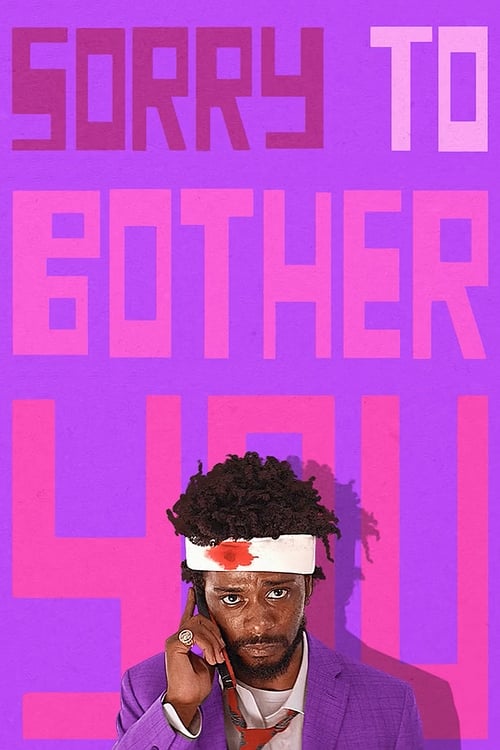
Sorry to Bother You
2018 · Boots Riley
For when you want a comedy with teeth and zero interest in playing it safe — a great pick with friends who like arguing about a movie afterward. Fair warning: it goes places, and it does not care if you're comfortable.
What it's about
In a warped, alternate present-day Oakland, a broke Black telemarketer discovers that using a 'white voice' on the phone sends him rocketing up the corporate ladder — right past his friends, who are trying to unionize the call floor, and into the orbit of a corporation selling lifetime labor contracts with a smile. The higher he climbs, the stranger and more sinister the view gets.
The experience
Fast, funny, and gleefully unhinged — a workplace comedy that keeps escalating until it tips into something genuinely jaw-dropping. You'll laugh a lot and then spend the last act with your mouth open.
Performances
Lakeith Stanfield is perfect as a man watching his own life get weirder by the day — hangdog, funny, and quietly heartbroken all at once.
The craft
Boots Riley directs his first feature like he's been saving up ideas his whole life: desks crashing through ceilings mid-sales-call, hand-made surrealist gags, and the inspired trick of dubbing the 'white voice' with entirely different actors. The energy is DIY punk with real visual wit.
Why it matters
One of the defining debuts of the 2010s indie wave — it caught the moment's arguments about race, work, and late capitalism and turned them into a midnight-movie provocation people are still recommending to each other.
Snapshot
Sorry to Bother You is the feature debut of Boots Riley, the Oakland rapper, producer, and longtime communist organizer best known as the frontman of The Coup. It follows Cassius "Cash" Green (Lakeith Stanfield), a broke Black telemarketer in a heightened, alternate-present Oakland, who discovers that adopting a "white voice" on the phone rockets him up the corporate ladder — past a unionizing workforce led by his friends and into the orbit of WorryFree, a corporation selling lifetime labor contracts that amount to legalized indenture. What begins as a workplace satire about code-switching mutates, in its final act, into outright body-horror science fiction. The film is at once a labor comedy, a surrealist provocation, and a Marxist parable, and it announced Riley as one of the most distinctive new directorial voices of the late 2010s American independent scene. It premiered at the Sundance Film Festival in January 2018 and was released by Annapurna Pictures that July.
Industry & production
The film's production history is inseparable from Riley's long apprenticeship outside cinema. He wrote the screenplay over several years and published it in McSweeney's (Issue 48, 2014) before it was financed — an unusual route that gave the project literary visibility while it struggled to attract money. The Coup's 2012 album of the same name functioned as a companion work, sharing the title and thematic preoccupations. Riley has spoken in interviews about the difficulty of raising funds for a debut feature by an untested, avowedly radical director working in an anti-realist register.
Financing ultimately came through a coalition of independent and mission-driven companies: Significant Productions (Forest Whitaker and Nina Yang Bongiovi, who had backed Fruitvale Station), Charles D. King's MACRO, Cinereach, and others, with Annapurna Pictures distributing. The reported budget was modest — on the order of a few million dollars — which is consequential: the film's deliberately handmade, lo-fi surrealism is partly an aesthetic choice and partly an economy. Shooting took place in Oakland, the city that is both setting and subject. The cast assembled an unusually deep bench for a debut — Tessa Thompson, Armie Hammer, Steven Yeun, Danny Glover, Terry Crews, Omari Hardwick — drawn in large part by the screenplay's singularity. The "white voices" were dubbed in post-production by separate performers (David Cross for Cassius, Patton Oswalt for Hardwick's character, Lily James for Thompson's Detroit), a casting-and-sound decision that is also a thesis statement.
Technology
Sorry to Bother You was shot digitally, but its relationship to technology is defined less by capture format than by a programmatic preference for the practical and the visibly artificial over the seamless. The film's most demanding visual element — the "equisapiens," human-horse hybrids engineered by WorryFree as a more durable labor force — is realized substantially through practical prosthetics, makeup, and animatronic effects rather than fully computer-generated bodies, supplemented by digital work. This is a meaningful authorial decision: the creatures have a tactile, grotesque physical presence that CGI smoothness would have undercut, and it keeps the film tonally adjacent to the handmade traditions of Gilliam and Gondry rather than to studio VFX spectacle.
The most important "technology" in the film, though, is sociolinguistic: the white voice itself. Within the fiction, it is a learned vocal performance — Langston (Danny Glover) instructs Cash that the white voice is not merely sounding white but sounding untroubled, like someone for whom the rent is always paid. Riley renders it through audibly post-synced dubbing, the white voice arriving slightly disembodied, mismatched to the moving mouth. The deliberate ADR seam turns a sound-engineering technique into the film's central metaphor.
Technique
Cinematography
Doug Emmett's cinematography keeps the film legible and grounded even as the world tips toward the absurd. The early telemarketing-floor sequences exploit a recurring gag literalized through camera and editing: when Cash makes a cold call, his desk — and Cash with it — physically drops through the floor into the prospect's living space, crashing into kitchens and bedrooms mid-dinner. The device makes the violation of cold-calling spatial and bodily rather than merely conceptual. As Cash rises into the world of the "power callers," the palette and framing grow cooler and more controlled — the golden elevator, Steve Lift's mansion — contrasting the warm clutter of the garage Cash shares with Detroit. The film generally favors clear, slightly heightened compositions over naturalism, in keeping with a fable that wants its ideas readable.
Editing
Terel Gibson's editing carries much of the film's comic timing and its escalating tonal management. The desk-drop gag is fundamentally an editing joke — a hard cut that collapses two spaces. The film's most discussed structural feature is its third-act swerve: the reveal of the equisapiens reorganizes the preceding satire into horror, and the cut has to sell a genre rupture without losing the audience. Reactions to that pivot were divided precisely because it is a deliberate gear-change rather than a smooth modulation; the film bets that the jolt is the point.
Mise-en-scène / staging
Production designer Jason Kisvarday builds an Oakland one notch askew from the real one — recognizable, then wrong. WorryFree's advertising saturates the world; the omnipresent TV game show I Got the Shit Kicked Out of Me plays in the background as ambient cultural rot; Detroit's earrings spell out slogans ("MURDER MURDER MURDER KILL KILL KILL"). The garage-apartment, with its roll-up door that opens onto the street, externalizes Cash's precarity. Detroit's gallery performance piece — in which she invites an audience to pelt her with objects while reciting fragments — stages, within the film, the same questions about spectacle, complicity, and the commodification of Black suffering that the film itself raises.
Sound
Sound is arguably the film's signature technical achievement, because the white voice lives there. The dubbed voices are mixed to feel uncanny rather than convincing — too smooth, too unbothered, never quite seated in the body. The score is by tune-yards (Merrill Garbus and Nate Brenner), with original music from The Coup, giving the film a percussive, off-kilter, politically charged sonic texture entirely consonant with Riley's own musical practice. The film's soundscape — call-center din, advertising jingles, the game show's laughter — builds a sense of a culture marinating in its own exploitation.
Performance
Lakeith Stanfield anchors the film with a performance built on watchfulness and slow corruption; his Cash is reactive, decent, and increasingly compromised, and Stanfield lets the moral erosion register in small recalibrations rather than speeches. Tessa Thompson's Detroit is the film's conscience and its most stylized presence, an artist whose politics are lived rather than argued. Armie Hammer plays Steve Lift as a seductive, coked-up avatar of frictionless capital. Steven Yeun (Squeeze), Danny Glover (Langston), and Terry Crews (Cash's uncle Sergio) fill out a world in which everyone is making compromises at a different point on the same curve. The split between on-screen actor and dubbed white voice also makes performance itself doubled and audible — the actors physically perform code-switching while another voice supplies its sound.
Narrative & dramatic mode
The film operates as escalating satire that crosses, without warning, into speculative horror. Its dramatic engine is a classic rise-and-fall: an ambitious have-not climbs, betrays his community, and confronts the monstrousness of the system that rewarded him. But Riley refuses the realist register that usually houses such arcs. The mode is closer to fable or parable — characters and institutions are slightly larger than life, names are emblematic (Cassius Green / "cash is green," WorryFree), and the plot is willing to literalize metaphors into physical fact. The equisapiens are the ultimate literalization: the dehumanization of labor rendered as actual transformation into beasts of burden. The film's tonal instability is a feature, designed to keep the audience from settling into a single comfortable genre contract.
Genre & cycle
Sorry to Bother You belongs to the late-2010s wave of Black American speculative and surrealist filmmaking that crystallized around Jordan Peele's Get Out (2017) — work that used genre (horror, sci-fi, the fantastic) to dramatize racial and economic experience that realism handled less forcefully. It is also part of a specifically Oakland-and-Bay-Area moment: Riley's film arrived the same year as Carlos López Estrada's Blindspotting (2018), and Stanfield was simultaneously central to Donald Glover's Atlanta, another work braiding deadpan realism with the surreal. More broadly it sits in the lineage of corporate/consumerist satire — Putney Swope, Network, Idiocracy — and of anti-capitalist science fiction. What distinguishes Riley's contribution is the explicitly Marxist, pro-union content: where much social satire diagnoses, Sorry to Bother You is unusually direct about class, organized labor, and the strike as its political horizon.
Authorship & method
The film is a singular auteur work in the strict sense — written and directed by Riley, and saturated with the worldview he had been developing for decades as a musician and organizer. His method imports the practices of a politically committed hip-hop artist: heightened language, slogan and image as agitprop, comedy as a delivery system for radical content. The white-voice conceit, the WorryFree contracts, and the strike plot all read as ideas a songwriter-organizer would generate before a film-school graduate would.
His key collaborators translate that sensibility into cinema. Cinematographer Doug Emmett gives the absurdism a clean, readable frame. Editor Terel Gibson manages the film's perilous tonal shifts and comic timing. The musical identity comes from tune-yards (Garbus and Brenner) alongside The Coup, keeping the score in dialogue with Riley's own catalog. Production designer Jason Kisvarday builds the askew Oakland. The producing coalition — Significant Productions, MACRO, Cinereach — represents a deliberate infrastructure for ambitious work by filmmakers of color outside the studio system. The dubbing performers (Cross, Oswalt, James) are, unusually, authorial instruments: their detached vocal presence is a directorial idea as much as a casting one.
Movement / national cinema
This is American independent cinema, and specifically a product of a Bay Area regional sensibility — Oakland as place, politics, and aesthetic. It connects to the post-Fruitvale Station ecosystem of Bay Area Black filmmaking (Ryan Coogler's milieu, via the Significant Productions/Forest Whitaker–Nina Yang Bongiovi throughline). Stylistically Riley draws on traditions that are not strictly American: the handmade surrealism of Michel Gondry and Terry Gilliam, the absurdist political theater of Brecht (the alienation effect is a useful frame for the dubbed white voice), and a strain of agitprop that runs back through politically engaged art cinema. The film is a hybrid — American independent in its financing and setting, internationalist in its formal and political imagination.
Era / period
The film is a document of the Obama-to-Trump transition and the period's anxieties: precarious gig and call-center labor, viral-media celebrity, surveillance capitalism, gentrification, and resurgent interest in socialism and unionization among younger Americans. WorryFree — offering housing and food in exchange for a lifetime labor contract, dressed in cheerful branding — satirizes both historical indenture and the contemporary tech-utopian pitch that workers should be grateful for total enclosure by their employer. Made in the mid-2010s and released in 2018, it reads as an intervention into debates that the Occupy aftermath and the 2016 election had pushed back into mainstream view.
Themes
The film's governing theme is the dehumanization of labor under capitalism, pushed to its literal extreme in the equisapiens. Around it cluster: code-switching and the price of assimilation (the white voice as the cost of admission to power); solidarity versus individual advancement (Cash's betrayal of the unionizing floor); the commodification and spectacle of Black suffering (Detroit's performance piece, the game show, the viral Coke-can video that makes Cash a meme); the seductions of consumer culture and frictionless wealth (Steve Lift); and the strike as the one form of power available to the exploited. Crucially, the film insists the system is not a misunderstanding to be reasoned with but a logic to be resisted collectively — its politics are organizational, not merely attitudinal.
Reception, canon & influence
Sorry to Bother You was received as one of the most original American debuts of its year. Critics widely praised its ambition, invention, and political nerve, and singled out the central performances and the white-voice conceit; the third-act turn toward body horror was the most divisive element, with some finding it a thrilling escalation and others a tonal overreach. The film was recognized in the independent-film awards conversation — it won the Independent Spirit Award for Best First Feature (for the 2018 films, awarded in early 2019) — and it secured Riley's standing as a director to watch. Precise box-office figures are best confirmed against a reliable database rather than asserted here, but the film was a modest commercial release whose cultural footprint exceeded its grosses.
Looking backward, the film's influences are eclectic and openly worn: Gondry and Gilliam's handmade surrealism, the corporate satire of Putney Swope and Network, Brechtian estrangement, anti-capitalist science fiction, and Riley's own decades of agitprop hip-hop with The Coup. Looking forward, its most important effect was to widen the lane — alongside Get Out and Atlanta — for Black American filmmakers to work in the speculative, surreal, and genre-bending registers while keeping an explicit political charge, and specifically to put organized labor and Marxist analysis on screen in a popular comic form. "The white voice" entered cultural shorthand for code-switching. The film remains a touchstone in discussions of contemporary anti-capitalist cinema and of the post-2017 efflorescence of Black surrealism, and Riley's subsequent move into television (I'm a Virgo) extended the same handmade, maximalist, politically frontal sensibility. The record on its long-term canonical standing is still being written, as is appropriate for a film not yet a decade old.
A Deleuzian reading
The mouth and the voice come apart.
The full Deleuzian reading of Sorry to Bother You →
Reception
It detonated at Sundance 2018 as the year's most out-there debut and became a genuine indie sleeper hit; since then it's settled into the late-2010s canon as the gonzo companion piece to Get Out in that era's wave of Black surrealist breakouts.
How Sorry to Bother You was received, from release to now →
Influences: the films it descends from and the films it influenced
- Brazil (1985) — Source of the handmade dystopian production design and bureaucratic-absurdist worldbuilding — an askew, lo-fi future built from practical sets rather than CGI, the explicit Gilliam debt Riley names.
- Bamboozled (2000) — Direct ancestor on code-switching and minstrelsy-in-media: a Black corporate striver performing a 'white' professional register inside a satirical media apparatus that turns racial performance into product.
- The Parallax View (1974) — The film-within-film device as ideological weapon — the horse-people video that Cassius discovers inside WorryFree's compound implicates the viewer in the corporate conditioning apparatus exactly as the Parallax test implicates the cinema audience; the conspiracy that grows stronger through attempted exposure and the protagonist whose procedural investigation reveals a system that has already incorporated the revelation are direct structural inheritances.
- The Spook Who Sat by the Door (1973) — A Bay Area Black-radical satire of subversion-from-within a white corporate system whose insurrectionary climax Riley has explicitly tied to Spook's infiltrate-then-detonate structure.
- The Working Class Goes to Heaven (1971) — Revives Petri's grotesque-caricatural register and hollow-consumerism satire, weaponizing surreal exaggeration of the workplace and union betrayal as political provocation rather than realism.
- Tootsie (1982) — Extends vocal-performance design as the whole mechanism of passing — the dubbed 'white voice' doing structurally what Hoffman's pitched register does, and, like Tootsie, keeping the technique audible rather than hiding it.
- Okja (2017) — Extends the corporate-satire-to-body-horror pivot: a media-trained executive presents an engineered human-animal hybrid as a productivity product in a launch-event setting, with the late genre rupture staged as a marketing reveal exactly as Mirando stages the superpig.
- They Cloned Tyrone (2023) — Named influence: the magic-realist Black satire that hard-swerves mid-film into sci-fi body-horror to unmask corporate dehumanization, sharing Tyrone's comedy-to-horror tonal friction.
- I Love Boosters (2026) — Riley's own debut supplies the template: literalizing a capitalist metaphor (the 'white voice' dub, the equisapien reveal) via code-switching audio tricks and practical body-horror rather than CGI.
- Putney Swope (1969) — Direct ancestor of the 'white voice' gag: Downey post-dubbed the Black ad-exec lead Putney with his own voice, weaponizing a swapped vocal track as racial satire exactly as Riley dubs Cassius with David Cross.
- Network (1976) — Model for satirizing a media-corporate machine by escalating its internal logic to literal spectacle (the on-air prophet/ratings stunt), the same 'follow capitalism to its grotesque conclusion' structure Riley uses for WorryFree.
- Eternal Sunshine of the Spotless Mind (2004) — Template for the in-camera, craft-fair surrealism Riley cites — practical effects and analog visual trickery used to render interior/conceptual states physically rather than digitally.
- Being John Malkovich (1999) — Precedent for grounding a single high-concept absurdist conceit inside a drab realist workplace, letting deadpan office mundanity sell the impossible premise.
- How to Get Ahead in Advertising (1989) — Sibling body-horror-as-capitalist-satire: an ad-man's literal physical mutation externalizes his moral corruption, the same literalized-metaphor device as Cassius's equisapien transformation.
- RoboCop (1987) — Ancestor of the satirical-SF mode that splices mock-corporate advertisements and a body-modified worker into a violent dystopia to indict capital, tonally rupturing comedy and horror.
- Sweet Sweetback's Baadasssss Song (1971) — Foundational Black-radical independent cinema whose agitprop, outside-the-studio financing and politics-as-form lineage Riley extends into Bay Area Black surrealism.
- Get Out (2017) — Sibling in the post-2017 Black genre cycle the dossier names — uses horror's body-invasion conceit as a literalized metaphor for the appropriation/commodification of Black bodies.
- Atlanta (Teddy Perkins / B.A.N.) (2018) — Sibling deadpan-surreal register from the same moment, deploying tonal rupture and absurdist set-pieces grounded in Black working-class texture — and shares lead Lakeith Stanfield's affectless presence.
- Idiocracy (2006) — Sibling corporate-dystopian comedy built from sloganeering fake brands and broad satirical extrapolation of consumer capitalism into a degraded near-future.
- Putney-adjacent: Holy Motors (2012) — Sibling in maximalist, episodic surrealism where a performer's body is endlessly transformed across grotesque set-pieces, privileging conceptual spectacle over plot coherence.
- They Live (1988) — Ancestor of the SF-allegory that makes the hidden mechanics of capitalist control literally visible/audible (the alien ad-overlords), the same reveal-the-system move as the equisapien exposé.
Similar films
- Get Out (2017) — influence & lineage
- RoboCop (1987) — influence & lineage
- Bamboozled (2000) — influence & lineage
- Brazil (1985) — influence & lineage · often watched together
- Being John Malkovich (1999) — influence & lineage · often watched together
- I Love Boosters (2026) — often watched together
- Blindspotting (2018) — often watched together
- The Big Lebowski (1998) — often watched together