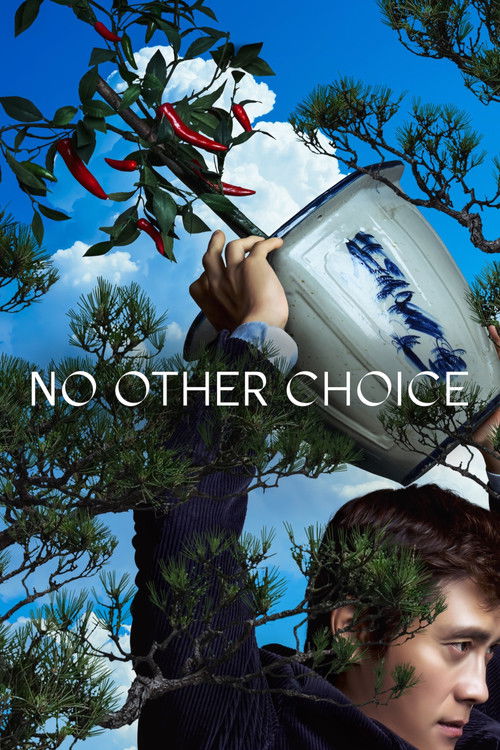
No Other Choice
2025 · Park Chan-wook
Decision to Leave made him Letterboxd's romantic-obsession auteur; No Other Choice's Venice reception restarted the "greatest living Korean director" argument with Bong partisans. Elegance-plus-perversity is his brand in the discourse.
For when you want a thriller with teeth and a sense of humor about it — something stylish and wicked that also hits a nerve about work, layoffs, and what a job means to a person. Challenging in subject, but slippery, propulsive fun to actually watch.
What it's about
A veteran paper-mill manager gets laid off after decades of loyal service and discovers the job market has no use for him. With his house, his marriage, and his self-respect on the line, he lands on a horrifyingly logical solution: identify the rivals competing for the one position that could restore his life, and eliminate them. Park Chan-wook adapts Donald E. Westlake's novel The Ax into a Korean black comedy where a devoted family man talks himself into murder one rationalization at a time.
The experience
It plays like a nightmare you keep laughing at — squirmy, elegant, and mean in the best way. The suspense of each botched, half-improvised scheme keeps tightening while the comedy of an ordinary man's wounded pride keeps puncturing it, so you're wincing and grinning in the same breath.
Performances
Lee Byung-hun is remarkable as the laid-off manager — he plays desperation as a kind of terrible earnestness, keeping you on the side of a man doing unforgivable things because you can see exactly how much he's drowning.
The craft
Park Chan-wook's signature control is everywhere: immaculate compositions, needle-sharp cuts, violence staged with the timing of farce. It's a film where the framing itself is often the joke, and the craftsmanship rewards a proper screen. A project Park chased for some sixteen years, and the long gestation shows in how precisely every beat lands.
Why it matters
It premiered in competition at Venice, opened Busan, and became South Korea's Oscar submission for Best International Feature, advancing to the shortlist — a late-career peak that confirmed Park as the reigning stylist of the morally compromised everyman.
Snapshot
No Other Choice (Korean: 어쩔 수가 없다, Eojjeol suga eopda) is Park Chan-wook's blackly comic crime thriller about a paper-industry lifer who, cast out of the workforce, resolves to murder his rivals for the one job that can restore his household. Adapted from Donald E. Westlake's 1997 novel The Ax, it is a project Park first announced at the 2009 Busan International Film Festival and later described as a "lifetime" pursuit, finally realized some sixteen years on. The film premiered in competition at the 82nd Venice International Film Festival on 29 August 2025, played Toronto and opened the Busan festival, and became South Korea's submission for the Academy Award for Best International Feature, advancing to the December shortlist without securing a final nomination. Reuniting Park with Lee Byung-hun — the star of his 2000 breakthrough Joint Security Area — it stands as one of his most accessible and savagely funny works, a recession-era fable in which corporate violence is literalized into homicide.
Industry & production
The film was produced through Park's own Moho Film banner with CJ Entertainment and KG Productions, and distributed by CJ ENM, the dominant force in Korean studio cinema and the company behind Parasite. Reported figures put the budget at roughly ₩17 billion (about US$12 million), a substantial mid-to-upper-tier spend by Korean standards, with reported worldwide grosses in the region of US$40 million — a commercial success that, alongside the film's festival run, was widely read as a tonic for a Korean theatrical sector still recovering from pandemic-era contraction. Principal photography ran roughly five months, from August 2024 into January 2025. The production's pedigree — a globally branded auteur, a marquee cast, and CJ's distribution muscle — positioned No Other Choice as exactly the kind of prestige export Korea has learned to engineer, premiering on the Lido before a domestic release on 24 September 2025. Park's continued reliance on his own production company underscores the authorial control he has maintained across his late career, even as financing and distribution flow through the majors.
Technology
Detailed technical documentation on capture format is, at the time of writing, thin in the public record, and specifics should not be overstated. Like the overwhelming majority of contemporary Korean studio features, the film was in all likelihood originated digitally and finished through a controlled digital intermediate, a workflow that suits Park's exacting approach to color and contrast. What the reviews make clear is less a matter of novel apparatus than of precision: the technology serves an almost architectural command of focus, framing, and movement rather than any showcased innovation. Where the factual record on rigs, lenses, or grading pipeline is genuinely sparse, it is more responsible to say so than to reconstruct it speculatively.
Technique
Cinematography
Shot by Kim Woo-hyung — not Park's longtime collaborator Chung Chung-hoon, who has spent recent years working internationally — the film extends Park's signature paradox: the deeper the narrative chaos, the more fastidious the image. Critics singled out compositions in which the camera spies through traffic mirrors and deep-focus corners, and motifs glimpsed at the frame's edge (a child's yellow rain boots swinging into view) that fold domestic tenderness into menace. The visual grammar is one of controlled vantage and surveillance, the everyday made geometric. It is characteristic Park: an ordered, deliberate eye trained on disorder.
Editing
Cut by Kim Sang-bum — Park's most enduring editorial collaborator, his hand present across Oldboy, The Handmaiden, and Decision to Leave — together with Kim Ho-bin, the film modulates between farce and dread with the tonal agility that has become a Park hallmark. The editing's task here is comic timing as much as suspense: the rhythm of escalation, the cutaway that converts horror into absurdity and back. The collaboration's longevity matters, since so much of Park's signature whiplash between registers is achieved in the cut.
Mise-en-scène / staging
Production design by Ryu Seong-hie — the designer behind the spaces of Oldboy, The Handmaiden, and Decision to Leave — was widely praised as the film's spatial engine. The protagonist's family home is built as a machine for the plot: eccentric in its angles, generous in its deep-focus corridors, equipped with rooftop sightlines that the staging exploits for spying and concealment. In Park's cinema the house is rarely neutral, and here the bourgeois domestic interior — the very thing the hero kills to keep — becomes both prize and trap, its design legible as a portrait of the life under threat.
Sound
Specific technical accounts of the sound design are limited in the available record, and the film's most discussed sonic element is its score (treated below). What reviews convey is a soundscape integrated with the picture's tonal swings, supporting the abrupt shifts from drawing-room comedy to violence rather than smoothing them.
Performance
Lee Byung-hun anchors the film as Yoo Man-su, the laid-off paper expert, in a performance critics called irreplaceable — a study in mounting desperation that keeps the audience's sympathy even as the body count rises, the "hapless" everyman curdling into killer. Son Ye-jin plays his wife (Mi-ri) as a figure of unexpected resourcefulness, her role notably expanded from the source. The ensemble of rivals — Lee Sung-min, Cha Seung-won, and Park Hee-soon as the men Man-su targets, with Yeom Hye-ran and Yoo Yeon-seok in support — was praised for refusing to function as mere plot fodder, each victim drawn with angular, absurdist specificity that makes the murders land as both comedy and moral cost.
Narrative & dramatic mode
The dramatic engine is grimly elegant and faithful to Westlake: a long-tenured specialist, made redundant, realizes that the few people standing between him and re-employment are the handful of rivals with his exact qualifications — so he sets out to eliminate them, one by one, while maintaining the fiction of normal family life. The mode is satirical black comedy braided with the procedural suspense of the serial-killer thriller, but inverted: the "killer's" logic is the pitiless arithmetic of the labor market itself. Park reportedly reworked the material to sharpen the moral dilemma and enlarge the wife's role, deepening the domestic stakes so that the violence reads as an extension of breadwinner anxiety rather than pathology. The result is a tragicomedy of provision, in which every escalation is rationalized as care for the family.
Genre & cycle
The film sits within Korean cinema's well-developed strain of socially pointed crime cinema and, more specifically, within the recent international cycle of "eat-the-rich" / class-rage satire that Parasite (2019) crystallized — though here the target is precarity and downsizing rather than wealth disparity per se. Several critics noted shared DNA with Parasite in its anatomy of Korean professional hierarchy and the cultural weight of male breadwinner status. As genre, it hybridizes black comedy, the murder thriller, and domestic melodrama; as a cycle entry, it belongs to the global post-2008, post-pandemic wave of films treating economic dispossession as horror, joining a lineage that runs from the source novel's own moment of 1990s corporate "rightsizing" to the present.
Authorship & method
No Other Choice is unmistakably a Park Chan-wook film: the moral revenge structure, the immaculate visual control, the oscillation between cruelty and absurd tenderness that defines his cinema from Sympathy for Mr. Vengeance through Oldboy, Thirst, The Handmaiden, and Decision to Leave. Park co-wrote, produced, and directed. Notably, the screenplay was developed not with his frequent writing partner Chung Seo-kyung but with a different team — director Lee Kyoung-mi (whose The Truth Beneath Park produced and co-wrote), Canadian filmmaker-screenwriter Don McKellar, and Lee Ja-hye — a collaboration that helped transpose Westlake's American premise (already relocated to France by Costa-Gavras) into a specifically Korean key. The technical authorship rests heavily on long-standing collaborators: composer Jo Yeong-wook (Cho Young-wuk), whose scores have shaped the Park sound since his earliest features; editor Kim Sang-bum; and production designer Ryu Seong-hie. Park's method here, as throughout his career, is one of meticulous pre-visualization and rigorous control of the frame, deployed in service of moral discomfort. In a gesture of explicit lineage, he dedicated the film to Costa-Gavras.
Movement / national cinema
The film is a flagship product of the mature Korean New Wave — the post-1999 industrial and artistic ascendancy that produced Park, Bong Joon-ho, and the globally exported "K-cinema" of the 2010s. It exemplifies that movement's defining synthesis: genre populism fused with social critique, technical polish at world-class scale, and a willingness to follow violence to its logical and ethical extremes. Premiering at Venice, winning festival accolades, and serving as Korea's Oscar submission, it functions as both a national-cinema standard-bearer and a calculated act of cultural diplomacy, extending the soft-power momentum that Parasite's 2020 Oscar sweep accelerated.
Era / period
No Other Choice is acutely a film of its moment — the mid-2020s anxiety economy of layoffs, automation fears, midlife redundancy, and the erosion of the lifetime-employment compact that once organized salaried life in East Asia and beyond. By staging this through a fifty-something man's fall from secure professional identity, it speaks directly to a generation confronting obsolescence. That the underlying novel dates to the 1990s wave of corporate downsizing only sharpens the point: the film argues that the precarity Westlake diagnosed has not abated but metastasized, making a quarter-century-old premise feel like reportage.
Themes
At its core the film dramatizes the violence latent in capitalist competition — the way a system that pits equally qualified people against one another for a single position already contains the logic of elimination, which the protagonist merely literalizes. Adjacent themes include masculine identity bound to provision and the shame of unemployment; the bourgeois home as both sanctuary and prison; the moral corrosion of self-justification, as each killing is rationalized as familial duty; and atomization, the severing of social solidarity into a war of all against all. Park's characteristic interest in the contagion of violence and the slipperiness of the sympathetic monster runs throughout. Critics described the film, for all its bloodshed, as among Park's most humane works precisely because it locates the horror not in an aberrant individual but in an ordinary man behaving rationally within a deranged structure.
Reception, canon & influence
Critical reception was strongly positive: the film earned a lengthy standing ovation at its Venice premiere and registered among the year's best-reviewed releases, with aggregators reflecting near-unanimous critical approval (a 97% Rotten Tomatoes score across 234 reviews and a Metacritic in the high 80s). Reviewers praised its precision, its tonal control, and Lee Byung-hun's central performance, frequently invoking Parasite as a comparison point for its class-conscious satire. On the awards circuit it was reported to have taken the Toronto International Film Festival's People's Choice Award and Best Director at Sitges, and went on to major domestic recognition including Blue Dragon and Baeksang honors, before its Oscar campaign reached the international-feature shortlist.
Its influences run backward through a clear genealogy: Westlake's source novel The Ax; Costa-Gavras's 2005 adaptation Le Couperet (to which Park pays tribute in his dedication); the social-realist crime tradition; and Park's own body of revenge cinema. Looking forward, it is early to assess legacy with any certainty, and prudent to say so. What can be observed is that the film consolidates the post-Parasite template of internationally legible Korean class satire and reaffirms Park's standing as one of world cinema's preeminent stylists; should it endure as expected, it is likely to be cited as a benchmark of 2020s recession-era cinema and a model for how genre craft can carry pointed economic critique to a mass audience.
A Deleuzian reading
A pair of small yellow rain boots swings into the bottom of the frame.
The full Deleuzian reading of No Other Choice →
Reception
Premiered at Venice 2025 to an 8½-minute ovation and instant Golden-Lion-favorite status — then walked away with nothing, which cinephiles immediately filed under 'the snub of the festival'. The vindication came fast: near-perfect reviews, Golden Globe nominations, and consensus best-of-2025 list placement.
How No Other Choice was received, from release to now →
How to watch No Other Choice: what to notice on a first viewing
- Watch the edges of the frame while Man-su is thinking. Kim Woo-hyung shoots in deep focus and lets domestic details swing into the corner of the shot, a child's yellow rain boots among them, while the man in the middle distance works out something terrible. Park holds the tender thing and the cold thing in one plane and refuses to tell you which to feel.
- Count how many men have exactly Man-su's resume. He is decades deep in one narrow trade. The film states the arithmetic plainly: one position, a handful of equally qualified men, and nothing else standing between him and his household staying intact. The elimination logic is already in the job market. He only carries it out with his hands.
- Look at the sightlines and corridors in the family house. Ryu Seong-hie builds the home with odd angles, long deep-focus corridors, and rooftop views. The staging keeps using those lines for watching and for hiding. The house does plot work in every scene. This is the life he is killing to keep, and its design is what makes the keeping possible.
- Notice the exact moment a scene tips from funny to awful. Kim Sang-bum cuts for comic timing as much as suspense. A beat lands as farce, then the next cut converts it into dread, then back. The switching never gets smoothed out. The whiplash keeps you laughing one second later than you should be, which is where the film wants you.
- Watch Lee Byung-hun stay courteous while the pressure climbs. He plays Man-su as an ordinary competent man first and keeps that register going long past the point where it should hold. The desperation shows in small failures of composure, not in outbursts. You keep your sympathy well past where you should, and noticing that is the film's sharpest move on you.
The whole guide to watching No Other Choice, with the keys for a rewatch →
Influences: the films it descends from and the films it influenced
- Le Couperet (2005) — Adapts the same Westlake novel Park adapts and is named in his dedication, supplying the core structural engine of a laid-off professional methodically murdering his rival job-seekers, which Park transposes from French corporate satire into a Korean key.
- The Ceremony (La Cérémonie) (1995) — Models the social-realist crime register Park draws on: class resentment detonating inside a bourgeois household, with a cool deadpan surface that tips into sudden domestic slaughter.
- The Discreet Charm of the Bourgeoisie (1972) — Provides the eat-the-rich satirical method of treating bourgeois aspiration as absurdist farce, the comic-tonal license behind the film's tragicomedy of provision.
- The Housemaid (1960) — Foundational Korean template of the middle-class home as a class battleground and lethal trap, the staging logic of house-as-plot-machine Park inherits.
- Falling Down (1993) — Establishes the unemployed white-collar provider unmanned by economic displacement and escalating into violence, the masculine-provider-identity crisis Lee Byung-hun's everyman enacts.
- Sympathy for Mr. Vengeance (2002) — Roots Park's revenge architecture in economic desperation — a fired worker driven to violence by financial ruin — the same working-class-grievance engine reused here.
- Oldboy (2003) — Codifies Park's signature tonal whiplash between cruelty and absurd tenderness and his meticulously pre-visualized, rigorously controlled frame deployed for moral discomfort.
- Thirst (2009) — Extends the long-running Jo Yeong-wook scoring partnership that shapes the 'Park sound,' using music to underscore moral unease beneath genre action.
- The Handmaiden (2016) — Ryu Seong-hie's production design turns a single house into a plot machine of rooms, sightlines, and traps — the spatial method carried directly into this film's staging.
- Decision to Leave (2022) — Develops the surveillance deep-focus cinematography and Kim Sang-bum's elliptical editing of watching and being-watched that structure the new film's voyeuristic frames.
- The Truth Beneath (2016) — Park co-wrote and produced it; Lee returns as a co-screenwriter here, and her fusion of domestic thriller with dark satire informs the screenplay's tonal construction.
- Parasite (2019) — Weaponizes domestic architecture and tonal whiplash for internationally legible Korean class satire — the post-Parasite template this film consolidates rather than imitates.
- Burning (2018) — Korean New Wave study of economic precarity and thwarted male provision, sharing the recession-anxiety register and slow-burn resentment of a man priced out of the bourgeois life.
- Sorry to Bother You (2018) — Recession-era genre satire that literalizes the violence of capitalist competition for a single job, matching the film's tragicomic eat-the-rich logic.
- The Menu (2022) — Executes eat-the-rich class satire as a precision-engineered genre-thriller with comic timing and escalating set-piece cruelty, a parallel craft solution to carrying critique through suspense.
- Triangle of Sadness (2022) — Builds class satire from tonal whiplash and mounting bourgeois discomfort, the same strategy of using formal control and comedy to expose the savagery beneath provision.
Similar films
- Oldboy (2003) — influence & lineage · same viewing thread
- Parasite (2019) — influence & lineage · same viewing thread
- The Handmaiden (2016) — influence & lineage · same viewing thread
- Decision to Leave (2022) — influence & lineage · same viewing thread
- Sympathy for Mr. Vengeance (2002) — influence & lineage
- Burning (2018) — influence & lineage
- A Hard Day (2014) — same viewing thread
- Joint Security Area (2000) — same viewing thread
All the films related to No Other Choice →
Watch it with: curated runs of related films
- New Korean Cinema — Watch these in a run and you feel one national cinema flip between monster movie, revenge thriller, gothic horror, and slow-burn procedural without ever loosening its grip on class, history, and family.