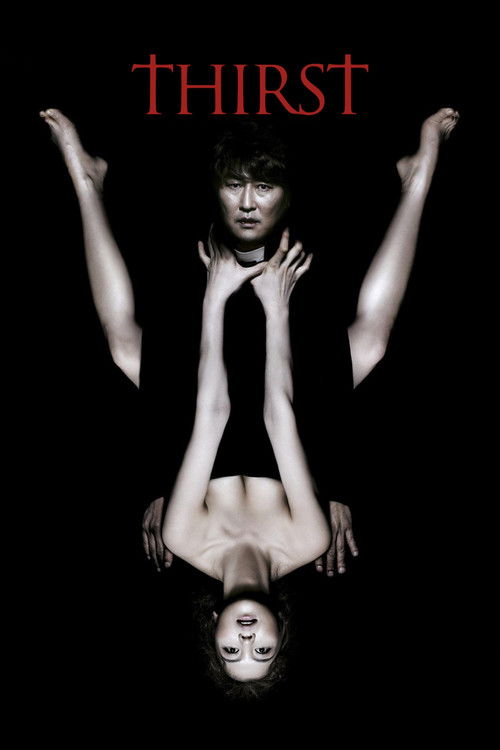
Thirst
2009 · Park Chan-wook
Decision to Leave made him Letterboxd's romantic-obsession auteur; No Other Choice's Venice reception restarted the "greatest living Korean director" argument with Bong partisans. Elegance-plus-perversity is his brand in the discourse.
When you're craving a smart, transgressive horror film that's as much about guilt and desire as about scares — adventurous-night viewing, not a cozy watch. Bring a strong stomach and a taste for the strange.
What it's about
A devout Catholic priest volunteers for a deadly medical experiment, dies, and is brought back by a mysterious blood transfusion — returning as something that needs blood to live. Caught between his vows and his new hungers, he's drawn to the unhappy wife of a childhood friend, and desire, guilt, and faith start tearing him apart from the inside.
The experience
Feverish and unpredictable — swinging between erotic tension, squirmy body horror, deadpan black comedy, and genuine anguish, sometimes within a single scene. It's unsettling in a way that gets under your skin and stays there.
Performances
Song Kang-ho makes the priest's torment painfully human, playing holiness and hunger in the same breath; Kim Ok-bin is ferocious as the woman who transforms alongside him, going from mouse to something far wilder.
The craft
Park Chan-wook directs with surgical precision and perverse wit — immaculate compositions, bold color, and set pieces that turn Catholic imagery and vampire lore against each other. The film reworks a nineteenth-century French novel of adultery and guilt into modern Seoul, and every frame is designed within an inch of its life.
Why it matters
A Cannes prize-winner that pushed Korean genre cinema further into the international spotlight and showed the vampire film could carry real theological weight. It stands with Park's revenge films as proof that extreme material and high art can share a body.
Snapshot
Park Chan-wook's Thirst (Korean: 박쥐, Bakjwi, "Bat") is a vampire film of unusual philosophical seriousness — a work that uses the genre's apparatus of blood, desire, and the undead to excavate the theological and erotic tensions that Park had been circling since the Vengeance Trilogy. A Catholic priest volunteers for a lethal viral-infection trial, dies, and is resurrected by a contaminated blood transfusion; he returns home to find himself a vampire and a reluctant saint, two identities that shred each other to pieces across the film's two-plus hours. The screenplay, co-written by Park and his regular collaborator Jeong Seo-kyeong, is a loose adaptation of Émile Zola's 1867 novel Thérèse Raquin — preserving the triangular structure of guilt, murder, and haunting while transplanting it into contemporary Seoul and saturating it with Catholic symbolism and genre excess. Thirst won the Jury Prize at the 2009 Cannes Film Festival and is widely regarded as one of the most formally and intellectually ambitious vampire films in the history of the genre.
Industry & production
Thirst was produced by Moho Film, Park Chan-wook's own production company, in co-production with CJ Entertainment, the dominant force in Korean commercial cinema during this era. CJ's willingness to back large-scale auteur projects — a pattern established with Oldboy — gave Park the creative latitude the film required. The project grew from Park's long-standing interest in Zola's Thérèse Raquin and his desire to make a vampire film that refused the genre's typical architecture of predator-and-prey. Casting Song Kang-ho as Sang-hyun, the priest-turned-vampire, was a signal choice: Song, one of the most acclaimed actors in Korean cinema, carries an inherent moral weight and everyman legibility that make Sang-hyun's corruption genuinely disturbing rather than merely stylish. Kim Ok-bin, then in her early twenties and relatively early in her career, was cast as Tae-ju, the role that would define her international profile. The film screened in competition at Cannes in May 2009 and won the Jury Prize — the festival's third-highest honor — presided over by a jury chaired by Isabelle Huppert, further cementing the international standing of Korean art cinema. The Palme d'Or that year went to Michael Haneke's The White Ribbon; the two prizes together marked 2009 as an exceptional moment for European and Asian art cinema.
Technology
Thirst was shot on 35mm photochemical film, consistent with Park's practice at the time and with the broader Korean industry's slow transition to digital acquisition during the late 2000s. The production design by Ryu Seong-hee — a frequent Park collaborator — constructs a visual world of deliberate constriction: the Ra family home where much of the film is set is a cramped, light-starved domestic enclosure whose low ceilings and cluttered surfaces express the psychological suffocation at the story's core. The color palette, developed in close collaboration with cinematographer Chung Chung-hoon, is predominantly cool — grays, muted greens, the blue-black of night — punctured by the deep red of blood and, in certain transgressive sequences, by a heightened, almost expressionist luminance that marks the intrusion of the supernatural.
Technique
Cinematography
Chung Chung-hoon, Park's regular cinematographer across several major films, brings to Thirst a visual grammar built on precise framing and carefully managed depth of field. His approach here is more architectural than fluid: the camera tends to observe and to hold the frame as the bodies within it decompose morally. Close-ups of skin, veins, and mouths recur as a visual motif that grounds the film's abstractions in flesh. A key exception is the levitation sequence — Sang-hyun and Tae-ju drifting above city rooftops in a nocturnal embrace — which Chung photographs with a lyrical looseness that signals the brief interval of transcendence before the third-act catastrophe. The film uses practical and available light extensively during interior scenes, giving the domestic spaces a desiccated realism that contrasts with the charged, almost theatrical illumination of the garden and the exterior night sequences.
Editing
The editing credit is shared between Kim Sang-bum and Kim Jae-bum, the team that had worked with Park across the Vengeance Trilogy. Their work accommodates Thirst's unusual tonal range — the film moves from medical procedural to body horror to dark comedy to classical melodrama within individual sequences — without straining at the joins. They cut between registers of mood rather than registers of pace, and the result is a film that can place a scene of black comedy (Tae-ju's increasingly deranged negotiations with Sang-hyun) directly adjacent to one of genuine tragic weight. The film's theatrical runtime of approximately 133 minutes reflects Park's preference for the extended form; an earlier cut was reportedly longer.
Mise-en-scène / staging
Park's staging in Thirst is characteristically precise about power geometry: who is supine, who stands, who occupies doorways that mark the threshold between containment and freedom. The domestic space of the Ra household is staged as a chronic imprisonment — Tae-ju's prostrate domestic servitude is made legible through the blocking before a word of her interiority is spoken. When Sang-hyun's vampirism gives her agency and eventually appetite of her own, Park registers this through the radical reorganization of her body in the frame: where she once lay flat she now prowls, crouches, leaps. The mahjong scenes — a recurring social ritual that structures the film's middle section — are models of blocked irony: on the surface, domestic propriety; beneath, a game of survival and concealment. The film's final image — Sang-hyun and Tae-ju in a car as dawn approaches, resolving what the narrative has forced upon them — achieves the stillness of a Flemish pietà transposed into the horror genre.
Sound
Composer Cho Young-wuk, Park's regular collaborator since Joint Security Area (2000), scores Thirst with characteristic restraint: the orchestral passages are reserved for moments of genuine emotional revelation, and much of the film's affective weight is carried by sound design rather than underscore. The sounds of the body — blood drawn from sleeping figures, the physicality of the vampire's sustenance — are rendered with a clinical explicitness that serves Park's thematic purpose, insisting on the material substrate of desire. The film uses silence strategically: scenes of moral crisis are frequently under-scored, placing the weight of the performances in a sonic vacuum that amplifies every swallow and breath.
Performance
Song Kang-ho's performance is one of the most technically demanding of his career. He must play Sang-hyun as a man of genuine, unperformative faith — a quality that has to remain legible through increasingly baroque circumstances — while simultaneously tracking the incremental moral dissolution that vampirism catalyses. Song's characteristic quality of radical normalcy, which served him so well in Memories of Murder (2003) and The Host (2006), is here turned against itself: the ordinariness of his appearance makes the horror of his transformation more, not less, disturbing. Kim Ok-bin's performance is wilder, more mercurial, and arguably more technically achieved. The role requires her to modulate between feral comedy, sexual ferocity, and a final desolation that is genuinely moving. Her physical performance — the athleticism, the stillness, the particular quality of her gaze — is fully calibrated to Park's visual system. Kim Hae-sook, as Tae-ju's adoptive mother-in-law Ra, anchors the film's melodrama in a recognizably Korean domestic register, providing the emotional baseline against which the supernatural transgressions register.
Narrative & dramatic mode
Thirst operates according to a logic of progressive contamination: the vampire's infection is also an infection of the narrative form, bending what begins as a quasi-realist medical drama toward increasing formal excess. The Zola source provides a triangular scaffold — a woman trapped in a loveless marriage, a lover who helps her escape it at the cost of her soul, a murder that returns as spectral torment — but Park and Jeong Seo-kyeong radically amplify the theological dimension that Zola's naturalism kept in the background. Sang-hyun's Catholicism is not an ironic alibi but a genuine frame of moral reckoning: the film's central drama is his inability to resolve the contradiction between his desire and his conscience — a contradiction Thérèse Raquin posed in psychological terms but that Thirst restates as theological. The narrative's resolution is not catharsis in the classical sense but something closer to ruinous completeness — an ending in which the moral logic is followed to its terminus, whatever the cost.
Genre & cycle
Thirst occupies a recognizable position in the vampire film's long generic history — it invokes the Dracula tradition, the Catholic imagery of the host and the chalice, the erotic economy of the undead — while systematically refusing its conventions. There are no aristocratic predators here, no gothic castles, no nocturnal aristocracy; the vampirism is a medical accident visited upon a man of deliberate humility. The film arrives alongside a significant global vampire cycle — Let the Right One In (Sweden, 2008), the Twilight franchise (US, 2008–), HBO's True Blood (2008–) — but its concerns are sufficiently distinct that cycle membership feels coincidental rather than constitutive. Its closer affinities are with the European art cinema tradition of the vampire as philosophical instrument: Carl Dreyer's Vampyr (1932), Werner Herzog's Nosferatu the Vampyre (1979), and more distantly the sexual-theological preoccupations of F.W. Murnau's Nosferatu (1922). Within Korean genre cinema, Thirst can be read as extending the formal experimentation demonstrated by Bong Joon-ho's The Host (2006), which had shown the commercial and critical viability of genre pictures that exceeded their generic contract.
Authorship & method
Park Chan-wook (born 1963) developed his mature style through the Vengeance Trilogy and I'm a Cyborg, But That's OK (2006) before arriving at Thirst. His authorial signatures — meticulous compositional geometry, tonal promiscuity that allows tragedy and black comedy to coexist, the structuring role of guilt in the dramatic architecture, and a persistent interrogation of violence as both symptom and revelation — are present here in particularly concentrated form. The vampire film gave him a generic license for formal extremity that remained legible to international audiences. Jeong Seo-kyeong (co-writer) has been Park's primary screenplay collaborator across his major films; her contribution is difficult to isolate from outside but is understood within Korean film culture as substantial, particularly in the architectural construction of the moral scenarios. Chung Chung-hoon (cinematographer) has worked with Park across several films and subsequently built a significant international career; his work on Thirst was noted outside Korea as evidence of a mature visual intelligence. Cho Young-wuk (composer) has scored Park's films from Joint Security Area onward, developing a compositional language — restrained, chamber-inflected, prone to sudden orchestral assertion — that has become inseparable from the emotional texture of Park's cinema. Kim Sang-bum (co-editor) had worked across the Vengeance Trilogy, and the continuity of the editorial team helps explain the formal confidence with which Thirst manages its tonal range.
Movement / national cinema
Thirst belongs to the second wave of the contemporary Korean cinema renaissance — the generational formation that emerged through the late 1990s and 2000s and included, alongside Park, Bong Joon-ho, Lee Chang-dong, Kim Jee-woon, and Hong Sang-soo. This formation was enabled by structural changes in the Korean film industry: the liberalization of the market, the rise of large conglomerate distributors like CJ Entertainment, and the screen quota system that had protected domestic production from American dominance. Korean cinema of this period is distinguished by a willingness to merge genre and art-cinema ambition largely absent from the prestige cinema of Europe and North America at the time. Thirst is also situated within a specifically Korean relationship with Catholicism — a religion that arrived via China in the eighteenth century, underwent waves of martyrdom and resistance under the Joseon dynasty and Japanese colonial rule, and has since acquired a particular association with Korean middle-class social identity. Park uses this context precisely: Sang-hyun's faith is not a foreign import grafted onto a neutral setting but a locally specific moral formation with its own historical weight.
Era / period
2009 falls within the high watermark of Korean cinema's international prestige — the years between Oldboy's Cannes Grand Prix (2004) and Parasite's Palme d'Or (2019), when Korean films regularly competed for and won major festival prizes and commanded serious critical attention in Europe and North America. The period is also marked, within horror and genre cinema internationally, by a questioning of dominant American idioms following the commercial exhaustion of the late-1990s horror revival. Thirst is part of a transnational tendency to reclaim horror for art-cinema seriousness, a tendency that also includes Let the Right One In, Pascal Laugier's Martyrs (France, 2008), and Lars von Trier's Antichrist (Denmark/Germany, 2009).
Themes
Faith and appetite. The film's central concern is the incompatibility of a sincerely held ethical system with the body's imperatives once those imperatives escape the ordinary. Sang-hyun's Catholicism does not dissolve when he becomes a vampire; it intensifies, turning into an instrument of self-torment that the film neither mocks nor endorses. The theological problem is stated directly: to kill to live is to sin; to refuse to live is despair, itself a sin; there is no exit.
The body as moral site. Park, following a trajectory from the Vengeance Trilogy, treats the body not as metaphor but as the ground on which moral questions are literally inscribed — through wounds, through illness, through the physical fact of blood as both sacred (the Eucharist) and transgressive (the vampire's sustenance).
Love as catastrophe. Thirst shares with Thérèse Raquin the conviction that romantic passion, when liberated from social constraint, becomes a destructive force tending not toward fulfillment but toward ruin. Tae-ju's desire, once awakened, follows its own logic to an end that the film regards with something between tragedy and dark comedy.
Containment and escape. The domestic space of the Ra house is explicitly a prison; the film tracks Tae-ju's attempts to escape it as a survival imperative. The irony is that her escape route — Sang-hyun, vampirism, murder — constitutes a different and more absolute form of containment.
Guilt and haunting. As in Zola, the murder of the husband does not liberate the lovers but shackles them. The ghost of the murdered Kang-woo returns in sequences that oscillate between psychological realism and supernatural literalism, declining to adjudicate between them — a refusal that is itself a moral statement.
Reception, canon & influence
Critical reception. Thirst received broadly admiring international reviews upon its Cannes premiere, with particular attention to Song and Kim Ok-bin's performances and to the film's unusual accommodation of tonal registers. The Jury Prize provided institutional ratification. Some reviewers found the film overlong or tonally inconsistent — Park's willingness to admit comedy and melodrama alongside horror remained, for certain critics, an unresolved problem rather than a formal achievement. This division in the critical response mirrors the division that Park's work has always produced: viewers who experience the tonal range as a deliberate formal strategy, and viewers who experience it as a failure of discipline.
Influences on the film (backward). The acknowledged primary literary source is Zola's Thérèse Raquin, which provides the triangular plot, the murder, and the haunting. The vampire film tradition — from Murnau and Dreyer through Herzog — supplies the film's genre coordinates without constituting a direct stylistic model. Korean melodrama, specifically the tradition of the woman-in-an-impossible-marriage narrative, is a structural background. Park's own Sympathy for Lady Vengeance (2005), with its cold Catholic iconography and its woman whose moral transformation is tracked through the film's visual palette, constitutes an immediate authorial precursor.
Legacy and forward influence. Thirst has not generated a recognizable cycle of imitation — its formal particularity makes it resistant to replication — but its demonstration that genre cinema can sustain serious theological inquiry has been registered by subsequent Korean filmmakers working in horror and melodrama. It established Kim Ok-bin as a significant screen presence; her subsequent work, including the action film The Villainess (Jung Byung-gil, 2017), can be traced partly through the physical and dramatic template she established here. Within Park's own filmography, Thirst reads as a laboratory for the sustained investigation of transgressive female desire that reaches its fullest development in The Handmaiden (2016). The film appears regularly on critical surveys of the vampire genre and of Korean cinema, and its position in the canon — significant but perhaps not yet fully assimilated — reflects its difficulty: a work that refuses the comfort of a single genre, a single emotional register, or a single conclusion.
A Deleuzian reading
Listen first.
The full Deleuzian reading of Thirst →
Reception
It won the Jury Prize at Cannes in 2009 but landed as the 'divisive one' in Park's run — praised as audacious, knocked for its length and tonal whiplash. It's since climbed steadily, with Song Kang-ho's post-Parasite global fame sending a new wave of viewers back to call it one of Park's best.
How Thirst was received, from release to now →
Influences: the films it descends from and the films it influenced
- Vampyr (1932) — Dreyer's gauze-filtered, available-light photography established the template for rendering vampiric contamination as an atmospheric condition rather than a creature effect — Thirst's practical-light interiors and refusal of genre spectacle are directly legible within this lineage.
- Nosferatu (1922) — Murnau's use of doorframes, windows, and shadow-angle compositions to encode the vampire's territorial dominion as an architectural fact prefigures Thirst's power-geometry staging, in which Sang-hyun's occupation of domestic space is tracked through framing rather than exposition.
- Nosferatu the Vampyre (1979) — Herzog's reframing of the vampire as a figure of theological desolation — the undead as condemned consciousness unable to die or be absolved — directly informs Thirst's conception of Sang-hyun as a priest whose vampirism is a specifically spiritual catastrophe rather than a predatory condition.
- Thérèse Raquin (1953) — Carné's adaptation of the same Zola source uses constricted bourgeois interiors and triangular blocking — Thérèse, Laurent, and Camille geometrically positioned to externalize power relationships — as the exact staging template Park imports for Sang-hyun, Tae-ju, and Kang-woo.
- Au Hasard Balthazar (1966) — Bresson's de-dramatized performance method — actors directed to strip affect so that spiritual content surfaces through restraint — is the model for Song Kang-ho's approach to Sang-hyun, whose theological crisis registers through controlled underperformance rather than expressionist display.
- In the Realm of the Senses (1976) — Oshima's staging of transgressive sexuality within a claustrophobic domestic interior as a consuming, self-annihilating force provides the structural parallel Thirst inherits: vampiric desire recast as the same kind of total compulsion that literally destroys its subjects.
- Oldboy (2003) — The editorial template developed with Kim Sang-bum — cross-register cuts that admit black comedy into traumatic narrative at precise tonal pressure points — is the method Thirst inherits and applies to horror; the sudden pivots from violence to absurdist domestic comedy are recognizable as a signature established here.
- Sympathy for Lady Vengeance (2005) — Park and Chung Chung-hoon's cold Catholic iconography — white tile, institutional fluorescence, religious statuary deployed as moral commentary — and their technique of tracking moral transformation through incremental palette shifts constitute the direct authorial precursor for Thirst's visual theology.
- Lady Vengeance (2005) — Park's continuation with Chung Chung-hoon extends Lady Vengeance's ambivalent Christianity into the film's explicit structuring irony — a vampire-priest — while the dissonant sacred-profane scoring logic established through the Vivaldi Gloria is expanded into explicit liturgical counterpoint.
- The Handmaiden (2016) — Chung Chung-hoon extends Thirst's architectural power geometry — now through the Japanese house's sliding screens and divided rooms encoding social hierarchy as spatial fact — while Park develops the investigation of transgressive female desire as narrative engine, the full articulation of the trajectory Tae-ju's arc begins.
- The Wailing (2016) — Na extends Thirst's contamination-logic — evil as a spreading condition that implicates community rather than isolating individual moral failure — into a folk-horror framework, with a similar refusal to resolve the theological question of who bears responsibility for the contaminating agent.
- The Villainess (2017) — Kim Ok-bin's specific register of internalized physicality — the performance template she developed as Tae-ju, in which extreme violence reads as an extension of desire rather than its opposite — forms the somatic basis for her action-film work here; the film is partly legible as a genre extension of that performance discovery.
- No Other Choice (2025) — Extends the long-running Jo Yeong-wook scoring partnership that shapes the 'Park sound,' using music to underscore moral unease beneath genre action.
- Stoker (2013) — Park and Chung Chung-hoon's immediate rehearsal — appetite as inherited condition, desire transmitted by an older infector, and the saturated-then-drained palette plus gliding lateral camera around a house of confined family — with Stoker essentially the same architecture with the vampirism deleted and the metaphor left standing.
- Trouble Every Day (2001) — Denis's complete refusal of vampire-genre conventions — no folklore, no fangs, just pathological compulsion rendered through extreme close-up and body-sound design — is the most rigorous formal parallel to Thirst's replacement of genre spectacle with visceral physicality; both films make the vampire's condition legible through sound texture rather than visual effect.
- Let the Right One In (2008) — Alfredson and Hoyte van Hoytema use available winter light and widescreen architectural framing to render vampirism as social alienation rather than supernatural spectacle — a photochemical restraint and practical-light formal register that runs parallel to Thirst's approach, arrived at independently and nearly simultaneously.
- A Girl Walks Home Alone at Night (2014) — Amirpour shoots on 35mm black-and-white and uses strategic silence and ambient sound in place of genre scoring to position the vampire as a figure of social critique rather than predation — a formal and ideological parallel to Thirst's vampire-convention refusal, with shared photochemical commitment.
- Only Lovers Left Alive (2013) — Jarmusch treats vampirism as a condition of heightened sensory awareness rather than predation, with long-take compositions and ambient body-sound design — the rustle and texture of material things — that parallel Thirst's practical-sound approach to the vampire's corporeality as theological burden rather than gothic power.
- Decision to Leave (2022) — Earlier Park study of illicit desire and formally restrained performance escalating to transgression, developing his method of eroticism conveyed through composure and suppressed gesture rather than display.
- Humanist Vampire Seeking Consenting Suicidal Person (2023) — A vampire paralyzed by conscience who parses who 'deserves' to be fed on — the same consent-and-ethics-of-killing dilemma driving the seed's premise.
Similar films
- Oldboy (2003) — influence & lineage
- The Wailing (2016) — influence & lineage
- The Handmaiden (2016) — influence & lineage
- No Other Choice (2025) — influence & lineage
- Sympathy for Mr. Vengeance (2002) — shared sensibility
- I Saw the Devil (2010) — shared sensibility
- The Host (2006) — shared sensibility
- Raw (2017) — shared sensibility
All the films related to Thirst →