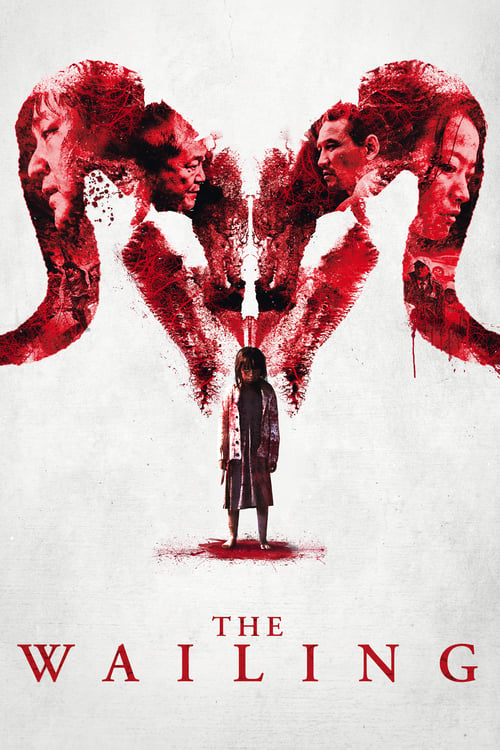
The Wailing
2016 · Na Hong-jin
For when you want horror that haunts rather than jump-scares — a long, engulfing watch for a night when you're ready to be unsettled and left holding questions.
What it's about
A bumbling policeman in a rain-soaked rural Korean county starts investigating a wave of gruesome killings that erupts after a silent Japanese stranger settles in the hills. When the mysterious sickness reaches his own young daughter, the case stops being a job — and he'll try anything to save her: police work, priests, and finally a flamboyant shaman.
The experience
It runs two and a half hours and earns every minute — opening almost as a bumpkin comedy, then dragging you down through dread into full spiritual terror. It leaves you genuinely rattled, and you'll argue about what actually happened for days.
Performances
Kwak Do-won is perfect as the ordinary, terrified father in far over his head, Hwang Jung-min tears through the film as the shaman, and young Kim Hwan-hee delivers an afflicted-child performance that ranks with the genre's most frightening.
The craft
Na Hong-jin shoots the misted mountains of Gokseong like a landscape with intentions, and stages a mid-film shamanic ritual — drums, blades, frenzied cross-cutting — that is one of the great set pieces in modern horror. The film juggles police procedural, folk religion, comedy, and outright possession without ever losing its grip.
Why it matters
An instant landmark of Korean genre cinema, it helped define the ambiguity-driven, ritual-steeped strain of 21st-century horror and cemented Na Hong-jin's international reputation.
Snapshot
Na Hong-jin's third feature is a 156-minute rural horror set in and around the real Gokseong County (곡성) in South Jeolla Province, South Korea. A fumbling provincial policeman named Jong-goo investigates a wave of murderous psychosis following the arrival of a silent Japanese stranger. The film's Korean title carries a deliberate double meaning: 곡성 is both the place name and a homophone for "the sound of wailing," a pun that concentrates the film's entire argument about grief, accusation, and the impossibility of certain knowledge. Premiering in Un Certain Regard at Cannes 2016, it arrived to near-universal critical rapture and has since entered the short canon of 21st-century horror that refuses to resolve its own metaphysics.
Industry & production
Following the commercial and critical success of The Chaser (2008) and The Yellow Sea (2010), Na Hong-jin spent roughly six years developing the screenplay for The Wailing, an unusually long gestation by South Korean industry standards. The production was co-financed through Fox International Productions Korea alongside Na's own company Side Mirror, a partnership that gave the film unusual budget security for a Korean-language genre picture while leaving creative control with the director. Shooting took place on location in Gokseong County itself, integrating the actual landscape — its fog-bound valleys, terraced paddies, and dense mountain ridgelines — as a functional dramatic element. The extended development period is legible in the screenplay's density; Na has acknowledged in interviews that the script went through many structural iterations as he worked out the precise calibration of ambiguity he required. The cast was assembled to balance recognizable faces within Korean cinema with a deliberately dissonant foreign presence: Kwak Do-won, a character actor best known for procedural roles, plays Jong-goo; Hwang Jung-min, one of the most bankable Korean stars of the decade, plays the shaman Il-gwang; the Japanese actor Jun Kunimura, familiar internationally from Takashi Miike films, plays the unnamed Stranger; and Chun Woo-hee plays the mysterious woman later identified only as Moo-myung (무명, "nameless"). The production's physical scale — village crowd sequences, a 20-minute unbroken shamanic ritual, rain-soaked night exteriors — required logistical ambition uncommon in Korean prestige horror of the period.
Technology
The Wailing was photographed on the ARRI ALEXA, the digital camera that had by 2016 become the dominant acquisition format for prestige international cinema. Cinematographer Hong Kyung-pyo — who had shot Bong Joon-ho's Snowpiercer (2013) and would go on to photograph Burning (Lee Chang-dong, 2018), Parasite (Bong Joon-ho, 2019), and Decision to Leave (Park Chan-wook, 2022), making him arguably the most decorated working DP in Korean cinema — worked in a range of focal lengths to serve the film's tonal shifts, from wide landscape compositions that situate the village as a place of rural enclosure to tighter, more agitated framings as possession advances. The film's color grading sustains a persistent desaturation that reads as morning-after pallor, reinforcing the narrative's chronic exhaustion. No special-effects gimmickry dominates; the horror is predominantly practical, environmental, and physiological.
Technique
Cinematography
Hong Kyung-pyo's work establishes two competing visual registers that the film never fully reconciles — which is the point. In the film's early passages, his camera holds generous, almost pastoral distance: Jong-goo's village is shot with a kind of bemused sociological curiosity, dwelling on the wet hills and cluttered domestic spaces that make the setting recognizable and ordinary. As the film progresses, these wide stabilizing views yield to closer, more hand-held observation, though never to chaos. The most formally controlled sequence is the intercutting of Il-gwang's shamanic gut with the Stranger's simultaneous ritual on the mountain: Hong frames these in deliberate structural parallel, alternating between them as if to force the viewer into the position of adjudicator, without providing the evidence adjudication requires. Light is used as an unreliable signal — dawn conventionally promises revelation, but in The Wailing the film's most devastating event occurs in full morning clarity.
Editing
The editing, credited to Kim Sun-min, refuses conventional horror rhythm. Rather than tightening the cut as dread accumulates, the film often holds, letting scenes breathe past the point of comfort. The infamous dual-ritual sequence is the centerpiece of this strategy: cross-cutting between two ceremony sites, it sustains its parallelism for an extended duration that has been timed by viewers at roughly twenty minutes, generating an almost unbearable sustained uncertainty about which ritual is working, in whose interest, and toward what end. Elsewhere, scenes of bureaucratic mundanity — Jong-goo's police station, a medical examination — are cut without irony, which makes the eruptions of violence land with more force than accelerated montage would allow.
Mise-en-scène / staging
Na Hong-jin stages much of the film in mid-shot, keeping his actors grounded in specific physical environments rather than isolating them in close-up. The village's geography is carefully established so that the audience develops a spatial map: the market, the forested hills above, the Stranger's isolated house. That spatial legibility becomes a trap — it promises the film will behave like a procedural, that knowledge of the terrain will lead to knowledge of the mystery. The Stranger's lair, when finally entered, is staged as a site of accumulation — photographs, ritual objects, animal remains — that seems to constitute evidence while remaining semantically open. The staging of possession is emphatically physical rather than technological: the afflicted are shown in states of extreme muscular distress, their bodies uncoordinated and self-destructive, drawing on physical performance traditions closer to Korean theatrical convention than to the CGI-assisted possession of Hollywood horror.
Sound
Sound design and score are integral to the film's argument. Composer Jang Young-gyu, who had scored both of Na's previous features, constructs a score built around the sonic vocabularies of the gut — the thunderous barrel drums (janggu and buk), the shrill of the haegeum — while braiding these against Western orchestral materials in ways that deny either system the authority to interpret events. The result is not fusion but tonal conflict. The ritual sequences are mixed to prioritize percussive impact over melodic intelligibility; the sound design during possession events emphasizes involuntary biological sounds — labored breathing, physical collapse — over musical augmentation. The film's most disturbing sonic choice may be the most mundane: the creaking of ordinary doors, the ambient rain, the distant barking of dogs that recurs throughout as a low-grade register of wrongness.
Performance
Kwak Do-won's Jong-goo is a sustained study in inadequacy, and the film's moral and dramatic pivot depends on the actor's willingness to make his protagonist persistently, unflattering incompetent without making him contemptible. Jong-goo is slow, frightened, susceptible to social pressure, and ultimately ruinous in his misjudgements. Kwak plays these qualities without winking at the audience. Hwang Jung-min, operating in a completely different register, gives Il-gwang a slippery bravado — by turns credible, ridiculous, and terrifying — that maps the film's uncertainty onto a single performance. Jun Kunimura does almost nothing legible for much of the film, which is its own kind of discipline; the Stranger's opacity is not vacancy but withheld information, and Kunimura holds that withheld state across the runtime without collapsing into either menace or innocence. Chun Woo-hee's Moo-myung appears sparingly and communicates in gestures and gazes that cannot be decoded within the film's own interpretive system.
Narrative & dramatic mode
The film operates through what might be called structured epistemic failure. It presents itself as a procedural — a mystery that should, by genre convention, yield to investigation — while systematically dismantling every mechanism of procedural resolution. Evidence accumulates but does not cohere. Witnesses contradict each other. The audience is given more information than Jong-goo and still cannot adjudicate the central question: is the Stranger a demonic force, a scapegoated outsider, or something else entirely? The film's narrative mode is closer to the Book of Job — a framework Na Hong-jin has himself alluded to in discussing the project — than to detective fiction: a righteous or at least ordinary man is assailed by forces that may be divine, Satanic, or random, and neither he nor the audience is given the theological key. The final sequence, in which Jong-goo's daughter's fate becomes irreversible, stages this failure with an almost cruel literalness: the answer exists; we did not act on it in time; we may still not understand it.
Genre & cycle
The Wailing synthesizes several genre traditions without being reducible to any of them. It belongs to folk horror in its premise — the corrupting stranger, the afflicted community, the efficacy of traditional ritual — while exceeding that framework through its structural ambiguity. It draws on J-horror's tradition of the invasive supernatural (the photographic evidence of wrongness, the liminal figure that may or may not be a ghost) while refusing J-horror's characteristic revelation logic. The shamanic ritual sequences align it with Korean traditional performance in ways that ground the supernatural in a specifically Korean cosmological framework, distinct from both Western Christian demonology and the secular-psychological possession narratives common to American horror. The film arrived during a cycle of "elevated horror" that would include Hereditary (Ari Aster, 2018) and Midsommar (Aster, 2019), and though The Wailing precedes these films, critical retrospective has placed it as a founding text of the cycle's global ambitions.
Authorship & method
Na Hong-jin writes his own screenplays and has directed only three features over nearly two decades, an authorial pace that reflects an unusual resistance to the pressures of the Korean studio system. His work across The Chaser, The Yellow Sea, and The Wailing constitutes a loose trilogy of pursuit and exhaustion — protagonists who chase or are chased, who accumulate evidence without gaining control, who are destroyed by their own misjudgements as much as by external forces. Na has described himself as drawn to situations where decent or ordinary people prove inadequate to the demands placed on them, a moral interest that shades into something darker in The Wailing than in his earlier crime films. Hong Kyung-pyo, the DP, brought to the collaboration an eye for landscape as mood and a willingness to hold rather than cut that aligned with Na's structural ambitions. Jang Young-gyu's score represents a third major collaboration — his percussive, ritual-inflected compositional approach has been central to the distinctive sonic identity of all three Na features. The extended production timeline suggests a directorial practice grounded in script development rather than improvisational spontaneity; the film's density is the product of prolonged premeditation.
Movement / national cinema
The Wailing belongs to the Korean New Wave — the sustained creative and commercial renaissance in Korean cinema that accelerated through the late 1990s and the 2000s under directors including Bong Joon-ho, Park Chan-wook, Lee Chang-dong, and Kim Jee-woon. That movement established Korean genre cinema as a site of serious formal and thematic ambition, and The Wailing is legible as an extension of its concerns: the use of genre infrastructure to examine social pathology, the willingness to deny audiences comfortable resolution, the integration of specifically Korean cultural material (here, shamanism and the gut ceremony) into internationally legible genre frameworks. The film also speaks to a strand of Korean horror that includes A Tale of Two Sisters (Kim Jee-woon, 2003) in its interest in domestic enclosure, unreliable perception, and the horror that resists exorcism because its source is not clearly identifiable.
Era / period
The film arrives in the mid-2010s, a moment when Korean cinema was consolidating the international recognition that had been building since the Palme d'Or for Oldboy was contested and the global circulation of Park Chan-wook and Bong Joon-ho's work expanded. The Wailing premiered four years before Parasite's watershed 2019 Palme d'Or and Academy Award, and its Un Certain Regard reception contributed to the mounting critical consensus that Korean cinema represented the most consistently vital national filmmaking culture of the period. Globally, 2016 sat at the threshold of the streaming expansion that would transform how international-language films circulated; The Wailing benefited from this shift, reaching audiences on Netflix and similar platforms who might not previously have accessed a 156-minute Korean folk horror film.
Themes
The film's governing thematic question is epistemological: how do we know evil when we see it, and what do we do when the available evidence is irresolvable? This unfolds across several registers simultaneously. The Stranger's ethnicity — he is Japanese in a village where Korean wartime memory of Japan remains latent — raises the question of whether Jong-goo's eventual certainty about the Stranger's guilt is discernment or xenophobia. The film does not settle this question; it makes the ambiguity load-bearing. Religion and spiritual practice are treated as genuinely competing epistemic systems: shamanism, Christianity (a deacon character appears as a vehicle for Christian skepticism of the gut), and a more diffuse folk supernaturalism are all represented without any being authorized as correct. The film is also, at a structural level, about the failure of the competent father — Jong-goo's inability to protect his daughter is the specific shape his epistemological failure takes, and the film's emotional devastation depends on that specificity.
Reception, canon & influence
The Wailing received near-universal critical acclaim on its Cannes premiere and in subsequent international release, with reviewers consistently noting its ambition, its formal control, and the rarity of its commitment to unresolved meaning in a genre context. It won numerous awards at the Grand Bell Awards (the Korean equivalent of the Oscars) and at international genre festivals. The record of specific box-office figures is not reproduced here, as precise numbers were not consistently documented in sources available to this account.
In terms of the influences that shaped the film: Na has cited a general debt to the tradition of Japanese horror, and the Stranger's visual presentation (the night photographs, the isolation in a mountain dwelling) draws recognizably on J-horror iconography. The narrative of communal suspicion visited upon a foreign scapegoat has antecedents in folk horror across cultures. The Book of Job framework, to which Na has alluded, structures the film's deepest level — the irreducibility of suffering to moral deserving, the inadequacy of human frameworks before the event.
Looking forward, The Wailing's most direct legacy may be The Medium (Banjong Pisanthanakun, 2021), a Thai horror film on which Na Hong-jin served as executive producer and which engages overtly with shamanic ritual, spiritual possession, and the failure of family protection — constituting something close to a continuation of The Wailing's preoccupations transposed into a Thai highland context. More broadly, the film has become a reference point in critical discussions of what was termed "elevated horror" in the late 2010s, cited alongside Hereditary and The Witch (Robert Eggers, 2015) as evidence that horror could sustain genuine philosophical ambiguity without sacrificing visceral effectiveness. Its influence on the form of folk horror — the unreliable ritual, the scapegoated outsider, the irresolvable ending — is evident in subsequent international genre work, though direct causal links are difficult to establish with precision. What can be said with confidence is that The Wailing has become a canonical text in the scholarship of 21st-century horror, reprinted in syllabi, cited in genre criticism, and invoked whenever the conversation concerns what horror might be able to claim for serious cinema.
A Deleuzian reading
Dawn breaks over Gokseong and you wait, the way horror has trained you to wait, for the light to settle the question.
The full Deleuzian reading of The Wailing →
Reception
No flop-to-classic story here — it premiered out of competition at Cannes 2016 to raves and was a smash in Korea, and its reputation has only climbed since, now a fixture near the top of best-horror-of-the-century lists.
How The Wailing was received, from release to now →
Influences: the films it descends from and the films it influenced
- The Exorcist (1973) — Na's possession-climax staging — the prolonged bodily ordeal, the exhausted family witness, the priest confronting incommensurable evil — directly extends Friedkin's template; both films embed a Book of Job structure where faith and paternal love prove structurally inadequate to what has arrived.
- The Wicker Man (1973) — Establishes the procedural-spatial-trap as folk-horror architecture: an outsider investigator is guided by communal ritual logic into a predetermined sacrificial role he cannot read until it is too late — the structural template Na's scapegoat mechanism inherits and complicates.
- Onibaba (1964) — Japanese folk horror using wide-frame landscape cinematography where terrain itself carries spiritual threat, and a ritual mask that becomes an agent of possession and disfigurement — a direct visual and thematic precedent for the Stranger's mountain isolation and its contaminating proximity.
- Rashomon (1950) — Provides the epistemic architecture Na inherits: irreconcilable witness accounts structured so that the ambiguity is the film's philosophical payload rather than a withholding — The Wailing's unresolved finale deploys this formal logic in a horror register.
- Cure (1997) — Establishes ambient wrongness as a procedural-horror method — dread embedded in sonic texture and spatial unease rather than in event — and models the detective protagonist whose investigative rationalism is undone by the phenomenon itself, both formal inheritances Na develops.
- Ringu (1998) — The Stranger's nighttime tableau — isolated mountain dwelling, cursed photographs, spectral figure in rural darkness — draws directly on Nakata's staging of J-horror dread through domestic-uncanny still imagery, the specific visual grammar Na has acknowledged as an influence.
- Memories of Murder (2003) — Establishes the Korean procedural's key formal innovation: desaturated wide-frame cinematography of rural landscape as moral terrain, and the structural decision to make investigative failure the film's actual subject rather than its ironic subplot — Na inherits both the look and the epistemological stance.
- Picnic at Hanging Rock (1975) — Weir's model of landscape as absorptive presence — the terrain that takes without explanation — and his anti-horror-rhythm of languorous pacing and ambient-wrongness sound design (Zamfir's panpipes as sonic unease) establishes the mode of epistemic non-resolution Na works within.
- The Chaser (2008) — Na's debut established the sustained-inadequacy protagonist and, in collaboration with DP Hong Kyung-pyo, the visual grammar of procedural entrapment and landscape-embedded chase that The Wailing deepens; the earlier film's moral interest in the ordinary man destroyed by his own misjudgements is the direct precursor.
- The Yellow Sea (2010) — Jang Young-gyu's percussive, ritual-inflected scoring method — gut-percussion cues driving physical pursuit — was developed in this collaboration and carried directly into The Wailing's sonic identity; the film also deepens the procedural-trap structure and the protagonist's accumulating, uncontrollable inadequacy.
- Oldboy (2003) — Na Hong-jin extends Oldboy's perceptual state design through sound — ambiguous sonic intrusions that contaminate the viewer's interpretation of whether events are supernatural or psychological — and structures the entire film around a protagonist's catastrophic misreading of available information, elevating Oldboy's strategic withholding into an epistemological principle about the unreliability of perception.
- The Host (2006) — Sustains scene-by-scene tonal genre-switching—village comedy into horror into procedural—refusing categorical stability as a deliberate disorientation device pioneered in The Host's editing.
- Midsommar (2019) — Aster extends The Wailing's wide-landscape-framing of ritual ceremony into Nordic daylight horror, and the procedural-spatial-trap in which the protagonist's spatial freedom is systematically closed by communal ritual logic — the structural and cinematographic debt to Na's folk-horror architecture is traceable in both framing strategy and editing rhythm.
- The Medium (2021) — Na Hong-jin served as executive producer and the film directly transplants The Wailing's shamanic-possession framework — competing rituals, family-protection failure, the inadequacy of inherited spiritual authority — into a Thai highland context, constituting the closest thing to an authorially sanctioned continuation of the earlier film's preoccupations.
- Memoir of a Murderer (2017) — Demonstrates that Korean genre cinema can sustain radical epistemological ambiguity through its final frame — the identity and nature of the malevolent force is never disclosed, and withholding resolution is itself the formal statement; Memoir's third-act irresolution strategy inherits this license.
- The Pig, the Snake and the Pigeon (2023) — Religious cult compound as site of institutional uncanny with quasi-supernatural manipulation; radical tonal destabilization that prevents the viewer from settling into genre expectation — the specific formal influence the dossier attributes directly to Na.
- Hope (2026) — Na's own prototype for belated understanding — Hong Kyung-pyo's rain-heavy wides, Hwang Jung-min as the charismatic interpreter whose reading of the phenomenon is the decisive error, and a withholding of the frame of reference until the protagonist's choice has already caused the ruin.
- The Witch (2015) — Eggers and Na independently converge on the scapegoated-outsider mechanism of folk horror, with ambient wrongness sustained through period-accurate sound design and a structural refusal of conventional horror catharsis — the critical discourse linking them as dual architects of elevated horror's formal ambitions is grounded in this formal parallel.
- Hereditary (2018) — Aster's prolonged grief-ritual deploys extreme physical possession sequences and a Book of Job structure — innocent family members suffer without moral logic — alongside a dual-ritual parallel montage (the grandmother's cult vs. the family's ignorance of it) that mirrors The Wailing's competing-ritual cross-cutting.
- Apostle (2018) — Evans' island-community folk horror deploys the procedural-spatial-trap — outsider protagonist enclosed by ritual logic he cannot decode — with strategic opacity about the community's supernatural agency and sustained staging of physical possession, working the same formal vocabulary as Na in a Welsh-gothic register.
- A Hard Day (2014) — Extends New Korean Cinema's tonal-compression method — the sustained management of dark comedy and escalating dread across a single runtime — demonstrating that A Hard Day's genre-register modulation belongs to a broader formal movement rather than individual authorial invention.
- Creepy (2016) — A procedural-horror hybrid of comparable runtime sustaining asymmetric information about the antagonist's nature across a community space; the police-protagonist's professional framework systematically dismantled by phenomena his training cannot classify — the same structural engine as Creepy.
- Forgotten (2017) — Operates paranoid fiction at the community scale: ambient sound heightening makes the village environment feel self-menacing, and narrative authority is so systematically withheld that the audience's interpretive instinct is the film's primary formal subject — a destabilization Forgotten applies to the domestic unit.
- Burning (2018) — Na sustains principled ambiguity about whether the violence is supernatural or criminal across the full length of a Korean genre film, using the investigation to expose the investigator's moral limitations rather than resolve the mystery — the same formal commitment to irresolution that Lee employs, both directors treating ambiguity as the ethically correct answer rather than a deferred one.
- Parasite (2019) — Na Hong-jin's three-register tonal architecture — village procedural comedy → rural thriller → folk-horror climax — and his ambient texture design (rain, forest sounds, and ritual percussion deployed as modulators between generic registers) directly parallel Bong's sound-design-as-genre-pivot strategy within the Korean New Wave's genre-hybridization tradition.
- Beasts Clawing at Straws (2020) — Shares the technique of multiplying incompatible explanatory frames around a single criminal event so that ensemble perspectives generate irresolution rather than resolution; spatial constraint in rural Korean interiors under low-key available lighting to produce dread through compositional compression.
- A Tale of Two Sisters (2003) — Extends Korean design-led horror's refusal of resolution, sustaining deliberate ambiguity over any single supernatural or psychological explanation.
- When Evil Lurks (2023) — Possession-plus-contagion where shamanic ritual fails and the protagonist's wrong choices doom his own child — the tragedy-of-error engine and collapse of ritual authority in a rural belief community.
- Kantara (2022) — Na gives the shaman's gut ritual a full uninterrupted set-piece — drum, chant, costume, no exposition offered — and lets the film's procedural realism collapse into a supernatural verdict it never adjudicates for the viewer; Kantara's climax is the same wager that belief filmed completely needs no gloss.
Similar films
- Memories of Murder (2003) — influence & lineage
- Onibaba (1964) — influence & lineage
- The Yellow Sea (2010) — influence & lineage
- The Witch (2016) — same viewing thread
- Bring Her Back (2025) — same viewing thread
- A Tale of Two Sisters (2003) — often watched together
- I Saw the Devil (2010) — often watched together
- Hope (2026) — shared sensibility
All the films related to The Wailing →
Watch it with: curated runs of related films
- Whatever's Wearing That Face — A run of horror-thrillers where the real terror is that you can't trust what a person appears to be — a double, a shapeshifter, a smiling stranger, the one you desire.