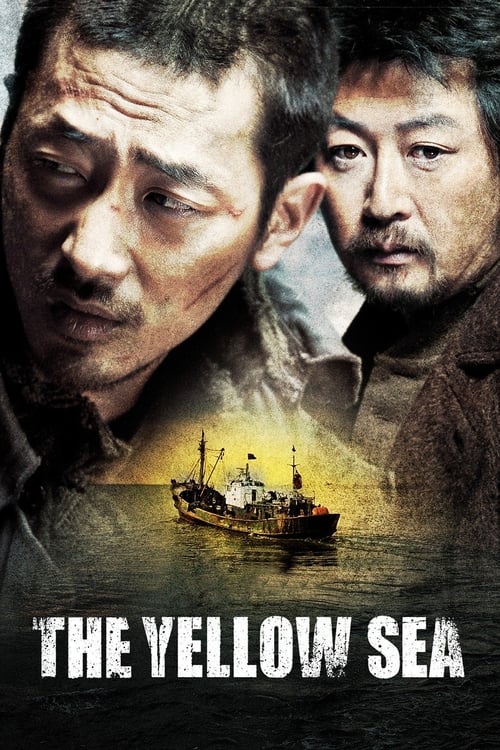
The Yellow Sea
2010 · Na Hong-jin
For when you want a thriller that genuinely puts you through it — white-knuckle, brutal, no comfort food here. Reach for it on a night you have the stamina to be pinned to your seat.
What it's about
A cab driver in the Korean-Chinese borderlands is drowning in gambling debt, so he accepts a one-way job: cross the Yellow Sea into South Korea, kill a man he's never met, and maybe find the wife who stopped writing home. The hit goes wrong before he can even attempt it, and suddenly he's being hunted through Seoul by the police, the gangsters who hired him, and the gangsters who want the whole mess buried.
The experience
Relentless is the word — a two-and-a-half-hour pursuit that keeps trading one kind of dread for a nastier one, with chases and knife fights that feel dangerously unchoreographed. It's exhausting in the way a nightmare is: you keep thinking it has to let up, and it doesn't.
Performances
Ha Jung-woo carries the film as a man being physically ground down in real time — you can watch the desperation harden in him — while Kim Yun-seok is terrifying as the gang boss who pursues him with an almost animal indifference to pain.
The craft
Na Hong-jin stages violence with hatchets, knives, and bare hands rather than guns, which makes every fight feel close, clumsy, and horribly plausible. The chase sequences — on foot, in trucks, through docks and stairwells — are cut with a rough, breathless energy that rewards a loud sound system and an uninterrupted sitting.
Why it matters
It cemented Na Hong-jin as one of the defining thriller directors of the Korean new wave and set a benchmark for how far a mainstream crime film could push physical, ugly realism.
Snapshot
Na Hong-jin's second feature is a punishing, almost deranged pursuit film built on a simple premise — a desperate man accepts a contract killing he cannot complete — that expands into something closer to a meditation on statelessness, debt, and the body under duress. Set across the liminal geography of Yanbian, China and Seoul, The Yellow Sea (황해, Hwang-hae) is one of the most sustained exercises in controlled escalation in contemporary Korean cinema: two hours and twenty minutes (in its domestic cut) in which the tension is never released so much as transmuted into further, more lurid forms. Where Na's debut The Chaser (2008) worked through the logic of the serial-killer procedural, The Yellow Sea is formally a hitman film that cannibalizes its own genre at every opportunity, leaving behind something rawer and more bewildering.
Industry & production
The Yellow Sea was produced by Soo Film, the same production company behind The Chaser, cementing a working relationship that allowed Na a degree of creative autonomy unusual for a sophomore feature. The film's casting reprises the central pairing of Ha Jung-woo and Kim Yun-seok from The Chaser, though with their positions effectively inverted: Ha, the detective in the earlier film, here plays Gu-nam, a gaunt and drifting taxi driver, while Kim inhabits Myun-ga, a Joseonjok crime broker whose charisma curdles into menace. Jo Seong-ha anchors the Seoul strand as the Korean mob figure at the center of the assassination plot.
Production required location shooting in Yanji (Yanbian Korean Autonomous Prefecture, Jilin Province, China), which posed logistical challenges and gave the film's opening act a documentary texture that distinguishes it sharply from the Seoul sequences. The Yanbian setting was not merely exotic backdrop; it required the production to engage with a community — the Joseonjok, or ethnic Koreans who have lived in northeastern China for generations — that Korean cinema had rarely placed at its center. The film exists in at least two significant versions: the domestic Korean theatrical cut (running approximately 140 minutes) and a slightly shorter international cut, with the longer version generally considered the more complete artistic statement.
Technology
The Yellow Sea was shot on 35mm film, a choice that contributes materially to its visual density — the grain and contrast latitude of photochemical stock suit the film's low-light interiors and the gray, featureless industrial zones through which much of its action unfolds. The extended action sequences, which run far beyond conventional genre duration, were achieved through a combination of practical stunt work and hand-held camera work that keeps the viewer inside the physical logic of each encounter. Unlike the wire-assisted or digitally composited spectacle of Hollywood action cinema in the same period, The Yellow Sea insists on weight and consequence: falls are hard, cuts accumulate, and the camera rarely offers the relief of a cutaway.
Technique
Cinematography
The cinematography, attributed to Lee Sung-je, is a direct extension of the visual grammar Na and his team developed on The Chaser: close, observational, partial. The camera frequently withholds spatial mastery; we are denied the establishing wide shot that would allow comfortable orientation, and instead tracked through environments at a pace that mimics the protagonist's own disorientation. In the Yanbian sequences, the palette is drained — grays, browns, the blue-white of fluorescent lighting in cramped interiors — which makes the eruption of red, when it arrives, all the more destabilizing. The Seoul sequences open up slightly in their geography only to make the city feel more hostile, an anonymous grid through which bodies move without belonging.
Editing
The editing sustains durations that conventional genre logic would truncate. Chase sequences extend past the point where the audience has metabolized their excitement and begins to feel something closer to dread or exhaustion — an effect that appears wholly deliberate. Na has spoken in general terms about his commitment to physical reality in action sequences, and the editing honors this by resisting the temptation to compress or glamorize. Cuts within action are functional rather than rhythmic; the goal is coherence of bodily space rather than kinetic pleasure.
Mise-en-scène / staging
The film's staging is most striking in its action choreography, which was developed through extensive rehearsal. The weapons of choice — hatchets, cleavers, a dog's femur bone used as a bludgeon in one notorious sequence — are deliberately unglamorous, rooted in the environments the characters pass through. This is not martial spectacle but attrition. Na stages his crowds and chases with a precision that is not immediately legible as such; the apparent chaos is organized around a clear spatial logic that allows the viewer to track, even when barely. The domestic and professional spaces of Yanbian — the cramped mahjong parlors, the taxi depots, the frozen riverbank — are observed with ethnographic attentiveness before they become sites of violence.
Sound
The sound design is a crucial and somewhat underappreciated element of the film's effectiveness. The Yanbian sequences are textured with ambient noise that conveys overcrowding and marginal existence — the sounds of labor, transit, and gambling that constitute Gu-nam's world. In the action sequences, sound is kept close and bodily; impacts register with a weight that the image alone could not convey. The score (the specific composer has not been reliably confirmed in English-language scholarship and is not attributed with certainty here) functions mostly as pressure rather than melody, sustaining dread across sequences that might otherwise collapse into routine. The choice to present much of the Yanbian dialogue in the Joseonjok dialect — a form of Korean inflected by Mandarin and regional Chinese speech — is both an ethnographic accuracy and an estrangement effect for South Korean audiences, marking Gu-nam as an outsider even within the Korean linguistic world.
Performance
Ha Jung-woo's work as Gu-nam is physically and emotionally demanding in ways the film does not ornament with sentimentality. He builds a character from hunger, debt, and the slow shame of a man whose wife has abandoned him — the motivating mystery of her disappearance in Seoul is what draws him into the assassination contract — and sustains this diminished interiority through sequences of extraordinary physical brutality. Kim Yun-seok as Myun-ga is playing a kind of force of nature, operatic and unpredictable, whose humor and menace are inseparable. The performances share the quality that distinguished Na's debut: the actors appear to be surviving rather than performing.
Narrative & dramatic mode
The film proceeds through a structure of compounding disasters. Gu-nam's assignment is relatively clear, his execution catastrophic, and from the failed assassination forward the film becomes a sustained state of exception in which every new situation is worse than the last. This is not quite the procedural logic of the police thriller or the moral clarity of the revenge narrative; it is closer to what might be called a theology of bad luck, in which the protagonist's initial transgression sets in motion a chain of consequences that he can neither escape nor fully comprehend. The mystery of the missing wife, which functions as the emotional core of the film, is resolved in a manner that is less a narrative revelation than a confirmation of the film's bleak worldview.
Genre & cycle
The Yellow Sea belongs most clearly to the cycle of Korean neo-noir crime films that dominated critical attention to Korean cinema in the 2000s and early 2010s — a cycle that includes Park Chan-wook's vengeance trilogy, Bong Joon-ho's Memories of Murder (2003) and Mother (2009), and Na's own The Chaser. Within this cycle, The Yellow Sea occupies a particular position: it is less interested in moral paradox or social allegory than in pure survival mechanics. It is also somewhat unusual in its willingness to locate its Korean protagonist outside Korea, engaging with the Joseonjok diaspora in a manner that few films of its generation attempted. The hitman genre and the chase film provide structural scaffolding, but Na dismantles their conventions as he uses them.
Authorship & method
Na Hong-jin (born 1974) made The Yellow Sea after the enormous commercial and critical success of The Chaser, which had been one of the most significant Korean genre debuts in recent memory. His filmography is deliberately sparse — six years would pass before The Wailing (곡성, 2016), his third feature — and this spacing reflects a working method characterized by extended preparation, extensive rehearsal, and an unwillingness to compromise on physical production values. Na's authorial signature across all three features includes: the escalating chase structure; protagonists who are morally compromised and physically diminished; a refusal of cathartic resolution; and an obsessive attention to the human body under stress.
Lee Sung-je, who shot both The Chaser and The Yellow Sea, is a significant collaborator in establishing the visual grammar associated with Na's work. The consistency of their approach across two films suggests a genuine creative partnership. The particular composers and editors across Na's work have received less sustained attention in English-language scholarship, a gap in the critical record this dossier cannot responsibly paper over.
Movement / national cinema
The Yellow Sea is a product of the Korean New Wave — the period beginning roughly in the late 1990s, associated with directors including Kim Ki-duk, Park Chan-wook, Lee Chang-dong, Bong Joon-ho, and subsequently Na Hong-jin, during which Korean cinema achieved international critical recognition while operating under a screen quota system that gave domestic films protected market access. This movement was characterized by genre fluency, auteurist ambition, and a willingness to engage with difficult social material — the legacy of authoritarian rule, economic precarity, the wounds of division — within commercially viable genre formats.
The Yellow Sea is also part of a specific body of work examining Korean diasporic experience in Northeast China. The Joseonjok community — ethnic Koreans in Yanbian, many descended from labor migrants and settlers of the Japanese colonial period — occupies an ambiguous position in relation to South Korea: culturally proximate, politically distant, economically disadvantaged. The film does not sentimentalize this community, but it treats Gu-nam's Joseonjok identity as the specific condition of his vulnerability. His debt, his statelessness, his willingness to cross the Yellow Sea for money — these are diaspora conditions, not simply individual misfortunes.
Era / period
The film belongs to a moment — roughly 2005 to 2015 — in which South Korean cinema was consolidating its international reputation through a combination of genre excellence and auteurist seriousness. It also reflects the specific economic anxieties of the post-1997 financial crisis era: the IMF crisis and its aftermath left a generation of Koreans with a sharper sense of economic precarity as a fundamental condition of existence. Gu-nam's crushing debt and willingness to risk his life for money are not melodramatic exaggerations but culturally legible situations.
Themes
Debt as existential condition; the fungibility of life in economies of desperation; statelessness and the limits of ethnic belonging; the male body as a site of attrition and degradation; the city as hostile organism; the failure of paternity and conjugal bonds as organizing structures; survival stripped of dignity; the impossibility of return. The Yellow Sea of the title is not merely a geographic marker but an emblem of the threshold between worlds — Chinese and Korean, diasporic and metropolitan, living and dead — that Gu-nam cannot successfully cross in either direction.
Reception, canon & influence
The Yellow Sea received strong critical attention in South Korea and was recognized at the major domestic awards bodies, including the Grand Bell Awards and the Blue Dragon Film Awards, where Ha Jung-woo's performance received significant attention. International festival screenings extended Na's profile beyond Korea; the film was distributed in multiple territories and is regularly cited in discussions of contemporary Korean genre cinema.
The films bearing on The Yellow Sea from behind include: the Hong Kong crime cinema of John Woo and Johnnie To, whose influence on Korean genre filmmaking of the period is pervasive; the raw action aesthetics of French films such as Philippe Grandrieux's work; the Korean thriller tradition crystallized by Memories of Murder; and, most immediately, Na's own The Chaser, which established the formal and ethical coordinates within which The Yellow Sea operates as a more extreme experiment.
The film's forward influence is harder to map with precision — influence rarely declares itself — but its particular combination of diaspora setting, unglamorous action, and extended durational commitment helped establish parameters for subsequent Korean genre films willing to take their action sequences as seriously as their dramatic ones. Ryoo Seung-wan's work and elements of the "Korean action cinema" that began attracting international streaming audiences in the following decade operate in a space the Na films helped define. The Yellow Sea also remains a touchstone in critical discussions of Na Hong-jin's filmography, often positioned as his most formally uncompromising work — the film in which his obsessions are most nakedly on display, without the supernatural scaffolding that would organize The Wailing. Its reputation has grown steadily in the years since release, and it is now consistently placed among the essential Korean films of its decade.
A Deleuzian reading
Start with the bone.
The full Deleuzian reading of The Yellow Sea →
Reception
A famously punishing production and a box-office disappointment in Korea after the smash of The Chaser, it was recut for its Cannes premiere — but a decade of word-of-mouth among genre fans has turned it into a crown jewel of the Korean thriller wave.
How The Yellow Sea was received, from release to now →
Influences: the films it descends from and the films it influenced
- The Chaser (2008) — DP Lee Sung-je's 35mm photochemical grammar — desaturated Seoul night palette, handheld proximity during pursuit — is carried unchanged into The Yellow Sea; Na's second film is built on the same technical and structural scaffold as his first, pushed to greater formal extremity.
- Memories of Murder (2003) — Bong's method of reading Korean crime through ethnographic peripheral geography — provincial roads, marginal social spaces, locations that resist genre glamorization — establishes the staging approach Na relocates to the Yanbian–Busan diaspora corridor.
- Oldboy (2003) — The corridor hammer fight codified the unglamorous-weapons aesthetic in Korean genre cinema — sustained, exhausting violence without ballistic resolution — which Na extends into the axe and bone-saw staging of The Yellow Sea's action sequences.
- Sympathy for Mr. Vengeance (2002) — Park's wet acoustic texture of bodily harm — kidnapping, drowning, improvised injury rendered as physical event through sound design rather than spectacle — is the direct ancestor of Na's bodily-impact design philosophy.
- Election (2005) — To's functional editing rhythm — cuts obeying narrative logic rather than kinetic excitement — and his demystification of criminal hierarchy as unglamorous bureaucratic labor model the way Na stages the hitman economy without genre glamorization.
- PTU (2003) — To's technique of withholding spatial establishing shots in nocturnal pursuit sequences, keeping the viewer disoriented within location rather than oriented above it — a formal device Na applies directly to Yanbian and Busan city space.
- The Killer (1989) — Woo's hitman mythology — ballistic grace, operatic slow-motion, redeemable morality — is the genre template The Yellow Sea systematically inverts; Na replaces elegance with physical degradation to argue against the hitman film's ethical and aesthetic conventions.
- A Bittersweet Life (2005) — Kim's structure of the Korean gangster protagonist as sustained punishment target — compounding violence absorbed rather than escaped — is the narrative architecture Na inherits and radicalizes by stripping away Kim's visual aestheticism entirely.
- Somber (1998) — Grandrieux's de-aestheticized harm in degraded photochemical grain — violence rendered as tactile surface rather than cinematic event — fed into Korean extreme cinema's anti-spectacular register; The Yellow Sea works in the same mode of bodily texture over genre sensation.
- The Wailing (2016) — Na's third feature retains the survival-mode performance style, compounding-disasters structure, and morally diminished protagonist from The Yellow Sea, with the same authorial DNA rehoused in a supernatural genre frame rather than crime realism.
- The Berlin File (2013) — Ryoo inherits The Yellow Sea's extended-duration action staging and stateless-Korean-diaspora premise, transplanting the peninsula's political geography onto a foreign city with the same ethnographic-location grammar Na established.
- A Hard Day (2014) — Kim Seong-hun applies The Yellow Sea's compounding-disasters narrative architecture — each attempted resolution generating the next crisis — within a more contained thriller register, extending Na's structural logic into mainstream Korean genre filmmaking.
- The Outlaws (2017) — Set explicitly in the joseonjok criminal diaspora community The Yellow Sea mapped — ethnic Korean Chinese gangsters in Seoul — this film is the most direct generic descendant of Na's diaspora-crime setting and dialect-estrangement device.
- The Gangster, the Cop, the Devil (2019) — Lee extends the Korean neo-noir's commitment to unglamorous weapons staging and functional editing over rhythm that Na and Ryoo established, with joseonjok criminal presence connecting it to the same diaspora-crime territorial grammar.
- New World (2013) — Anti-glamour violence aesthetics in Korean crime cinema — protracted, effortful, unglamorous physical struggle stripped of choreographic elegance — established the genre convention that New World deploys in its corporate-gangster staging of institutional violence as bureaucratic rather than spectacular.
- Deliver Us from Evil (2020) — Transnational Korean thriller grammar — the border-crossing manhunt, exhausted rather than balletic fight bodies, and blunt impact sound mixed dry and close rather than orchestrally sweetened.
- Hope (2026) — Na's vehicular grammar — chases built from blunt weighted collision and real traffic geography, cut long enough to register mass — is the direct precedent for the Cannes-singled-out car sequence in Hope.
- I Saw the Devil (2010) — Kim's same-year film shares The Yellow Sea's commitment to extended-duration, unglamorous action with realistic bodily-impact sound design and a compounding-disasters structure that refuses cathartic genre resolution.
- Confession of Murder (2012) — Shares the commitment to extended practical action across real urban geography, maintaining spatial coherence across multi-minute pursuit sequences through location-specific staging rather than rapid cutting deployed to conceal disorientation.
- Asura: The City of Madness (2016) — Sibling in collision-heavy, blunt-weapon action choreography where bodies are flung through closed urban spaces, the kinetic desperation Asura's set-pieces extend.
Similar films
- The Chaser (2008) — influence & lineage
- I Saw the Devil (2010) — influence & lineage
- Oldboy (2003) — influence & lineage
- Sympathy for Mr. Vengeance (2002) — influence & lineage
- A Hard Day (2014) — influence & lineage
- Memories of Murder (2003) — influence & lineage
- The Wailing (2016) — influence & lineage
- A Bittersweet Life (2005) — influence & lineage