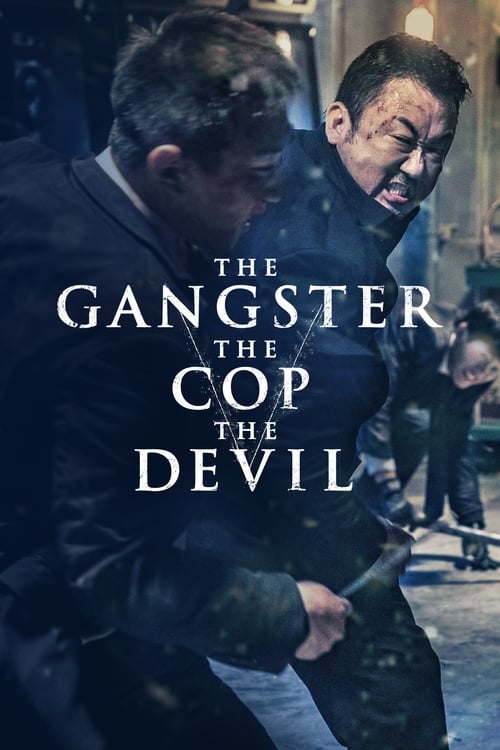
The Gangster, the Cop, the Devil
2019 · Lee Won-tae
For a Friday-night action fix — when you want fists, rain-slicked streets, and two guys who hate each other forced to work together, no homework required. Pure genre comfort food with an edge.
What it's about
Crime boss Jang Dong-su is attacked at random one rainy night by a serial killer — and survives, which for a gangster is almost worse than dying, since the humiliation invites every rival to circle. To find the man known only as K, he strikes a deal with Jung Tae-seok, a hot-headed, incorruptible detective who's spent his career trying to shut Jang's operation down. The alliance has one fault line: the gangster wants the killer dead, the cop wants him in court.
The experience
Pulpy, punchy, and gleefully entertaining — a muscular crowd-pleaser that moves fast, hits hard, and knows exactly how fun its central odd couple is. The mood is grim on paper but the film has a swagger that keeps it a blast.
Performances
Ma Dong-seok (Don Lee) is the whole show: a tank in a tailored suit, hilarious and terrifying in the same beat, one of the great physical screen presences in modern action cinema.
The craft
Lee Won-tae stages the mayhem with heavy, readable impact — brawls you can feel in your shoulders — and splices serial-killer thriller, cop procedural, and gangster picture into one propulsive machine. The neon-and-rain nightscapes look great big and loud.
Why it matters
A domestic hit that traveled unusually far — Sylvester Stallone's production company snapped up American remake rights almost immediately, and it cemented Ma Dong-seok's rise as an international action star.
Snapshot
A mid-budget Korean crime-action film built around the star power of Ma Dong-seok (also credited as Don Lee), The Gangster, the Cop, the Devil (Korean: 악인전, Akinjeon, literally Villain's Chronicle) operates as a genre hybrid: part serial-killer thriller, part odd-couple procedural, part vehicle for its lead's physically imposing screen presence. Its central conceit — a crime boss and a detective forced into tactical alliance to hunt a sadistic serial killer who preys, by chance, on the powerful — inverts the standard Korean crime-thriller moral architecture without dissolving it. The film earned strong domestic returns and achieved unusual international visibility when Sylvester Stallone's Balboa Productions acquired American remake rights shortly after the film's release, signaling the degree to which the South Korean genre product of the late 2010s had become globally legible.
Industry & Production
The Gangster, the Cop, the Devil was produced by Kyung-hee Film and distributed domestically by Megabox Plus M. The production emerged at a moment of considerable confidence in the Korean film industry: the late 2010s saw Korean genre cinema — crime thrillers especially — operating with sophisticated self-awareness, drawing on decades of local filmmaking tradition while remaining fluent in the grammar of international action cinema. Lee Won-tae had directed a smaller crime film before this, and Akinjeon represented a significant step up in scale, with a production design that creates a convincing geography of Cheonan, the mid-sized Korean industrial city where much of the story unfolds.
The film's premise is reported to have originated from a real-world anecdote — the vulnerability of organized crime figures to random violence — though the specifics of how that kernel was developed into screenplay form are not well documented in the English-language record. The production secured Ma Dong-seok as lead early; his involvement shaped the film's tonal and physical register from the outset, and the project is designed around his particular star qualities. Kim Mu-yeol's casting as the detective provided a counterweight: lean, intense, procedurally focused against Ma's blunt-force presence. Kim Sung-kyu brought a genuinely unsettling blankness to the serial killer K.
The Stallone remake rights acquisition — announced in 2019-2020 — had meaningful industry implications beyond flattery: it confirmed that Korean genre product had moved from art-house niche to mainstream commercial target in Hollywood acquisition strategy, a trend accelerated by Parasite's global profile in the same year.
Technology
The film was shot digitally, consistent with Korean industry standard practice in the late 2010s. The nighttime exterior sequences — rain-slicked streets, industrial lots, the cramped interiors of gangland vehicles — suggest the cinematographic team took advantage of digital's low-light sensitivity, achieving an ambient dread in the film's opening sequences (the initial attack on Jang) that would have required substantially more artifice on photochemical stock. Production design leans on practical locations in Cheonan rather than elaborate builds, grounding the genre machinery in a recognizable, non-glamorous Korean urban geography.
The action choreography draws on a physical style calibrated to Ma Dong-seok's specific body: brawling over precision, weight and impact over acrobatics. This is not wire-assisted Hong Kong martial arts; the fight sequences are blunt, close-quarters affairs that emphasize Ma's extraordinary physical mass — his background as a strength trainer is legible in every confrontation. The sound design accordingly foregrounds bodily impact, making the action sequences tactile in a way that distances the film from both the elegantly choreographed school of Korean action and the hyperkinetic cutting of American superhero cinema.
Technique
Cinematography
The visual grammar of Akinjeon is functional rather than conspicuous — which is itself a choice. Cinematographer Kim Tae-soo (whose involvement has been reported in Korean-language sources; details of his wider filmography are thin in the English record) works in a palette of wet asphalt and sodium-vapor orange for the night exteriors, with flatter, more clinical lighting in institutional spaces like police precincts. The opening assault sequence is filmed with a controlled panic — handheld but not chaotic — that establishes the serial killer's threat efficiently before the genre machinery kicks in.
The camera tends to hold on Ma Dong-seok rather than cut away from him: his reactions, his silences, the gradual recalibration of his face from rage to something resembling tactical patience, are given room to register. This restraint is cinematographically consistent with the film's understanding that its lead's presence is its primary resource.
Editing
The editing structure follows a clean genre logic: the first act establishes both the gangster's world (organized, hierarchical, surveilled) and the serial killer's threat (random, predatory, anti-structural), before the detective enters as a third variable. Cross-cutting between the parallel investigative tracks — gang enforcers and police detectives both hunting K — creates a procedural momentum without sacrificing the film's tonal core, which remains anchored in Jang's personal vendetta. The pacing tightens as the film narrows toward its climax; the editing in the final pursuit sequences is competent rather than distinguished.
Mise-en-scène / Staging
The staging consistently flatters Ma Dong-seok's physicality while using spatial contrast to articulate the gangster-cop dynamic. Police spaces are bureaucratic, cluttered with the paraphernalia of official process; the gangster's domain is hierarchical in a different register — restaurants, backrooms, loyalty expressed through bodies in proximity. The serial killer K, by contrast, is staged in zones of transition: parking lots, roadways, the liminal spaces of late-night Korean urban life. This tripartite spatial logic reinforces the film's genre argument: organized crime and organized law are mirror structures that the random predator can penetrate precisely because he belongs to neither.
The film stages the Jang-Jung relationship with careful physical grammar. Their early confrontations position them across barriers — desks, cars, the implied threshold of legality — while their later scenes together are framed with a proximity that communicates a grudging structural sympathy without tipping into sentimentality.
Sound
The sound design, as noted, prioritizes impact weight in action sequences. The score works in the mode of Korean genre cinema in the late 2010s: propulsive and functional, scoring tension and release without the operatic ambitions of, say, the orchestral register of Park Chan-wook's crime films. The absence of a notably distinctive sonic signature is part of the film's calibration — Akinjeon does not position itself as auteur cinema in the way that Oldboy or A Bittersweet Life do, and its sound design reflects that self-placement. It is genre-competent rather than genre-transcendent, and makes no apology for this.
Performance
Ma Dong-seok's performance is the film's center of gravity and primary critical point of interest. The actor has developed, across a series of action-adjacent Korean genre films, a distinctive star persona: the man of overwhelming physical capability who moves through the world at a slightly different speed than everyone around him, capable of sudden violence but essentially possessed of a settled dignity. In Akinjeon, this persona acquires more interior texture than many of his supporting roles allowed. Jang Dong-su's wounded pride — the humiliation of being nearly killed by someone he should, by the logic of his world, be able to crush — is the film's genuine emotional engine, and Ma threads the comedy of gangland bureaucracy (the scene management of his underlings' anxiety is genuinely funny) with the character's underlying sense of violated order.
Kim Mu-yeol plays the detective as the film's moral legibility anchor without making him pious: Jung's incorruptibility reads as almost pathological in its consistency, which the film treats with a dry, affectionate irony. Kim Sung-kyu's serial killer is the film's most difficult performance problem — making K threatening without simply rendering him opaque — and the film wisely refuses to psychologize him at length, preserving his function as a structural catalyst rather than a psychological subject.
Narrative & Dramatic Mode
The film operates in a mode that Korean genre cinema has made distinctively its own: moral ambiguity managed through genre pleasure rather than resolved through moral argument. The central alliance is explicitly transactional — each party needs the other's resources; neither pretends to respect the other's code. What the film is interested in is what happens to both men as the hunt progresses: whether the temporary suspension of the law-crime binary generates anything beyond tactical cooperation.
The answer the film arrives at is characteristically Korean in its refusal of both American buddy-comedy synthesis and Hong Kong triad-romance: these men are not friends, and the film's ending does not pretend they are. But they have, temporarily, recognized in each other something — a will, a discipline, a refusal to be victims — that their respective institutional worlds would normally keep invisible. The serial killer K functions as what genre theorists would call a revel figure: his very existence outside the organized structures of both law and crime produces the temporary alliance that is the film's subject.
The narrative mode is fundamentally suspense-procedural with action set pieces as punctuation rather than primary interest. The film is closer in rhythm to a thriller than to a pure action picture — it earns its climactic confrontations through patient procedural accumulation.
Genre & Cycle
Akinjeon arrives at the intersection of several robust Korean genre cycles. The serial-killer thriller has been a significant strand of Korean cinema since Bong Joon-ho's Memories of Murder (2003) established a template: the monster as symptom of social disorder, the investigative process as moral education. Kim Jee-woon's I Saw the Devil (2010) pushed the cycle into more extreme territory, blurring the line between hunter and hunted. Akinjeon is notably less interested in this psychic contamination narrative — its serial killer remains external to its moral drama — but it inherits the cycle's formal grammar of investigation and pursuit.
The crime-organization film — focused on Korean mob structures, their hierarchies, their internal codes — is an equally strong current, traceable through films like A Bittersweet Life (2005), The Yellow Sea (2010), and Ryoo Seung-wan's Veteran (2015). Akinjeon is closer in tone to Veteran's energetic genre populism than to the more elegiac or aestheticized crime films of Park and Kim.
The odd-couple cross-institutional alliance — criminal and law enforcement forced into cooperation — has Hong Kong antecedents (it is a structural premise of numerous Johnnie To films, particularly the PTU cycle) and American genre precursors, but Korean cinema has developed its own variant that tends to foreground institutional corruption and individual integrity in ways specific to Korean social experience of the late twentieth and early twenty-first centuries.
Authorship & Method
Lee Won-tae's directorial signature on this film is primarily one of efficient genre management rather than idiosyncratic vision — which, given that the primary authorial force is the star, represents a sound professional choice. He demonstrates genuine skill in action staging (the first attack sequence is constructed for maximum impact with minimal fuss), in managing tonal shifts between the film's procedural, comedic, and action registers, and in keeping Ma Dong-seok's performance from tipping into self-parody. His direction creates space for the star rather than competing with him.
Specific information about Lee's wider working relationships — his regular collaborators, his documented aesthetic position — is not well established in the English-language critical record, and this account declines to speculate. What the film demonstrates is competence in the craft traditions of Korean commercial genre cinema, an ability to work efficiently within constraints, and a genuine understanding of what his lead actor can and cannot do.
Ma Dong-seok's authorial contribution to his own star vehicles merits note: he has been, through this period of Korean cinema, a figure who actively shapes the projects he attaches himself to, ensuring they are built around his specific physical and comic register. Akinjeon is as much a Ma Dong-seok project as a Lee Won-tae project in this sense.
Movement / National Cinema
Akinjeon belongs to the mature phase of Korean commercial cinema — post-New Wave, after the 1990s and 2000s auteur explosion (Park Chan-wook, Bong Joon-ho, Kim Jee-woon, Hong Sang-soo) had established Korea as a site of serious cinematic production, and the industry had developed the infrastructure to produce genre films at a consistently high level of craft without necessarily aspiring to festival prestige. The film sits comfortably in this industrial and aesthetic position: it is a well-made popular film that would not embarrass the Korean industry's international reputation, even if it does not advance it.
The late 2010s in Korean cinema were characterized by this confidence: the industry could produce films like Akinjeon, The Wailing, Extreme Job, and Parasite in the same commercial ecosystem, covering the spectrum from populist genre entertainment to international art-house triumph. Akinjeon is the healthy genre mainstream of a mature national cinema.
Era / Period
The film is a product of a specific moment in Korean urban geography: the Cheonan setting is meaningful in ways that a Seoul setting would not be. Mid-tier Korean industrial cities occupy a particular social space — organized crime hierarchies of the kind Jang represents are plausible here in ways that have become somewhat mythologized in Seoul-set crime films. The film's 2019 moment is also one in which Korean anxieties about random violence, a social phenomenon that had generated significant media and policy attention in the 2010s, had entered the genre vocabulary as a recognizable source of dread.
Internationally, 2019 was the year of Parasite's triumph and the peak of what might be called the Korean wave's second, cinema-centered phase — the period in which Korean genre films became genuinely mainstream objects of global commercial attention rather than festival curiosities.
Themes
The film's primary thematic concern is the relationship between institutional order and personal honor — or, more precisely, the way that violent disruption of the former compels individuals to act from the latter. Jang is not a man who believes in the law; Jung is not a man who respects organized crime. Both are men who believe in something like justice, differently configured. The serial killer K is interesting precisely because he operates outside both their systems: he is not motivated by money, territory, or vengeance, and his very inexplicability is what generates the film's philosophical pressure.
A secondary theme concerns the spectacle of competence: both Jang and Jung are, within their respective domains, extraordinarily capable. The film observes them with something approaching admiration for this capability, regardless of its moral register. There is a persistent current in Korean crime cinema of this grudging respect for efficacy — traceable to the aesthetic influence of Hong Kong crime films, but inflected by a Korean cultural valorization of disciplined mastery.
The film also, without making heavy weather of it, sketches the structural adjacencies of organized crime and police work in Korean society — the ways in which the former can exist as a kind of parallel order, the corruption and accommodation that make the Jang-Jung alliance logistically possible, the institutional complicity that the film treats as ambient reality rather than scandal.
Reception, Canon & Influence
Critical Reception: The film was received warmly by Korean audiences and achieved solid commercial performance domestically. International critical reception was generally positive within genre terms: reviewers praised Ma Dong-seok's performance reliably, noted the film's efficient genre craft, and placed it in the tradition of Korean crime cinema without claiming it as a canonical work. It screened in international genre contexts, gaining exposure among audiences for whom Korean action cinema was an established interest. No major critical claim was made for the film as auteur work, and the film did not seem to seek such positioning.
Influences on the Film (Backward): Akinjeon draws visibly on Memories of Murder (2003) for its serial-killer procedural framework, on I Saw the Devil (2010) for its moral stakes, and on the Johnnie To crime-organization tradition for its understanding of criminal hierarchy as a form of social order. American influences include the serial-killer thriller tradition from Silence of the Lambs forward, though these are more distantly refracted through a Korean genre sensibility. The film's action register owes something to the bone-crunching physicality that has become a hallmark of a strand of Korean action cinema running through films like The Man from Nowhere (2010) and The Outlaws (2017) — the latter, also starring Ma Dong-seok, being a particularly direct precursor.
Legacy and Forward Influence: The most legible index of the film's influence is the Stallone remake acquisition, which — regardless of whether the American version eventually materializes — confirms the film's status as a genre template: a workable premise, a strong physical star vehicle, a cross-institutional alliance structure legible to international audiences. Within Korean cinema, Akinjeon consolidates rather than inaugurates: it refines the Ma Dong-seok star vehicle template (subsequently extended in The Gangster, the Cop, the Devil 2, announced for development) and demonstrates that the Korean crime film can absorb serial-killer thriller mechanics without losing its distinctive social texture. It also contributes, modestly but clearly, to the international visibility of Korean genre cinema in the immediate pre-Parasite moment — part of the accumulation of evidence that Korean film was producing consistently watchable commercial product across a wide generic range.
A Deleuzian reading
Open on a wet road outside Cheonan.
The full Deleuzian reading of The Gangster, the Cop, the Devil →
Reception
A Cannes 2019 Midnight Screening premiere and a solid hit in Korea, it's since settled in as a staple of the Ma Dong-seok fan canon — the film people point to when explaining why the internet adores Don Lee.
How The Gangster, the Cop, the Devil was received, from release to now →
Influences: the films it descends from and the films it influenced
- Memories of Murder (2003) — Established the Korean serial-killer procedural built on institutional-failure cross-cutting — investigators separated by jurisdiction and ego, cutting between territories rather than between killer and prey — a structural grammar Akinjeon inherits wholesale.
- PTU (2003) — Night-city crime film lit entirely in amber sodium-vapor with criminal hierarchy staged as parallel bureaucracy to law enforcement; Akinjeon's tripartite spatial logic and warm nocturnal palette derive directly from this template.
- I Saw the Devil (2010) — Introduced the 'revel figure' serial killer who engineers his own pursuit as pleasure and engineers moral contamination in his pursuer; Akinjeon's killer-who-controls-the-dynamic device and the inversion of investigator/prey positions are borrowed from this film.
- The Chaser (2008) — Korean serial-killer thriller built around kinetic handheld pursuit and procedural institutional failure that forces a civilian into the investigator role; Akinjeon inherits the controlled-handheld chase staging and the premise of the reluctant expert dragged into police work.
- The Silence of the Lambs (1991) — Established the procedural grammar of the investigator who must recruit the criminal's cognitive expertise to solve the serial-killer case; Akinjeon refracts this through Korean genre conventions, replacing psychological profiling sessions with physical alliance.
- Heat (1995) — Developed the parallel cross-cutting architecture that gives cop and criminal equal narrative weight as structural opposites, including the staged institutional-barrier scene where the two meet across a table — a device Akinjeon adapts into its gangster-precinct confrontations.
- Election (2005) — Rendered criminal organization governance as formal institutional procedure with its own spatial logic and hierarchical rites; the three-way power contestation within the triad maps onto Akinjeon's tripartite gangster-cop-killer structure.
- Infernal Affairs (2002) — The institutional mirror structure — police and triad as organizational reflections of each other rendered through alternating parallel editing — is the formal architecture Akinjeon borrows for its cross-institutional alliance and its framing of hierarchy as shared social logic.
- A Bittersweet Life (2005) — Korean crime-organization film that established the visual register of measured handheld work in amber-lit nocturnal spaces with impact-precise violence staging; Akinjeon inherits both the color palette and the economy of physical force as organizational expression.
- The Outlaws (2017) — The direct Ma Dong-seok star vehicle template: physical mass deployed against criminal organization through bone-crunching impact choreography, with a comic register that diffuses the violence — Akinjeon is its immediate heir in structure, star, and action grammar.
- The Man from Nowhere (2010) — Codified the hyper-real impact-weight action register in Korean genre cinema — the sound design and physical staging of body-on-body collision as percussive spectacle — that Akinjeon's action sequences adopt as genre standard.
- New World (2013) — Korean crime film built entirely on tripartite spatial logic — cop, criminal organization, and governing figure — with staged institutional-barrier scenes (boardroom, prison meeting) that share Akinjeon's formal vocabulary for the gangster precinct confrontation.
- The Roundup (2022) — Direct franchise extension of the Ma Dong-seok star vehicle template consolidated in Akinjeon: physical mass as spectacle, crime organization combat, odd-couple institutional pairing — the formula here is inherited and serialized.
- The Roundup: No Way Out (2023) — Second-generation iteration of Akinjeon's franchise grammar: the tripartite institutional logic expanded to government/drug cartel/police confrontation, the odd-couple procedural serialized, and the physical mass performance mode scaled into franchise spectacle.
- Asura: The City of Madness (2016) — Korean crime film structured entirely on institutional mirror logic — cop embedded in criminal hierarchy with both worlds equally corrupt — using parallel cross-cutting as ethical architecture; the closest sibling to Akinjeon's thesis that police and criminal organization are structurally identical.
- Beasts Clawing at Straws (2020) — Direct sibling in the Korean ensemble crime cycle: institutional spaces function as liminal zones where social hierarchies collapse, and the MacGuffin function is distributed across character types — each pursues the same target with incompatible motivations — rather than localized in an object.
Similar films
- I Saw the Devil (2010) — influence & lineage · same viewing thread
- New World (2013) — influence & lineage · same viewing thread
- A Bittersweet Life (2005) — influence & lineage · same viewing thread
- The Man from Nowhere (2010) — influence & lineage · same viewing thread
- Asura: The City of Madness (2016) — influence & lineage
- The Chaser (2008) — influence & lineage
- Memories of Murder (2003) — influence & lineage
- The Pig, the Snake and the Pigeon (2023) — same viewing thread
All the films related to The Gangster, the Cop, the Devil →
Watch it with: curated runs of related films
- Elegant Savagery — A run of sleek, merciless thrillers where vengeance arrives in tailored suits and is paid in broken bone — watch these when you want beauty and brutality in the same frame.