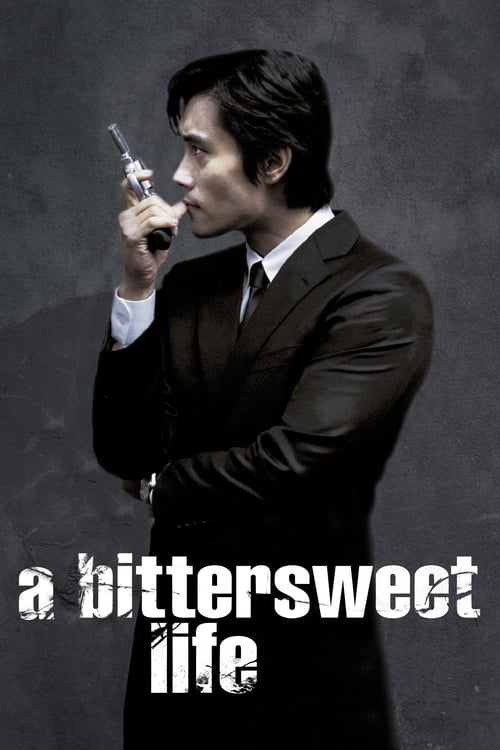
A Bittersweet Life
2005 · Kim Jee-woon
For when you want something stylish and brutal with a soul — a late-night pick when a straight action movie feels too empty and you'd rather your adrenaline came with heartbreak. Challenging in its violence, but gorgeous company.
What it's about
Sun-woo is the perfect enforcer: immaculate suits, flawless manners, a hotel to run, and total loyalty to his crime boss. Sent to watch the boss's young mistress while the old man is away — with orders to kill her and her lover if she's cheating — he makes one small, human choice of mercy. That single hesitation turns the entire world he served against him, and the film follows what a man like that does when loyalty stops protecting him.
The experience
Sleek, melancholy, and then suddenly ferocious — long stretches of hushed elegance punctured by some of the most bruising fight and gun sequences Korean cinema has produced. It's a revenge film with an ache in it; the violence lands hard because the sadness underneath is real.
Performances
Lee Byung-hun is magnetic — he plays Sun-woo as a man so controlled that every crack in the surface registers like a scream, and he's equally convincing sipping espresso and fighting for his life.
The craft
Kim Jee-woon directs like a jeweler: every frame lacquered, every interior glowing, so that when chaos arrives it feels like vandalism against beauty. The action is choreographed with escalating, punishing physicality, and the film's sound and lighting make the hotel itself a character. It looks so good that a big screen genuinely changes the experience.
Why it matters
It landed at the peak of the 2000s Korean film boom and helped define the internationally beloved Korean noir style — pristine surfaces, sudden violence, revenge shot through with sorrow — while making Lee Byung-hun a star far beyond Korea.
Snapshot
A Bittersweet Life (달콤한 인생, Dalkomhan insaeng) is Kim Jee-woon's lacquered neo-noir about Kim Sun-woo (Lee Byung-hun), the impeccably groomed enforcer-cum-hotel-manager who, ordered to surveil and if necessary kill his boss's young mistress, hesitates for a single act of mercy and brings the whole architecture of his loyalty down on his head. Released in South Korea on 1 April 2005 and screened out of competition at that year's Cannes Film Festival, the film arrived at the high-water mark of the post-millennial Korean cinema boom and crystallized a particular national mode: the gangster picture reconceived as an exercise in pure surface, melancholy, and physical violence. It is at once a genre exercise of almost fetishistic polish and a Buddhist-inflected parable about attachment, impermanence, and the impossibility of explaining why one acts. The film consolidated Lee Byung-hun's transformation from television heartthrob into a serious screen actor and stands, alongside A Tale of Two Sisters (2003) and I Saw the Devil (2010), as a cornerstone of Kim's reputation as Korean cinema's most fluent stylist of genre.
Industry & production
The film was produced by b.o.m. Film Productions, the company led by producer Oh Jung-wan, and distributed through CJ Entertainment, the vertically integrated conglomerate arm that did so much to industrialize and capitalize Korean filmmaking in the late 1990s and 2000s. It belongs to the institutional moment after the dismantling of the old screen-quota-protected, military-era system, when chaebol and venture financing, a maturing multiplex infrastructure, and a generation of cinephile directors converged to produce films that were simultaneously commercial and authored. Kim Jee-woon came to the project off the critical and commercial success of A Tale of Two Sisters, and the production was conceived as a star vehicle built around Lee Byung-hun, then transitioning from a hugely successful television career toward the cinema. The budget, by Korean standards of the period, was substantial and visible on screen in the production's sheen, though precise figures are not something I can responsibly quote. Domestic box-office returns were respectable rather than spectacular; the film's reputation has grown steadily through home video, festival exposure, and its standing among genre connoisseurs rather than through any single blockbuster opening. Its Cannes berth, even out of competition, was part of CJ and the Korean industry's broader strategy of using the European festival circuit to build the international prestige and export value of Korean genre cinema.
Technology
A Bittersweet Life was shot photochemically on 35mm, the standard professional format of mid-2000s Korean production, before the industry's wholesale migration to digital capture later in the decade. Its imagery depends on the dense blacks, controlled highlights, and shallow-focus glamour that anamorphic-influenced widescreen 35mm afforded, and on a meticulous laboratory and color-timing process that gives the film its cold, jewel-like palette of charcoal, amber lamplight, and steel blue. The film predates the routine use of digital intermediate as a creative grading tool in every Korean production, though the precise post pipeline is not something I can detail with certainty. What is plain on screen is that the technology is marshaled entirely in service of surface and atmosphere: the gleam of glass curtain walls, the reflective sheen of a hotel lobby, the way a single practical light source models a face out of surrounding darkness. The violence, when it arrives, is achieved largely through practical means—stunt choreography, squibs, physical effects—rather than digital augmentation, which lends the film's brutality a bodily, concussive weight.
Technique
Cinematography
Kim Ji-yong's photography is the film's signal achievement and the engine of its mood. The visual scheme is built on hard contrast and deep, enveloping shadow, with characters frequently isolated in pools of light against fields of black—a noir vocabulary inherited but rendered with a contemporary, architectural cleanliness. Glass, mirrors, and reflective surfaces recur as motifs, fragmenting and doubling Sun-woo and emphasizing the theme of a man watching, and watched. The camera alternates between an almost still, composed elegance in the early hotel and restaurant scenes—precise, symmetrical, glacially controlled—and a sudden kineticism in the action set-pieces. Color is rigorously disciplined: warm tungsten interiors that promise comfort give way to the blue-black of nocturnal exteriors and the clinical neutrality of the spaces where violence is done. The cumulative effect is of a world too beautiful to be safe, where the polish of the image is itself a kind of moral irony.
Editing
Choi Jae-geun's cutting modulates between two registers that define the film's rhythm. The dramatic passages are patient, holding on faces and on Sun-woo's increasingly opaque composure, letting silence and stillness accrue tension. The action sequences, by contrast, are assembled with percussive momentum—particularly the extended late-film confrontations and the protracted, escalating gunfight that drives toward the climax—where the editing tracks bodies through space with a clarity that refuses the incoherent jump-cutting fashionable elsewhere in mid-2000s action cinema. The film's celebrated structure of escalation, in which a small mercy metastasizes into total war, is fundamentally an editorial achievement of pacing and accumulation.
Mise-en-scène / staging
Production design by Ryu Seong-hee—among the most accomplished designers in Korean cinema—gives the film its world of cold luxury: the modernist hotel, the boss's restaurant and offices, the chrome-and-glass surfaces of a criminal milieu that has fully assimilated the aesthetics of upscale corporate Korea. Sun-woo's tailored suits, his manicured surfaces, his very grooming are part of the staging: he is a man whose identity is his impeccable control of appearances, and the film stages his unraveling as a progressive degradation of that surface, the suit torn and bloodied, the composure cracking. Spaces are organized around hierarchy and surveillance—who sits where, who watches whom, who is permitted to speak. The recurrent imagery of windows and high vantage points frames Sun-woo as both predator and specimen.
Sound
The sound design balances long stretches of quiet—the hush of expensive interiors, the menace of restraint—against the brutal report of the violence. The score, credited to Dalpalan and Jang Yeong-gyu, frequent collaborators in this period of Korean genre cinema, leans toward melancholy and a faintly Latinate, tango-inflected romanticism that cuts against the cruelty on screen, deepening the film's elegiac register. The deployment of a wistful, almost mournful musical theme over scenes of carnage is central to the "bittersweet" tonal contract the title announces.
Performance
Lee Byung-hun's performance is a study in suppression: for much of the film he gives almost nothing away, his beauty and stillness functioning as a mask over a man who cannot articulate—perhaps does not himself know—why he spared the mistress. The role's power lies in the gap between immaculate surface and unreadable interior, and in the controlled escalation toward a final, exhausted desperation. Kim Yeong-cheol as the boss Kang plays paternal warmth curdling into wounded, vindictive cruelty, embodying the film's view of loyalty as a transaction that turns lethal the instant it is questioned. Shin Min-a, as the mistress Hee-soo, anchors the brief, fragile interlude of grace—often associated with a scene of her playing the cello—that becomes the pivot of the entire tragedy.
Narrative & dramatic mode
The film operates in a tragic-ironic mode framed explicitly by Buddhist parable: it opens and closes with a koan-like meditation on a disciple, a master, and a swaying branch—an image of a mind disturbed not by the wind but by itself. The plot is a tightly causal chain in which a single deviation from orders unspools into catastrophe, and a great deal of the drama's force comes from the withholding of motive. Repeatedly, characters demand of Sun-woo an explanation he cannot give; the question "why did you do this to me?" passes between boss and enforcer like a curse. This refusal of psychological transparency is deliberate: the film treats its violence not as the product of clean motivation but as the eruption of something attachment-bound and finally inexplicable. Its closing movement reframes the entire revenge narrative as a kind of dream of longing, a "sweet" life glimpsed and lost.
Genre & cycle
A Bittersweet Life is a neo-noir gangster film and a revenge thriller, participating in the rich vein of Korean revenge cinema that flourished in the mid-2000s—the years bracketing Park Chan-wook's Vengeance Trilogy—while pursuing a distinctly cooler, more elegiac register than the baroque cruelty of Oldboy. It draws on the international lineage of the existential criminal: the lone, professional, doomed killer of Jean-Pierre Melville's French policiers and the romantic fatalism of Hong Kong heroic-bloodshed cinema. Within Kim Jee-woon's own genre-hopping filmography—horror, comedy, Western, serial-killer thriller—it represents his pure-noir entry, and it helped define a strain of glossy, design-forward Korean crime film that prizes atmosphere and style as much as plot.
Authorship & method
Kim Jee-woon wrote as well as directed, and the film is characteristic of his method: a conspicuous mastery of a recognizable genre framework, deployed with such formal control that style becomes the substance. Kim is often described as Korean cinema's great stylist, a director whose authorship lies less in a consistent thematic obsession than in tone, craft, and the orchestration of genre pleasure. Here that authorship is inseparable from his collaborators—cinematographer Kim Ji-yong's contrast-driven lighting, editor Choi Jae-geun's command of escalation, production designer Ryu Seong-hee's world of cold luxury, and the Dalpalan/Jang Yeong-gyu score's romantic melancholy. Above all the film is built around Lee Byung-hun, and the collaboration between director and star—continued in The Good, the Bad, the Weird (2008) and I Saw the Devil (2010)—is one of the defining director-actor partnerships of modern Korean cinema. Kim's working aesthetic prizes surface, atmosphere, and the precise calibration of tone over realism or message.
Movement / national cinema
The film is a product of the Korean New Wave's commercial maturity—the so-called Korean cinema renaissance that began in the late 1990s and ran through the 2000s, when directors such as Park Chan-wook, Bong Joon-ho, Kim Ki-duk, and Kim Jee-woon achieved both domestic dominance and international festival prestige. It exemplifies the period's signature synthesis: Hollywood-grade production polish and genre fluency married to a darker, more morally unresolved sensibility and a willingness to push violence and tonal extremity further than mainstream American cinema typically allowed. CJ Entertainment's backing and the Cannes screening situate it within the industry's deliberate, and largely successful, strategy of building Korean genre film into a globally exportable brand.
Era / period
Set and made in contemporary mid-2000s urban South Korea, the film is a portrait of a particular moment of conspicuous, glassy affluence—a criminal world fully clothed in the aesthetics of corporate modernity, conducted in upscale hotels and restaurants rather than back alleys. It reflects the period's confidence and its anxieties about surface, status, and the emptiness beneath consumer gloss. Technologically and industrially it sits at the late-photochemical, pre-digital-capture juncture of Korean production, its 35mm sheen part of what now reads as a specific period luxury.
Themes
The film's governing themes are loyalty and its betrayal; the lethal fragility of hierarchical, paternalistic bonds; and, most deeply, a Buddhist meditation on attachment and impermanence. Its framing parable insists that suffering arises from the mind's own clinging—that Sun-woo's catastrophe begins not with an external event but with an internal stirring, a moment of feeling that breaks his perfect detachment. Connected to this is the theme of inexpressibility: the impossibility of accounting for one's own actions, the failure of explanation between men bound by violence. The title's "bittersweetness" names the film's central irony—that a single taste of tenderness or beauty is precisely what dooms its protagonist. Masculinity as performance, identity as immaculate surface, and the vanity of revenge complete the thematic web.
Reception, canon & influence
Critically, A Bittersweet Life was admired—at home and increasingly abroad—for its formal beauty, its action craft, and Lee Byung-hun's controlled central performance, even as some early responses found its narrative familiar or its emphasis on style over depth a limitation. Its standing has risen markedly over time; it is now widely regarded among the strongest entries in 2000s Korean genre cinema and a touchstone of the stylish-noir mode. Its influences run backward to Melville's existential professionals, to Hong Kong heroic-bloodshed romanticism, and to the broader noir tradition of the doomed lone killer, filtered through the contemporaneous Korean revenge cycle. Looking forward, the film was pivotal in launching Lee Byung-hun's international career—his subsequent move into Hollywood productions followed from the global visibility his Kim Jee-woon collaborations afforded—and in cementing Kim Jee-woon's reputation, which carried him to his own Hollywood debut, The Last Stand (2013). Within Korean cinema it helped license a continuing strain of design-forward, atmosphere-driven crime film. For a substantial international cult audience, it remains a defining example of how thoroughly Korean filmmakers of the 2000s could absorb a genre and remake it as something cooler, sadder, and more beautiful.
A Deleuzian reading
Watch the glass.
The full Deleuzian reading of A Bittersweet Life →
Reception
A modest performer at home in 2005 (about 1.1 million admissions) that screened out of competition at Cannes, it quietly grew abroad into one of the defining cult objects of the 2000s Korean wave — now routinely named alongside Oldboy as essential viewing.
How A Bittersweet Life was received, from release to now →
Influences: the films it descends from and the films it influenced
- Le Samouraï (1967) — The template for the suppressed, ritualized lone professional — minimal dialogue, an impassive star face (Delon/Lee Byung-hun), and behavior-as-character that lets stillness carry the existential weight.
- Le Cercle Rouge (1970) — Cold-blue-gray palette, hushed procedural restraint, and the doomed-fatalism architecture of the crime film that Kim transposes into his cold-luxury interiors.
- The Killer (1989) — Supplies the heroic-bloodshed grammar — romantic melancholy fused to balletic, escalating gun choreography — that powers the film's final restaurant/garage shootout.
- A Better Tomorrow (1986) — Codes loyalty and betrayal as operatic male melodrama within the gangster milieu, the emotional register Kim sublimates beneath Sun-woo's curdled paternal bond to his boss.
- Point Blank (1967) — Modernist revenge built on glass, mirrors, and reflective architectural surfaces — the cold geometric framing of a betrayed man stalking corporate space that Kim's reflective-surface compositions echo.
- Branded to Kill (1967) — Pioneers the hitman film as pure stylized abstraction, prioritizing graphic surface and tonal cool over plausibility — the 'style as substance' license Kim takes up.
- Get Carter (1971) — The implacable, impeccably-dressed enforcer moving through a corrupt organization toward his own annihilation — the doomed-lone-killer arc rendered with chilly composure.
- The Good, the Bad, the Weird (2008) — Extends the director-star partnership with Lee Byung-hun and Kim's genre-mastery method, transposing the same choreographic and design control onto the western.
- I Saw the Devil (2010) — Completes the Kim/Lee trilogy, pushing the escalation-pacing and chiaroscuro cruelty further into a revenge structure where suppressed control finally ruptures.
- The Man from Nowhere (2010) — Inherits the lone, beautiful, withheld-motive avenger and the design-forward, atmosphere-driven Korean action template Kim helped license.
- New World (2013) — Carries on the cold-luxury gangster aesthetic — glass-and-steel corporate crime spaces, suppressed loyalty/betrayal, and Lee Jung-jae's impassive performance register.
- John Wick (2014) — Globalizes the choreographed lone-killer-in-immaculate-spaces mode — cold-luxury underworld design, escalation set-pieces, and a grief-driven impassive avenger descended from this stylish-noir lineage.
- The Yellow Sea (2010) — Kim's structure of the Korean gangster protagonist as sustained punishment target — compounding violence absorbed rather than escaped — is the narrative architecture Na inherits and radicalizes by stripping away Kim's visual aestheticism entirely.
- Confession of Murder (2012) — Refines spatial dominance assignment as a Korean action-film device: physical position within the frame communicates hierarchical power before any blow is struck, assigning screen zones to bodies as a grammar of control that Confession's confrontation sequences deploy.
- The Gangster, the Cop, the Devil (2019) — Korean crime-organization film that established the visual register of measured handheld work in amber-lit nocturnal spaces with impact-precise violence staging; Akinjeon inherits both the color palette and the economy of physical force as organizational expression.
- Beasts Clawing at Straws (2020) — Set the compositional standard for Korean genre cinema — off-center framing, deep focus, disciplined low-key lighting in interior spaces — establishing that formal rigor rather than kinetic spectacle could be the primary register of Korean crime filmmaking.
- The Pig, the Snake and the Pigeon (2023) — High-contrast chiaroscuro visual grammar in Korean crime, and prolonged physical containment followed by volcanic release as the signature performance-action unit — the bodywork pattern Wong's staging of the protagonist's escalating violence directly echoes.
- Night in Paradise (2020) — Supplies the core template of the loyal enforcer destroyed by his bosses, paired with Kim's signature alternation of glassy, composed stillness and sudden brutal eruption — the contemplative-then-violent rhythm Night in Paradise inherits wholesale.
- The Chaser (2008) — Nocturnal Seoul-set genre stylism with choreographed escalating violence and a doomed lone protagonist, part of the immediate Korean thriller cycle Na builds on.
- Sympathy for Mr. Vengeance (2002) — Anchors the Korean revenge cycle Kim works within — escalating reciprocal violence and withheld motive treated with cool formal precision rather than catharsis.
- Oldboy (2003) — Shares the design-forward Korean revenge mode and the choreographed corridor brawl as set-piece, where a lone man's hand-to-hand endurance becomes a sustained formal showcase.
- A Tale of Two Sisters (2003) — Kim's prior collaboration with the same craft team — contrast-driven lighting and Ryu Seong-hee's meticulous production design building dread through immaculate, oppressive interiors.
- Failan (2001) — The melancholy gangster reverie — a low-ranking enforcer's suppressed interiority and impossible tenderness — that prefigures Sun-woo's mute attachment and elegiac tone.
- Drive (2011) — Parallel descendant of the Melvillian lone professional — a near-silent driver, neon-and-reflection surfaces, and a melancholic synth/pop score doing the emotional work the face withholds.
- Infernal Affairs (2002) — Kim absorbs Infernal Affairs' suppressed-affect performance paradigm — the protagonist's impassive face as the site of catastrophically suppressed loyalty conflict, interior states visible only through controlled micro-expression — and combines it with Lau's high-contrast nocturnal 35mm cinematography, making this the Korean crime cinema's most precise formal absorption of the Hong Kong model.
- A Hard Day (2014) — Shares the Korean nocturnal thriller's cinematographic grammar — medium-shot observational staging in institutional interiors, artificial light as a spatial threat indicator — and the dual-antagonist structure in which institutional authority and criminal violence converge simultaneously on a single protagonist.
- Nameless Gangster (2012) — A contemporaneous Korean meditation on the organization man undone by a breach of loyalty protocol, sharing the theme of hierarchy-as-trap though pursued through noir lyricism rather than Yoon's social realism.
- Asura: The City of Madness (2016) — Established the glossy-yet-brutal Korean noir register of a loyal enforcer destroyed by the patron he serves, the desaturated-elegant violence and self-lacerating lead that Asura inherits.
- Exiled (2006) — A contemporaneous Korean elegiac-gangster film sharing the golden-hued, melancholic stylization of a loyal enforcer's balletic downfall, staged with the same lyrical-violence aesthetic.
Similar films
- I Saw the Devil (2010) — influence & lineage · same viewing thread · often watched together
- Sympathy for Mr. Vengeance (2002) — influence & lineage · same viewing thread · often watched together
- The Man from Nowhere (2010) — influence & lineage · same viewing thread
- New World (2013) — influence & lineage · same viewing thread
- The Killer (1989) — influence & lineage · same viewing thread
- Oldboy (2003) — influence & lineage
- Lady Vengeance (2005) — same viewing thread · often watched together
- A Better Tomorrow (1986) — influence & lineage · same viewing thread
All the films related to A Bittersweet Life →
Watch it with: curated runs of related films
- Elegant Savagery — A run of sleek, merciless thrillers where vengeance arrives in tailored suits and is paid in broken bone — watch these when you want beauty and brutality in the same frame.